

The Nationcraft Framework: 18 Variables, 8 Goals, 100+ Proven Reform Packets
Nationcraft is a nation-design framework created by Yu-kai Chou in 2024. It scores each country across 18 cultural, political, and economic variables, then matches reforms to that specific context, instead of copy-pasting policies from countries with completely different DNA.
Every year, governments and international organizations deploy hundreds of billions of dollars into development and reform efforts. Many underperform, not because reform is impossible, but because policy packages are often imported from countries with completely different cultural, political, and economic DNA.
- Sweden’s welfare model requires social trust scores of 8+/10. Import it to Afghanistan (trust score: 2/10) and you get corruption, not prosperity.
- Singapore’s economic miracle demanded acceptance of strong authority (9/10). Try that in Switzerland and voters revolt.
- America’s innovation engine runs on individualism (1/10 collectivism). Apply it in Japan and you destroy the social cohesion that makes their system work.
The cost of getting this wrong? Wasted billions. Lost elections. Destroyed legacies.
Illustrative case: When Singapore paired its reform sequencing with a high-authority, high-achievement, low-resource starting profile, GDP per capita rose from roughly $500 in 1965 to about $13,500 by 1990. That is the kind of context-matched trajectory Nationcraft is designed to study, not a promise that every country can copy Singapore mechanically.
Reference points: OECD official development assistance data and World Bank historical GDP per capita data for Singapore.
Speed Run Notes
- Nationcraft scores 18 national variables across culture, political history, and economics before recommending policy.
- It forces leaders to stack-rank 8 nation goals instead of pretending every objective can be optimized at once.
- The method looks for historical reform packets from countries with similar starting conditions, then adapts rather than copies them.
- Singapore, Sweden, and post-conflict states require different sequencing because their variables create different reform constraints.
- Nationcraft Sovereign is the framework’s AI layer for searching those structured packets and surfacing likely matches.
- The page is built for policymakers, consultants, analysts, and institution-builders who need clearer policy fit, not more ideology.
In This Article
- About the Creator of the Nationcraft Framework
- Who Should Apply the Nationcraft Framework?
- Framework Scope: A Diagnostic System for National Transformation
- Component I: Nation Variables (Inputs)
- Component II: Nation Goals (Output)
- Component III: Nation Crafting (Policies)
- Nationcraft Sovereign
- FAQ
- Appendix: Technical Deep Dive
- How to Cite the Nationcraft Framework
- Nationcraft Case Studies
About the Creator of the Nationcraft Framework
Yu-kai Chou created the Nationcraft Framework after two decades of studying how systems shape human behavior. As a Human-Systems Architect and Behavioral Designer, his Octalysis Framework has been applied by LEGO, Microsoft, Porsche, Coca-Cola, Salesforce, and MrBeast.
Chou has taught the Octalysis methodology at Harvard, Stanford, Yale, Tesla, Google, BCG, and IDEO.
His work has been cited by Harvard, Stanford, MIT, US Department of Energy, NIST, NSF, NCBI, and ClinicalTrials.gov. Chou is also a Fellow of the Royal Society of Arts, a Council Member for the Taipei Smart City Council, and has advised governments including Ukraine, the United Kingdom, Bahrain, Singapore, Taiwan, the Netherlands, Kazakhstan, and South Korea. Explore his books here.
What is the Nationcraft Framework?
DEFINITION: The Nationcraft Framework is a systematic methodology for national development that matches policy interventions to a country’s unique cultural, political, and economic profile. It uses 18 measurable Nation Variables, 8 stack-ranked Nation Goals, and 100+ Successful Crafting Packets (proven historical reform packages) to provide evidence-based policy recommendations. These packets form the structured historical library behind the Nationcraft Sovereign Engine, which is designed to analyze policy fit through Chou’s variable-and-packet model rather than generic public-policy prompting.
The core innovation: Instead of asking “What policy should we copy?” Nationcraft asks “Which successful nation had variables most similar to ours — and what did they do?”
Nationcraft sits within Chou’s broader systems-design work. Readers who want the adjacent motivation and systems layer can compare it with the Octalysis Framework, the Octalysis Strategy Dashboard, the Economy Design Framework, how the 8 Core Drives apply to public policy, and Chou’s academic contributions and citations.
Who Should Apply the Nationcraft Framework?
1) For Politicians & Government Leaders
Problem: You need policies that deliver visible results before the next election. Copying what worked in Singapore or Sweden sounds good in speeches — but if the policies fail, you lose.
Solution: Nationcraft shows you which historical precedents actually match your country’s profile. You get evidence-based confidence, not ideology-based hope.
- Campaign tool: Show voters you have a data-driven plan, not just slogans. Use Nationcraft to identify which policies are culturally compatible with your electorate, reducing the risk of rejection.
- Governance tool: Stack-rank goals based on voter priorities, then track delivery
- Crisis tool: When polls drop, re-run variables to see if you’ve misread the cultural landscape
2. For Political & Development Consultants
Problem: Every consultant claims “experience.” That’s not differentiation — it’s table stakes.
Solution: Nationcraft gives you a structured methodology backed by a growing library of documented reform cases and policy packets. You move from “I’ve seen this before” to “Here’s why this looks like a strong fit based on variable matching.”
- Win RFPs: Stop selling hours. Sell diagnostic precision. Use the 18-variable scorecard as your initial “free” audit to lock in clients.
- Deliver faster: Match client nations to historical packets for instant strategic direction
- Build credibility: Every recommendation is grounded in documented historical precedent
3. For Political Analysts & Journalists
Problem: Commentary on policy is easy. Predicting what will actually work — and explaining why failures were predictable — is much harder.
Solution: Nationcraft provides a systematic framework for predictive analysis. Score variables, match to packets, forecast outcomes.
- Predictive analysis: Forecast policy success before budgets are spent
- Comparative studies: Stop asking “should X copy Y?” Start asking “do their variables match?”
- Investigative stories: Expose why failed policies were doomed from the start due to variable mismatch


Framework Scope: A Diagnostic System for National Transformation
| Component | Scope |
| Nation Variables | 18 measurable factors across culture, politics, economics |
| Nation Goals | 8 outcome categories to stack-rank |
| Successful Crafting Packets | 100+ proven reform packages from 150+ years of data |
| Countries Profiled | 100+ nations with scored variable profiles |
The Three Components of Nationcraft
The Nationcraft Framework operates as a diagnostic-to-action pipeline with three interconnected components:
Nation Variables (Input) → Nation Crafting (Policies) → Nation Goals (Output)
Core Structure: The Diagnostic-to-Action Engine
Nationcraft is composed of three interconnected, essential components, creating a clear workflow from assessment to outcome:
Nation Variables (Input) → Nation Crafting (Policies) → Nation Goals (Output)
- Nation Variables (Input): Foundational factors shaping a country’s character — from culture to economy — that determine which policies are feasible and what outcomes are realistically achievable.
- Nation Goals (Output): The prioritized outcomes (e.g., prosperity, security, equity) that define what a country seeks and serve as the scorecard for all policies.
- Nation Crafting (Policies): The operational layer where government and institutions design, sequence, and implement policy interventions.
Component I: Nation Variables (Inputs) | Why Copy-Paste Policies Fail

Before prescribing solutions, we must diagnose reality. Nation Variables are the 18 measurable factors that define a country’s starting condition — its cultural DNA, historical-political context, and economic fundamentals. As an example, a post-conflict nation with high collectivism (8) and low infrastructure (3) would prioritize Rwanda’s reconciliation model first.
The “Reform Agility” Scoring System (1-10)
Academic frameworks describe what cultures ARE. Nationcraft scores how cultures OPERATE for policy implementation — specifically, their vector-alignment to Governance Capacity.
In this framework:
- Score = 10 → Maximum Reform Agility (easiest to implement reform)
- Score = 1 → Maximum Reform Friction (hardest to implement reform)
How This Works in Practice
Variable 1 (Authority Dynamics):
- Score = 10 (High Hierarchy): Leader announces policy by decree → Immediate compliance → Fast Implementation = High Reform Agility
- Score = 1 (Low Hierarchy): Leader must negotiate with parliament, unions, regions, civil society → Compliance takes years → Slow Implementation = High Reform Friction
Variable 2 (Collectivism vs. Individualism):
- Score = 10 (High Collectivism): Government sets new norm → Society self-polices compliance → Fast Implementation = High Reform Agility
- Score = 1 (High Individualism): Government must persuade millions of independent actors → Each individual decides → Slow Implementation = High Reform Friction
Real-World Example: Healthcare Response During COVID-19
Singapore (V1 Authority = 8, V2 Collectivism = 8, V10 Non-Partisanship = 7):
- Government issues circuit breaker lockdown + mandatory masking → Compliance within 72 hours → Contact tracing app adopted by 78% of population
- Reform Agility: Maximum (High Authority + Collectivism = Rapid coordinated action)
Sweden (V1 Authority = 3, V2 Collectivism = 2, V10 Non-Partisanship = 10):
- Government issues voluntary recommendations (no lockdown, schools open) → Public Health Agency scientific briefings → Gradual voluntary adoption stabilizes over 6-8 weeks
- Reform Agility: Moderate (Low Authority prevents mandates BUT High Cohesion enables trust-based voluntary compliance)
- Key: Attempting Singapore’s mandatory approach would have caused backlash → Sweden’s variables demanded a different policy design
USA (V1 Authority = 4, V2 Collectivism = 1, V10 Non-Partisanship = 2):
- Federal guidance issued → 50 states implement contradictory policies → Masking becomes partisan tribal marker → Blue states mandate (50-70% compliance), red states resist (20-40% compliance) → No national coordination achieved
- Reform Friction: Maximum (Low Authority + Lowest Collectivism + Extreme Tribalism = Neither mandates NOR voluntary recommendations achieve majority buy-in)
Critical Insight:
Variable configuration doesn’t just affect implementation speed — it determines which policies are viable.
- Singapore can mandate compliance (V1=8, V2=8 enable it)
- Sweden must use recommendations (V1=3 prevents mandates; V10=10 enables voluntary trust)
- USA struggles with both mandates AND voluntary approaches (V2=1, V10=2 fragment any national strategy)
All three nations saved lives relative to worse-case scenarios. But they required fundamentally different tactics because of variable configuration. Reform Agility measures how easily a government can execute its chosen strategy — not whether the strategy is morally superior.
The Ideological Neutrality Principle
A score of 10 is not “Good” — it is “Efficient.”
- A dictatorship may score 10 on Authority Dynamics (Easy to Change)
- A vibrant democracy may score 3 on Authority Dynamics (Hard to Change)
Both can produce prosperous, safe, happy societies. The difference is operational, not moral. (This principle mirrors White Hat vs Black Hat Gamification in Chou’s Octalysis Framework, where neither approach is inherently superior — only contextually appropriate.)
Nationcraft deals in political physics, not ideology. The framework measures “what policies this nation can execute given its structure,” not “what structure this nation should have.”
The 18 variables are organized into three categories:
✓ 6 Cultural Dimensions measure value systems
✓ 7 Histo-Political Factors assess governance structures
✓ 5 Economic Fundamentals (18 sub-variables) evaluate resource base
A) Cultural Dimensions: The Operating System of Society
These are structured lenses for comparing how societies organize beliefs, norms, and behaviors, which helps analysts anticipate how people coordinate, decide, and respond to institutions. Policy acceptance and implementation capacity are directly shaped by a country’s prevailing value profile.
The GLOBE project, Schwartz’s value theory, and the World Values Survey provide a strong comparative foundation for the cultural layer of Nationcraft. The framework uses them as inputs, then extends them with policy-oriented scoring and cross-country matching.
Below are the 6 Culture Dimensions within Nation Variables (Input) of the Nationcraft Framework.
| Dimension | High Score (8-10) Means… | Low Score (1-3) Means… | Policy Example |
| 1) Authority Dynamics | Citizens accept hierarchy (China, Saudi Arabia) | Citizens challenge authority (Sweden, Denmark) | Tax reform: High-score = top-down mandate works. Low-score = requires town halls and consensus. |
| 2) Collectivism vs. Individualism | Collective duty trumps individual rights (Japan, South Korea) | Individual rights are sacred (USA, Australia) | Healthcare: High-score = universal mandate accepted. Low-score = triggers “freedom” backlash. |
| 3) Achievement vs. Harmony | Winning and success are celebrated (USA, Singapore) | Balance is more important than inequality of success (Sweden, Bhutan) | Economic policy: High-score = growth targets motivate. Low-score = emphasize equality |
| 4) Time Orientation | Long-term planning is normal (Japan, Germany) | Short-term gratification dominates (Brazil, Philippines) | Infrastructure: High-score = 10-year plans credible. Low-score = need quick wins to maintain support. |
| 5) Uncertainty & Adaptability | Risk and change are embraced (USA, Singapore) | Stability is paramount (Russia, North Korea) | Innovation policy: High-score = “move fast” works. Low-score = phased pilots required. |
| 6) Specialization vs. Equity | Role specialization is valued (Singapore, Switzerland) | Broad equity and representation is prioritized (Venezuela, Cuba) | Labor policy: High-score = merit-based hiring accepted. Low-score = quotas expected. |
Reminder: These scores are not arithmetic averages — they’re cultural DNA sequences.
Singapore (High Authority + High Achievement + High Adaptability) operates like a Formula 1 pit crew: precision choreography under centralized command.
Sweden (Low Authority + High Individualism + High Harmony) functions like a jazz ensemble: improvisation within shared values, no conductor needed.
Apply Singapore’s playbook to Sweden, and unions strike. Apply Sweden’s consensus model to Singapore, and infrastructure projects stall for a decade. The configuration is the strategy.
Ukraine’s post-2014 reforms validate this principle: early failures came from copying EU frameworks wholesale. Breakthroughs emerged when institutions like ProZorro married Western transparency with Ukrainian civic activism — a configuration that matched the nation’s cultural DNA rather than importing foreign templates.
B) Histo-Political Factors : The Ghosts in the Machine
These factors reflect a nation’s historical experience and political context.
| Factor | What It Measures | High (8-10) Example | Low (1-3) Example | Policy Implication |
| 7) Stability vs. Turmoil | Years of peace vs. crisis in recent history | Switzerland, Canada | Afghanistan, Syria | Post-crisis societies need reconciliation before reform. |
| 8) Pragmatism vs. Idealism | Focus on practical outcomes vs. ideological purity | Singapore, Deng’s China | North Korea, Iran | Pragmatic societies can pivot fast; idealistic ones need narrative alignment. |
| 9) Social Stratification | Historical acceptance of class hierarchies | India, Saudi Arabia | Sweden, Finland | High stratification = targeted elite incentives work. Low = universal programs required. |
| 10) Non-Partisanship vs. Tribalism | Political parties cooperate vs. fight to the death | Switzerland, Germany | United States, Taiwan | Tribal environments need cross-party “veto-proof” coalitions. |
| 11) Homogeneity vs. Diversity | Cultural uniformity vs. fragmentation | Japan, South Korea | United States, Brazil | Homogenous = one-message-fits-all. Diverse = hyper-localized implementation. |
| 12) Geopolitical Leverage | External influence on other nations or the reverse | United States, China | Bhutan, Maldives | Low leverage = security-first policy sequencing. High leverage = experimentation possible. |
| 13) Governance Transparency | Accountability and openness of institutions | Finland, New Zealand | North Korea, Syria | Low transparency = informal networks rule; must map power structures. |
C) Economic Fundamentals: The Building Blocks
These variables cover the physical and capital resources, labor quality, and market environment of the nation.
| Factor | Sub-Variables | High (8-10) Example | Low (1-3) Example | Policy Implication |
| 14) Land Resources | Resource abundance, strategic positioning | Russia, Singapore (port) | Chad, Afghanistan | Resource-rich = sovereign wealth funds. Resource-poor = talent attraction imperative. |
| 15) Labor Force | Population distribution, education, talent flow | India, Singapore | Afghanistan, Haiti | Low Brain drain = diaspora engagement policies. High Youth bulge = urgent job creation. |
| 16) Capital Quality | Money supply stability, industrial assets, advanced industries | Switzerland, USA | Zimbabwe, Venezuela | Capital scarcity = need foreign direct investment anchors. |
| 17) Commercial Friendliness | Ease of business, trade openness, investment attractiveness | Singapore, Hong Kong | Venezuela, North Korea | Low friendliness = must fix rule of law before anything else. |
| 18) Utility Infrastructure | Transport, digital, energy, sustainability | Japan, Singapore | Haiti, Yemen | Infrastructure gaps = public-private partnership models required. |
Below are examples of Nation Variables for different countries.
Nationcraft Variables Wheel Examples: USA, Thailand, Ukraine (Pre and Post War)

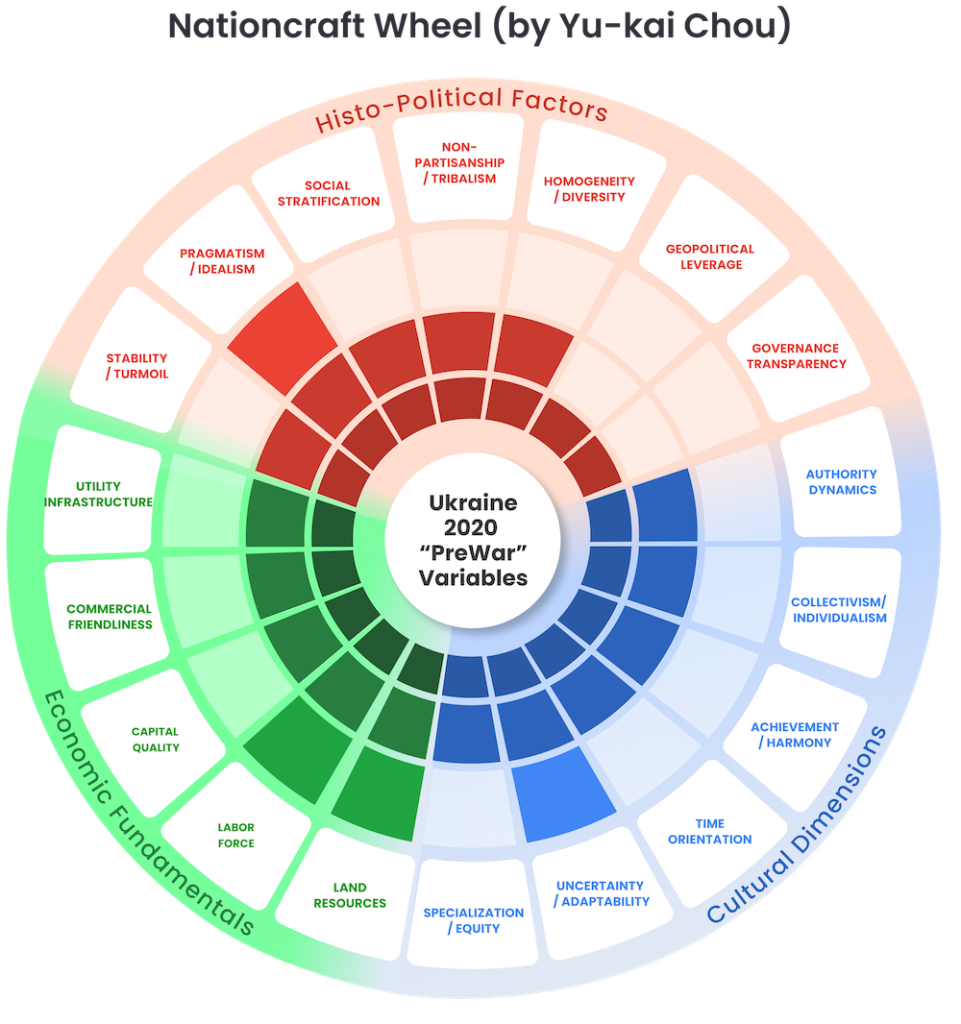

Check here for all the Nationcraft Variable Wheels
Component II. Nation Goals (Output): Stack-Rank Your Priorities
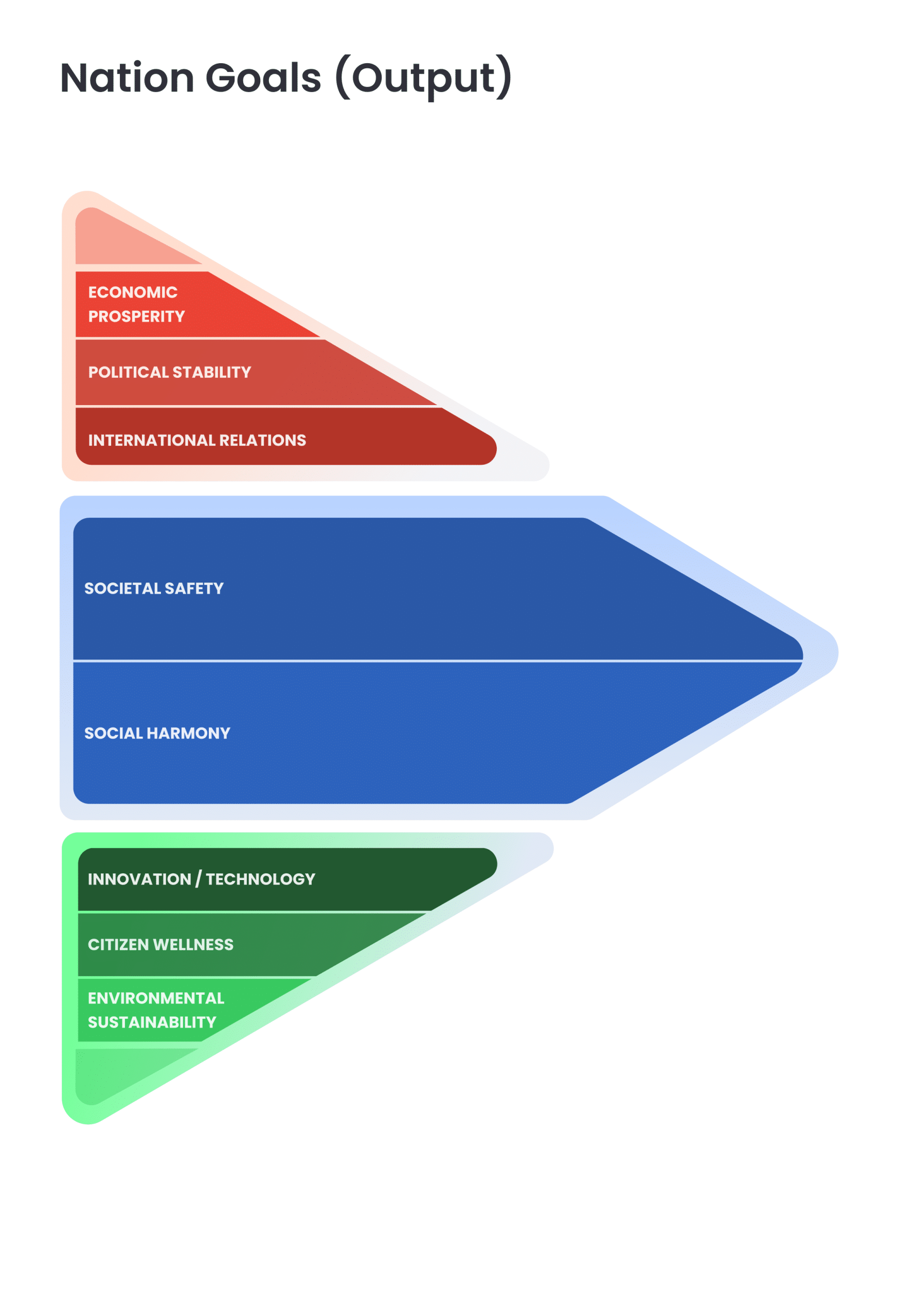
Now that we know what the nation is like, we need to understand what its goals are. Nation Goals are the 8 measurable outcome categories that define what “winning” looks like for a country. The Nationcraft Framework requires explicit stack-ranking — not equal weighting — because resources are finite and tradeoffs are inevitable. A nation that claims all goals are equally important has no strategy.
The Power of Prioritization: Resolving Tradeoffs and Allocating Resources
Effective nation crafting requires prioritization because resources are finite and stakeholders have competing demands
The Nationcraft Framework requires explicit ordering through Stack-Ranked Hierarchies
- Resource Allocation: Explicit goal hierarchies guide which ministries get priority funding and which reforms launch first, as budgets and political capital are scarce.
- Tradeoff Resolution: A ranked goal structure provides the decision rule when conflicts emerge (e.g., faster growth vs. widening inequality), enabling transparent justification and preventing paralysis.
- Accountability and Learning: Ranked goals clarify whether a problem lies in policy design, implementation, or goal feasibility itself, enabling faster course correction.
Stack-Ranking in Action: Two Countries, Two Priorities
Singapore Nation Goals (1960s–1980s):
1. Economic Prosperity (survival imperative)
2. Societal Safety (attract foreign investment)
3. Political Stability (enable long-term planning)
4. Social Harmony (manage diversity)
Singapore Nationcrafting: Policies prioritized export zones, meritocracy, and rule of law over democratic participation — controversial but effective for context.
Sweden Nation Goals (1950s–1970s):
1. Social Harmony (equity/equality)
2. Citizen Wellness (healthcare, education)
3. Economic Prosperity (fund welfare state) .
Sweden Nationcrafting: High taxes, universal services, and consensus politics — different goals, different policies, both successful.
The Lesson: There is no “best” goal ranking — only honest ranking matched to national reality and stakeholder consensus.
The 8 Nation Goals
1) Citizen Wellness
Happiness: Scandinavia, Switzerland.
Mental Health: Australia, Canada, Germany.
Physical Health: Japan, Singapore, Australia.
Meaning/Purpose: New Zealand, Canada, Sweden.
Civil Liberties/Freedom of Expression: Norway, Switzerland.
When a nation ranks wellness highly, it is signaling that longevity, trust, mental resilience, and day-to-day quality of life matter more than squeezing out every last point of short-term GDP.
2) Political Stability
Government Trust: Finland, Norway, Switzerland.
Citizen-Government Security: US, UK, Germany.
Post-partisanship: Denmark, NZ, Switzerland.
Political stability is not just about suppressing conflict. It is about creating enough institutional continuity that reforms can survive election cycles, coalition shifts, and narrative wars.
3) Economic Prosperity
Employment: Germany, Japan, Switzerland.
Talent Attraction: US, Canada, Australia.
Resiliency: Singapore, Switzerland, Norway.
Innovation: South Korea, Sweden, Singapore.
Prosperity can come from different mixes of industrial policy, talent density, export strength, and entrepreneurial energy. Nationcraft asks which mix fits the country’s actual constraints.
4) Societal Safety
C2C (Citizen-to-Citizen) Safety: Iceland, New Zealand, Portugal.
G2G (Government-to-Government) Security: US, China, Russia.
Disaster Preparedness: Japan, Netherlands, New Zealand.
For fragile or post-conflict nations, safety often has to come first. Citizens, investors, and civil institutions stop making long-term bets when daily life feels exposed.
5) Social Harmony
Cohesion: Canada, Australia, Singapore.
Equity/Equality Balance: Denmark, Norway, Iceland.
Collectivism vs. Individualism: Japan, China, South Korea.
Harmony does not mean uniformity. It means a nation can sustain cooperation across class, ethnic, ideological, or regional differences without tearing its reform agenda apart.
6) Innovation & Technology
R&D: South Korea, Israel, Japan.
Digital Transformation: US, South Korea, UK.
Education/Training: Finland, Singapore, South Korea.
Entrepreneurship: US, Canada, Israel.
Nations that prioritize this goal usually accept present-day spending and institutional experimentation in exchange for future capability, productivity, and strategic leverage.
7) International Relations
Geopolitical Influence: US, China, Russia.
Diplomatic Relations: Switzerland, Sweden, Canada.
Global Reputation: Switzerland, Canada, Sweden.
For many countries, diplomacy is not a soft bonus. It expands trade access, security options, coalition power, and room to maneuver during crises.
8) Environmental Sustainability
Resource Management: Norway, New Zealand, Canada.
Climate Action: Sweden, Denmark, Switzerland.
Conservation: Costa Rica, New Zealand, Bhutan.
This goal asks whether growth is being converted into durable national health or borrowed against ecological decline that future governments will be forced to absorb.
Component III. Nation Crafting (Policies with 100+ Successful Crafting Packets)
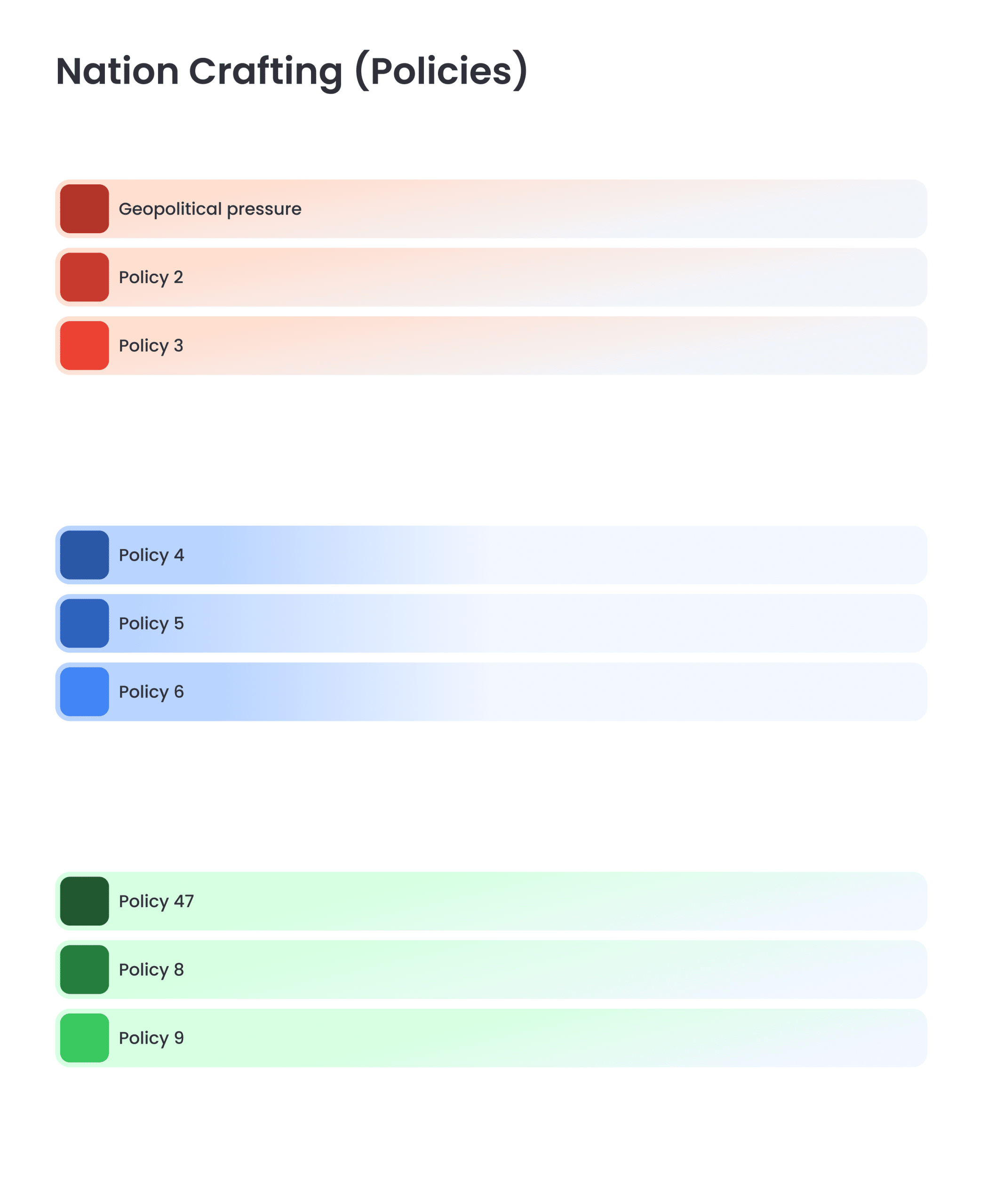
Now that the nature of the nation (Variables/Input) and the goal of the nation (Goals/Output), it is time to work on the black box, which is the actual Crafting (Policies). Nation Crafting is the operational layer where policy interventions are designed, sequenced, and implemented. Instead of building policy from scratch, practitioners draw from Successful Crafting Packets — documented historical reform packages that produced measurable transformation under specific variable conditions.
The key insight: Don’t ask “What worked somewhere?” Ask “What worked somewhere with variables similar to ours?”
Common Crafting Areas:
1. Infrastructure: Transportation (roads, ports, airports), connectivity (internet), and energy.
2. Policies: Education (schools, training), healthcare, housing, anti-corruption.
3. Economic Strategies: Talent attraction, retention, agriculture, technology, and trade.
Historical and recent policy packages are analyzed, adapted, and scaled across nations.
Blueprints for Change: Learning from Successful Crafting “Packets”
The most powerful insight in Nation Crafting comes from analyzing proven reform packages — Successful Crafting Packets — that produced measurable transformation under specific conditions. These packets distill decades of trial, error, and adaptation into replicable blueprints, showing which policy combinations, sequences, and implementation tactics worked in comparable contexts.
Anatomy of a Successful Crafting Packet
Each of the 100+ packets in the Nationcraft database is deconstructed into eight components:
- Historical Preconditions: Contextual background and triggering events that made reform necessary
- Nation Goals (Output): The stack-ranked goals of the nation.
- Nation Variables (Input): The specific 18 measurable factors of the nation during that time
- Policy Core (Crafting): The 5-10 signature reforms that drove transformation
- Sequencing Logic: Which policies came first and why
- Implementation Tactics: Political coalitions, technocratic teams, and communication strategies
- Outcome Trajectory: Quantified results over 5, 10, and 20 years
- Lessons and Limits: What worked, what failed, and what cannot be copied
100+ Iconic transformation packets as templates, including:
- Marshall Plan’s coordinated reconstruction across Europe (1948)
- Japan’s Meiji modernization integrating Western technology with indigenous governance (1868)
- Singapore’s Lee Kuan Yew industrialization combining export zones with meritocratic institutions (1960s — 1980s)
- South Korea’s Park Chung-hee heavy industry push financed by discipline and global markets (1962–1979)
- Germany’s Rhine Miracle coupling currency reform with social market principles (1948), China’s Deng Xiaoping opening blending special economic zones with one-party stability (1978)
- Brazil’s Plano Real taming hyperinflation through fiscal discipline and currency anchor (1994)
- Rwanda’s Kagame post-genocide rebuilding via reconciliation and performance contracts (1994–present)
- Bosnia’s Dayton-era reconstruction managing ethnic federation complexity (1996)
- Poland’s Balcerowicz shock therapy privatizing and liberalizing at speed (1990)
- Georgia’s Rose Revolution anti-corruption and state-building surge (2003).
Variable-to-packet matching
The key to applying these packets lies in matching a target nation’s variable profile to the conditions under which each packet succeeded.
A landlocked, resource-poor, post-conflict country resembles Rwanda more than Singapore; a middle-income state with state-owned enterprise drag mirrors China 1978 more than Japan 1868; a hyperinflation crisis echoes Brazil 1994 more than Germany 1948.
By systematically comparing Nation Variables — geography, population, institutions, social fabric, security context, starting income — practitioners identify which packets offer the highest-fidelity lessons and which adaptations are required.
Packet Example: “Singapore 1965-1990”
- Preconditions: Low resources, high geopolitical leverage, high Authority Dynamics, high Achievement orientation
- Policy Core: Export manufacturing zones, forced savings (CPF), English-language education, anti-corruption with teeth
- Sequencing: Security → Infrastructure → Education → Economic liberalization
- Outcome: GDP per capita grew 27x in 25 years
This process ensures that every intervention is grounded in historical precedent, variable matching, and explicit outcome expectations, transforming the framework into an executable plan
Nationcraft Sovereign: A Purpose-Built AI Engine for National Transformation
Beyond General-Purpose AI: ChatGPT was trained on the internet. Claude learned from books and articles. Gemini ingested public datasets.
None were trained on what actually transforms nations.
When you ask a general-purpose AI “How should Rwanda rebuild post-conflict?”, it synthesizes plausible-sounding advice from Wikipedia entries, think-tank reports, and news articles. What it cannot do is:
- Calculate which of the 18 Nation Variables Rwanda scores lowest on
- Identify which historical Success Packets match Rwanda’s exact variable profile
- Explain why Singapore’s industrialization packet would fail catastrophically in Rwanda’s context, but reconciliation-first sequencing from Bosnia 1996 offers adaptable precedent
- Predict which policy sequences will succeed based on 150 years of empirical transformation data
General LLMs hallucinate policy because they predict the next word. Nationcraft Sovereign predicts the next outcome based on a structured database of 150 years of variable-matched history.
Nationcraft Sovereign is not a large language model retrained on policy documents. It is a specialized intelligence system built on three proprietary datasets that exist nowhere else:
1. The Nation Variables Matrix
- 18 variables scored across 100+ countries
- Continuously updated as nations evolve
- Variable interdependencies mapped across thousands of historical observations
2. The Success Packets Archive
- 100+ historical transformation blueprints deconstructed into standardized components:
- Preconditions (scored variable states before reform)
- Nation Variables (18 factors of a nation timestamped at the beginning of the Crafting)
- Nation Goals (Stack-ranked 8 objectives at the beginning of the Crafting)
- Policy cores (the 5-10 signature interventions during the Crafting)
- Sequencing logic (implementation order and dependencies)
- Implementation tactics (coalition-building, communication strategies)
- Outcome trajectories (quantified results at 5, 10, and 20 years)
- Failure modes (conditions under which the packet breaks down)
3. The Correlation Engine
- Millions of variable interactions analyzed across 150 years of transformation data
- Pattern recognition across temporal, geographic, and institutional contexts
- Example: High Authority Dynamics (9+) + Low Stability (1-3) + High Pragmatism (8+) produces distinct sequencing requirements that differ fundamentally from High Homogeneity (9+) + High Time Orientation (9+) contexts
These datasets required years of fieldwork, government partnerships, and longitudinal analysis. Much of the structured packet logic is proprietary, and it is not organized as a single public database that policymakers can query off the shelf.
Nationcraft Sovereign’s Intelligence Advantage
When analyzing a nation, Sovereign:
1. Identifies Variable-Packet Matches
Ukraine (2024 profile) matches:
- Poland 1990 (87% variable similarity) - shock therapy with EU anchor
- Estonia 1991 (76% variable similarity) - digital transformation path
- Rwanda 1994 (71% variable similarity) - post-conflict reconstruction

Sovereign flags adaptation requirements:
"Ukraine's Stability score (1) is significantly lower than Poland's baseline (7).
Recommend prioritizing Bosnia 1996's external peacekeeping components
before attempting Balcerowicz-style rapid privatization."
2. Sequences Policy Implementation
Rather than recommending all policies simultaneously, Sovereign identifies dependencies:
- “Commercial Friendliness reforms require Governance Transparency ≥6 first (see Georgia 2003)”
- “Digital infrastructure (Estonia 1991 packet) cannot deploy until Utility Infrastructure >4”
- “Singapore’s top-down industrialization requires Authority Dynamics ≥8; lower scores need Poland’s consensus-building approach”
3. Predicts Failure Modes By analyzing similar historical attempts, Sovereign forecasts risks:
- “Turkey 2010 attempted rapid secularization with Pragmatism score of 4 (idealism high). Result: policy reversal within 8 years. Your Pragmatism score of 5 suggests similar risk.”
- “Chile 1982 banking crisis followed premature financial liberalization with Capital Quality score of 3. Your score of 4 is marginal — recommend phased approach.”
Why Nationcraft Sovereign Rules
Traditional policy advice follows three paths:
1. Ideological (“Free markets always work” or “State planning is essential”)
- Ignores variable context
- Result: Afghanistan’s $148 billion reconstruction failure (SIGAR 2025 report)
2. Anecdotal (“Singapore succeeded, let’s copy them”)
- Misses variable mismatches
- Result: Dozens of failed “Singapore model” attempts in high-diversity, low-authority nations
3. Theoretical (“Economic models predict X”)
- Lacks implementation sequencing
- Result: Correct diagnosis, failed execution (see: multiple IMF structural adjustment programs)
Nationcraft Sovereign follows a fourth path: Empirical pattern-matching.
It identifies which nations historically faced your exact variable configuration, examines what policies they deployed and in what sequence, tracks which succeeded over 5/10/20 year horizons, and maps adaptation requirements for your specific context.
This is not ideology dressed up as expertise. It is a structured comparative method built from long-horizon transformation data that most human teams can only sample in fragments. General-purpose AI can summarize public-policy literature, but it does not come preloaded with Nationcraft’s curated variable-to-packet dataset, sequencing logic, or outcome tagging.
That is why Nationcraft Sovereign is positioned as a dedicated research layer for this analytical challenge, not a generic chatbot with policy opinions.
FAQ
“How is Nationcraft different from World Bank development frameworks?”
Nationcraft fundamentally differs in its diagnostic-to-action pipeline and emphasis on contextual matching.
- World Bank/Traditional Frameworks: Tend to prescribe universal best practices (e.g., privatization, deregulation) based on general economic theory, often leading to a “copy-paste” policy failure due to insufficient accounting for local conditions.
- Nationcraft: Is a strategic system that first requires a diagnostic of the nation’s unique DNA using 18 measurable Nation Variables (Input). It then matches this profile to historically proven Successful Crafting Packets (SCP) from nations that faced similar variable conditions, providing an evidence-based, adaptive blueprint for change.
“Can small nations use the same policies as large nations?”
Not necessarily, but the Nationcraft Framework shows you which ones apply.
- The ability to use similar policies is determined by Variable-to-Packet Matching, not size alone.
- A policy that worked in a large, resource-rich country (e.g., China’s Deng-era opening ) may not work in a small, resource-poor country (e.g., Singapore).
- However, a policy that succeeded in a small, high-density, trade-dependent nation (like Singapore’s industrialization ) may be highly relevant to another nation with similar Land Resources (e.g., a strategically positioned port nation ) regardless of its total area or population.
“Which Crafting Packets work for post-conflict reconstruction?”
The framework contains curated landmark cases, and for post-conflict scenarios, the Variable-to-Packet Matching often points toward precedents like:
- Rwanda’s Post-Genocide Rebuilding (1994–present): Focused on reconciliation, performance contracts, and rebuilding institutions.
- Bosnia’s Dayton-Era Reconstruction (1996): Focused on managing ethnic federation complexity.
These packets would be prioritized for nations scoring low on Stability vs. Turmoil. A landlocked, resource-poor, post-conflict country, for example, is identified as resembling Rwanda more than Singapore.
“How often should Variables be reassessed?”
Nation Variables should be reassessed regularly, as they are not static and are influenced by policy implementation and external shocks.
- Cultural Dimensions (e.g., Collectivism, Time Orientation) are the slowest to change and may need reassessment every 5-10 years or after a generational shift.
- Histo-Political Factors (e.g., Stability, Governance Transparency) and Economic Fundamentals (e.g., Capital Quality, Talent Flow) can change more rapidly due to crises, reforms, or geopolitical events. These should be reviewed annually or after any major political or economic shock.
- The continuous learning loop requires feeding deviations back into the diagnostic layer to refine the understanding of variables.
“What if my nation scores low on most Variables — where do I start?”
A low score (1-3) means the country is difficult for the government to implement positive change. This requires focusing on policies that create the preconditions for future reform.
- Prioritize Foundation Goals: The initial Nation Goals must be focused on basic survival and stability, such as Societal Safety and fundamental Economic Prosperity (e.g., fixing hyperinflation as in Brazil 1994 ).
- Focus on Quick Wins: Implement small, visible policies that build credibility and generate resources for harder reforms.
- Address Foundational Gaps: Policies must target the lowest-scoring variables first, particularly in the Histo-Political and Economic Fundamentals sections (e.g., fixing Governance Transparency or basic Utility Infrastructure). For instance, a low score on Commercial Friendliness means fixing the rule of law must precede economic liberalization
Appendix: Technical Deep Dive
Glossary of Terms
- Nation Variables: The 18 measurable factors that define a country’s starting condition
- Nation Goals: The 8 outcome categories, stack-ranked by priority
- Successful Crafting Packet: A historical reform package that produced measurable transformation under specific variable conditions
- Variable-to-Packet Matching: The algorithm for identifying which historical precedents apply to your country
Methodology Sources
- Hofstede, G. Culture’s Consequences (6 cultural dimensions)
- House, R.J. et al. GLOBE: Culture, Leadership, and Organizations (9 dimensions, 62 societies)
- Schwartz, S.H. A Theory of Cultural Values (40+ nations)
- Inglehart & Welzel World Values Survey (cultural mapping)
How to Cite the Nationcraft Framework
Academic Citation (APA 7th Edition)
Chou, Y. (2025). The Nationcraft Framework: A systematic methodology for national development. Retrieved from https://yukaichou.com/nationcraft-framework
Government/Policy Report Citation
Chou, Yu-kai. (2025). “The Nationcraft Framework: 18 Nation Variables, 8 Goals, 100+ Proven Reform Packages.” Nationcraft Whitepaper. https://yukaichou.com/nationcraft-framework
Chicago Style
Chou, Yu-kai. “The Nationcraft Framework: A Systematic Methodology for National Development.” Whitepaper, 2025. https://yukaichou.com/nationcraft-framework.
BibTeX for LaTeX Users
@misc{chou2025nationcraft,
  author = {Chou, Yu-kai},
  title = {The Nationcraft Framework: A Systematic Methodology for National Development},
  year = {2025},
  url = {https://yukaichou.com/nationcraft-framework},
  note = {18 Nation Variables, 8 Goals, 100+ Proven Reform Packages}
}
Framework Components to Reference
When citing specific components:
- Nation Variables: Chou (2025), Nationcraft Variables (18 factors)
- Success Packets: Chou (2025), Successful Crafting Packets Database
- Nationcraft Sovereign: Chou (2025), Nationcraft Sovereign AI Engine
Downloadable Citation Formats
Citation files coming soon.
Related Reading
- The Octalysis Framework for Gamification & Behavioral Design
- What is Gamification? Definition, Examples & Framework
- Actionable Gamification: Beyond Points, Badges & Leaderboards
- 90+ Gamification Examples & Cases with ROI Stats
- The $1.06 Billion Octalysis Gamification Case Study
- How Yu-kai Chou Pioneered Gamification in 2003
- 10,000 Hours of Play — Personal-Scale Gamification Design
- The Digital Convergence Model — Technology’s Impact on Nations
Nationcraft Case Studies
See how the Nationcraft Framework has been applied to real nations: