
![How 750words.com Uses Gamification to Build a Daily Writing Habit [Octalysis Analysis]](https://yukaichou.com/wp-content/uploads/2026/05/ftierA-3641-how-750wordscom-uses-featured-v8.png)
How 750words.com Uses Gamification to Build a Daily Writing Habit [Octalysis Analysis]

Can a writing site keep you coming back every day — not for a week, but for years? 750words.com has done exactly that, turning a blank page into one of the most effective gamified habit-building tools on the internet.
This guest post by “Average Joey” — a self-described secret gamification agent — breaks down how 750words.com applies all 8 Core Drives of the Octalysis Framework to keep writers engaged across every phase of the player journey.

Table of Contents
- About Yu-kai Chou
- The Empowerment to Just Write (Core Drive 3)
- Simple and Visual Feedback on Progress (Core Drive 2)
- Rewarding Commitment and Consistency (Core Drives 4, 5, 8)
- Profiling the Quantified Writer (Core Drive 7)
- Writing Alone Together (Core Drives 1 & 5)
- Egg to Spacebird: Long-Term Engagement from Discovery to Endgame
- Playing the Writer’s Game
- Frequently Asked Questions
Author Credibility: Yu-kai Chou

Yu-kai Chou created the Octalysis Framework after studying gamification since 2003 — years before the term entered mainstream vocabulary. As a Human-Systems Architect & Behavioral Designer, his framework has been applied by LEGO, Microsoft, Porsche, Coca-Cola, Salesforce, and MrBeast, impacting over 1.5 Billion Users.
Chou has taught the Octalysis methodology at Harvard, Stanford, Yale, Tesla, Google, BCG, and IDEO.
His work has been cited by Harvard, Stanford, MIT, Forbes, Wall Street Journal, Wired, US Department of Energy, NIST, NSF, NCBI, US Department of Education, ClinicalTrials.gov, and Google Scholar — with 3,700+ more academic publications. Explore his books here.

The Empowerment to Just Write
The site’s every design choice feels tightly focused around a central goal: write every day.
Sounds easy, but anyone who’s actually tried to write that novel, get down some of that essay, or write a journal entry after a long day knows that finding that writer’s flow is often difficult.
This is why it feels like such an empowering first experience when you log in to the site. Before anything else — any browsing or the site showing off — you are simply challenged to write.
In our digital lives filled with endless procrastination and distraction at every turn, a blank page with its sole intent at its center feels refreshingly honest.
This is simple Empowerment of Creativity & Feedback (Core Drive 3). Like any sandbox game, you are given the tools early on and all the freedom to attack it any way you want.
The site name itself is all the tutorial for the onboarding phase you need — the objective is clear from the moment you type in the URL: “750words.” Go.
Here’s how it could have all gone wrong: a standard frame of menus, badges, lists of other users, and challenges — all gamified elements used later — if introduced at this point would have been a disaster. Those sparks for another chain of thought would send your writing muse wandering off.
Instead, the gamification recognizes the different player journey phases and by focusing in on empowerment, gets you to that early win-state of a successful writing day completed.
Simple and Visual Feedback on Progress

In line with this stripped-back design, there is no big progress bar with swirly lights for feedback. The smallest of word counters is placed at the bottom of the page along with a timestamp update that lets you know an autosave has happened.
It’s subtle and functional, but marks your progress and Accomplishment (Core Drive 2) every word along the way.
Once completed, the day is then marked by an X for the month you’re in. A kiss perhaps, I thought at first…
Why not a more fancy icon? When the Xs start to build up in a little chain across the top of those empty boxes, it starts to make sense. Strike!

I can almost hear the skittles falling over and in my head I do the obligatory turn around, fist pump, and jaunty walk back to the pit.
If you happen to only partially complete your writing on any given day, the box fills with a tantalizing spare and an email is sent reminding you to not give up. It’s a clever visual feedback trick that challenges you to do the bowling unthinkable and turn your spare into a full strike.
Rewarding Commitment and Consistency
After completing the most important action of writing, the site opens up its second layer of accomplishment that reinforces long-term engagement.
Like an attentive partner, each visit reminds me when we first started our journey together. It even wants to celebrate our anniversary by giving me a penguin. Ahhhh!
The scaffolding phase is led by the badges. Animal badges reflect the milestones of 5, 30, and more days of writing in a row.
The chain of Xs and the promise of a new badge is enough to encourage me to avoid breaking my streak (Core Drive 8, Loss & Avoidance). It’s a long way to fall back to day 1 on the way to that impressive and coveted 500-day Space Bird status (Core Drive 5, Social Influence).
The next thing you’ll notice is the available special badges for certain behaviors, and the collector in us is inspired (Core Drive 4, Ownership & Possession).
Type consistently fast and get the Cheetah badge. Type without distractions and get the Hamster badge. Each one is designed to elicit a certain behavior that pushes you to stretch your writing muscles and habits.
Profiling the Quantified Writer
Even without these badges, the ownership drive is also satisfied by the really interesting use of a writing analysis page.
The pretty graphs and meta-analysis of my thoughts and feelings on any given day are often surprising — providing a personalized dose of Unpredictability & Curiosity (Core Drive 7). I’m always curious to see if the algorithm thinks my writing was extroverted or introverted, upset or happy.
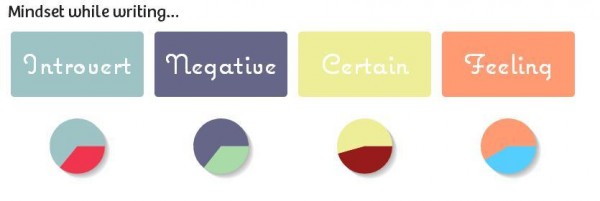
This customization is more powerful than any avatar or profile. By intimately linking my presence on the site back to the core action of writing, the gamification once again reinforces the writing.
Like staring in the fun-house writer’s mirror, stripped past the choices I might have made on a profile — instead, here is a reflection of my writer’s face revealed by the words themselves.
Buster admits this is not exactly a foolproof algorithm, but I think this rather adds to its fun. Apparently I was pretty “touchy” and “feely” about my “future success” today.
Writing Alone Together
Then there is the one-month challenge — a recurring chance to write 750 words every day within a single month.
The wall of awesomeness celebrates the champions, and the wall of shame is there to chide the losers at the end of each month. There is a countdown of challengers as they fall to the wayside, and it brings together the usually invisible users as a group working towards a common writing goal.
The challenge introduces an important element of competition and social pressure.
The voluntary sign-up to the month also asks each individual to fill in their own reward or penalty for the challenge:
“If I succeed, I will… treat myself to x.
If I miss a day or more, I will… y”
This simple self-made narrative, witnessed by your fellow participants, is powerful. Instead of shoehorning some standardized Epic Meaning & Calling (Core Drive 1) into your interaction, it astutely allows you to craft your own — a surefire way to tap into the intrinsic or extrinsic motivations that drive you.
Egg to Spacebird: Long-Term Engagement from Discovery to Endgame
I first discovered the site in one of those serendipitous online conversations, where a virtual stranger tells you in the hushed tones of a friend sharing a secret about something special they have discovered.
This was very consistent with the Discovery Phase as an effective way of engaging curiosity (Core Drive 7) and the social influence (Core Drive 5) offered by word of mouth from one writer to another.
Once you have joined the site, achieved your first few Xs, and started the daily mastery towards a few badges, the final experience phase of gamification — the Endgame — comes into view.
This is where the relatively underused Scarcity & Impatience (Core Drive 6) appears. The patron cup of coffee is the only way to contribute and appear on the site beyond the core action of writing. It allows you to vote for site features or post an inspirational note on the patron page.
Cups of coffee can only be obtained by donations or earned from monthly challenges.
These cups of coffee encourage a sense of belonging to the community and investment in its future development. They can also be donated into a winner’s pool for the monthly challenges, as a way for users to give back to the community and demonstrate their mastery.
One member I saw recently gave away 40 cups to the winners pool.
Interestingly, there is also a locked-down feature area limited to early members of the site. Currently it is impossible to ever earn the right to join this group — an extreme form of scarcity.
Opening this up as an Endgame opportunity for more recent members to earn would be one of the practical improvements that the Octalysis Framework points to.
Another improvement would be providing new forms of accomplishment and ways to engage with other players through collaborative challenges. For example, there could be a special month challenge where if 80% of the members signed up complete it successfully, it unlocks a new badge for everyone.
This kind of Group Quest would provide a surprising and tangible reward for long-term players taking on repeated monthly challenges, as well as new meaning to the writing of inspirational notes as a rallying call to the group to win this prize.
Playing the Writer’s Game
Buster says on the site that he created it out of his own desire and needs for something to motivate his daily writing practice — and I believe you can feel this through the gamified elements.
Unlike sites with plugin gamification features tagged on to the experience, 750words integrates it around this shared desire and at every phase of the writer’s journey.
Writing each day can sometimes feel like a lonely experience.
In the quiet space between the blank page and the words we try to wring out, 750words delivers an intimate gamified experience. Like the daily presence of an encouraging friend, who simply lends you their best pen.
Frequently Asked Questions
What is 750words.com?
750words.com is a gamified daily writing platform created by Buster Benson. It challenges users to write 750 words each day in a distraction-free environment, using streaks, badges, and writing analytics to build a consistent writing habit.
How does 750words.com use gamification?
The site applies gamification across all 4 Experience Phases of the player journey. It uses Core Drive 3 (Empowerment) with a blank-page-first design, Core Drive 2 (Accomplishment) through streak tracking, Core Drive 8 (Loss & Avoidance) to prevent streak-breaking, and Core Drive 7 (Unpredictability) through mood and sentiment analysis of your writing.
What Core Drives from the Octalysis Framework does 750words.com activate?
750words.com activates all 8 Core Drives of the Octalysis Framework: Epic Meaning (self-set goals), Accomplishment (streaks and Xs), Empowerment (blank-page creativity), Ownership (writing analysis data), Social Influence (monthly challenges and leaderboards), Scarcity (patron coffee cups), Unpredictability (mood analytics), and Loss & Avoidance (streak protection).
Is 750words.com free?
750words.com offers a free 30-day trial, then costs $5 per month. The site has been running since its creation by Buster Benson and maintains a dedicated community of daily writers, some with multi-year streaks.
What can gamification designers learn from 750words.com?
The biggest lesson is restraint. 750words.com delays gamification elements until after the core action (writing) is complete — a design choice that prevents Black Hat distraction from undermining the user’s primary goal. It also demonstrates how all 8 Core Drives can work together across the full player journey without feeling forced or artificial.
Related Reading
- The Octalysis Framework: Complete Gamification Framework
- The 4 Experience Phases in Gamification
- The Strategy Dashboard for Gamification Design
- White Hat vs Black Hat Gamification
- Serious Games vs Gameful Design