
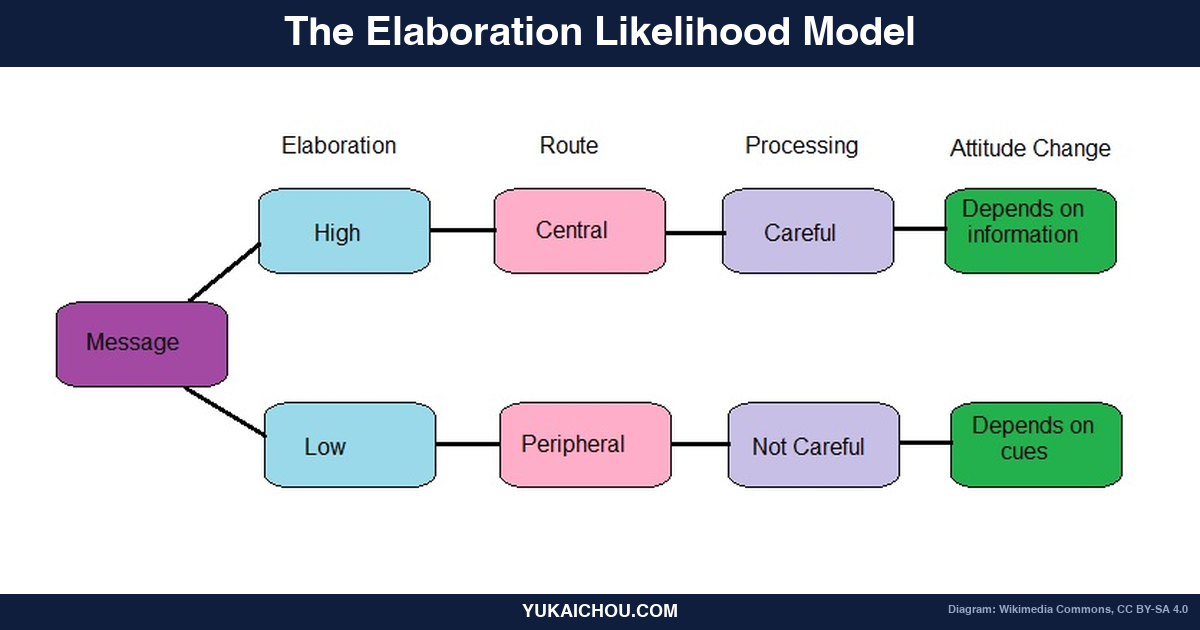

Most persuasion on the internet today is fighting the wrong fight. Brands obsess over the cleverness of their hook, the weight of their proof, the A/B test of their button copy — and then ship those arguments to audiences who were never going to read them in the first place. The message is not the bottleneck. The reader’s elaboration is.
Richard Petty and John Cacioppo spent the 1980s formalizing this split into the Elaboration Likelihood Model (ELM) — showing across dozens of experiments that the same argument, landing on the same brain, produces opposite effects depending on a single variable: how hard the person is thinking. Hit them when they care and can process, and every word of the argument counts. Hit them when they are busy, distracted, or indifferent, and the argument does not matter at all. Only the cues around it do — your face, your title, the sheer number of points on the page, the music behind the voice-over.
This is the Elaboration Likelihood Model (ELM), and if you design experiences for a living, it is the closest thing social psychology has to a traffic-control system for attention. Below I will walk you through what ELM actually says, where it has held up after forty years, where it genuinely breaks, and — because this is what we do — how to fold it into the Octalysis Framework without losing either rigor or design power.
Speed Run Notes
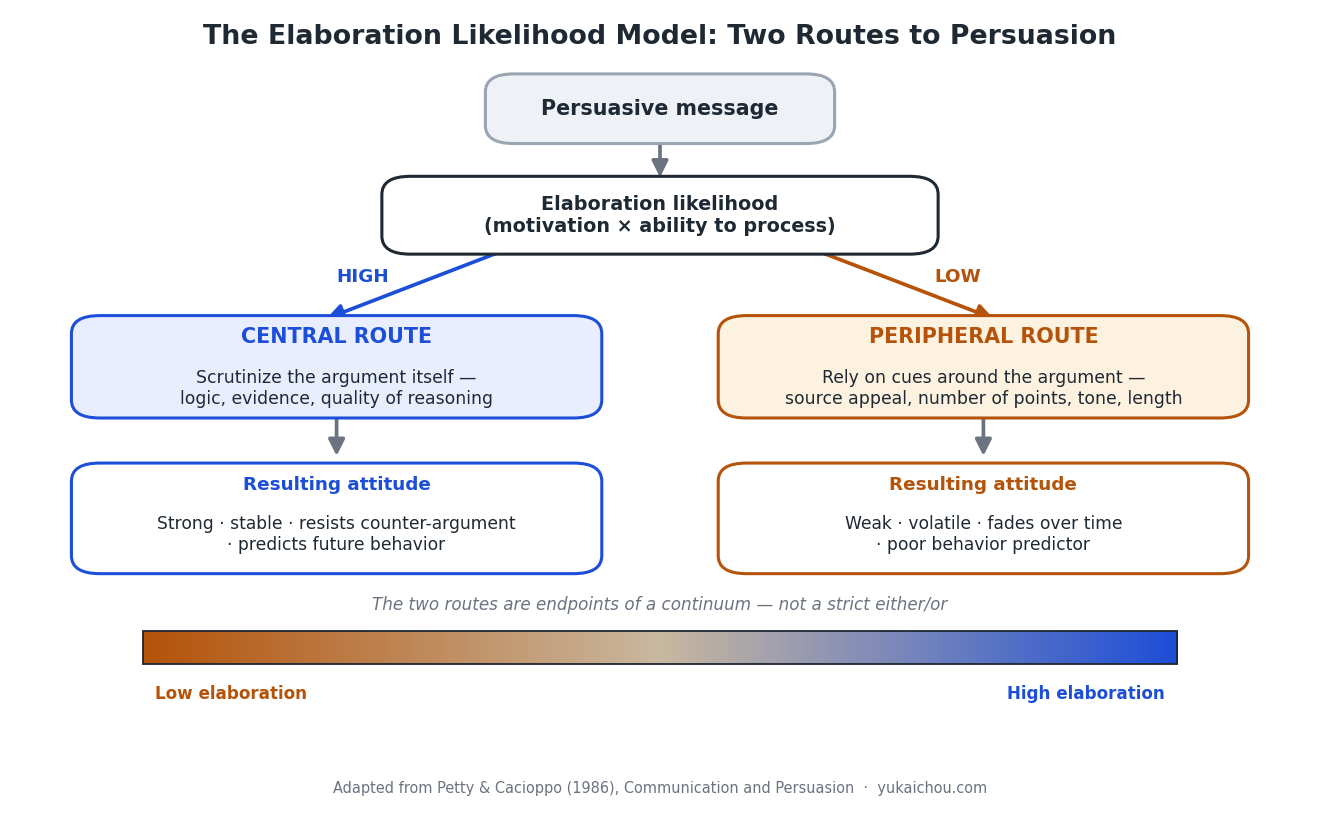
- Two routes, not two types. ELM posits two paths to attitude change: the central route (careful scrutiny of arguments) and the peripheral route (reliance on surface cues).
- Elaboration = motivation × ability. A reader elaborates when they care about the topic (personal relevance, need for cognition, accountability) and can process it (time, cognitive resources, prior knowledge, low distraction).
- Central attitudes stick. Peripheral attitudes flake. When persuasion comes through careful thinking, the resulting attitude predicts behavior, resists counter-argument, and persists over time.
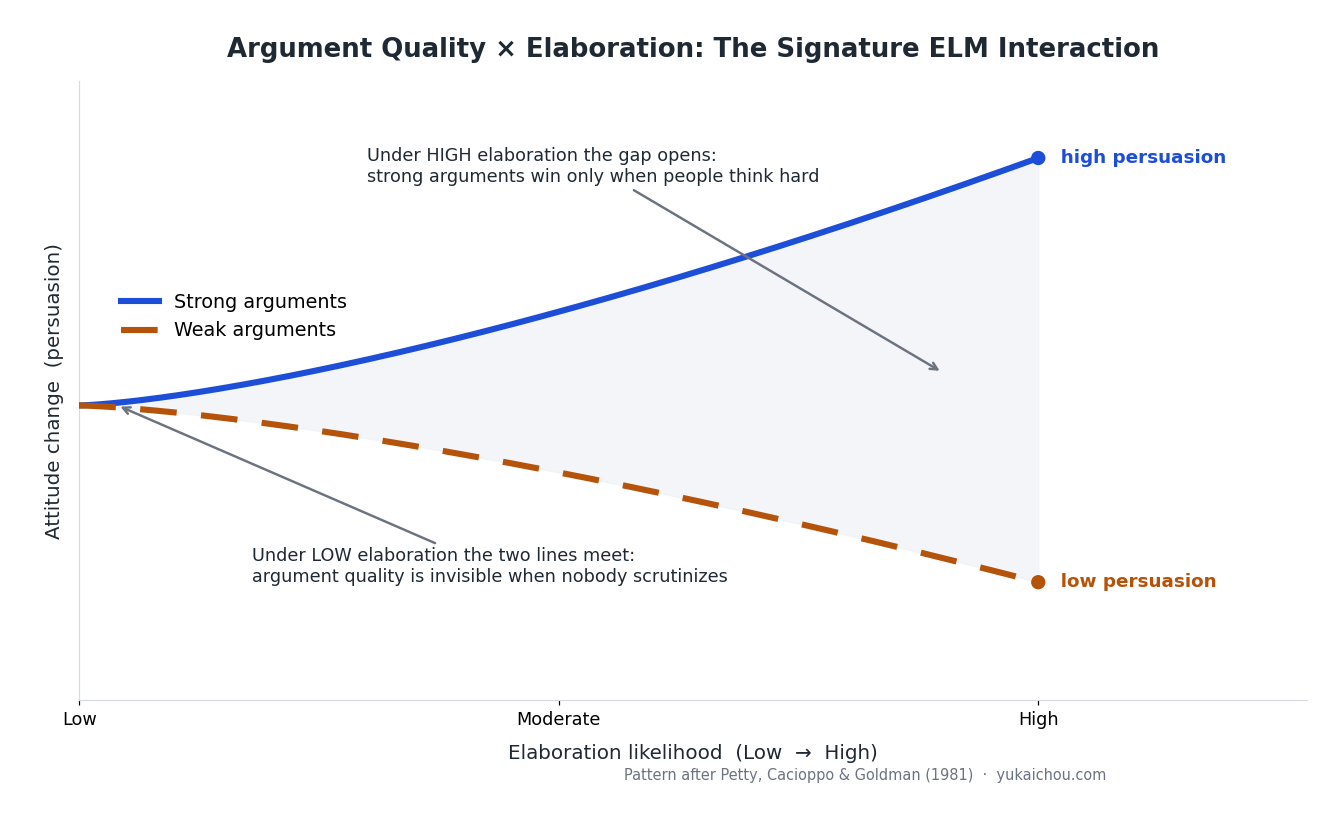
- Argument quality only matters under elaboration. The most robust ELM finding is a simple interaction: strong arguments beat weak arguments only when people are thinking hard.
- The same variable can play multiple roles. Source attractiveness is a peripheral cue under low elaboration and a substantive argument under high elaboration (for, say, a shampoo ad).
- Octalysis mapping. The central route maps onto the White-Hat Core Drives (CD1 Epic Meaning, CD2 Development, CD3 Creativity) — empowerment through understanding.
In This Article
- What is the Elaboration Likelihood Model?
- The Core Findings of ELM
- What Petty and Cacioppo Got Right
- Where the Elaboration Likelihood Model Falls Apart
- The Brain on Persuasion
- The Elaboration Likelihood Model vs Other Theories
- The Elaboration Likelihood Model in the Real World
- The Elephant in the Room
- How to Apply the Elaboration Likelihood Model with the Octalysis Framework
- Practical Steps to Apply the Elaboration Likelihood Model
- Frequently Asked Questions
About the Author

Yu-kai Chou is an S-Tier Behavioral Designer and the creator of the Octalysis Framework, the gamification design system now applied to products and experiences reaching over 1.5 billion users. His book Actionable Gamification is one of the most-cited works in the field, and he has been ranked the #1 Gamification Guru in the World.
He has advised MrBeast, LEGO, Microsoft, Porsche, Tesla, Stanford, Harvard, and governments including Ukraine on turning behavioral psychology into product mechanics that actually change user behavior.
Verify: Wikipedia · Google Scholar · Wikidata · LinkedIn
What is the Elaboration Likelihood Model?
The Elaboration Likelihood Model, introduced by social psychologists Richard E. Petty and John T. Cacioppo in a 1986 monograph titled Communication and Persuasion: Central and Peripheral Routes to Attitude Change, is a dual-process theory of how people form and change attitudes in response to persuasive communication. Its core claim is deceptively simple: the amount of cognitive effort a recipient devotes to evaluating a message — what Petty and Cacioppo called elaboration likelihood — determines which features of the message actually drive attitude change.
At one end of the elaboration continuum sits the central route to persuasion. A recipient high in elaboration is scrutinizing the argument itself: the logic, the evidence, the quality of the reasoning, the plausibility of the claim. Attitudes formed under the central route are built on cognitive effort, and because the person has connected the argument to their existing knowledge structures, the resulting attitude tends to be strong, stable, and predictive of future behavior.
At the other end sits the peripheral route to persuasion. Here the recipient is not scrutinizing the argument — because they do not care enough, do not have enough mental bandwidth, do not know enough to evaluate it, or all three. Attitude change still happens, but it is driven by cues adjacent to the argument: the attractiveness of the source, the number of arguments (regardless of quality), the tone of the music, the length of the message, simple heuristics like experts can be trusted or long messages must be substantive. Peripheral attitudes are weaker, more volatile, and far less predictive of behavior.
The critical point — and the one most summaries of ELM miss — is that the two routes are not a dichotomy. They are the endpoints of a continuum. A reader scanning your landing page while eating lunch is not purely peripheral; they might elaborate the headline in detail and ignore everything below it, or notice the logo and ignore the headline. Elaboration is graded, contextual, and unstable from moment to moment. The design implication is that you cannot assume a fixed route — you have to design for whatever route the context actually permits.
ELM was born in direct response to what Petty and Cacioppo saw as the fragmented state of persuasion research in the 1970s. By that point, the field had accumulated hundreds of findings, many of them contradictory: some studies showed that credible sources persuade, others showed source credibility had no effect; some showed that more arguments worked, others showed quality trumped quantity. ELM’s contribution was to reframe these contradictions as an interaction: whether a variable persuades depends on the recipient’s elaboration likelihood. The apparent contradictions dissolved once the moderating role of elaboration was made explicit.
ELM is often grouped with the other great dual-process theory of social cognition, Shelly Chaiken’s Heuristic-Systematic Model (HSM). The two models rose in parallel and make overlapping predictions; the differences are mostly technical. ELM is also a close cousin of Daniel Kahneman’s System 1 / System 2 framing, though Kahneman’s work focuses on judgment and decision-making rather than attitude change specifically. The cultural fact is that when someone says “dual-process theory” in a persuasion context in 2026, they are almost certainly invoking ELM.
The Core Findings of ELM
Across more than four decades of experiments, the Elaboration Likelihood Model has accumulated a specific set of empirical regularities. The following findings are the ones that have held up across many replications, earned treatment in meta-analyses, and become standard citations in the persuasion literature.
The argument-quality × elaboration interaction
The single most-cited ELM finding is the interaction between argument quality and elaboration likelihood. When elaboration is high, strong arguments produce significantly more attitude change than weak arguments. When elaboration is low, the strong and weak arguments produce the same attitude change — which is to say, the quality of the argument is invisible when nobody is scrutinizing it. Petty, Cacioppo, and Goldman’s 1981 experiment manipulating personal relevance (students told a university policy would affect their own tuition vs. a policy for a different university) produced the canonical demonstration: high-relevance students were persuaded by strong arguments and unmoved by weak ones; low-relevance students responded to neither.
Peripheral cues work best under low elaboration
Source credibility, source attractiveness, number of arguments, and the use of heuristic cues (consensus information, social proof, authority signals) tend to produce their largest effects when elaboration is low. Under high elaboration, these peripheral features get scrutinized along with everything else and can be rejected or reframed as arguments themselves. A 2009 meta-analysis by Carpenter reviewing 153 independent persuasion effects found robust support for the asymmetric pattern: peripheral cues carry the persuasion burden in low-elaboration contexts and fade out in high-elaboration ones.
Attitude strength differs systematically by route
Attitudes formed via the central route are, on average, held with greater confidence, more resistant to counter-persuasion, more temporally stable, and more predictive of behavior than attitudes formed via the peripheral route. This is not a marginal finding; it is the reason ELM matters in applied settings. An advertiser who wants a quick sales lift can chase peripheral change and get it. A movement organizer who wants a voter to still show up six months later needs central change — which costs more cognitive effort to induce.
Motivation and ability jointly gate elaboration
Elaboration is not free. Petty and Cacioppo identified motivation (personal relevance, accountability, need for cognition, mood) and ability (cognitive resources, prior knowledge, absence of distraction, message comprehensibility) as the two necessary conditions. Eliminate either and elaboration collapses. Frequent replications include distraction manipulations (playing background noise during message exposure drops elaboration even when recipients care about the topic) and expertise manipulations (novices cannot elaborate on technical arguments even when highly motivated).
The multiple-roles principle
Perhaps the most theoretically important finding, and the one designers abuse the most: a single persuasion variable can play different roles depending on elaboration. Source expertise, for example, is a peripheral cue when a reader is not elaborating (the expert halo pushes attitudes without engaging the content). Under high elaboration, the same source expertise gets folded into the argument evaluation: “Does this expert have domain-specific evidence? Does their claim fit the literature?” Source attractiveness is peripheral for a laundry detergent but substantive for a shampoo, where attractiveness is part of the product claim. What counts as a cue is not a property of the variable — it is a property of the situation.
The boomerang effect
Under high elaboration, weak arguments do more than fail to persuade — they can produce attitude change opposite the advocacy. The scrutiny that amplifies strong arguments also amplifies the recognition that weak arguments are weak, and the recipient updates against the message source. This is the empirical basis for the design warning that marketers who pile on low-quality claims at a high-elaboration audience often make their audience less favorable toward the product than if they had said nothing. Peripheral audiences will forgive a weak argument; central audiences will punish it.
What Petty and Cacioppo Got Right
Every framework eventually gets critiqued, and we will get to ELM’s critiques in the next section. But before we do, it is worth stating plainly what the model got right — because a lot of behavioral science from the same era has not aged this well.
First, Petty and Cacioppo correctly identified that the persuasion field’s apparent contradictions were the result of a missing moderator, and that the missing moderator was cognitive effort. Before ELM, the literature was a swamp of “source credibility sometimes works, sometimes doesn’t” studies. ELM’s contribution was not to invent a new variable — it was to provide the organizing framework that showed why existing variables were behaving erratically. That is a rare contribution in social psychology and one that has held up far better than most 1980s-era theories.
Second, the predictive distinction between central and peripheral attitudes — in terms of strength, persistence, and behavioral prediction — has survived a tremendous amount of scrutiny. Longitudinal studies, behavior-follow-up studies, and cross-domain replications all converge on the pattern that cognitively-elaborated attitudes predict behavior more reliably than cue-driven attitudes. This is the single most useful thing ELM tells designers: the surface metric of “did the message change their mind” is not the same as “will they act on it six months from now.”
Third, the multiple-roles principle is, in my opinion, ELM’s deepest contribution to behavioral design. It breaks the temptation to classify variables as “good cues” or “bad cues” and forces the designer to ask what role is this variable playing in the current elaboration state? That is a structural question, not a tactical one, and it leads to better design decisions than almost any other dual-process framing available.
Fourth, ELM was unusually generous about acknowledging that the two routes are not a binary. Many 1980s dual-process models were sold as “you are in mode A or mode B.” Petty and Cacioppo were careful — and became even more careful over time — to insist that elaboration is a continuum, that a person can be partially engaged with a message, that the central and peripheral routes can operate simultaneously with different weights. That nuance is what allows ELM to still be useful in 2026, when our actual information environment (TikTok between tasks, Slack while on a call, landing pages during ad-break TV) is inherently hybrid-elaboration.
Fifth, and this is an underrated point: ELM is one of the few persuasion theories that explicitly builds the boomerang possibility into its structure. Many marketing frameworks treat persuasion as monotonic — more arguments, more cues, more emotion = more persuasion. ELM says clearly: at high elaboration, weak arguments hurt. That prediction lines up with real marketing experience, where flooding a savvy audience with low-quality claims produces backlash, not buy-in.
Where the Elaboration Likelihood Model Falls Apart
ELM is one of the most influential persuasion theories of the last fifty years, and it is also subject to serious critique. A designer who leans on ELM without understanding its limits will over-predict — which is worse than not using the model at all. Three critiques are important enough to work through carefully.
The dichotomy critique: Kruglanski’s Unimodel
The most sustained attack on ELM has come from Arie Kruglanski and collaborators (most notably in a series of papers starting with Kruglanski & Thompson, 1999). Their argument — formalized as the Unimodel — is that the “two routes” distinction is an artifact of how ELM studies have historically operationalized “arguments” vs. “cues,” not a real feature of the underlying cognitive architecture. If you code both arguments and cues as information with relevance to a conclusion, the Unimodel claims, the same single process handles both, with elaboration determining how carefully any piece of information is processed — not which information gets processed.
Kruglanski’s team ran studies showing that manipulations which are identical in information content but differ in surface form produce attitudes consistent with a single-process account. If source expertise is presented as evidence (“This claim is backed by peer-reviewed studies”), it is treated centrally even under supposedly low-elaboration conditions. ELM defenders (Petty & Briñol most prominently) respond that the multiple-roles principle already absorbs this critique — a variable can be cue or argument depending on elaboration — but the formalism debate remains unresolved. The practical upshot for designers is that the “route” language is useful shorthand but may not carve nature at the joints. If someone tells you their audience is “on the peripheral route,” ask what they mean.
The measurement problem
Elaboration is almost never measured directly. It is inferred from independent-variable manipulations (personal relevance, distraction, need for cognition) or from proxies (thought-listing, self-reports of effort, cognitive response profiles). This creates a circularity risk: if strong arguments persuade, we conclude elaboration was high; if they do not, we conclude elaboration was low. The theory becomes difficult to falsify in a single study.
Modern attempts to measure elaboration physiologically — pupil dilation, EEG, reading-time patterns — have added empirical traction, but the measurement gap remains real. In applied settings (A/B tests, field experiments) elaboration is almost never measured at all; designers infer it from their audience profile and context. This is fine as working craft, but it means ELM-derived claims in the marketing literature are often more speculative than the primary-source literature would support. When a consultant tells you a campaign “works through the peripheral route,” they are telling you a story, not reporting a measurement.
Generalization and the WEIRD-sample problem
The foundational ELM experiments were run in the 1970s and 1980s on American undergraduates — the WEIRD sample (Western, Educated, Industrialized, Rich, Democratic) that has come under increasing scrutiny across social psychology. The multi-lab replication efforts of the 2010s and 2020s have been kinder to ELM than to some of its contemporaries; the argument-quality × elaboration interaction has replicated in several European and East Asian samples. But cross-cultural work also finds that what counts as a peripheral cue is not universal. In collectivist cultures, in-group endorsement functions closer to a central argument than it does in individualist samples, and in high-power-distance cultures, source-status cues persist as influential even under high-elaboration conditions. ELM’s structural claims are more robust than its specific variable assignments. If you deploy ELM globally, verify the cues you assume are peripheral are still peripheral in the target culture.
The Brain on Persuasion
ELM was originally a cognitive theory, not a neurobiological one. Petty and Cacioppo did not claim that central and peripheral routes corresponded to specific brain regions — they were careful to treat the model as a functional description of information processing. But the rise of social neuroscience in the 2000s and 2010s has produced a body of neuroimaging and psychophysiological evidence that bears directly on ELM’s claims, and it is worth knowing what the brain data say and do not say.
Central-route processing, as defined by ELM, correlates with increased activity in the dorsolateral prefrontal cortex (dlPFC) and anterior cingulate cortex (ACC) — regions associated with effortful cognitive control, working memory, and conflict monitoring. This matches the theory’s prediction that central elaboration is resource-intensive. When participants in persuasion studies are given high personal relevance and strong arguments, fMRI work (notably by Emily Falk and colleagues at UPenn) shows greater engagement of medial prefrontal cortex and precuneus — regions involved in self-referential processing and integration of new information with existing self-knowledge.
Peripheral-route processing, by contrast, relies more on subcortical and affective systems: the ventromedial prefrontal cortex for valuation shortcuts, the amygdala for emotional tagging, and the basal ganglia for habitual response. Peripheral cues — attractiveness, likability, consensus — activate networks associated with rapid affective evaluation rather than deliberative reasoning. This is roughly consistent with Kahneman’s System 1 / System 2 mapping, though the social-neuroscience literature is more granular and more cautious than the popular framing suggests.
One important finding from this literature: the brain does not operate in a clean “one route or the other” mode. Affective and deliberative systems are active simultaneously, with different weights, and the weights shift throughout message exposure. The “dual-process” language is a functional abstraction; the neural reality is more of a dynamic blend. This reinforces the continuum framing that ELM’s best formulations already endorse.
Another finding: individual differences in need for cognition — the trait disposition to enjoy and engage in effortful thinking, introduced by Cacioppo and Petty in 1982 — show up as measurable differences in dlPFC engagement during persuasion tasks. High-NFC individuals literally recruit more prefrontal resources for the same message than low-NFC individuals. This is the neural signature of what Petty and Cacioppo originally hypothesized as a dispositional moderator of elaboration.
The design takeaway from the neuroscience is modest but real: the distinction ELM draws between central and peripheral processing corresponds to measurable differences in how the brain handles persuasive information, even if the specifics are more continuous than the original model suggested. When you design for the central route, you are placing a cognitive load bet — asking the reader’s prefrontal cortex to do work. When you design for the peripheral route, you are placing an affective-system bet. Both bets are real; the brain data confirms the stakes are real too.
The Elaboration Likelihood Model vs Other Theories
No theory sits in isolation. ELM is part of a broader family of dual-process and persuasion frameworks, and a mature designer keeps a mental map of which model answers which question best. Here is the one I use.
ELM vs. Heuristic-Systematic Model (Chaiken). Chaiken’s HSM is ELM’s closest sibling. Both are dual-process theories of persuasion; both distinguish effortful and shortcut processing. The main difference is that HSM explicitly models the conditions under which heuristic and systematic processing co-occur (the “sufficiency threshold” — people process systematically until they feel confident enough to stop). HSM has sharper predictions about co-occurrence; ELM has richer predictions about the multiple-roles principle and attitude strength. For most applied contexts, the two models converge enough that the choice is mostly taste.
ELM vs. Kahneman’s System 1 / System 2. System 1 / System 2 is a broader judgment-and-decision-making framework; ELM is narrower and focused specifically on attitude change in response to persuasive communication. Kahneman’s model is better for understanding heuristics and biases in everyday cognition; ELM is better for diagnosing why a specific campaign worked or failed. They are compatible — you can think of central-route elaboration as a flavor of System 2 engagement on a persuasion message — but they are not interchangeable.
ELM vs. Cialdini’s 6 Principles of Persuasion. Cialdini gives you a toolbox of cues (reciprocity, commitment, social proof, authority, liking, scarcity); ELM tells you when those cues will actually work. Most of Cialdini’s principles are peripheral cues and perform best when the audience is not elaborating. Under high elaboration, Cialdini’s tools get scrutinized along with the argument and can backfire. A designer using Cialdini’s toolkit without ELM’s gate is working half-blind.
ELM vs. the Fogg Behavior Model. BJ Fogg‘s B = MAP (Behavior = Motivation × Ability × Prompt) is about getting someone to act in the moment. ELM is about changing attitudes that may produce behavior later. The two complement each other: Fogg wins the single action; ELM wins the durable disposition. A habit-building product uses both — Fogg for the daily prompt, ELM for the meaning layer that keeps the user coming back next month.
ELM vs. the Theory of Planned Behavior. Ajzen’s Theory of Planned Behavior maps the downstream chain from attitude → intention → behavior. ELM tells you how the attitude gets formed in the first place. Used together, the pair gives you upstream (how was the attitude built — central or peripheral?) and downstream (will intention translate into behavior under what conditions?) predictions. Central-route attitudes feed TPB’s intention-behavior link more reliably than peripheral-route attitudes do.
The Elaboration Likelihood Model in the Real World
ELM is not an ivory-tower framework. It has been applied in marketing, public health, political campaigning, and, increasingly, in UX and product design. Four domains are worth walking through because they surface different design implications.
Marketing and advertising
Marketing is where ELM gets deployed most often and most sloppily. The clean application is the high-involvement vs. low-involvement product distinction: high-involvement products (cars, insurance, enterprise software) map onto high-elaboration audiences and reward central-route design — detailed comparisons, specification tables, third-party test data. Low-involvement products (snack foods, toothpaste, streaming subscriptions) map onto low-elaboration audiences and reward peripheral-route design — emotional music, attractive spokespeople, repetition-based familiarity. The sloppiness comes when marketers assume a product’s involvement level without checking the moment of exposure. A car ad during a Super Bowl halftime is a low-elaboration context no matter how high-involvement the product is — and the ads that win that slot tend to be peripheral-route executions (aspirational music, cinematography, humor) rather than central-route ones (spec sheets, crash-test ratings).
Public health communication
Public health has used ELM extensively, most notably in anti-smoking, vaccine uptake, and HIV-prevention campaigns. The pattern that has emerged is depressingly consistent: peripheral-route campaigns produce short-term attitude shifts that fade within months and rarely translate to behavior change. Central-route campaigns — personal-relevance framing, engagement with counter-arguments, elaborated message design — produce smaller immediate effects but much more durable behavior change. The 2014 “Tips From Former Smokers” CDC campaign, which elaborated personal consequences of smoking through specific, personal testimonials, is the canonical modern example of central-route public-health design. It outperformed prior campaigns that relied on peripheral cues (celebrity endorsements, scary statistics without context) by a factor many times larger than the budget difference would predict.
Political campaigning
Political campaigns, especially in the digital era, have leaned increasingly on peripheral-route tactics — short-form video, affective framing, celebrity endorsement, mass repetition. This works for low-information voters and fails predictably for the subset of voters who do elaborate (typically the more educated, higher-income, and more partisan segments). A campaign that relies exclusively on peripheral tactics wins short-term persuasion metrics (ad recall, favorability bumps) and underperforms on the metric that matters (turnout consistency, persistence of partisan identification). The best-run modern campaigns run a dual strategy: peripheral-route broadcast messaging for the low-elaboration majority and central-route long-form content (podcasts, written policy platforms, debate moments) for the high-elaboration swing segment.
Product and UX design
Product teams rarely think of themselves as persuaders, but every onboarding flow, every feature announcement, every pricing page is a persuasion event. The ELM-aware UX designer asks two questions about each surface: what is the user’s current elaboration state? and do we want central or peripheral attitude change here? A pricing page is almost always a low-elaboration context (the user is tired, comparing options, in decision fatigue); trying to win it with a wall of spec text is a central-route design deployed in a peripheral-route moment. A post-purchase onboarding email, by contrast, is a high-elaboration context (the user has committed, is curious, is actively reading); leaning on peripheral cues instead of a substantive walk-through wastes the elaboration window you just bought. Match the route to the moment.
The Elephant in the Room
The uncomfortable truth about ELM is that it predicts — and implicitly endorses — a world in which the powerful can persuade the inattentive with cues while reserving actual argument for the narrow band of recipients who can and will elaborate. That is, the model describes the mechanics of a two-tier epistemic system: one tier gets reasons, the other tier gets vibes. Forty years on, the internet economy has industrialized that split, not dissolved it. Most content online is peripheral-route by design, optimized for attention capture rather than understanding.
About the Author

Yu-kai Chou is an S-Tier Behavioral Designer and the creator of the Octalysis Framework, the gamification design system now applied to products and experiences reaching over 1.5 billion users. His book Actionable Gamification is one of the most-cited works in the field, and he has been ranked the #1 Gamification Guru in the World.
He has advised MrBeast, LEGO, Microsoft, Porsche, Tesla, Stanford, Harvard, and governments including Ukraine on turning behavioral psychology into product mechanics that actually change user behavior.
Verify: Wikipedia · Google Scholar · Wikidata · LinkedIn
How to Apply the Elaboration Likelihood Model with the Octalysis Framework

The Elaboration Likelihood Model tells you how much scrutiny a persuasion target will bring to a message. The Octalysis Framework tells you which motivational drive your design should activate. Put them together and you get something neither model gives you alone: a route-aware map of which Core Drives do heavy lifting under which elaboration conditions.
The mapping I teach my S-tier students runs like this. The central route corresponds structurally to the White-Hat Core Drives — the top half of the Octagon: Core Drive 1: Epic Meaning & Calling, Core Drive 2: Development & Accomplishment, and Core Drive 3: Empowerment of Creativity & Feedback. These drives motivate through cognitive engagement: the user elaborates on why the mission matters (CD1), how their skill is progressing (CD2), and what they can build (CD3). Central-route persuasion feeds these drives because the user is already thinking deeply about the content; strong arguments, transparent mechanics, and substantive feedback all compound on White-Hat elaboration.
The peripheral route corresponds to the Black-Hat Core Drives — the bottom half of the Octagon: Core Drive 6: Scarcity & Impatience, Core Drive 7: Unpredictability & Curiosity, and Core Drive 8: Loss & Avoidance. These drives operate through affect and heuristic — countdown timers trigger loss aversion without scrutiny, random rewards hijack curiosity without analysis, scarcity cues pressure decisions without evaluation. Peripheral persuasion feeds Black-Hat drives because the user is not elaborating; the cue does its work before the prefrontal cortex can intervene.
The middle drives — Core Drive 4: Ownership & Possession and Core Drive 5: Social Influence & Relatedness — are the hybrid zone. Personal relevance (a central-route motivator) is itself a function of ownership: I elaborate on what I already possess (literal or psychological). Social influence is ELM’s textbook case of a variable that plays multiple roles: consensus cues (peripheral) vs. credible expert arguments (central) vs. in-group norms (cultural, sometimes central, sometimes peripheral). CD4 and CD5 are the drives most likely to switch routes depending on the moment of exposure.
The design protocol that follows from this mapping is simple. If your audience can and will elaborate — high personal relevance, high cognitive capacity, low distraction — then lean White-Hat and build central-route experiences: meaning-rich framing (CD1), transparent progress mechanics (CD2), substantive user agency (CD3). The attitude change you produce will be strong, durable, and predictive of long-term behavior. If your audience cannot or will not elaborate — low relevance, decision fatigue, peripheral exposure — then Black-Hat tactics will produce more immediate conversion, but the attitude change will fade unless you escort the user toward elaboration downstream. The classic mistake is running Black-Hat at the top of the funnel (fine) and never shifting to White-Hat elaboration after the user commits (a catastrophic churn problem).
The route-and-drive map also reframes a debate that has dogged gamification for years: the accusation that all gamification is “manipulative” Black-Hat design. The honest answer is that peripheral-route mechanics are more manipulative than central-route mechanics, and the ethical designer’s job is to know when to deploy each. If your product requires durable attitude change — learning platforms, fitness products, financial tools, community movements — you cannot live on Black-Hat alone, because ELM predicts the attitudes you produce will not stick. If your product requires only a moment of conversion — an impulse purchase, a one-time donation, a click — peripheral design is defensible, provided the moment itself is not high-stakes.
Practical Steps to Apply the Elaboration Likelihood Model
The following is the checklist version I hand to teams integrating ELM into their design process. It is deliberately concrete — every step corresponds to a design decision that can be made this week, not a research program that will take five years.
Step 1: Audit the elaboration context, not the audience. Before you design the message, name the elaboration state you are targeting. Not “busy professionals” (that is an audience) but “busy professionals checking email at 7am on their phone during the commute” (that is an elaboration context). The same audience has different elaboration likelihoods across contexts, and the message that wins the commute loses the Sunday-afternoon long-read.
Step 2: Decide what kind of attitude change you actually need. Do you need a click, a purchase, a sign-up — a single action? Peripheral-route design is legitimate. Do you need a long-term behavior change, a subscription that won’t churn, a political turnout across multiple elections? You need central-route design, and peripheral short-cuts will actively hurt you.
Step 3: Design the argument before the cue. Even if you expect low elaboration, write the argument first. This does two things: it forces you to articulate why your claim is true (useful regardless of route), and it gives you the raw material to elaborate the message if the audience turns out to be more engaged than expected. Design the cues on top of a real argument, not instead of one.
Step 4: Match the Core Drive to the route. For central-route contexts, foreground CD1, CD2, CD3 — meaning, progression, creativity. For peripheral-route contexts, CD6, CD7, CD8 will carry more load — but plan an escort back to the White-Hat drives once the user commits. CD4 and CD5 work in both routes; be explicit about which you are using and why.
Step 5: Vary argument quality, not argument quantity. Under high elaboration, one strong argument beats three weak ones; under low elaboration, more arguments can help through the peripheral “length equals substance” heuristic. If you are uncertain about the route, bias toward quality: strong arguments work in both routes; weak arguments only work under low elaboration and actively hurt under high elaboration.
Step 6: Build the escort path. After a peripheral-route conversion, design the post-conversion experience to increase elaboration — onboarding content, welcome sequences, skill-building walk-throughs. This is how you convert a peripheral attitude into a central one over time, and it is the difference between 12-month churn of 80% and 30%.
Step 7: Measure strength, not just change. Short-term conversion metrics tell you peripheral persuasion is working. Strength metrics — long-term retention, unprompted brand recall, behavior consistency, resistance to competitor messaging — tell you central persuasion is working. A product optimizing only the first set will ship an experience that looks great in the first month and decays for the rest of its life.
Step 8: Audit your ethics. If your design relies predominantly on peripheral cues to move users through high-stakes decisions — financial commitments, health interventions, political positions — you are deploying persuasion the user is not equipped to evaluate. ELM does not say this is wrong, but the Octalysis framing does: Black-Hat persuasion in the service of a decision the user could not elaborate on is the behavioral-design version of selling to someone who does not know what they are signing. Build the elaboration scaffold instead.
Closing Thoughts
Forty years after Petty and Cacioppo published their monograph, the Elaboration Likelihood Model remains the cleanest answer we have to a question most behavioral designers either ignore or get wrong: how much thinking does my audience bring to this message, and how should that change what I send them? The two-routes metaphor is imperfect and the measurement problems are real, but the core insight — that the same message produces different effects depending on recipient elaboration — is something you will see evidence for every time you ship a campaign to the wrong audience state.
The practical test I use is simple. If your team’s last three design debates were about the argument — which claim, which copy, which proof — you are probably assuming a central-route audience, and you should ask whether that is true. If the last three debates were about the cue — which spokesperson, which music, which countdown timer — you are assuming a peripheral-route audience, and you should ask whether that audience will ever translate their momentary attitude change into the behavior you actually need. Most of the bad work I see is route-mismatched, not argument-weak.
The Octalysis move is to treat ELM as the elaboration thermostat on top of the Core Drives. White-Hat mechanics are the central-route implementation; Black-Hat mechanics are the peripheral-route implementation; CD4 and CD5 are your hybrid instruments. The designer’s job is not to pick a side — it is to know which instrument the room can hear right now, and to escort the audience toward the route that produces the attitudes you actually want them to still be holding next year.
Frequently Asked Questions
What is the Elaboration Likelihood Model in simple terms?
The Elaboration Likelihood Model (ELM), developed by Richard Petty and John Cacioppo in the mid-1980s, is a theory of persuasion that distinguishes two routes to attitude change: a central route, in which recipients carefully evaluate the quality of the arguments, and a peripheral route, in which recipients rely on surface cues like source attractiveness, message length, or social consensus. Which route dominates depends on how motivated and able the recipient is to think about the message.
Who created the Elaboration Likelihood Model?
ELM was developed by social psychologists Richard E. Petty and John T. Cacioppo, primarily through a series of experimental papers in the late 1970s and early 1980s, and formalized in their 1986 monograph Communication and Persuasion: Central and Peripheral Routes to Attitude Change. Cacioppo also co-developed the Need for Cognition scale, a related individual-difference measure.
What is the difference between the central and peripheral routes?
The central route involves careful, effortful scrutiny of the argument itself; attitudes formed this way are strong, persistent, and predictive of behavior. The peripheral route involves reliance on heuristic cues adjacent to the argument — source credibility, likability, message length, consensus — and produces weaker, more volatile attitudes. The two routes are endpoints of a continuum of elaboration, not a binary switch.
What determines which route a person takes?
Two factors jointly gate elaboration: motivation (personal relevance, accountability, need for cognition, mood) and ability (cognitive resources, prior knowledge, absence of distraction, message comprehensibility). When both are high, elaboration is high and the central route dominates. When either is low, elaboration drops and peripheral cues take over.
Why do central-route attitudes last longer than peripheral-route ones?
Central-route attitudes are built through cognitive effort and integrated with the recipient’s existing knowledge structures, which gives them more connective tissue and more resistance to counter-argument. Peripheral attitudes are built on shortcuts — cues that can be flipped or forgotten when the cue changes. The same message, processed via different routes, yields different attitude stability.
What is the multiple-roles principle?
The multiple-roles principle states that a single persuasion variable can play different roles depending on elaboration. Source expertise can be a peripheral cue under low elaboration or a substantive argument under high elaboration. The variable itself is not intrinsically a “cue” or an “argument” — the role depends on the cognitive context. This is why tactical classifications of variables as “good” or “bad” tend to be shallow.
How does ELM apply to gamification and behavioral design?
In Octalysis terms, the central route maps to the White-Hat Core Drives — CD1 (Epic Meaning), CD2 (Development), CD3 (Creativity) — which motivate through cognitive engagement. The peripheral route maps to the Black-Hat Core Drives — CD6 (Scarcity), CD7 (Unpredictability), CD8 (Loss) — which motivate through affective and heuristic shortcuts. CD4 (Ownership) and CD5 (Social Influence) are hybrid, working in both routes depending on the moment of exposure.
What are the main critiques of the Elaboration Likelihood Model?
The three most substantive critiques are: (1) Kruglanski’s Unimodel, which argues the two-routes distinction is an artifact of how variables are operationalized rather than a real cognitive divide; (2) the measurement problem, in that elaboration is rarely measured directly and is usually inferred from independent-variable manipulations; and (3) the WEIRD-sample problem, in that many classic ELM studies were run on American undergraduates and some peripheral/central assignments do not generalize cleanly across cultures.
How is ELM different from System 1 and System 2?
ELM is a narrower theory of attitude change in response to persuasive communication; Kahneman’s System 1 / System 2 is a broader model of human judgment and decision-making. The two frameworks are compatible — central-route elaboration can be understood as a form of System 2 engagement — but they do not answer the same question. ELM is better for diagnosing specific persuasion campaigns; System 1 / System 2 is better for understanding everyday heuristics and biases.
Is peripheral-route persuasion always manipulative?
No. Peripheral-route persuasion is appropriate when the decision is low-stakes, the user is busy, and the content does not merit deep scrutiny (choosing a brand of paper towels, for example). It becomes ethically questionable when peripheral cues are used to drive high-stakes decisions — financial commitments, health choices, political positions — that the user could have elaborated on if the designer had built the scaffolding to support elaboration. The Octalysis distinction between White-Hat and Black-Hat design captures this ethical dimension directly.
References
- Petty, R. E., & Cacioppo, J. T. (1986). Communication and persuasion: Central and peripheral routes to attitude change. Springer-Verlag.
- Petty, R. E., Cacioppo, J. T., & Goldman, R. (1981). Personal involvement as a determinant of argument-based persuasion. Journal of Personality and Social Psychology, 41(5), 847–855.
- Petty, R. E., & Cacioppo, J. T. (1984). The effects of involvement on responses to argument quantity and quality: Central and peripheral routes to persuasion. Journal of Personality and Social Psychology, 46(1), 69–81.
- Cacioppo, J. T., & Petty, R. E. (1982). The need for cognition. Journal of Personality and Social Psychology, 42(1), 116–131.
- Petty, R. E., & Briñol, P. (2012). The Elaboration Likelihood Model. In P. A. M. Van Lange, A. W. Kruglanski, & E. T. Higgins (Eds.), Handbook of Theories of Social Psychology (Vol. 1, pp. 224–245). Sage.
- Kruglanski, A. W., & Thompson, E. P. (1999). Persuasion by a single route: A view from the unimodel. Psychological Inquiry, 10(2), 83–109.
- Chaiken, S. (1980). Heuristic versus systematic information processing and the use of source versus message cues in persuasion. Journal of Personality and Social Psychology, 39(5), 752–766.
- Carpenter, C. J. (2015). A meta-analysis of the ELM’s argument quality × processing type predictions. Human Communication Research, 41(4), 501–534.
- Falk, E. B., & Scholz, C. (2018). Persuasion, influence, and value: Perspectives from communication and social neuroscience. Annual Review of Psychology, 69, 329–356.
- Cacioppo, J. T., Petty, R. E., Kao, C. F., & Rodriguez, R. (1986). Central and peripheral routes to persuasion: An individual difference perspective. Journal of Personality and Social Psychology, 51(5), 1032–1043.
- Petty, R. E., Briñol, P., & Priester, J. R. (2009). Mass media attitude change: Implications of the Elaboration Likelihood Model of persuasion. In J. Bryant & M. B. Oliver (Eds.), Media Effects: Advances in Theory and Research (3rd ed., pp. 125–164). Routledge.
- O’Keefe, D. J. (2013). The relative persuasiveness of different forms of arguments-from-consequences: A review and integration. Annals of the International Communication Association, 36(1), 109–135.
- Kahneman, D. (2011). Thinking, fast and slow. Farrar, Straus and Giroux.
- Cialdini, R. B. (2021). Influence, New and Expanded: The Psychology of Persuasion. Harper Business.
- Chou, Y. K. (2019). Actionable Gamification: Beyond Points, Badges, and Leaderboards. Packt Publishing.
Related Reading
- The Octalysis Framework — the complete gamification system
- Dual Process Theory — System 1 and System 2 persuasion
- Cialdini’s 6 Principles of Persuasion — the peripheral toolbox
- BJ Fogg Behavior Model — motivation × ability × prompt
- Prospect Theory — the math behind CD8 (Loss & Avoidance)