
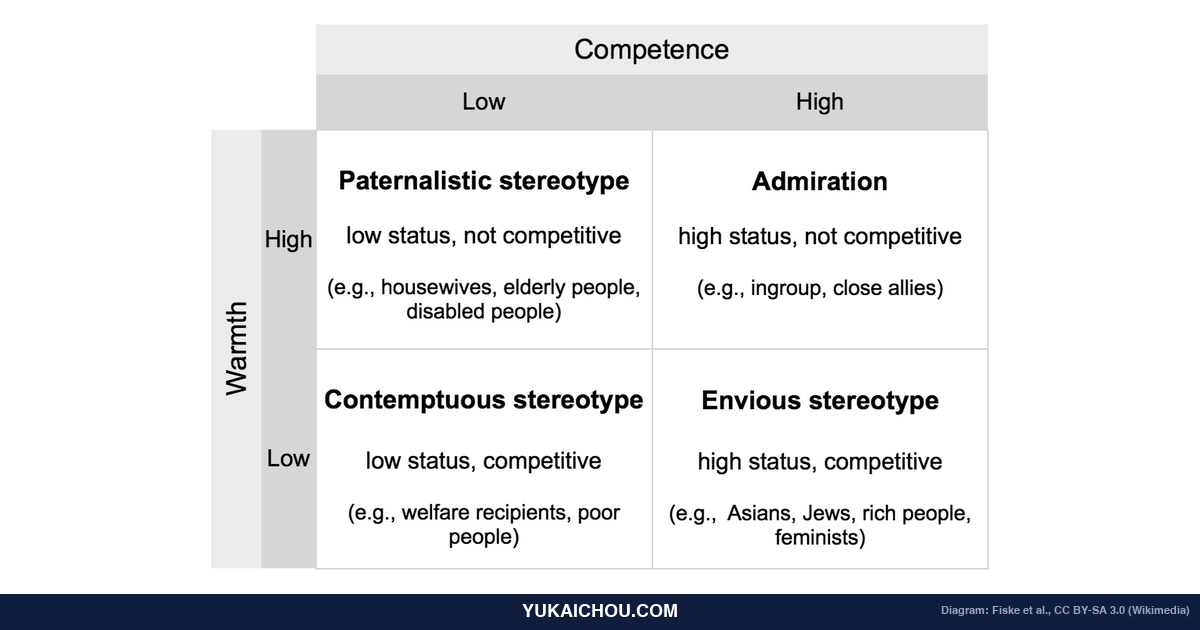

The first thing your brain does when it encounters a person, a brand, an avatar, or a country is run a two-question screen so fast you do not notice you ran it. Are they on my side, or against me? And are they capable of acting on it? Forty milliseconds in, before you can name a single fact about who they are, your social-perception system has already plotted them on a two-dimensional grid — warm or cold, competent or incompetent — and pre-loaded the emotion you are about to feel toward them. Admiration, pity, envy, or contempt. The grid is older than language and faster than reasoning, and it determines whether the next interaction goes anywhere worth going.
That grid is the Stereotype Content Model. In 2002 Susan Fiske, Amy Cuddy, Peter Glick and Jun Xu published the cleanest two-axis map of intergroup perception the field has ever produced and showed that across 23 societal groups in nine American samples, the same two dimensions accounted for almost everything — including which prejudices stayed warm and which turned violent. Five years later, Cuddy, Fiske and Glick extended it into the BIAS Map (Behaviors from Intergroup Affect and Stereotypes) and pinned each quadrant to a specific behavioral output: who you help, who you cooperate with, who you exclude, and who you attack.
One map is never enough for me, though. Warmth and competence tell you how people judge a group; Realistic Conflict Theory explains why those judgments harden, and the Framing Effect shows how a single sentence can shift them. That is why I keep every framework side by side in my Behavioral Framework Library: the grid you are about to learn gets sharper each time you lay another model over it.
If you build characters, brands, teams, NPCs, or onboarding flows for a living, the Stereotype Content Model is the closest thing the field has to a cheat sheet for what your audience will instantly feel about a face the second it appears. The post you are reading is the long-form version of that cheat sheet — what the model gets right, where it falls apart, and how to actually use it inside the Octalysis Framework without producing the warmth-versus-competence trade-off that has cost careers and crashed brand launches.
Speed Run Notes
- The Stereotype Content Model says all group stereotypes load on two dimensions — Warmth (intent: friend or foe) and Competence (capability: can act on it or not) — producing four quadrants and four predictable emotions.
- Warmth is predicted by perceived competition (cooperative groups are warm, competitive groups are cold). Competence is predicted by perceived status (high-status groups are competent, low-status groups are not). Two structural inputs, one matrix.
- The four quadrants map to four prejudices: high-high → admiration; high-warmth/low-competence → paternalistic pity; low-warmth/high-competence → envious resentment; low-low → contempt. Most groups land mixed, not extreme.
- The BIAS Map (Cuddy, Fiske, Glick 2007) routes each quadrant to behavior: warmth drives active behaviors (help vs. attack); competence drives passive behaviors (associate vs. ignore). Envy is the most dangerous — passive cooperation today, active harm under threat.
- For Octalysis design: every avatar, NPC, brand, and team archetype lives in one of those four quadrants the moment it loads, and the emotion it triggers is set before any later content can re-write it. Warmth-first onboarding beats competence-first onboarding for retention every time.
- Where it falls apart: morality is increasingly shown to be a separate primary dimension (Brambilla & Leach), the warmth/competence compensation effect distorts ratings, and the implicit-explicit gap means the model captures conscious stereotypes much better than the automatic ones.
Table of Contents
- What Is the Stereotype Content Model
- The Core Findings: Warmth, Competence, and the Four Quadrants
- What Fiske, Cuddy, Glick and Xu Got Right
- Where the Stereotype Content Model Falls Apart
- The Brain on Warmth and Competence
- The Stereotype Content Model vs Other Theories
- The Stereotype Content Model in the Real World
- The Elephant in the Room
- How to Apply the Stereotype Content Model with the Octalysis Framework
- Practical Steps to Apply the Stereotype Content Model
- Frequently Asked Questions
Author Credibility: Yu-kai Chou

Yu-kai Chou is an S-Tier Behavioral Designer and the creator of the Octalysis Framework, the gamification design system now applied to products and experiences reaching over 1.5 billion users. His book Actionable Gamification is one of the most-cited works in the field, and he has been ranked the #1 Gamification Guru in the World.
He has advised MrBeast, LEGO, Microsoft, Porsche, Tesla, Stanford, Harvard, and governments including Ukraine on turning behavioral psychology into product mechanics that actually change user behavior.
Verify: Wikipedia · Google Scholar · Wikidata · LinkedIn
The Stereotype Content Model has shown up in roughly half of the avatar-design, brand-strategy, and team-mechanic disputes I have arbitrated in the last decade, even when none of the people in the room knew the model by name. It is the reason “efficient but cold” brands lose to “friendly and capable” brands at the same price point, the reason competent women in tech still get a backlash penalty their male counterparts do not, and the reason villains who feel pitiable land harder than villains who feel only menacing. I have used it to fix character lineups for studios I cannot name, to retune the warmth-axis of a Fortune-500 customer-service script, and to argue against six different gamified-leaderboard designs that would have triggered the envy quadrant on day one. This guide is the version of the model I would have wanted before any of those calls.
What Is the Stereotype Content Model
The Stereotype Content Model is a social-psychology framework developed by Susan T. Fiske and her collaborators that claims all stereotypes about groups can be efficiently described along two orthogonal dimensions — warmth (whether the group’s intentions toward the perceiver are positive or negative) and competence (whether the group has the capability to act on those intentions). The two dimensions are not arbitrary. They correspond, the authors argue, to the two questions that any social animal needs to answer before deciding whether to approach or avoid another organism: Are they friend or foe? And are they strong enough to matter?
The model emerged from a 2002 paper in the Journal of Personality and Social Psychology, “A Model of (Often Mixed) Stereotype Content: Competence and Warmth Respectively Follow From Perceived Status and Competition,” co-authored by Fiske, Amy Cuddy (then her doctoral student), Peter Glick, and Jun Xu. Across nine samples and 23 societal groups, ratings of the groups on warmth-related and competence-related traits separated cleanly into two factors that were nearly orthogonal. Crucially, most groups did not land at the high-high or low-low corners. They landed in the off-diagonal quadrants — high on one dimension, low on the other — which is why the paper’s subtitle calls the resulting stereotypes “often mixed.”
Two structural antecedents predict where a group lands. Status — how high a group sits in the perceived social hierarchy — predicts perceived competence. Groups with prestige, money, education, or institutional power get rated as competent, regardless of any actual performance data. Competition — whether a group is seen as competing with the perceiver’s in-group for finite resources, recognition, or values — predicts perceived warmth, in the negative direction. Cooperative groups feel warm; competitive groups feel cold. The model’s explanatory power comes from collapsing the messy individual-level facts about a thousand groups into two perceptual dimensions driven by two structural inputs.
The intellectual lineage is older than the 2002 paper. Solomon Asch, in his 1946 work on impression formation, had already shown that warmth was a “central trait” that reorganized how every other trait about a person was interpreted. Rosenberg, Nelson and Vivekananthan (1968) had already split person perception into a “social good–bad” axis and an “intellectual good–bad” axis. Bogdan Wojciszke (1994) had shown the same two-factor structure recurring across European samples. Fiske and her team did not invent the two dimensions; they assembled the case that those dimensions are the structure of stereotype content, mapped each quadrant to a specific emotion, and connected the model to a structural theory of where stereotypes come from. That synthesis is what gave the model the staying power its predecessors lacked.
If you only remember three things from this section, remember these. Warmth and competence are the two dimensions every social perception travels on. Status drives competence; competition drives (low) warmth. Most stereotypes are mixed, not extreme. Everything else in the post is consequence.
The Core Findings: Warmth, Competence, and the Four Quadrants
The cleanest way to read the Stereotype Content Model is as a 2×2. Cross warmth on the vertical axis with competence on the horizontal, and you get four quadrants, each tied to a stable emotional reaction and a stable behavioral tendency.
Quadrant 1 — High Warmth, High Competence: Admiration
This is the in-group quadrant. People reliably place their own group, their close allies, and the cultural reference groups they identify with in the upper-right corner. In the United States samples Fiske and her team ran, “middle class,” “Christians,” and “Americans” all clustered here. The associated emotion is admiration with a hint of pride. The behavioral tendency is both active and passive facilitation — you help these people directly when they need help, and you cooperate with them by default the rest of the time.
For a designer the upper-right is where heroes, mentors, customer-favorite brands, and trusted leaders live. It is also a quadrant most products fail to land in, because landing in it requires both dimensions, and any single-axis optimization — for efficiency, or for relatability, or for prestige — pushes the design into one of the off-diagonals.
Quadrant 2 — High Warmth, Low Competence: Pity
This is the paternalistic quadrant. The 2002 paper placed elderly people, disabled people, and (in mid-twentieth-century American stereotypes) housewives here. The emotion is pity or sympathy, and the behavior pattern is active facilitation paired with passive harm. You help them in concrete ways — opening doors, donating, advocating — while simultaneously leaving them out of the rooms where decisions get made. Paternalistic prejudice feels generous to the perceiver and is one of the hardest forms of prejudice to dislodge precisely because the perceiver does not experience it as prejudice at all.
In product and brand design, the pity quadrant is where well-meaning campaigns about “underserved” populations live, where charity-themed gamification often lands, and where customer-service archetypes designed to be “non-threatening” accidentally end up. The retention cost is enormous: users in this quadrant feel the warmth, register the implied incompetence, and quietly leave.
Quadrant 3 — Low Warmth, High Competence: Envy
The envious quadrant is the most explosive corner of the model. Groups perceived as competent but cold — the 2002 paper sampled rich people, Asian Americans, Jewish Americans, and career women — trigger envy and resentment. The behavioral pattern is the most dangerous of any quadrant: passive facilitation under stable conditions, but active harm under threat. You will work with these groups, even rely on them, when the system is stable and the gains are mutual. The moment resources tighten or status feels threatened, the same competence that made them useful makes them targets.
This is the quadrant that produces scapegoating during economic downturns, “model minority” backlash, and the specific kind of violence that targets visibly successful out-groups. Cuddy, Fiske and Glick (2007) showed in the BIAS Map paper that the envy quadrant drove the strongest active-harm scores of any combination — stronger than the contemptuous quadrant, which mostly produced exclusion rather than aggression. The implication for designers is brutal: a brand or character optimized for competence at the expense of warmth is sitting on a fault line that activates the moment market conditions sour.
Quadrant 4 — Low Warmth, Low Competence: Contempt
The lower-left quadrant produces contempt and disgust. The 2002 paper placed homeless people, drug addicts, and (in the American sample) welfare recipients here. The behavioral pattern is passive harm and active harm — exclusion, dehumanization, sometimes physical aggression. Harris and Fiske’s 2006 fMRI work on this quadrant showed that low-low targets uniquely failed to activate the medial prefrontal cortex, the brain region that signals social cognition; perceivers were processing them more as objects than as people.
For designers, this quadrant is the one to never end up in. No legitimate consumer brand wants to live here, no protagonist works here, no NPC class wants to read like the contempt quadrant unless contempt is the design goal — which, in moderation, it sometimes is, for villains and disposable enemy mobs in games. Even there, the dehumanization risk means contempt-grade design choices need to be deliberate.
The BIAS Map: From Stereotype to Behavior
The 2002 paper stopped at affect. The 2007 follow-up — Cuddy, Fiske and Glick’s “The BIAS Map: Behaviors from Intergroup Affect and Stereotypes” in the Journal of Personality and Social Psychology — extended the model into behavior, and the result is the operational version of the framework.
The BIAS Map proposes that each of the four quadrants drives two distinct kinds of behavior. Warmth drives active behaviors: high warmth produces active facilitation (help, defend, advocate); low warmth produces active harm (attack, sabotage, denigrate). Competence drives passive behaviors: high competence produces passive facilitation (associate with, cooperate with, defer to); low competence produces passive harm (ignore, exclude, neglect). The active-passive split matters because it explains why some prejudices look quiet (passive harm) while others look loud (active harm), and why a single quadrant can produce both kinds of behavior in the same person depending on the situation.
The model also explains a peculiar empirical finding the simple 2×2 cannot: in the envy quadrant, behaviors flip. Passive facilitation predominates in normal conditions (you cooperate with high-competence-low-warmth groups because their capability is useful), but a sudden destabilization — recession, terror attack, election upset — flips the same group from cooperator to scapegoat overnight, with active-harm behaviors spiking. This is the BIAS Map’s most important contribution to design: it tells you which quadrant configurations are stable and which are conditional. Admiration is stable. Pity is stable. Contempt is stable. Envy is conditional, and the condition is system stress.
What Fiske, Cuddy, Glick and Xu Got Right
Strip the Stereotype Content Model down to its three load-bearing claims and ask which ones have survived twenty-three years of replication, methodological scrutiny, and cross-cultural extension. Three claims are intact, and they are the three that matter for design.
The two-dimensional structure replicates almost everywhere it has been tested. Cuddy, Fiske, Kwan, Glick, Demoulin and a team of international collaborators ran the model across ten non-U.S. samples on three continents (Cuddy et al., 2009), with sample sizes that ranged from large student bodies to nationally representative panels. The two-factor warmth-competence structure recovered cleanly in every sample, and the structural antecedents — competition predicting (low) warmth, status predicting competence — held with culturally specific noise but no structural reversal. The Stereotype Content Model is one of the most thoroughly cross-culturally replicated frameworks in social psychology, which is a higher bar than “peer-reviewed and published.” Many famous models cannot clear it.
Mixed stereotypes — the off-diagonal quadrants — are the empirically dominant case. This was the finding the 2002 paper went out of its way to highlight, and it has held up. When researchers run modern SCM batteries, the median group lands somewhere off the high-high to low-low diagonal. That has implications a designer can use immediately: the question to ask about your character or brand is not “is this entity positively or negatively perceived?” but “which off-diagonal quadrant does the audience read it into, and what behavior does that quadrant license?” A “positive” brand that lives in the pity quadrant and a “positive” brand that lives in the admiration quadrant are not interchangeable. They will produce different actions even though both score above the midpoint on overall favorability.
The active-passive behavioral split (the BIAS Map’s contribution) gives the model behavioral teeth that its predecessors lacked. The Asch and Rosenberg lineage was a perception model. Fiske and her co-authors turned it into a perception-emotion-behavior chain by routing each quadrant through a specific affect and into a specific behavior class. That is what makes the model usable for design rather than just descriptive social science. When your character lands in the envy quadrant, you do not just know “people will feel envy.” You know that under stable conditions they will cooperate (passive facilitation) and under stress they will attack (active harm), and you can ship a product knowing which conditional path the audience is on.
One quieter contribution deserves a mention because it is doing more work in the design world than people realize. Fiske and her team explicitly framed warmth and competence as functionally orthogonal — ratings on one dimension can move independently of ratings on the other. Practical implication: you can buff the warmth of a competent-cold brand without sacrificing the competence rating, and you can buff the competence of a warm-but-bumbling brand without losing the warmth. The model implies a non-zero-sum design space. Most of the brands and characters who ended up in the off-diagonals stayed there because their teams treated warmth and competence as a slider, when the model says they are two sliders.
Where the Stereotype Content Model Falls Apart
Three failure modes are worth a designer’s attention because each one changes how the model should be applied, not whether it should be. The model is a useful map; these are the places where the map and the territory diverge.
Morality may be a separate primary dimension, not a sub-component of warmth
The most serious challenge to the two-dimensional structure comes from a research program led by Marco Brambilla, Colin Wayne Leach, Bogdan Wojciszke and their collaborators. Their argument, sustained across more than a decade of papers (Brambilla, Rusconi, Sacchi & Cherubini 2011; Leach, Ellemers & Barreto 2007; Brambilla & Leach 2014), is that warmth in the original SCM conflates two distinct sub-dimensions — sociability (how friendly and approachable a group is) and morality (how trustworthy and principled it is) — and that morality, not sociability, is the dimension that does the actual heavy lifting in stereotype formation.
The empirical pattern is consistent. When research participants form impressions of groups or persons, morality information is processed faster than sociability information, weighted more heavily in the final judgment, and produces stronger behavioral effects. A group can be friendly but untrustworthy; the friendliness will not save it from negative downstream behavior. A group can be unfriendly but principled; the principledness will pull positive cooperation despite the social friction. The original SCM’s warmth dimension does not separate these cases, and the resulting predictions in domains like brand trust and political messaging are noticeably less precise than a three-dimensional Sociability-Morality-Competence model produces.
For a designer, the implication is concrete. If you have applied the SCM to your brand or character archetype and the predictions feel directionally correct but quantitatively off, the most likely diagnosis is that the warmth axis is hiding a morality-sociability split. Audit your warmth signals. Does your brand voice cue principledness, or only friendliness? Does your villain’s coldness signal corruption, or only social distance? The 2×2 will let you build something that scores fine; the 3-axis upgrade will let you build something that lands.
The compensation effect distorts ratings under direct comparison
Nicolas Kervyn, Vincent Yzerbyt, and colleagues (Kervyn, Yzerbyt, Demoulin & Judd 2008; Yzerbyt, Provost & Corneille 2005) have documented a robust compensation effect: when two groups are evaluated side by side, raters systematically push the warmth-competence ratings in opposite directions, even when the underlying information would justify high-high or low-low ratings. If Group A is rated as more competent than Group B, raters will rate Group B as warmer than Group A, regardless of whether the warmth information actually supports that.
The mechanism appears to be a soft justice motive: the perceiver wants the world to be fair, and a high-high group offends that motive by “winning” on both dimensions, so ratings get re-balanced to produce a more equitable distribution of perceived virtue. The compensation effect is a serious problem for any application of the model that relies on comparative ratings, including brand-perception tracking, political-candidate evaluations, and any A/B test that runs two characters against each other in a within-subjects design. The numbers you get back will not reflect absolute perception; they will reflect the comparison-induced compensation, and the design decision based on those numbers will be wrong.
The practical fix is to run between-subjects evaluations whenever possible, treat any within-subjects warmth-competence rating as a relative not absolute measurement, and accept that the “land in the high-high quadrant” design goal may be harder to achieve than the model implies, because the audience’s mind is doing background compensation work that pulls every successful design back toward the diagonal.
Implicit and explicit stereotypes diverge, and SCM mostly captures the explicit
The SCM as originally validated relies on explicit, self-reported ratings of how warm and competent each group is. Anything explicit is subject to social-desirability pressure, demand characteristics, and the general well-documented gap between what people say about groups and what they implicitly associate. The Implicit Association Test literature, as well as more recent affective-priming and reaction-time methods, repeatedly find that participants who rate a group as warm-and-competent on an SCM scale produce automatic associations that load on a different (often more negative) part of the warmth-competence space.
The implicit-explicit divergence does not invalidate the model. It does mean that an SCM-based design optimization will work for the part of the audience’s response that is conscious, deliberate, and survey-reportable, and will not necessarily work for the parts that drive split-second avoidance, micro-aggressions, or implicit hiring biases. Designers building for the deliberate part of the funnel — brand perception, character archetype, customer-service tone — are mostly fine. Designers building for the automatic part — first-impression NPC encounters, twenty-millisecond avatar reactions, system-1 customer-service triage — need to pair SCM with implicit-measure validation, because the explicit-only ratings will mislead them.
The Brain on Warmth and Competence
The neuroscience of the Stereotype Content Model is unusually consistent for a social-psychology framework. Three converging findings make the case that warmth and competence are not just convenient survey factors but separable cognitive operations with distinct neural signatures.
The first finding, established by Lasana Harris and Susan Fiske (2006, Psychological Science), is that the medial prefrontal cortex — the brain region that handles social cognition, theory of mind, and the basic process of treating another being as a person — activates differentially across the four SCM quadrants. The high-high admiration quadrant produces full mPFC engagement. The pity and envy quadrants produce reduced but present engagement. The low-low contempt quadrant uniquely fails to activate the mPFC at all, while activating the insula and amygdala — the regions associated with disgust and threat. Translated: the brain physically processes contempt-quadrant targets less like people and more like objects. This is the strongest neural finding in the prejudice literature, and it has held up across more than a decade of follow-up work.
The second finding, from Mina Cikara, Matthew Botvinick and Susan Fiske’s research program on intergroup neuroscience (Cikara, Botvinick & Fiske 2011), is that the envy quadrant produces a distinct reward-system response when the envied group experiences a misfortune — schadenfreude. The ventral striatum, which lights up for personal rewards, also lights up when watching a competitor fall. The neural envy response is specifically reactive to envy-quadrant targets, not pity- or contempt-quadrant ones, and the magnitude correlates with how strongly the participant rates the target group as competent-but-cold. This is the neurological signature of the BIAS Map’s active-harm-under-threat prediction: the brain is rewarding observers for the envy-quadrant target’s setbacks, which is one mechanism by which scapegoating and retaliation get psychologically consolidated.
The third finding, more recent and still being mapped, is that the warmth and competence dimensions appear to dissociate at the perceptual level — participants extract warmth information from facial features faster than competence information, and the two dimensions are processed in partially distinct face-evaluation networks (Oosterhof & Todorov 2008; Sutherland, Young & Rhodes 2017). This bottom-up evidence is what justifies the “fast unconscious screen” framing the post opened with. Warmth is not just a survey factor. It is one of the two earliest social signals the human visual system extracts from a face, and the trade-off any avatar designer is making between “trustworthy-looking” and “competent-looking” is the same trade-off the SCM is mapping at the cognitive level.
Put together, the neural evidence supports the strong version of the model: warmth and competence are not arbitrary descriptors but actual cognitive primitives, the four quadrants are not just statistical clusters but distinct processing modes, and the active-harm-under-threat behavior the BIAS Map predicts has a neural reward signature that gives it more grip than purely top-down survey results would suggest. Designers can treat the model as describing real machinery, not just stable rating patterns.
The Stereotype Content Model vs Other Theories
The SCM does not stand alone. Three neighboring frameworks describe overlapping territory, and knowing where they diverge is the difference between using SCM as a precision tool and using it as a generic excuse.
The closest neighbor is the Big Two tradition associated with Andrea Abele and Bogdan Wojciszke (2007 and onward), which argues that all of person and group perception loads on two superordinate dimensions called communion (other-orientation, including warmth and morality) and agency (self-orientation, including competence and assertiveness). The Big Two is functionally identical to SCM at the descriptive level but differs in two ways: communion explicitly includes morality (which SCM’s warmth conflates), and agency includes a wider range of self-promotional traits than SCM’s competence does. If you are working in the perception of individuals rather than groups, the Big Two is a better fit. If you are working in the perception of groups, SCM’s structural-antecedents account (status → competence, competition → warmth) does work the Big Two does not.
The next neighbor is Social Identity Theory (Tajfel & Turner 1979), which says that mere categorization into groups — even arbitrary categorization — is sufficient to produce in-group favoritism. SIT and SCM are usually treated as complementary. SIT explains the always-on baseline of in-group preference; SCM explains how that baseline differentiates across specific out-groups, with some out-groups landing in the admiration quadrant and others in contempt. Designers building team mechanics should know both. SIT tells you that any boundary will produce some preference; SCM tells you which kinds of boundaries produce which kinds of preference, and which configurations are stable versus volatile.
Realistic Conflict Theory (Sherif et al. 1961) is the third neighbor and the upstream source of one of SCM’s structural antecedents. Sherif’s claim that intergroup hostility comes from competition over scarce resources is exactly the “competition predicts low warmth” pathway in SCM. The relationship is hierarchical: RCT supplies the macro-structural input; SCM converts it into a perceptual map; the BIAS Map converts the perceptual map into specific behaviors. Designers who run a system where players or factions can compete for finite resources should expect the SCM warmth axis to drift downward for the out-group — not as a model failure, but as exactly what SCM predicts when RCT’s precondition is met.
The fourth neighbor, often forgotten, is Implicit Personality Theory in the Asch (1946) and Rosenberg, Nelson & Vivekananthan (1968) lineage. SCM is the group-level extension of these person-perception findings, and the two-factor structure recovered in those individual-target studies is not an accident; it is the same machinery firing at a different unit of analysis. For brand and character design, the implication is that the line between “person perception” and “group perception” is fuzzier than the SCM literature sometimes implies, and a single character can pull either set of associations depending on whether the audience reads it as an individual or as a representative of a category.
The Stereotype Content Model in the Real World
Four domains have generated enough applied SCM work that the practical implications are no longer theoretical. Each one is also a domain where Octalysis designers commonly ship.
Brand strategy and the warmth-competence trade-off
The single most-cited applied SCM paper outside the prejudice literature is Jennifer Aaker, Kathleen Vohs and Cassie Mogilner’s 2010 Journal of Consumer Research article, “Nonprofits Are Seen as Warm and For-Profits as Competent: Firm Stereotypes Matter.” The argument is exact: consumer brands are routinely sorted into the same four quadrants the SCM predicts, with measurable consequences for purchase intent, willingness to pay, and trust. Nonprofits typically cluster in the high-warmth-low-competence quadrant; for-profits cluster in the high-competence-low-warmth one. The off-diagonal placement is what produces the behavioral patterns each sector is known for: charitable donations track the warmth quadrant; market-share dominance tracks the competence quadrant; and the rare brands that crack the high-high admiration quadrant outperform both on every long-run loyalty metric.
The applied takeaway has been picked up by every consultancy with a brand-strategy practice. A premium brand that scores high on competence and is leaking on warmth is not at risk of losing market share to a more competent competitor. It is at risk of losing it to a brand with comparable competence and significantly higher warmth, because the warmth difference resolves the off-diagonal placement that was leaving a behavioral gap on the table. The same warmth-buffing strategy is what saved Microsoft from its early-2000s envy-quadrant placement and what Apple has spent two decades buying with its industrial-design language. Nvidia ran the same playbook on a faster clock starting in 2023 — a chip vendor that had lived in the pure-competence quadrant for two decades suddenly loaded warmth signals (Jensen Huang’s leather jacket as costume, the “we make miracles possible” GTC framing, the public-praise-of-customers tone) without dropping a single point of perceived competence. The dual-buff worked; Nvidia is the rare admiration-quadrant brand inside enterprise hardware, and the move is straight off the SCM playbook.
Workplace and the role-congruity penalty for competent women
The second domain is hiring, performance review, and workplace evaluation, where the SCM has produced some of the most consequential applied findings of the last two decades. Alice Eagly and Steven Karau’s Role Congruity Theory (2002, Psychological Review) and Cuddy, Fiske and Glick’s 2004 follow-up paper on working mothers and working fathers showed that women perceived as competent at work were systematically penalized on warmth, in a way that men with the same competence ratings were not. The pattern is the SCM compensation effect we covered earlier, applied to gender stereotypes: the perceiver’s mind balances the warmth-competence sheet, and a woman who scores high on competence pays for it with reduced warmth ratings, which then routes through the BIAS Map into reduced active-facilitation behaviors (mentorship, sponsorship, advocacy).
The applied stakes are concrete: warmth is a load-bearing variable for promotion decisions, mentor matching, and lateral cooperation, and an organization that does not actively counter-program against the compensation effect will see a measurable warmth-axis penalty applied to its competent female employees. The fix the SCM literature converged on — explicit warmth-signaling without competence-discounting, structural rather than personality-based mentorship matching, and design-level interventions that surface morality-axis information to disrupt the compensation pattern — is what successful diversity programs ended up running on, even when their proponents could not name the underlying model.
Political and intergroup messaging
The third domain is political and intergroup communication, where SCM-informed framing has been shown to shift intergroup attitudes more reliably than either pure warmth-appeals or pure competence-appeals on their own. Susan Fiske’s 2011 Russell Sage Foundation book Envy Up, Scorn Down documented how messaging that flipped a target group’s perceived competition framing — recasting them from competitors to cooperators — produced larger and more durable warmth gains than messaging that simply asserted the target group was friendly. The structural antecedent is what moves; the dimension follows.
For brand and product messaging, the implication transfers directly. A campaign that asserts your brand is warm will produce smaller and shorter-lived warmth gains than a campaign that restructures the perceived competition landscape so the audience sees your brand as cooperating with their goals rather than extracting from them. Restructure the antecedent; the dimension takes care of itself.
NPC, avatar, and character design in games
The fourth domain is character design, and the SCM provides one of the cleanest design tools the field has. Every NPC, every party member, every brand mascot, every voice-assistant persona lands in one of the four quadrants the moment its face appears, and the player’s behavior toward it is largely set by quadrant before any later content can re-write it. Companion characters land in admiration. Disposable mob enemies land in contempt. Aristocratic antagonists and rival mages land in envy. Comic-relief characters and broken-down old mentors land in pity.
The studios that get character lineups right tend to be the ones who think about the quadrant distribution explicitly — making sure the cast covers the four quadrants in proportions that match the emotional palette of the game. The studios that get it wrong tend to be the ones who optimize every character for the same single dimension (usually competence) and end up with a cast where every face triggers the same reaction. The Octalysis section below turns this into a concrete worksheet.
The Elephant in the Room
The Stereotype Content Model was developed inside the prejudice and intergroup-relations literature, by researchers studying actual stereotypes about actual social groups, with all of the political and ethical weight that work carries. Applying it to brand strategy and character design is an extension the original authors signed off on (Fiske herself has consulted on brand work for decades), but the extension carries a responsibility most applied uses do not acknowledge.
The responsibility is this: the same model that lets you design a more admired brand also lets you design a more contemptible out-group. The same compensation effect that explains why competent women get penalized on warmth also lets a marketing team strategically place a competitor in the envy quadrant where it becomes a target for active harm. The neural finding that contempt-quadrant targets are processed less like people and more like objects is not a designer’s tool to weaponize. It is a warning that certain design choices — a faceless enemy mob, a dehumanizing competitor framing, a low-warmth-low-competence customer archetype baked into a service script — have measurable cognitive consequences for the audience.
The elephant in the room of any SCM-informed design work is that the framework is morally agnostic, but its applications are not. Designers who use the model to land their own brand or character in the admiration quadrant are doing what the model was extended to enable. Designers who use it to push another group into contempt are running the prejudice machinery the model was built to study, with the model’s predictive power on their side. The line between those uses is not always crisp, especially in competitive brand work, and a working ethics sense for the framework is part of what separates designers who use it well from designers who use it cynically.
None of this is a reason to avoid the model. It is a reason to use it with the same care a structural engineer uses load calculations: knowing the math is what lets you build buildings that stand up, and knowing the math also means you are responsible for buildings that fall down because you specified the wrong materials. SCM is structural math for social perception. Design accordingly.
How to Apply the Stereotype Content Model with the Octalysis Framework
The Stereotype Content Model is a perception model. The Octalysis Framework is a motivation model. Putting them together is a one-step move: the four SCM quadrants map onto specific Octalysis Core Drives, and once you know the mapping, every character, brand, and team archetype in your design becomes a Core Drive lever.

The mapping is dense, so the bullet sketch first, then the design implications.
- Admiration quadrant (high warmth, high competence) → Core Drive 1 (Epic Meaning & Calling) and Core Drive 5 (Social Influence & Relatedness). Admiration-quadrant entities feel like part of the player’s side in a story bigger than either of them and like reliable allies in the social mesh. The associated Game Techniques are Higher Meaning (#26), Mentorship (#7), and Social Treasures (#63).
- Pity quadrant (high warmth, low competence) → Core Drive 5 (Social Influence) with a Black-Hat tilt toward Core Drive 8 (Loss & Avoidance). Pity-quadrant entities pull caretaking behavior, but the implied incompetence routes through CD8 as “don’t let them down.” Game Techniques: Mentor Loops (#7) where the player is the mentor, Protectorship mechanics, and Sympathy-driven mission framing.
- Envy quadrant (low warmth, high competence) → Core Drive 6 (Scarcity & Impatience) and Core Drive 4 (Ownership & Possession). Envy is the Octalysis Black-Hat reading of competence-without-warmth: the entity has what the player wants and is unwilling to share. Game Techniques: Anchored Juxtaposition (#52) with rivals one tier above, Magnetic Caps (#53) on aspirational rewards, and Status displays calibrated to be slightly out of reach.
- Contempt quadrant (low warmth, low competence) → Core Drive 8 (Loss & Avoidance) and Core Drive 7 (Unpredictability & Curiosity). Contempt-quadrant entities are disposable threats and obstacles, pulling avoidance and clearance behavior. Game Techniques: trash-mob design, Sudden Rewards (#34) on clearance, and any “clean up the mess” loop.
Three concrete design moves drop out of the mapping.
Move 1: Build a quadrant audit into your character lineup. List every named character, brand persona, NPC class, and faction in your design. Assign each one a quadrant on a single 2×2. Look at the distribution. If 80% of your cast lives in the admiration quadrant, your design is emotionally flat — everything pulls the same warm-competent reaction, and the player’s emotional palette never opens past mild approval. If 80% lives in contempt, you have built a target-rich shooting gallery with no emotional ladder. The healthiest ratios I have seen in shipped games and brand portfolios cluster around 30/20/20/30 across admiration/pity/envy/contempt, with the exact split tuned to the genre.
Move 2: Use the BIAS Map to predict and design behavioral tendencies, not just feelings. A character that lives in the envy quadrant is a passive-cooperation-under-stable-conditions entity who will become an active-harm target the moment the system stresses. If your design’s late-game beats include resource scarcity, faction wars, or status threats, the envy-quadrant characters are the ones who will absorb the players’ aggression. That is sometimes the design intent (rival mage who deserves to be brought down). It is sometimes a disaster (a competent-but-cold player class that becomes the target of in-game harassment the moment the meta shifts). Plan the conditional path the BIAS Map predicts, not just the steady state.
Move 3: Treat warmth and competence as two independent sliders for any brand, character, or team archetype. The single most common SCM-informed design mistake is treating the two dimensions as a trade-off when the model says they are orthogonal. A character can become more warm without becoming less competent; a brand can become more competent without becoming less warm. Audit your design copy, your art direction, and your interaction patterns for places where you have implicitly assumed the trade-off and built only on one axis. The fix is usually small — a softer onboarding line, a more confident competence cue in a previously self-deprecating character — and the quadrant shift is reliably the difference between admiration-quadrant performance and off-diagonal performance.
Practical Steps to Apply the Stereotype Content Model
If you want to ship a design that uses SCM rather than just acknowledges it, the next ten paragraphs are the working version of the protocol. Run it on whatever surface you are designing — a single character, a brand, a team mechanic, a customer-service script, an entire NPC roster — and the model becomes a live input rather than a wall decoration.
Step 1: List every entity that the audience will perceive as a person, persona, or group. This includes obvious cases (named characters, brand mascots, customer-service AI personas) and less obvious cases (player-class archetypes, faction names, generic NPC classes, the “voice” of a notification system, the implied protagonist of a marketing campaign). Anything the audience anthropomorphizes lands somewhere on the warmth-competence map and should be on this list.
Step 2: Plot each entity on the 2×2 using audience inputs, not your own. Run a small qualitative pass — five users, fifteen minutes each, “rate this entity on warmth from 1 to 7 and on competence from 1 to 7” — and use the average placement, not your team’s intent. Designer-side ratings systematically diverge from audience ratings, especially in the warmth dimension, and most of the surprises come from the audience reading a competence-coded character as colder than the team intended.
Step 3: Run a quadrant-distribution diagnosis. Look at the four-quadrant map. Identify clusters and gaps. A cast or portfolio with a heavy concentration in one quadrant is rendering an emotionally flat experience. A gap in one quadrant means the corresponding emotion (admiration, pity, envy, contempt) is unavailable to the audience and any narrative beat that needed it will fall short. Decide which quadrants you want at which densities given the genre and emotional arc.
Step 4: Identify any compensation-effect risks. If two adjacent entities in the player’s experience differ on one dimension, expect the audience to compensate on the other dimension whether your content supports it or not. A high-competence rival placed next to an in-group ally will get warmth-compressed; a high-warmth helper placed next to a hero will get competence-compressed. Either lean into the compensation (the rival is supposed to feel cold) or deliberately load both dimensions with strong cues to override it.
Step 5: Audit the warmth axis for sociability vs. morality. For any entity that feels warm but is not landing the way you wanted, check whether the warmth signals are sociability-only (smiles, friendly voice lines, approachable poses) or whether they include morality signals (principled choices, trustworthy commitments, ethical consistency). Brambilla and Leach’s research suggests morality is the heavier of the two warmth sub-dimensions, and a sociability-only warmth will not produce the behavioral facilitation the model predicts.
Step 6: Plan the BIAS Map behavioral path for each quadrant. Admiration produces active and passive facilitation. Pity produces active facilitation and passive harm. Envy produces passive facilitation under steady state and active harm under stress. Contempt produces passive harm and (under threat) active harm. Map your design’s expected player-behavior outputs to these predictions; if the prediction does not match the desired behavior, the quadrant placement is wrong, not the prediction.
Step 7: Stress-test envy-quadrant entities specifically. Envy is the most volatile quadrant. Walk through your design’s late-game, post-launch-meta, and worst-case-scarcity states and ask: which envy-quadrant entity is going to absorb the active-harm pivot? Is the design ready for that? In multiplayer or community contexts, the answer is sometimes “move that entity out of the envy quadrant by adding warmth signals.”
Step 8: Build a warmth-and-competence dual-buff for the entities you want in the admiration quadrant. Admiration is the rarest quadrant and the highest-payoff. The dual-buff means both signals have to be loaded, repeatedly, across the audience’s touchpoints — a single high-competence cue followed by a single high-warmth cue is not enough; the model wants consistent multi-touchpoint loading. Brand campaigns that win the admiration quadrant tend to load 8–12 distinct touchpoints with one or both signals over a 90-day window.
Step 9: Re-test after every major design change. Quadrant placement is not stable across narrative beats, season changes, or feature launches. A friendly NPC who suddenly becomes a quest-giver tied to a high-stakes failure mode can shift from admiration to pity in a single update. Re-running the Step 2 audience plot after every major change catches the drift before it ships.
Step 10: Document the quadrant intent in your design spec. The most expensive SCM-related mistakes I have seen in studio reviews are quadrant drift across team handoffs — a writer intends an envy-quadrant rival, an artist designs the rival in the contempt quadrant, a localization team softens the dialogue into pity, and the shipped character lands in a fourth quadrant nobody intended. A line in the design spec that says “warmth target: low. competence target: high. quadrant: envy. emotional payload: aspirational rivalry” is what keeps that drift from happening. The line costs five seconds. Skipping it costs a re-launch.
Closing Thoughts
The Stereotype Content Model is one of the rare frameworks in social psychology that earns the “use this” status I reserve for the few. The two-dimensional structure has cleared every cross-cultural replication test the field knows how to throw at it. The four quadrants are not statistical conveniences but separate cognitive operations with distinct neural signatures. The BIAS Map turns the perceptual map into a behavior generator that designers can act on. And the structural antecedents — status drives competence, competition drives (low) warmth — tell you not just where you are but how to move.
It is also a model that demands honest application. The same machinery that builds admiration-quadrant brands runs the prejudice processes the framework was designed to study, and the line between persuasive design and manipulative design runs straight through the four-quadrant map. The morality dimension that Brambilla and Leach have been pushing for is not just a refinement of the model. It is a reminder that the perceived warmth of any entity carries an ethical signal, and that designs which load warmth without backing it with morality cues are running the same play that lands politicians and brands in trouble when the cover gets pulled.
If you take one thing from this guide, take the orthogonality claim. Warmth and competence are not a slider; they are two sliders. Most teams ship designs that have implicitly chosen one and let the other drift. The teams that ship designs that land in the high-high admiration quadrant — the rarest and most valuable corner — are the ones that load both signals deliberately, audit for the compensation effect that wants to drag the design back to the diagonal, and run the work as a structural problem rather than a tone problem. The Stereotype Content Model is the structural map. Use it.
If you want the worked-example version of this protocol — with a quadrant-audit worksheet, real studio before-and-afters, and the dual-buff campaign template — that is what Actionable Gamification walks through chapter by chapter.
Frequently Asked Questions
What is the Stereotype Content Model in simple terms?
The Stereotype Content Model is a social-psychology framework which claims that all stereotypes about groups of people can be efficiently described along two dimensions — warmth (whether the group’s intentions toward the perceiver are good or bad) and competence (whether the group has the capability to act on those intentions). Combining the two dimensions produces a 2×2 matrix with four quadrants, and each quadrant is associated with a distinct emotional reaction (admiration, pity, envy, or contempt) and a distinct behavioral pattern. The model was developed by Susan Fiske, Amy Cuddy, Peter Glick, and Jun Xu in 2002.
Who developed the Stereotype Content Model?
The model was introduced in a 2002 Journal of Personality and Social Psychology paper titled “A Model of (Often Mixed) Stereotype Content: Competence and Warmth Respectively Follow From Perceived Status and Competition,” co-authored by Susan T. Fiske of Princeton University, Amy J. C. Cuddy (then a doctoral student at Princeton, later at Harvard Business School), Peter Glick of Lawrence University, and Jun Xu. Fiske had been working on the underlying ideas since the 1990s, and the 2002 paper consolidated those ideas into a single coherent framework.
What are the four quadrants of the Stereotype Content Model?
The four quadrants are: high warmth + high competence, which produces admiration and is typically reserved for in-groups and close allies; high warmth + low competence, which produces pity and paternalistic prejudice and is associated in the original sample with elderly and disabled people; low warmth + high competence, which produces envy and resentment and is associated with high-status out-groups perceived as competitors; and low warmth + low competence, which produces contempt and disgust and is associated in the original sample with the homeless and other socially excluded groups.
What is the BIAS Map?
The BIAS Map (Behaviors from Intergroup Affect and Stereotypes) is the 2007 extension of the Stereotype Content Model, developed by Amy Cuddy, Susan Fiske and Peter Glick in the Journal of Personality and Social Psychology. It maps each of the four SCM quadrants onto specific behavioral tendencies. Warmth is associated with active behaviors (active facilitation when warmth is high, active harm when warmth is low). Competence is associated with passive behaviors (passive facilitation when competence is high, passive harm when competence is low). The BIAS Map is what turns SCM from a perception model into a behavior model.
Has the Stereotype Content Model been replicated?
Yes, extensively. The most influential cross-cultural validation is Cuddy, Fiske, Kwan, Glick, Demoulin and colleagues’ 2009 paper covering ten non-U.S. samples on three continents, in which the two-factor warmth-competence structure recovered cleanly in every sample with culturally specific noise but no structural reversal. Subsequent replications have run in dozens more countries and across multiple decades. The model is one of the most thoroughly cross-culturally replicated frameworks in social psychology.
How does the Stereotype Content Model differ from Social Identity Theory?
Social Identity Theory, developed by Henri Tajfel and John Turner in 1979, claims that mere categorization into groups is sufficient to produce in-group favoritism, even when the categorization is arbitrary. The Stereotype Content Model claims that specific out-groups are perceived along warmth and competence dimensions and produce one of four distinct emotional reactions. The two are usually treated as complementary: SIT explains the always-on baseline of in-group preference, while SCM explains the differentiation across specific out-groups and which out-groups produce which emotions and behaviors.
What does the Stereotype Content Model say about brands?
Applied work led by Jennifer Aaker, Kathleen Vohs and Cassie Mogilner has shown that consumer brands sort into the same four-quadrant structure as social groups. Nonprofits typically cluster in the high-warmth-low-competence quadrant; for-profits cluster in the high-competence-low-warmth quadrant. Brands that successfully land in the high-high admiration quadrant outperform on every long-run loyalty metric. The implication for brand strategy is that warmth and competence are independent, not zero-sum, and a deliberate dual-buff on both dimensions is what produces admiration-quadrant brand performance.
What is the compensation effect?
The compensation effect, documented in research by Nicolas Kervyn and colleagues, is the tendency for raters to push warmth and competence ratings in opposite directions when comparing two groups side by side, even when the underlying information would justify same-direction ratings. The mechanism appears to be a soft justice motive that wants to balance perceived virtue across groups. The compensation effect is a real problem for any application of the model that relies on within-subjects comparative ratings, including brand-tracking studies and political-candidate evaluations.
Is morality a separate dimension from warmth?
An influential research program led by Marco Brambilla and Colin Wayne Leach argues that warmth in the original Stereotype Content Model conflates two distinct sub-dimensions — sociability (how friendly and approachable a group is) and morality (how trustworthy and principled it is) — and that morality, not sociability, does the heavier work in stereotype formation and downstream behavior. The empirical evidence is consistent across more than a decade of papers. The practical implication is that a three-dimensional Sociability-Morality-Competence model produces noticeably more precise predictions than the two-dimensional original, especially in domains like brand trust and political messaging.
How can the Stereotype Content Model be applied in product or game design?
Three specific moves drop out of the model. First, run a quadrant audit on your character lineup, brand portfolio, or NPC roster and look at the distribution; emotionally healthy designs cover all four quadrants in proportions matched to the genre. Second, use the BIAS Map to predict behavioral tendencies, not just feelings — envy-quadrant entities will be passively cooperated with under stable conditions and actively attacked under stress. Third, treat warmth and competence as two independent sliders rather than a trade-off; the highest-payoff designs load both dimensions deliberately and audit for the compensation effect that wants to push the design back toward the diagonal.
References
- Fiske, S. T., Cuddy, A. J. C., Glick, P., & Xu, J. (2002). A model of (often mixed) stereotype content: Competence and warmth respectively follow from perceived status and competition. Journal of Personality and Social Psychology, 82(6), 878–902.
- Cuddy, A. J. C., Fiske, S. T., & Glick, P. (2007). The BIAS map: Behaviors from intergroup affect and stereotypes. Journal of Personality and Social Psychology, 92(4), 631–648.
- Cuddy, A. J. C., Fiske, S. T., Kwan, V. S. Y., Glick, P., Demoulin, S., Leyens, J.-P., et al. (2009). Stereotype content model across cultures: Towards universal similarities and some differences. British Journal of Social Psychology, 48(1), 1–33.
- Fiske, S. T., Cuddy, A. J. C., & Glick, P. (2007). Universal dimensions of social cognition: Warmth and competence. Trends in Cognitive Sciences, 11(2), 77–83.
- Asch, S. E. (1946). Forming impressions of personality. Journal of Abnormal and Social Psychology, 41(3), 258–290.
- Rosenberg, S., Nelson, C., & Vivekananthan, P. S. (1968). A multidimensional approach to the structure of personality impressions. Journal of Personality and Social Psychology, 9(4), 283–294.
- Wojciszke, B. (1994). Multiple meanings of behavior: Construing actions in terms of competence or morality. Journal of Personality and Social Psychology, 67(2), 222–232.
- Abele, A. E., & Wojciszke, B. (2007). Agency and communion from the perspective of self versus others. Journal of Personality and Social Psychology, 93(5), 751–763.
- Brambilla, M., Rusconi, P., Sacchi, S., & Cherubini, P. (2011). Looking for honesty: The primary role of morality (vs. sociability and competence) in information gathering. European Journal of Social Psychology, 41(2), 135–143.
- Leach, C. W., Ellemers, N., & Barreto, M. (2007). Group virtue: The importance of morality (vs. competence and sociability) in the positive evaluation of in-groups. Journal of Personality and Social Psychology, 93(2), 234–249.
- Aaker, J., Vohs, K. D., & Mogilner, C. (2010). Nonprofits are seen as warm and for-profits as competent: Firm stereotypes matter. Journal of Consumer Research, 37(2), 224–237.
- Eagly, A. H., & Karau, S. J. (2002). Role congruity theory of prejudice toward female leaders. Psychological Review, 109(3), 573–598.
- Cuddy, A. J. C., Fiske, S. T., & Glick, P. (2004). When professionals become mothers, warmth doesn’t cut the ice. Journal of Social Issues, 60(4), 701–718.
- Harris, L. T., & Fiske, S. T. (2006). Dehumanizing the lowest of the low: Neuroimaging responses to extreme out-groups. Psychological Science, 17(10), 847–853.
- Cikara, M., Botvinick, M. M., & Fiske, S. T. (2011). Us versus them: Social identity shapes neural responses to intergroup competition and harm. Psychological Science, 22(3), 306–313.
- Kervyn, N., Yzerbyt, V., & Judd, C. M. (2010). Compensation between warmth and competence: Antecedents and consequences of a negative relation between the two fundamental dimensions of social perception. European Review of Social Psychology, 21(1), 155–187.
- Fiske, S. T. (2011). Envy up, scorn down: How status divides us. Russell Sage Foundation.
Related Reading
- Social Identity Theory: An S-Tier Behavioral Designer’s Guide
- Realistic Conflict Theory: An S-Tier Behavioral Designer’s Guide
- Stereotype Threat: An S-Tier Behavioral Designer’s Guide
- Moral Foundations Theory: An S-Tier Behavioral Designer’s Guide
- The Octalysis Framework