
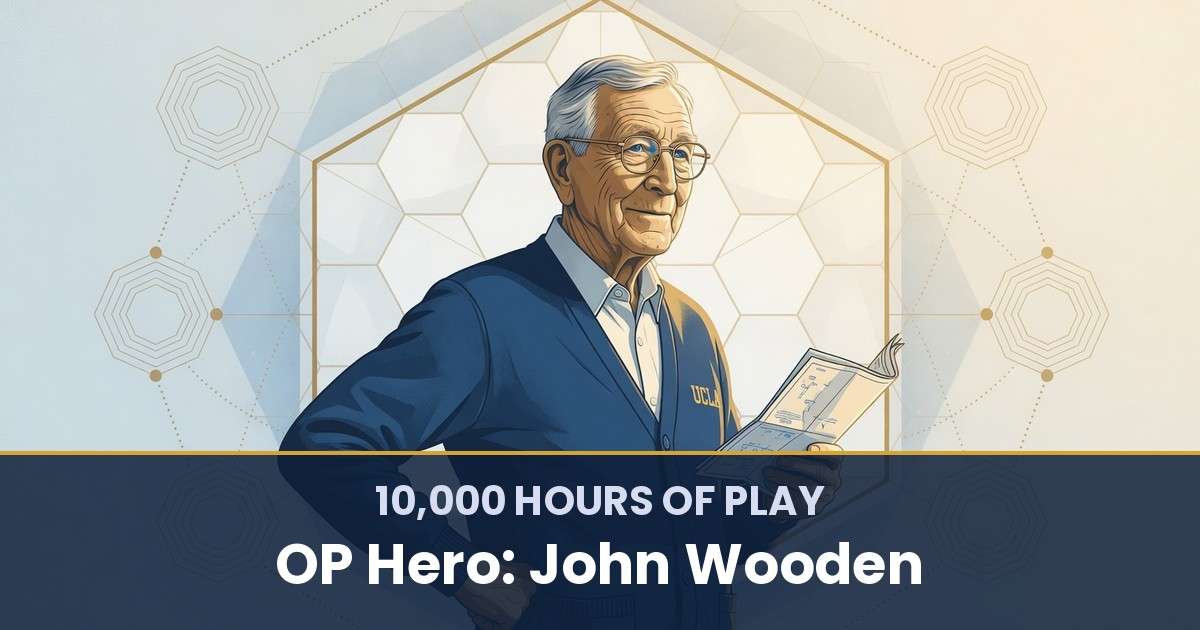


In 1948, an Indiana basketball coach named John Wooden took a head-coaching job at a Los Angeles university that had never made a Final Four. He was 37 years old, he had just left Indiana State Teachers College, and his preferred job had been Minnesota. UCLA was the consolation pick.
He coached there for 27 seasons. The first 14 produced exactly zero national championships. The final 12 produced ten. Seven of those titles came in a row, between 1967 and 1973, a record no other men’s college basketball program has ever matched. The teams under him also strung together 88 consecutive wins, a streak that still has not been broken at the Division I men’s level. He retired after the 1975 NCAA final, which UCLA won, then spent the next 35 years giving away the system that had built it.
The pop framing of John Wooden is “winningest college coach ever.” That framing makes the story smaller than it is. The interesting question is what build he was actually running over the 50 years before the trophies came, and what the rest of us can lift from it. Read through the 6-Step 10K HP framework and Wooden’s life starts to look less like a coaching biography and more like the cleanest case study of a teacher-class build we have on file.
⚡ Speed Run Notes
- Wooden’s “game” was never winning basketball. It was building character through teaching, with basketball as the practice field. He kept playing that game for 76 years.
- His Pyramid of Success was not a one-day creation. He refined it for roughly 14 years before its 1948 final form, then kept teaching from it for the next 62.
- The UCLA dynasty took 14 seasons to start. He was hired in 1948. The first NCAA title came in 1964, a 98-83 win over Duke. Most coaches would have been fired by year six.
- His role transitions stacked: high-school teacher, Navy lieutenant, college coach at Indiana State, UCLA head coach, then 35 years as an author and elder teacher. Five classes in 80 years.
- He taught his players how to put on socks and shoes correctly. He also taught them how to handle being the best player in the country. The same Skill ran both.
- Retired in 1975 after winning his final game. The 10 titles in 12 years, the 88-game streak, and the player-and-coach Hall of Fame induction all came after a 14-year wait that would have ended any normal coaching career.
Table of Contents
- Step 1: The Game (What Wooden Was Actually Playing)
- Step 2: Attributes (The Innate Stats)
- Step 3: Role(s) (The Character Class Across Chapters)
- Step 4: Skills (The Real-Life Game Skills Wooden Mastered)
- Step 5: Allies (The People Who Multiplied Wooden)
- Step 6: Quests (The Milestones That Shaped the Saga)
- What You Can Steal From Wooden’s Build
- Where this framework comes from
- Related Reading
About Yu-kai Chou

Yu-kai Chou is the author of 10,000 Hours of Play — the book that treats your life as the most important game you’ll ever build a character in, and gives you the 6-Step framework (Game · Attributes · Role · Skills · Allies · Quests) to play it on purpose. He has spent two decades developing the system through which this post analyzes its OP Hero, and applies it to his own life and to the lives of the people he advises around the world.
Chou’s other framework, the Octalysis Framework, has been applied by LEGO, Microsoft, Porsche, Coca-Cola, Salesforce, and MrBeast, impacting over 1.5 Billion Users. He has taught the methodology at Harvard, Stanford, Yale, Tesla, Google, BCG, and IDEO, and has advised governments in eight nations including Ukraine, the United Kingdom, the Kingdom of Bahrain, Singapore, Taiwan, the Netherlands, Kazakhstan, and South Korea.
His work has been cited by Harvard, Stanford, MIT, Forbes, Wall Street Journal, Wired, US Department of Energy, NIST, NSF, NCBI, US Department of Education, ClinicalTrials.gov, and Google Scholar — with 3,700+ more academic publications. Explore his books here.
John Wooden is the OP Hero I find most instructive on the question of how long it is reasonable to wait for the build to pay off. He spent 14 seasons at UCLA before the first championship and another 27 years there in total, and across that entire run he treated practice planning and shoelace-tying with the same attention he gave to championship games. If you want the one lesson to lift, it is the Skill of refusing to swap your standards for your scoreboard. Wooden never did, and the scoreboard eventually caught up.
Step 1: The Game — What Wooden Was Actually Playing
The pop framing of Wooden is “win basketball games.” That is true and unhelpful. The actual game he was playing across half a century was sharper, and he stated it openly long before the trophies started arriving.
Wooden wanted to build people of strong character through the medium of a sport. The Pyramid of Success, which he refined for roughly 14 years before its 1948 final form, defines success as “peace of mind which is a direct result of self-satisfaction in knowing you made the effort to become the best you are capable of becoming.” Not “wins.” Not “rings.” Effort, measured against your own ceiling, with character as the load-bearing structure underneath.
You can read that mission line in the moves. He coached high-school English alongside basketball at Dayton, Kentucky from 1932 to 1935 and then at South Bend Central from 1935 to 1944, where he held both jobs as one. He took a Navy commission during World War II. He coached two years at Indiana State Teachers College, then accepted UCLA in 1948. At every stop, the work was teaching first and basketball second. The order never flipped.
That ordering is why he could survive the long wait at UCLA. From 1948 through 1961, his teams won a lot of regular-season games but no championships, and a younger coach without his framing would have read that record as failure. Wooden did not. The Pyramid told him success was the effort, the championships were the by-product, and the by-products would arrive when they arrived. They did, in 1964. They kept arriving for the next 11 years.
Step 2: Attributes — The Innate Stats
Attributes in the 10K HP framework are the dial settings on your character before you spend any XP. Wooden’s are unusually well documented because he wrote about them, his father wrote about them, and his Indiana hometown talked about them for the better part of a century.
The first dial was discipline. By his teenage years he was already running his life on routines that did not need outside enforcement, and his Martinsville High School teams won three consecutive trips to the Indiana state finals (1926, 1927, 1928), taking the 1927 title. He was a three-time all-state selection in a state where high-school basketball was a serious civic event. None of that is the result of talent alone. That is a dial.
The second dial was fairness and moral steadiness. The Pyramid’s first cornerstones are Industriousness and Friendship, and its base is Loyalty and Cooperation. He chose those words deliberately because they described how he had always seen the world. Even in adolescence he was the player teammates trusted. If you want a sober frame for how much of any career is the innate dial versus the trained one, the Talent Triangle Method is the cleanest lens. Wooden’s moral-steadiness dial was already at the ceiling well before any coach got to him.
The third dial was teaching-pattern recognition. From an early age he reduced complicated activities to teachable components. By the time he was coaching high-school English at South Bend Central in the late 1930s, his lesson plans for sentence diagramming and his lesson plans for the high-post offense looked structurally similar. He saw both as problems of sequencing, repetition, and feedback.
The fourth dial was intentness. He used the word himself: one of the Pyramid’s middle blocks is “Intentness,” which he defined as the resolve to stay the course when results were slow. A 14-year wait at UCLA without a single championship is not survivable on talent or temperament alone. It is survivable on a dial set to “I will not quit.”
Step 3: Role(s) — The Character Class Across Chapters
Wooden did not run one class. He multi-classed five times across 80 years, and the role changes are where the saga earns its shape.
High-School Teacher-Coach (1932–1943, roughly ages 22–33). Three seasons at Dayton, Kentucky, then eight at South Bend Central. He taught English and coached basketball as a single role. The teaching habits formed here, including the practice-card discipline and the obsession with detail, never left him.
Navy Lieutenant (1943–1946). He served in the U.S. Navy during World War II. The chapter is short in his biographies, but it produced a 33-year-old who had operated under military command and was now ready to design his own programs from the ground up rather than inherit them.
Indiana State Teachers College Head Coach (1946–1948). Two seasons. This is the chapter that almost gets skipped, and it is where his moral steadiness showed up publicly for the first time. He famously declined the 1947 National Association of Intercollegiate Basketball tournament invitation because the tournament would not allow his only Black player, Clarence Walker, to participate. The next year, when the rules were changed, Indiana State went and Walker played. The role here was head coach; the actual class transition was from “teacher who coaches” to “teacher who runs a program.”
UCLA Head Coach (1948–1975). The 27-year run that built the dynasty. The first 14 seasons were the patient build: respectable records, no titles, and the slow assembly of a recruiting pipeline and a practice methodology. The final 12 seasons were the catalog. He won 10 NCAA championships in 12 years, including the seven-in-a-row from 1967 to 1973 and the 88-game winning streak. He retired after the 1975 final, which UCLA won, on his own terms.
Author and Elder Teacher (1975–2010). The 35 years after retirement were not a victory lap. He wrote They Call Me Coach in 1973 (started before he retired) and Wooden: A Lifetime of Observations and Reflections in 1997 with Steve Jamison. He gave thousands of talks. He received the Presidential Medal of Freedom in 2003. He was the first person inducted into the Naismith Memorial Basketball Hall of Fame as both a player (1960) and a coach (1973). The teaching never stopped. He just changed the classroom.
Step 4: Skills — The Real-Life Game Skills Wooden Mastered
Here is where the framework’s vocabulary earns its keep. Wooden’s skill tree is wider than the “old-school coach” frame allows, because most of what he ran on was learned across decades of teaching adolescents, not handed to him at Purdue.
Loremaster (Druid) is the skill of weaving compelling, inspiring stories that people can carry. Wooden’s Pyramid of Success is a Loremaster artifact. He began assembling it during his high-school teaching years in the early 1930s, refined it for roughly 14 years, and reached its recognizable 1948 form. He then taught from it for the next 62 years, in books, talks, and one-on-one mentoring. The Pyramid is not a poster. It is a teaching narrative that survives the speaker.
Floral Blossom (Druid) is the skill of educating and mentoring others. This was his identity from the start. He taught English literature as carefully as he taught the high-post offense. Two of the most talented college players of the 20th century, Lew Alcindor (later Kareem Abdul-Jabbar) and Bill Walton, came through his program at UCLA, and both later credited his teaching for shaping their character as much as their game. He could mentor transcendent talent without losing it to ego or to outside coaches because the teaching was always sincere.
Lich Grind (Warlock) is the skill of intense, secluded work periods. The clearest example is his practice planning. He famously wrote each daily practice on index cards, blocking the session minute by minute, often the night before, and he kept those cards. His preparation discipline carried into the Pyramid itself: 14 years of solitary refinement before he showed the final form to anyone. If you want a feel for what concentrated grinding looks like inside a teacher-class career, the Lich Pact writeup describes the same energy applied to a sleep schedule.
Cognitive Lens (Mage) is the skill of zooming in on details and zooming out for strategy at the same time. Wooden ran this dial at maximum. He taught his players how to put on their socks and lace their shoes correctly so they would not get blisters during the season. He also taught them, in the same week, how to handle being the best player in the country without losing themselves. Micro and macro, in the same voice, on the same day. If you are sketching your own skill loadout, the Skills Spectrum is the place to think about how to mix that level of detail focus with that breadth of life vision.
Aegis (Paladin) is the skill of ignoring public criticism while pushing the work. From 1948 through 1961 he won regular-season games at UCLA and lost in the postseason. The Los Angeles press treated him as a competent regional coach. He was not invited to coach all-star teams. Stanford, USC, and California recruiters out-recruited him. He did not change his methods, he did not chase the celebrity hires that were available, and he did not start coaching for the scoreboard. The wait ended in 1962 with UCLA’s first Final Four and in 1964 with the first championship. The Aegis came first; the trophies came after.
Mastermind (Ranger) is the skill of creating, adapting, and executing complex plans. The 1964 championship was built on a 2-2-1 zone press that his assistant Jerry Norman had pushed him to adopt, and which Wooden then refined into a season-long system that suffocated faster teams. The high-post offense, the conditioning regimens, the recruiting calendar, the practice-card method: each piece looks small on its own, but together they ran a 12-year dynasty against opponents who were just as athletic and often better-funded. The Mastermind dial was set high; the discipline was in keeping all the pieces moving simultaneously.
Step 5: Allies — The People Who Multiplied Wooden
Wooden did not run solo. Six names matter most, and each multiplied a different part of the build.
Joshua Hugh Wooden, his father, was the original teacher. The values Wooden returned to publicly across decades, including hard work, kindness, and never trying to be better than someone else (only the best you yourself can be), are values his biographers trace to his father’s example on the family farm. The Pyramid grew out of soil his father had already prepared.
Piggy Lambert, his coach at Purdue, taught him the fundamentals-first approach he would later refine into his own method. Wooden played for Lambert from 1929 through 1932, made All-American three times, and was named the college basketball Player of the Year as a senior in 1932. Lambert’s emphasis on conditioning, ball movement, and high-percentage shots shows up later in every UCLA practice card Wooden ever wrote.
Nellie Riley Wooden, his wife from 1932 onward, ran the household and the steady center of his life through every move and every disappointed season. The first 14 years at UCLA were lean ones in terms of public reward, and the steady support at home is the kind of ally most coaches’ wives do not get credit for. The fact that Wooden continued writing love letters to her after her death is a footnote that says everything about the role she played.
Jerry Norman, his longtime UCLA assistant, was the ally most casual fans have never heard of. Norman pushed him on the 2-2-1 press that became the signature of the dynasty years, and Norman also pushed him on national recruiting. Without that push the dynasty either does not happen or happens later and smaller. Phil Knight’s build with Bill Bowerman is the closest sibling story here: the head coach gets the credit, the assistant supplies the missing ingredient.
Lew Alcindor (Kareem Abdul-Jabbar) and Bill Walton were not allies in the mentor sense, but they were the players who validated the system at the highest possible level. From 1967 through 1969 Alcindor anchored three consecutive championship teams. From 1972 through 1974 Walton anchored two more. Two of the most independent-minded athletes of the 20th century chose, year after year, to stay inside Wooden’s program. That is the cleanest proof a teacher-class build can ever get.
Step 6: Quests — The Milestones That Shaped the Saga
Five quests carry most of the weight of Wooden’s catalog, and one long setback connects them.
Quest 1: Purdue All-American and 1932 College Player of the Year. Three consecutive consensus All-American selections (1930, 1931, 1932) and the Player of the Year nod as a senior. He left Purdue as the most decorated college guard of his era, then walked into a high-school teaching job at Dayton, Kentucky. The choice to coach high schoolers right after a college peak is itself a tell about what game he was playing.
Quest 2: Pyramid of Success codified, 1948. Roughly 14 years of solo refinement reached a recognizable final form the same year he took the UCLA job. The timing was not coincidence. He needed a teaching artifact he could trust before he walked into a job he had not chosen first, in a city he did not know, with a program that had no track record. The Pyramid was the gear he packed.
Quest 3: First UCLA Final Four, 1962. Fourteen years after the hire. UCLA had been a regional name, not a national one. The Final Four trip in 1962 changed how the rest of the conference and the rest of the country read his program. The dynasty was still two years away, but the runway had been cleared.
Quest 4: First NCAA title, 1964. UCLA defeated Duke 98-83 to take the championship, finishing the season at 30-0. That same 2-2-1 zone press Jerry Norman had pushed him to adopt was the spine of the title run. The first championship is also the moment the patience finally paid out.
Quest 5: Seven straight, 1967–1973, plus the 88-game streak. Seven consecutive NCAA championships, a record no one has matched. The 88-game winning streak ran across the 1971 through 1974 seasons. Ten titles in 12 years, capped by a final championship in 1975 and a retirement on his own terms. To see how other dynasty-class careers run a comparable loop, the OP Hero profile hub is the place to start; the patterns repeat in surprising places.
The setback that connects them: the 14-year UCLA wait, 1948–1961. Not a single championship through the first 14 seasons. The crater years were not glamorous and they were not short. Wooden simply did not treat them as failure, because the Pyramid told him success was the daily effort, not the trophy. He kept teaching from the same artifact he had brought from Indiana, and the artifact eventually built the dynasty around it.
What You Can Steal From Wooden’s Build
The temptation with Wooden is to admire the trophies and skip the 14 years before them. Resist that. Three lessons translate clean.
The first lesson is that the artifact comes before the win. Wooden did not invent the Pyramid of Success after he had the championships; he had been refining it for 14 years before UCLA hired him, and then he taught from it for another 27 years while waiting for the world to catch up. If you do not have an artifact yet, that is your first move. Not a brand, not a deck, not a tagline. A teaching framework you would trust to use on yourself if the trophies never came. Build that first, then play.
The second lesson is that micro and macro live in the same Skill. He taught socks and shoelaces on the same day he taught life philosophy, and he did not see those as different conversations. The detail was the philosophy in practice. If you are running a build that has a beautiful vision but no daily protocol, you have half a Skill. If you have a daily protocol but no vision, you have the other half. Wooden ran both at once, which is why the players who came through his program carried the system out of the gym.
The third lesson is that you cannot rush the wait. Fourteen years at UCLA without a championship would have ended any coach who measured himself by external results. Wooden survived it because he measured himself by the Pyramid. If you are in a long quiet chapter of your own build right now, the framework’s only honest reply is: define success by the effort you can control, not the outcome you cannot, and keep teaching from your artifact. The dynasty arrives when it arrives.
Where this framework comes from

Want the full system this profile is built on?
Every OP Hero piece runs through the same 6-Step framework from 10,000 Hours of Play: Unlock Your Real-Life Legendary Success. The book covers the full system, walks through Yu-kai’s own life run as the first applied case study, and gives you the worksheets to audit your own build.
Related Reading
- The full OP Hero profile hub. Every 10K HP profile so far, indexed by Skill and Role.
- 10,000 Hours of Play by OP Hero: Michael Jordan. The basketball-class build a generation later, with a very different temperament.
- 10,000 Hours of Play by OP Hero: Stephen Covey. Another character-first teacher whose artifact long outlived him.
- 10,000 Hours of Play by OP Hero: Marcus Aurelius. The original “make each day your masterpiece” build, in a very different role.
- The 10K HP framework. The 6 Steps every OP Hero profile walks through.