
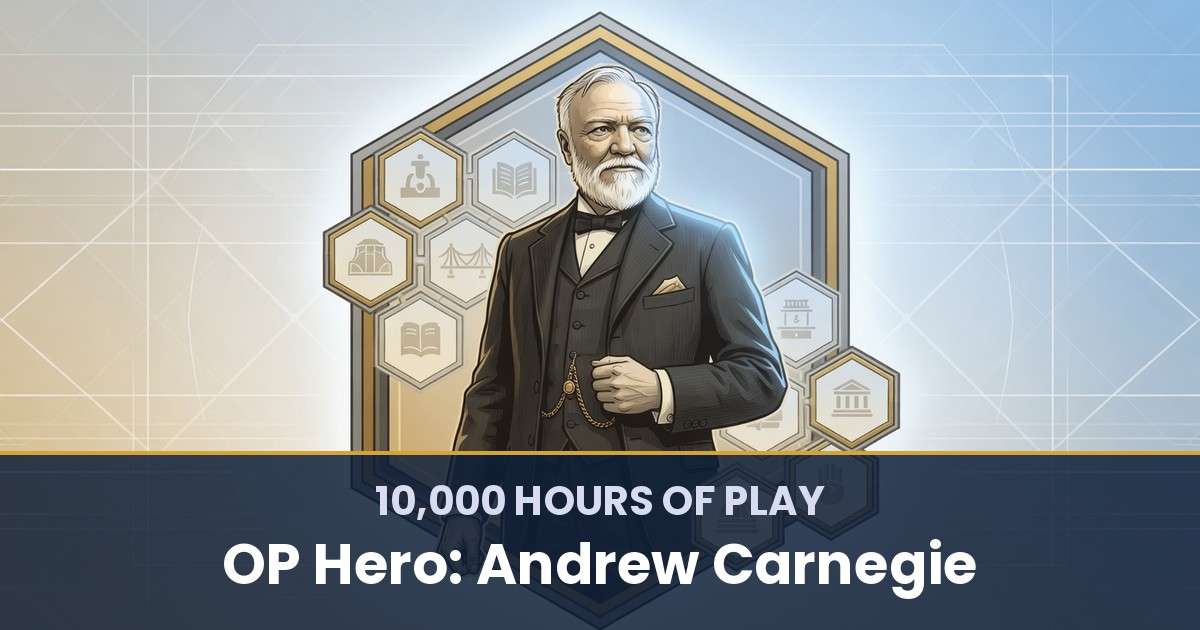


In 1848, a thirteen-year-old Scottish boy stepped off a boat in Pittsburgh with his parents, his younger brother, and almost nothing else. His father, a handloom weaver, had been wiped out by industrial mechanization back in Dunfermline. Within weeks the boy was working twelve-hour shifts in a cotton mill for $1.20 a week, swapping bobbins on the looms.
Half a century later that boy sold his steel company to J.P. Morgan for what’s commonly cited as $480 million and proceeded to give the bulk of it away on purpose. More than 2,500 public libraries. A music hall in midtown Manhattan. A research university in Pittsburgh. An endowment for world peace. By the time he died in 1919, Andrew Carnegie had transferred well over $350 million from his own balance sheet into civic institutions that still carry his name in 2026.
Most rags-to-riches stories stop at the riches. Carnegie’s becomes interesting after the cash-out. He treated the back half of his life as a separate game with a separate win condition, and he reverse-engineered every move he’d made before to fund it. If you look at his run through the 6-Step framework from 10,000 Hours of Play, you can see exactly how a bobbin boy ends up running the largest industrial fortune in American history and then dismantling it on his own terms.
⚡ Speed Run Notes
- Carnegie ran two games back-to-back: accumulate industrial capital at maximum scale, then convert it into public infrastructure at maximum scale. He wrote the rules for both in The Gospel of Wealth (1889).
- His superpower was vertical integration. He owned the ore mines, the coke ovens, the rail lines, the steel mills, and the ships. Nobody else’s margin sat between him and the customer.
- He was a “Bind Fate” Warlock long before he was a steel mogul. Telegraph operator at fifteen, attached himself to Thomas Scott of the Pennsylvania Railroad, rode that rocket into managerial work and capital markets.
- The Homestead Strike of 1892 is the failure he never fully recovered from. He outsourced the fight to Henry Clay Frick, fled to Scotland, and watched his reputation crater while seven workers died.
- The 1901 sale to J.P. Morgan was the cleanest exit in industrial history. From that moment forward he spent eighteen years on the Phoenix Rebirth: not retired, just playing a different game.
Table of Contents
- Step 1: The Game. What Carnegie Was Actually Playing
- Step 2: Attributes. The Innate Stats
- Step 3: Role(s). The Character Class Across Chapters
- Step 4: Skills. The Real-Life Game Skills Carnegie Mastered
- Step 5: Allies. The People Who Multiplied Carnegie
- Step 6: Quests. The Milestones That Shaped the Saga
- What You Can Steal From Carnegie’s Build
- Where this framework comes from
- Related Reading
About Yu-kai Chou

Yu-kai Chou is the author of 10,000 Hours of Play, the book that treats your life as the most important game you’ll ever build a character in, and gives you the 6-Step framework (Game · Attributes · Role · Skills · Allies · Quests) to play it on purpose. He has spent two decades developing the system through which this post analyzes its OP Hero, and applies it to his own life and to the lives of the people he advises around the world.
Chou’s other framework, the Octalysis Framework, has been applied by LEGO, Microsoft, Porsche, Coca-Cola, Salesforce, and MrBeast, impacting over 1.5 Billion Users. He has taught the methodology at Harvard, Stanford, Yale, Tesla, Google, BCG, and IDEO, and has advised governments in eight nations including Ukraine, the United Kingdom, the Kingdom of Bahrain, Singapore, Taiwan, the Netherlands, Kazakhstan, and South Korea.
His work has been cited by Harvard, Stanford, MIT, Forbes, Wall Street Journal, Wired, US Department of Energy, NIST, NSF, NCBI, US Department of Education, ClinicalTrials.gov, and Google Scholar — with 3,700+ more academic publications. Explore his books here.
What I find instructive about Carnegie’s build isn’t that he made a fortune. Plenty of people did that during the Gilded Age. What I find instructive is that he wrote down the rules of the second game before he was done playing the first. Most builders never define their post-cashout win condition, so when the money lands they drift. Carnegie pre-committed to a Quest he could only fund by winning the first one, and that pre-commitment is the move I’d lift from his build for anyone running their own life as a long game.
Step 1: The Game. What Carnegie Was Actually Playing
The naive read on Carnegie is that he was playing the get-rich game and got freakishly good at it. That’s wrong by half. He was playing two stacked games on the same board.
Game one: build the most dominant industrial capital base in America. Not “be wealthy.” Not “be successful.” Build the actual machinery that produces and distributes steel at a scale and cost no rival can touch. Steel was the substrate of the second industrial revolution. Rails, bridges, skyscrapers, ships. Carnegie wanted to be the one selling it to all of them.
Game two, which he started articulating in earnest with The Gospel of Wealth in 1889, was civic infrastructure at the same scale. Libraries where there had been no libraries. Universities that didn’t exist. Concert halls in cities that hadn’t yet built them. A formal endowment whose explicit purpose was to make great-power war between nations impossible. The man who’d built the steel that went into battleships spent his last years funding an institution to put those battleships out of business.
What links the two games, and what makes Carnegie such a useful study for the 10K HP framework, is the operating belief that surplus wealth is a trust fund for the public. Carnegie wrote that the rich man’s duty was “to consider all surplus revenues which come to him simply as trust funds, which he is called upon to administer.” Game one accumulated the surplus. Game two administered it. He framed both as a single life mission with a clean handoff between phases.
Step 2: Attributes. The Innate Stats
Attributes are the traits you arrived with, the dice you were rolled with. Looking at Carnegie’s childhood and the patterns that repeat across every chapter of his life, four stats stand out.
Risk appetite. Carnegie kept moving from wage labor into ownership stakes from the moment he had any capital at all. His first investment, in his early twenties, was ten shares of Adams Express bought partly with money borrowed against his mother’s house. He treated salary as fuel for speculation, not a destination.
Pattern recognition under load. As a telegraph operator he reportedly learned to read incoming Morse code by ear without writing it down, one of three people in Pittsburgh who could do it. That same ability to see the signal inside the noise shows up later when he picks the chokepoints in the steel supply chain (coke, iron ore, rail transport) and acquires control of them before anyone else realizes they’re chokepoints.
Social wiring. Carnegie built durable relationships with operators above his pay grade from his teens onward. He didn’t just network. He attached himself to specific mentors and made himself indispensable to them, then used the resulting relationships as on-ramps to industries he had no formal credentials in. This is the Talent Triangle in action long before anyone named it: natural ability times domain access times raw hours.
Long-range vision. Carnegie thought in decades when most of his peers were thinking in quarters. The Gospel of Wealth was written in his mid-fifties, ten years before he sold Carnegie Steel. He’d been planning the philanthropic phase while still running the industrial one. People with this stat distribution build institutions; people without it build careers.
Step 3: Role(s). The Character Class Across Chapters
Carnegie’s character sheet shows at least six distinct classes across his run.
Bobbin Boy (Mill Hand). Age 13, Pittsburgh cotton mill, $1.20 a week. The role taught him industrial discipline and what twelve-hour shifts feel like from the floor. He never romanticized labor and he never forgot it.
Telegraph Operator. By 14 he was a messenger boy for the O’Reilly Telegraph Company. By 15 he was a full operator. Telegraphy in the 1850s was the closest thing to working in a tech startup. He learned fast information handling, code, precision, and how to be useful to high-status adults who passed through his office.
Pennsylvania Railroad Superintendent. Thomas Scott pulled him into the railroad world. By 24 Carnegie was running the Pittsburgh Division of the largest corporation on Earth. He learned operations at industrial scale: schedules, payroll, asset utilization, crisis management when bridges burned and shipments stalled.
Bond Salesman and Financier. In his late twenties he sold railway bonds in Europe and discovered he was extraordinary at it. This is the role that converted his railroad credibility into capital and put him in the rooms where industrial investments got made.
Steel Mogul. From the late 1860s through 1901, Carnegie was an industrialist by trade. He didn’t run the mills day-to-day. He set strategy, picked partners, and bet ferociously on technology.
Philanthropist and Public Moralist. Final form. From 1901 until his death in 1919 he ran what amounted to a private foundation before private foundations were a thing, and he wrote about it constantly. The author class is where he closed the loop on the first five.
Step 4: Skills. The Real-Life Game Skills Carnegie Mastered
Six canon Skills sit at the center of Carnegie’s build. Each one is paired with a specific moment in the run where you can see it crack open a result.
Bind Fate (Warlock) — leverage someone else’s brand or resource to become powerful yourself. Thomas Scott of the Pennsylvania Railroad was Carnegie’s first and most important hook. Scott brought him into railroad management at 18, lent him money to make his first investment, and vouched for him in capital markets. Carnegie repaid the trust by becoming indispensable, and the railroad credibility became the launchpad for everything that followed.
Vision Manifestation (Warlock) — visualize success through mental rehearsal so vividly it shapes reality. Carnegie bet on the Bessemer process in the early 1870s when most American steelmakers were skeptical. He’d seen it work in Britain and he could already see the cost curve: cheaper steel meant longer rails, taller buildings, bigger bridges, and he wanted to be the one supplying them. The mill at Braddock, Pennsylvania (the Edgar Thomson Steel Works) was the manifestation of that vision in brick and fire.
Mastermind (Ranger) — create, adapt, and execute complex plans. Vertical integration was Carnegie’s masterpiece. He owned the iron-ore mines in the Mesabi Range, the lake fleet that hauled the ore, the rail lines that ran it inland, the coke ovens via the H.C. Frick Coke Company, and the steel mills that finished it. No competitor could undercut him because he was paying internal prices at every step. This isn’t a single move; it’s a decade-long acquisition plan executed without losing momentum on the core business.
Lich Grind (Warlock) — intense, secluded work periods. Carnegie wasn’t a polyphasic-sleep cultist (you can read about that variant in the Lich Pact profile), but the broader Warlock work-intensity stat was clearly maxed. He started at 13 and didn’t really stop until 65. Six decades of compounding focused effort in one industry is what produced the cost curve that beat everyone else. If you want a feel for where this Skill sits on the depth-vs-breadth map, the Skills Spectrum piece is the cleanest read I have on the topic.
Sacrificial Cycle (Warlock) — reinvest all resources back into the project. While the Vanderbilts and Astors were building Newport cottages, Carnegie was plowing nearly every dollar of profit back into expanding capacity, buying out partners, and acquiring upstream inputs. The personal lifestyle stayed modest by Gilded Age standards. The company kept compounding because the surplus never left the company.
Phoenix Rebirth (Paladin) — recover from devastating failure and come back stronger. Homestead 1892 was the failure. The reputational damage was real, the deaths were real, and Carnegie’s hand in handing the labor fight to Frick from the safety of Scotland was real. He did not undo any of it. What he did do was use the next 27 years to build a body of public work so large that the historical record had to weigh it against Homestead rather than reading it as the final word. Whether you grade that recovery as redemption or as PR is a separate argument; the rebirth itself is undeniable.
Step 5: Allies. The People Who Multiplied Carnegie
No one builds an empire alone. Carnegie’s roster of multipliers is one of the cleanest in industrial history.
Margaret Morrison Carnegie (his mother). The disciplining force in his early life and the emotional anchor through his thirties and forties. Carnegie didn’t marry until after her death in 1886; she was the dominant relationship of his first fifty years and the source of the thrift-and-ambition pattern that shaped him.
Thomas A. Scott (Pennsylvania Railroad). The patron. Scott pulled him into the railroad, taught him operations at scale, and vouched for his first investments. Without Scott there is no Carnegie. The on-ramp matters that much.
Henry Phipps (long-time partner). The conservative counterweight inside the steel partnership. Phipps managed cash flow and held the books steady while Carnegie was off making big bets. Every Vision Manifestation needs a Phipps in the room or it burns out before it ships.
Henry Clay Frick (coke and steel). The operational ruthlessness Carnegie needed, and the labor liability he eventually couldn’t survive. Frick locked up the coke supply that fed Carnegie Steel and ran the day-to-day at the mills. He’s also the man who ordered the Pinkertons to Homestead in 1892. The same skill set that made him indispensable made him the partner whose decisions Carnegie couldn’t fully own or disown.
Charles M. Schwab (the operator). Schwab rose through the Carnegie organization and ran Homestead, then Carnegie Steel as a whole, with operational genius that’s still studied in business schools. He’s also the one who brokered the 1901 sale to J.P. Morgan, which means the cleanest exit in industrial history happened because Carnegie had built a Schwab.
Step 6: Quests. The Milestones That Shaped the Saga
1853. The Pennsylvania Railroad hire. Eighteen-year-old Carnegie joins Scott’s office as a personal telegrapher and clerk. This is the chapter break that converts him from telegraph kid to industrial player.
1865. Leaving the railroad to go full-time investor. At 30 he resigns his railroad position to manage his investments directly. The salary loss is real; the upside is unlimited. Most of his peers thought he’d lost his mind. He’d already done the math.
Early 1870s. The bet on the Bessemer process and the Edgar Thomson Steel Works. Carnegie commits to a steelmaking technology most American producers consider unproven, and builds a mill designed around it from the ground up. The cost curve breaks in his favor immediately. By the late 1880s Carnegie Steel is the dominant producer in the country.
1889. Publishing The Gospel of Wealth. The essay that pre-commits him to the second game. He publicly argues that a rich man who dies rich dies disgraced, and that surplus wealth must be administered for the public good. Twelve years before the sale, he has already announced the win condition for his post-industrial life.
1892. The Homestead Strike. The setback. Locked-out workers at the Homestead Steel Works clash with Pinkerton agents Frick has brought in. Seven workers and three Pinkertons die in the violence; the state militia is called in. Carnegie is in Scotland the entire time, claiming he’s leaving labor decisions to Frick. The strike collapses the union, hardens public opinion against Carnegie personally, and stays attached to his name for the rest of his life. Of every milestone on the sheet, this is the one he most clearly mishandled. (Frederick Douglass, Carnegie’s contemporary, spent his final years writing about exactly this kind of moral failure of American industrial capital.)
1901. The sale of Carnegie Steel to J.P. Morgan. Schwab brokers the deal. The combined entity, U.S. Steel, becomes the first billion-dollar corporation in American history. Carnegie’s personal proceeds, commonly cited at $480 million in 1901 dollars, make him the wealthiest individual in the world at that moment. He treats the cash as raw material for the second game.
1901 to 1919. The institutional build-out. Carnegie Hall (founded 1891, well before the sale, but heavily endowed afterward), Carnegie Mellon (founded 1900 as Carnegie Technical Schools), Carnegie Endowment for International Peace (1910), the Carnegie Corporation of New York (1911), and more than 2,500 public libraries across the English-speaking world. By the time of his death in August 1919, he has given away well over $350 million, which works out to roughly 90% of the fortune.
What You Can Steal From Carnegie’s Build
Three moves from this build are worth taking with you whether or not you’ll ever run a steel mill.
Define the second game before you finish the first. Carnegie wrote The Gospel of Wealth in 1889 and didn’t sell Carnegie Steel until 1901. That twelve-year gap is the point. He committed publicly to a post-cashout win condition while still running the cashout game, which meant the exit had a purpose pre-installed. Most builders don’t do this and then drift after they win. Yvon Chouinard is one of the rare modern figures who did it the same way (he announced the Patagonia ownership transfer years before it happened). Bill Gates is the explicit modern echo of the Carnegie pattern.
Attach yourself to a Thomas Scott before you need money or credentials. The single most consequential move in Carnegie’s whole sheet wasn’t a technology bet. It was the relationship with one specific railroad executive who became his patron at age 18. The Bind Fate Skill is underrated by people who think networking is about quantity. Carnegie’s was about quality and proximity to one mentor at a time.
Vertical integration is a personal-life pattern, not just a business one. When you can own more of the chain that produces the outcome you want (health, family, learning, financial independence), fewer other people’s margins sit between you and your result. The steel-mill version is famous. The personal version is available to anyone who notices the analog.
If you want to see how this 6-Step pattern shows up in other lives, the OP Hero Profiles hub has dozens more: different industries, different centuries, same framework.
Where this framework comes from

Want the full system this profile is built on?
Every OP Hero piece runs through the same 6-Step framework from 10,000 Hours of Play: Unlock Your Real-Life Legendary Success. The book covers the full system, walks through Yu-kai’s own life run as the first applied case study, and gives you the worksheets to audit your own build.
Related Reading
- All OP Hero Profiles: the full collection of life-as-RPG case studies through the 10K HP framework.
- Phil Knight: another founder who turned a single mentor relationship and a contrarian product bet into a generational company.
- Ingvar Kamprad: the IKEA founder whose personal frugality mirrored Carnegie’s Sacrificial Cycle pattern almost exactly.
- Howard Schultz: built an American institution from the floor up, the same way Carnegie built steel from the bobbin room up.
- Warren Buffett: the modern compounding-and-philanthropy build, in the Carnegie lineage by his own admission.