
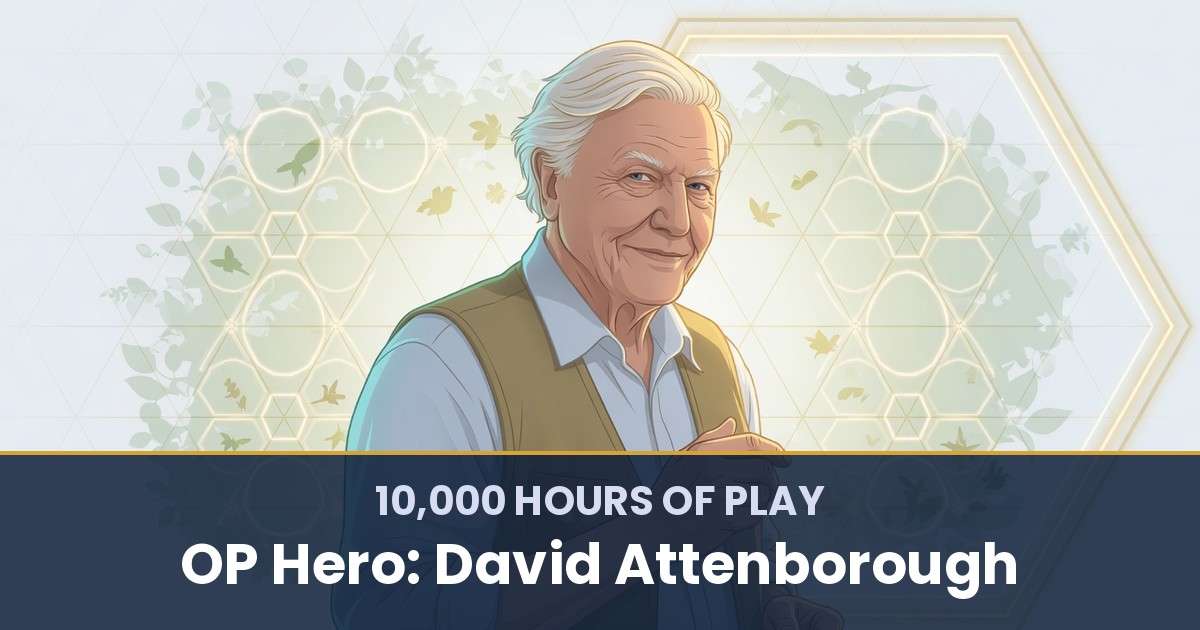
10,000 Hours of Play by OP Hero: David Attenborough
At 100, David Attenborough has spent seventy years making the world love the living planet. His life, run through the 6 Steps of 10,000 Hours of Play.


On 8 May 2026, the Royal Albert Hall filled up to celebrate a man turning 100 years old. The King sent a handwritten message. Scientists named a wasp after him. And the guest of honour had spent roughly seventy of those hundred years doing one job: walking up to a wild animal, lowering his voice almost to a whisper, and making millions of strangers fall in love with it.
That man is David Attenborough, and the strange thing about his life is how unfair his advantage looks once you map it. He took the dullest-sounding subject on television, nature documentaries, and turned it into the most-watched programming on the planet. Then he spent his final chapters using that audience to argue for the survival of the living world itself.
Run his life through the 6 Steps of 10,000 Hours of Play and the career stops looking like a gentle drift into national-treasure status. It looks like a deliberate, century-long build.
⚡ Speed Run Notes
- Attenborough’s “game” stayed fixed for seventy years: use the most powerful media of each era to make people love the living world, then to fight to save it.
- His edge was never loud charisma. It was a trust-inducing calm plus a naturalist’s eye he had owned since he was a boy collecting fossils in Leicester.
- His 1979 breakthrough, Life on Earth, came from a structural bet: organise three years of global footage around evolution itself, turning scattered nature into a single story.
- As Controller of BBC Two he treated colour television as a weapon, using snooker and Civilisation to prove a point. Format mastery, not just talent, builds platforms.
- The setback people forget: he walked away from the top of BBC management in the early 1970s to go back to making programmes himself.
- His last level was advocacy. A Life on Our Planet (2020) and his COP26 address reframed his whole body of work as a warning.
Table of Contents
- Step 1: The Game Attenborough Was Playing
- Step 2: Attributes (The Innate Stats)
- Step 3: Role(s) Across the Chapters
- Step 4: Skills Attenborough Mastered
- Step 5: Allies Who Multiplied Him
- Step 6: Quests That Shaped the Saga
- What You Can Steal From Attenborough’s Build
- Where This Framework Comes From
- Related Reading
About Yu-kai Chou

Yu-kai Chou is the author of 10,000 Hours of Play — the book that treats your life as the most important game you’ll ever build a character in, and gives you the 6-Step framework (Game · Attributes · Role · Skills · Allies · Quests) to play it on purpose. He has spent two decades developing the system through which this post analyzes its OP Hero, and applies it to his own life and to the lives of the people he advises around the world.
Chou’s other framework, the Octalysis Framework, has been applied by LEGO, Microsoft, Porsche, Coca-Cola, Salesforce, and MrBeast, impacting over 1.5 Billion Users. He has taught the methodology at Harvard, Stanford, Yale, Tesla, Google, BCG, and IDEO, and has advised governments in eight nations including Ukraine, the United Kingdom, the Kingdom of Bahrain, Singapore, Taiwan, the Netherlands, Kazakhstan, and South Korea.
His work has been cited by Harvard, Stanford, MIT, Forbes, Wall Street Journal, Wired, US Department of Energy, NIST, NSF, NCBI, US Department of Education, ClinicalTrials.gov, and Google Scholar — with 3,700+ more academic publications. Explore his books here.
What I take from Attenborough’s build is that he never separated the message from the medium. Most experts assume that if their idea is good enough, the audience will come. He assumed the opposite: that even the most wondrous truth dies on the vine unless you master the channel that carries it. The lesson I would lift is that picking one subject and staying with it for fifty years is not narrowness, it is compounding, and almost nobody is patient enough to let it run.
Step 1: The Game — What Attenborough Was Actually Playing
Most broadcasters play a game called “be on television.” The subject is interchangeable; the point is the platform, the fame, the next commission. Attenborough was never really playing that game.
His objective held steady across seven decades and at least five generations of technology: use whatever the most powerful communication tool of the moment happened to be, from black-and-white TV to colour to satellite to 4K streaming, to bring the non-human world into human awareness. First as wonder. Later as warning.
You can see the game in three phases. Discover and reveal the planet’s life. Make people love it. Then persuade them to protect it. That last phase only became possible because the first two had quietly built the largest, most trusting audience any naturalist has ever had. This is precisely the kind of long, self-chosen game the 6-Step framework is built to surface: the single question a person keeps answering for a lifetime, even as the tools around them change beyond recognition.
It is worth noticing how different his game was from pure science. Jane Goodall went into the field to study one species in extraordinary depth. Attenborough’s job was almost the inverse: take everything the field scientists discovered and make a global audience care enough to keep them funded. He was the bridge between the laboratory and the living room, and he treated that bridge as the most important structure of all.
Step 2: Attributes — The Innate Stats
Several of Attenborough’s core stats were visible decades before a camera was ever pointed at him.
The first was obsessive curiosity about the natural world. As a boy in Leicester he collected fossils, stones, and specimens, assembling a private “museum” of natural objects long before anyone suggested it could be a career. That pull toward the living world was not taught into him; it was simply there.
The second was a rare kind of pattern recognition. He could see a single story hiding inside thousands of scattered observations, the trait that later let him organise the entire history of life into one coherent television series. Most people see a pile of facts. He saw the narrative spine running through them.
The third is the one audiences feel without being able to name it: a calm, low-ego, trust-inducing presence. His charisma is not the flashy kind. It is the kind that makes a stranger believe what he says, which is why conservation groups still build campaigns around his voice. Trust, it turns out, is a stat, and his was maxed out.
Underneath all of it sat a quiet appetite for hardship. The early expeditions were small, under-resourced, and genuinely dangerous, and he kept signing up for them. Stack these together and you get his natural Talent Triangle: a mind that notices nature, a temperament people instinctively trust, and the nerve to go where the footage actually is.
Step 3: Role(s) — The Character Class Across Chapters
Attenborough did not start as the elder statesman of the planet. He multiclassed through several distinct roles, and each one handed the next the exact tool it needed.
He began as a student-naturalist, studying natural sciences at Clare College, Cambridge, and graduating in 1947. That gave him the scientific literacy that would later let him narrate complex biology without faking it.
In 1952 he joined the BBC and became an explorer-broadcaster, the man who went to remote places and came back with film. Then, in a twist most fans forget, he changed class entirely. From March 1965 he served as Controller of BBC Two, and from 1969 as Director of Programmes for BBC Television, becoming a broadcast strategist responsible for whole channels rather than single shows.
That executive chapter mattered more than it looks. Running a network taught him how attention actually works at scale, what makes audiences show up, and how a new technology can be turned into a reason to watch. He was learning the platform from the inside.
Then came the role he is remembered for. From 1979 onward he became the natural-history auteur, writing and presenting the landmark series that defined the genre. And in his final chapter, from roughly 2019, he became the sage-advocate, spending the authority he had banked across fifty years on the single argument that the planet is in trouble. Scholar, explorer, strategist, storyteller, elder. Five classes, one continuous character.
Step 4: Skills — The Real-Life Game Skills Attenborough Mastered
Strip away the “national treasure” label and Attenborough’s career traces back to a handful of repeatable skills, each of which maps cleanly onto a canon Real-Life Game Skill.
The foundation was True Sight (Ranger), the knack of seeing keen detail that others miss. It is the same skill that started with a boy sorting fossils and peaked in his most famous moment, the 1979 encounter with mountain gorillas in Rwanda, where his ability to read an animal up close turned a risky field shoot into one of television’s defining sequences. That bet to go narrow and deep on the living world, rather than wide and shallow across many subjects, is the specialist’s play mapped out in the Skills Spectrum.
On top of that sat Loremaster (Druid), the skill of weaving compelling, inspiring stories. His 1979 series Life on Earth was the proof: instead of organising it by geography or animal type, he structured all thirteen episodes around evolution itself, so the series became one continuous tale running from single cells to human beings. The footage was always good. The story architecture is what made an estimated 500 million people watch it.
Pulling that off required Mastermind (Ranger), the ability to create, adapt, and execute genuinely complex plans. Life on Earth meant roughly three years of filming across the globe, and the shoot survived a coup in the Comoros and Attenborough being shot at along the way. Coordinating that scale of expedition so the footage would still cut together into a single argument is a logistics feat as much as a creative one.
Then there is Arcane Wisdom (Mage), the skill of absorbing wide, technical information and synthesising it into something clear. Attenborough’s quiet superpower was taking the dense findings of working biologists and turning them into sentences a child could follow without ever dumbing them down. And in his final act he reached for Thunder Clap (Paladin), public speaking that charges up and moves a room, condensing decades of observation into his “People’s Advocate” address at the COP26 climate summit in Glasgow on 1 November 2021.
Step 5: Allies — The People Who Multiplied Attenborough
The lone naturalist whispering in a forest is a myth. Attenborough was multiplied at every stage by people and institutions most viewers never see.
The earliest was his own family. His elder brother, the actor and director Richard Attenborough, grew up in the same household of high ambition, and the two became one of the most accomplished sibling pairs in British cultural history. His wife, Jane Elizabeth Ebsworth Oriel, whom he married in 1950 and who died in 1997, anchored the home life that made decades of long expeditions possible.
Professionally, his first great multiplier was a near-accident. When the naturalist Jack Lester, intended presenter of the 1954 series Zoo Quest, fell ill, Attenborough stepped in front of the camera himself, and a presenter was born out of a colleague’s misfortune. The institution that grew up around that style, the BBC Natural History Unit in Bristol, established in 1957, became the engine room of his entire output, with early producers like Christopher Parsons helping turn one man’s instinct into a durable production system.
Decades later, producer Alastair Fothergill multiplied him onto a new scale, leading the landmark series The Blue Planet in 2001 and Planet Earth in 2006, both fronted by Attenborough’s voice. And looming over all the underwater work was an earlier influence: Jacques Cousteau, whose pioneering marine films helped prove that the hidden ocean could be made into must-watch television in the first place.
Step 6: Quests — The Milestones That Shaped the Saga
Attenborough’s life reads like a quest log where each victory unlocks a bigger map, and the hardest decision is the one that looks like a step backward.
The opening quest was Zoo Quest in 1954, which fused studio presentation with location footage and effectively invented the template for modern wildlife television. The second was stranger: as Controller of BBC Two from 1965, he weaponised colour broadcasting, bringing in snooker so viewers could see the coloured balls and commissioning the lavish 1969 series Civilisation to show off the new colour service. He understood that a technology is only as valuable as the reason you give people to watch it. Years later, in 1986, he even helped push the tennis world toward the yellow ball because white ones did not read well on colour screens.
Then came the setback that was really a choice. By the early 1970s he sat near the very top of BBC management, on a track that pointed toward running the whole corporation. He walked away from it to go back to making programmes with his own hands. Most people climb toward the corner office. He climbed down from it because the work he loved was on the lower floor.
That decision unlocked the masterwork quests: Life on Earth in 1979, The Living Planet in 1984, and The Trials of Life in 1990, followed in the new century by The Blue Planet and Planet Earth, the latter the BBC’s first major high-definition wildlife series. His final and most personal quest abandoned neutrality altogether. In the 2020 film A Life on Our Planet he delivered what he called a “witness statement,” and at COP26 he turned his lifetime of observation into a direct plea to world leaders. The patterns running through these milestones, mastery compounding into mission, recur across the OP Hero profiles: the build that starts as a craft and ends as a cause.
What You Can Steal From Attenborough’s Build
You are not going to narrate the planet. That is not the point. The point is that Attenborough’s build is made of moves you can actually copy.
Pick one subject and refuse to leave it. His entire advantage is the compounding interest of seventy years aimed at a single domain. In a culture that rewards constant pivoting, the person who stays on one thing long enough to become its definitive voice is holding something almost nobody else has the patience to build.
Master the medium, not just the message. He was a great naturalist, but his real edge was that he learned television as a craft, from the field shoot all the way up to running a network. If your ideas are good but invisible, the gap is usually not the idea. It is the channel you have not bothered to learn. The same instinct shows up in fellow communicator Carl Sagan, who treated the popular medium itself as the work, not a distraction from it.
And let calm be your superpower. In a loud age, Attenborough won attention by lowering his voice. His trustworthiness was not a personality quirk he got lucky with; it became the most valuable asset he owned. If your work depends on people believing you, steadiness compounds just like skill does.
Where This Framework Comes From

Want the full system this profile is built on?
Every OP Hero piece runs through the same 6-Step framework from 10,000 Hours of Play: Unlock Your Real-Life Legendary Success. The book covers the full system, walks through Yu-kai’s own life run as the first applied case study, and gives you the worksheets to audit your own build.
Related Reading
- All OP Hero Profiles: the full roster of legendary real-life builds, analyzed through the 6 Steps.
- The 10,000 Hours of Play Framework: the 6-Step system behind every OP Hero profile.
- Jane Goodall, OP Hero: the field scientist who went deep on one species while Attenborough went wide for the world.
- Jacques Cousteau, OP Hero: the pioneer who proved the hidden ocean could be must-watch television.
- Carl Sagan, OP Hero: another master of turning hard science into mass wonder.
- The Skills Spectrum: when to go deep like a specialist versus wide like a dabbler.