


Every gamer knows the difference between a game you respect and one you don’t. A pay-to-win game lets you swipe a credit card and skip the grind. It works, your character really is stronger, but you know you didn’t actually play. A play-to-win game makes you earn every level, and you keep that progress after you stop playing. Weight loss has quietly become a pay-to-win game, and Ozempic is the credit-card swipe. This is the case for a play-based Ozempic alternative: play-based weight loss, the kind you actually own. You earn it, you keep it, and the way you get there is fun.
⚡ Speed Run Notes
- Ozempic is pay-to-win. It works, but it lists at $900–$1,400 a month (2026 discount programs still run $150–$500), and roughly two-thirds of the weight returns within a year of stopping. The body is a rental.
- Play-to-win keeps the gains. Build the habit as a game you enjoy and the progress is permanently yours, because you’d live this way anyway.
- Match the engine to the player. My co-author Mark Diaz has discipline, so he won with left-brain Core Drives (tracking, numbers, accountability). I don’t, so I won with right-brain Core Drives (fun, curiosity, play).
- Substitution over suppression. VR exercise games, an anime-intro pushup rule, and a doorway pull-up bar turned my entertainment into my workout.
- It’s cheaper and healthier. A one-time headset costs less than a month of Ozempic, builds muscle instead of losing it, and you can skip the gadget entirely with a sport you love.
- The scoreboard: down 9 kg so far, 15 more to go, and not dreading a single day of it.
Table of Contents
- Pay-to-Win vs. Play-to-Win
- Weight Loss Was Always a Play-to-Win Game
- Why Ozempic Is Pay-to-Win (And When That’s Fine)
- The Catch: You’re Renting Your Body
- The Play-to-Win Playbook: 10K HP and Octalysis
- Left Brain vs. Right Brain: How Mark and I Played Differently
- How I Made Exercise Fun Enough to Do Without Trying
- How I Eat Without Ever Feeling Deprived
- “But a VR Headset Is Expensive!”
- The Scoreboard So Far
Author Credibility: Yu-kai Chou

Yu-kai Chou created the Octalysis Framework after studying gamification since 2003 — years before the term entered mainstream vocabulary. As a Human-Systems Architect & Behavioral Designer, his framework has been applied by LEGO, Microsoft, Porsche, Coca-Cola, Salesforce, and MrBeast, impacting over 1.5 Billion Users.
Chou has taught the Octalysis methodology at Harvard, Stanford, Yale, Tesla, Google, BCG, and IDEO.
His work has been cited by Harvard, Stanford, MIT, Forbes, Wall Street Journal, Wired, US Department of Energy, NIST, NSF, NCBI, US Department of Education, ClinicalTrials.gov, and Google Scholar — with 3,700+ more academic publications. Explore his books here.

Pay-to-Win vs. Play-to-Win
Let me sharpen the distinction, because the whole argument rests on it.
In a pay-to-win game, money buys power. You can be the strongest player on the server without ever getting good at the game. The power is real, but it’s rented from your wallet. The day you stop spending, someone who actually plays will pass you, because your strength was never skill. It was a recurring charge.
In a play-to-win game, you get stronger because you got better. The legendary sword means something because of the hours behind it. And the skill you built doesn’t vanish when you log off. It compounds. That’s the quiet magic of earning a thing instead of buying it: it stays.
Hold that frame in your head, because weight loss fits it perfectly. There’s now a way to swipe a card and watch the number on the scale drop without changing how you live. And there’s the older way, where you change how you live and the number follows. One you rent. One you own.

Weight Loss Was Always a Play-to-Win Game
For almost all of human history, health ran on a play-to-win economy. You couldn’t buy your way to a leaner body. You earned it, or you grinded for it, and sometimes you grinded miserably. The path was open to anyone willing to walk it.
And the path itself was never a mystery. Eat less. Eat better. Move more. That’s the whole behavioral instruction set, and it has been the same for a century. Nobody fails to lose weight because they haven’t discovered the secret macronutrient. The “what” was always simple.
This matters because weight loss pays out far beyond the scale. Lower weight tends to bring better blood sugar, better sleep, more energy, and lower risk across a long list of conditions (your waist measurement alone predicts a surprising amount of it). It also sends signals other people read instantly. We find people more attractive at a healthy weight, partly because of health itself, and partly because staying there broadcasts something deeper. A fit body is a visible track record. It quietly says this person can set a hard goal and keep it.
So if the behavior is simple and the rewards are huge, why does almost everyone fail? Because simple is not the same as easy. The instruction is one sentence. The execution runs straight into every wiring problem the human brain has: we crave short-term gratification, we discount the future, we hate discomfort, and we have endless cheap dopamine waiting on every screen. The obstacle was always the grind itself, and that is the gap Ozempic walked into.
Why Ozempic Is Pay-to-Win (And When That’s Fine)
Let me be clear about something, because I’m not here to shame anyone holding a pen injector.
Ozempic, Wegovy, Mounjaro, and the rest of the GLP-1 class actually work. They quiet the food noise, blunt appetite, and pull real weight off real bodies. If your time and energy are better spent building a company, raising kids, or doing the thing only you can do, then paying to solve weight loss can be a perfectly rational trade. I encourage it for plenty of people. Pay-to-win is not a moral failing. Sometimes buying the sword is the smart move, because the grind isn’t where your life’s value sits.
But every pay-to-win system has a catch buried in the terms, and this one has three.
The first is the bill. These drugs list at roughly $900 to $1,400 a month in the US, insurance coverage is a coin flip, and even the discounted direct-to-pharmacy programs of 2026 still run $150 to $500 a month. It’s a subscription to your own body.
The second is the side effects. Nausea is common enough to be a punchline. More seriously, researchers have flagged muscle loss, possible bone-density loss, gallbladder and pancreatitis risk, and concerns about triggering disordered eating. You’re not only losing fat. You can lose the lean tissue you actually want to keep.
The third catch is the one that makes it textbook pay-to-win, and it deserves its own section.
The Catch: You’re Renting Your Body
Stop paying, and the gains evaporate. The STEP 1 trial extension that followed people after they stopped semaglutide found that roughly two-thirds of the weight lost returned within a year. You can spend more than $10,000 in a year, and the moment you stop, the game resets your character.
You were renting the progress the whole time.
That’s the tell. In a real play-to-win game, the skill you build is permanent. In a pay-to-win game, the power belongs to whoever keeps paying. Ozempic can give you the body of a level-50 player who reverts to level 1 the day the credit card declines. For some people, in some seasons of life, that rental is still worth it. For most people who want this handled once, there’s a better economy, one that just asks you to play.
The Play-to-Win Playbook: 10K HP and Octalysis
When I want to redesign a behavior so it sticks, I reach for two of my own frameworks: 10,000 Hours of Play (10K HP), the life-as-a-game system I built with my co-author Mark Diaz, and the Octalysis Framework for human motivation. Weight loss is a perfect test case for both.
Start with 10K HP. The core idea, the heart of lifestyle gamification, is that any meaningful pursuit becomes more winnable when you stop treating it as a chore and start treating it as a game with a character, a class, allies, and quests. So let’s build the character sheet for the game called Lose Weight.
The 10K HP Character Sheet for “Lose Weight”

Here’s the part most weight-loss advice gets wrong. It hands everyone the same hard-mode plan, then calls them weak when they quit. A good game scales difficulty to the player. So the 40-day quest has tiers. You pick the star level you can actually sustain, then climb.

The tiers are concrete. On the fasting quest line, one star means eating only between 11am and 6pm, two stars means a normal lunch and then no carbs after 4pm, and three stars means one meal a day, anything you want. On the exercise line, one star is 15 minutes a day, two is an hour, three is two hours.
Notice what the star system does. It kills the all-or-nothing trap that ends most attempts. A one-star day is still a cleared quest. You’re still playing. Once one star feels easy, two stops feeling scary. The design levels the player up instead of punishing them.
Look back at my attributes, though. Low discipline. Allergic to rigid rules. If I tried to white-knuckle the three-star quest through willpower, I’d fail by day four. So the real question is which engine powers the quest. That’s where Octalysis comes in, and it’s also where my co-author and I split.
Left Brain vs. Right Brain: How Mark and I Played Differently
The Octalysis Framework maps the 8 Core Drives behind every human action. For this conversation, the split that matters is the left brain versus the right brain.


The left-brain Core Drives are about logic, ownership, and results: Core Drive 2 (CD2): Development & Accomplishment (hitting numbers, climbing levels), Core Drive 4 (CD4): Ownership & Possession (your streak, your data, your progress as a thing you own), and Core Drive 6 (CD6): Scarcity & Impatience (deadlines and urgency). These reward people who can delay gratification and grind toward a goal, because the goal itself is motivating.
The right-brain Core Drives are about intrinsic experience: Core Drive 3 (CD3): Empowerment of Creativity & Feedback, Core Drive 5 (CD5): Social Influence & Relatedness, and Core Drive 7 (CD7): Unpredictability & Curiosity. These reward you through the joy of the activity itself, in the moment, whether or not the scale moves today.
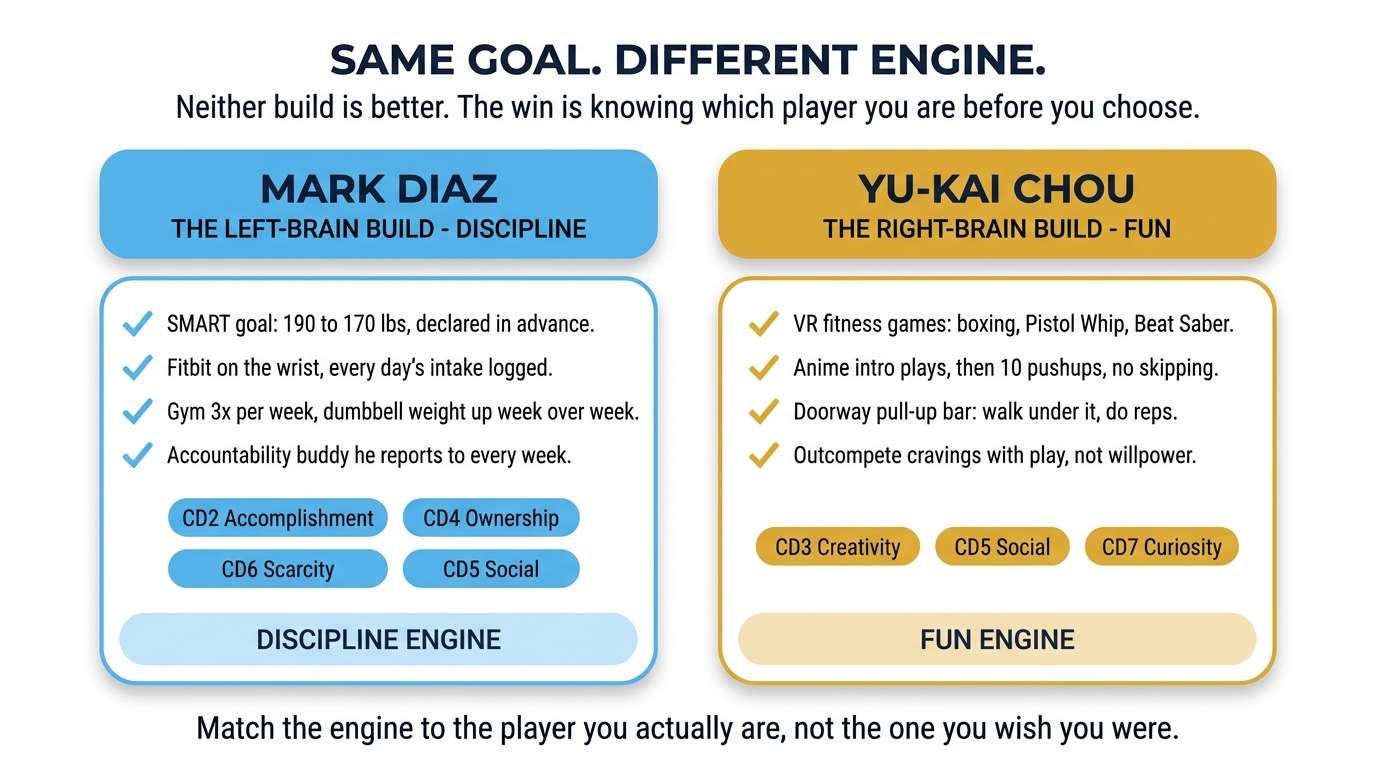
Here’s the most useful idea in this whole article: you don’t pick the “best” Core Drives. You pick the ones that match your attributes. And Mark Diaz is the clearest proof I have, because we wrote his actual plan into the book.
What Mark Did: The Left-Brain Build
Mark came up through my Octalysis Prime mentorship guild and later became my co-author on 10K HP. One of his game objectives was to “live a long, healthy life,” and his main health quest was to lose weight. He has something I don’t: real discipline. So he leaned hard into the left brain, and it shows in every detail of his plan.
First he made the goal SMART. Instead of a vague “I want to lose weight,” he set a precise quest: shed twenty pounds of body fat in two months, starting at 190 pounds, victory declared at 170. Specific, measurable, time-bound. That’s CD2 talking. A clear number to hit is the whole point.
Then he built two task lists. For diet, he consulted a nutritionist, planned and prepped weekly meals against a calorie target, cut empty calories, kept a list of healthy foods he actually enjoyed, drank his eight glasses of water a day, and tracked every day’s intake in the Fitbit app. For exercise, he bought a Fitbit to count steps, joined a gym, scheduled workouts at least three times a week, walked 8,000 steps a day, pushed his dumbbell weight up week over week, and logged each session’s duration and intensity.
Look at the machinery there. The Fitbit data he owns and watches climb is CD4, Ownership & Possession. The rising step count and the heavier dumbbells are CD2, the satisfaction of measurable accomplishment. He even added a dose of black-hat urgency through CD6: a rule that if he didn’t finish a task on schedule, he had to wait out a cooldown before trying again, which manufactured the pressure to just do it. And he recruited an accountability buddy he reported to every week, which is the one right-brain ingredient he borrowed: CD5, Social Influence.
Did it work in two months? Not quite. It took him six. Old habits die hard, and Mark had several. But because every part of his system was measurable, his progress stayed visible even when it was slow, so he kept going and reset the deadline every two months until the scale read 170. The numbers that motivated him in the first place are the same numbers that carried him through the dip. That’s the left brain working exactly as designed.
What I Did: The Right-Brain Build
I am not built like Mark. Discipline is one of my weaknesses, and I’ve stopped pretending otherwise. If I lean on CD2 and CD4, on tracking and targets, I burn out in a week. A Fitbit telling me I missed my step goal doesn’t push me to move. It pushes me to feel bad and quit.
So I went the other way and built my entire weight-loss game on the right brain. I didn’t try to become more disciplined. I made losing weight more fun. Same destination as Mark, completely different engine, chosen to fit the player I actually am instead of the player I wish I were.
This is the core move of play-to-win, and almost nobody does it on purpose: redesign the activity so the Core Drives that already light you up are doing the work. Neither build is “better.” Mark’s would fail me, and mine would feel chaotic to Mark; the win is knowing which player you are before you choose your engine.
How I Made Exercise Fun Enough to Do Without Trying
My counter-move for any bad habit is substitution. Instead of trying to want the junk less, I find something better that scratches the same itch.
I love games and entertainment, and I was going to spend that time anyway. So I substituted my sedentary entertainment for entertainment that happens to torch calories. VR exercise games turned out to be the cheat code, except it’s the legitimate kind, where the cheat is that you’re having too much fun to notice you’re working out. VR fitness can burn 400 to 800 calories an hour (San Francisco State’s VR Health Institute rated Thrill of the Fight at 9.74 to 15.32 calories per minute in metabolic-cart testing), and the real prize is consistency, because you actually come back tomorrow.
Here’s my current rotation, and what each one trains:
- Boxing (Thrill of the Fight, Underdog Boxing): pure cardio. Gets me out of breath with my heart pounding within minutes. Conditioning work disguised as throwing hands.
- Pistol Whip: legs. All the dodging and ducking leaves my legs sore the next day, and it feels like a rhythm shooter instead of a squat session.
- Beat Saber: big arm motions and some cardio. The surprise benefit is that it helped resolve the shoulder pain I’d built up from chronic desk work. Mobility I’d never have done as “exercise.”
- Eleven Table Tennis and the ninja games: active legs and arms at a lighter intensity, great for a day I want to move without dying.
- Dungeons of Eternity: continuous activity with the heart rate up. This is the one I’m most addicted to. I’ve played five hours straight, swapping batteries to keep going.
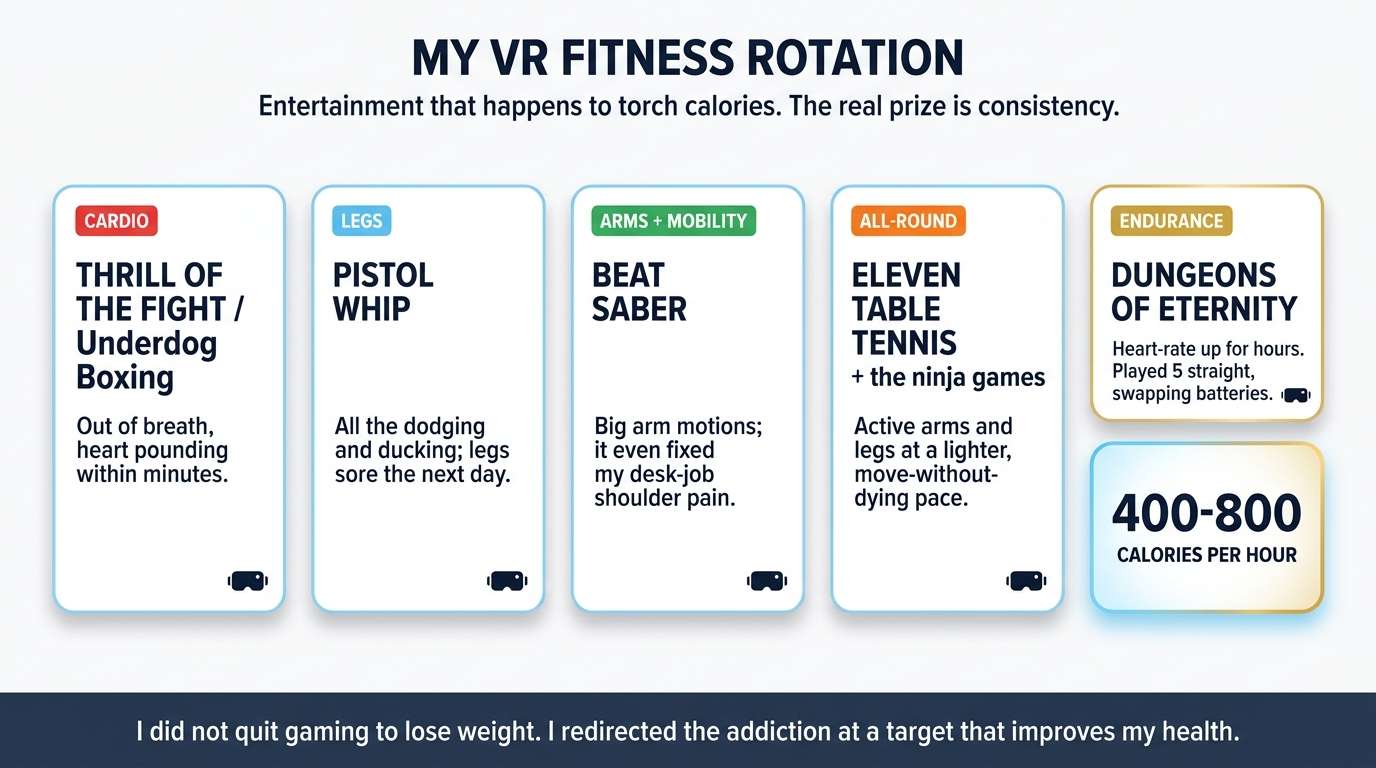
That last point is the whole philosophy in one example. I used to give that kind of marathon to World of Warcraft. Rather than quit gaming to lose weight, I redirected the same addiction loop the Hook Model builds at a target that improves my health instead of eroding it. The pull is identical; the outcome flipped.
Then I gamified the entertainment I wasn’t going to give up either. I watch a lot of anime, so I turned the watching itself into a trigger. The rule: whenever the intro music plays, I don’t skip it. I do 10 pushups, or 40 situps, or a 60-second plank. It sounds small until you do the math on a binge. Accidentally watch ten episodes, and that’s 100 to 200 pushups or 400 situps in a day I’d otherwise have spent fully horizontal. The bad habit became the workout bell.
While the episode actually plays, I’m rarely still. I’ll stretch, spin a hula hoop, or move some light weights. And I keep a pull-up bar in a doorway I pass constantly, with one rule: walk under it, do 10 to 20 pull-ups. No scheduling, no willpower. The environment does the reminding.
The meta-rule on top of all of it: do some of it every day, and never let boredom become an excuse to quit. If I get sick of boxing, I skip it and play something else. The goal is to keep playing, and you only keep playing a game you enjoy; the day it feels like a chore is the day the design failed.
How I Eat Without Ever Feeling Deprived
The eating side runs on the same principle. No suffering, because suffering doesn’t last.
I wake up late, because I work late, and I skip breakfast without thinking about it. By the time I’m up, the fasting window has mostly closed itself. Then I eat a huge, satisfying lunch, the kind that leaves me almost guilty for how much I put away. Anything I want. That single permission removes the deprivation feeling that sabotages most diets before lunch on day one.
Between 4 and 6pm I have a second meal, this time with no carbs. Again, within that one rule, I eat as much and as lavishly as I want. Steak, fish, eggs, vegetables, fat, flavor. The carb cutoff does the heavy lifting, and the abundance keeps me sane.
After 6pm the kitchen is closed, which is exactly where most people break. So I don’t rely on willpower for the hard part either. When the hunger hits at night, I go play a VR game, and within a few minutes it’s simply gone, because my brain is busy dodging bullets or clearing a dungeon. Anime works too. So does getting absorbed in real work. Instead of resisting the craving, I outcompete it with something my brain finds more interesting than food, which is the right brain again, quietly doing what discipline was supposed to do.
“But a VR Headset Is Expensive!”
This is the objection I hear most, and I understand it. A VR headset or a Ring Fit setup feels like a real expense, especially next to “just eat less,” which is free. Three things change the math.
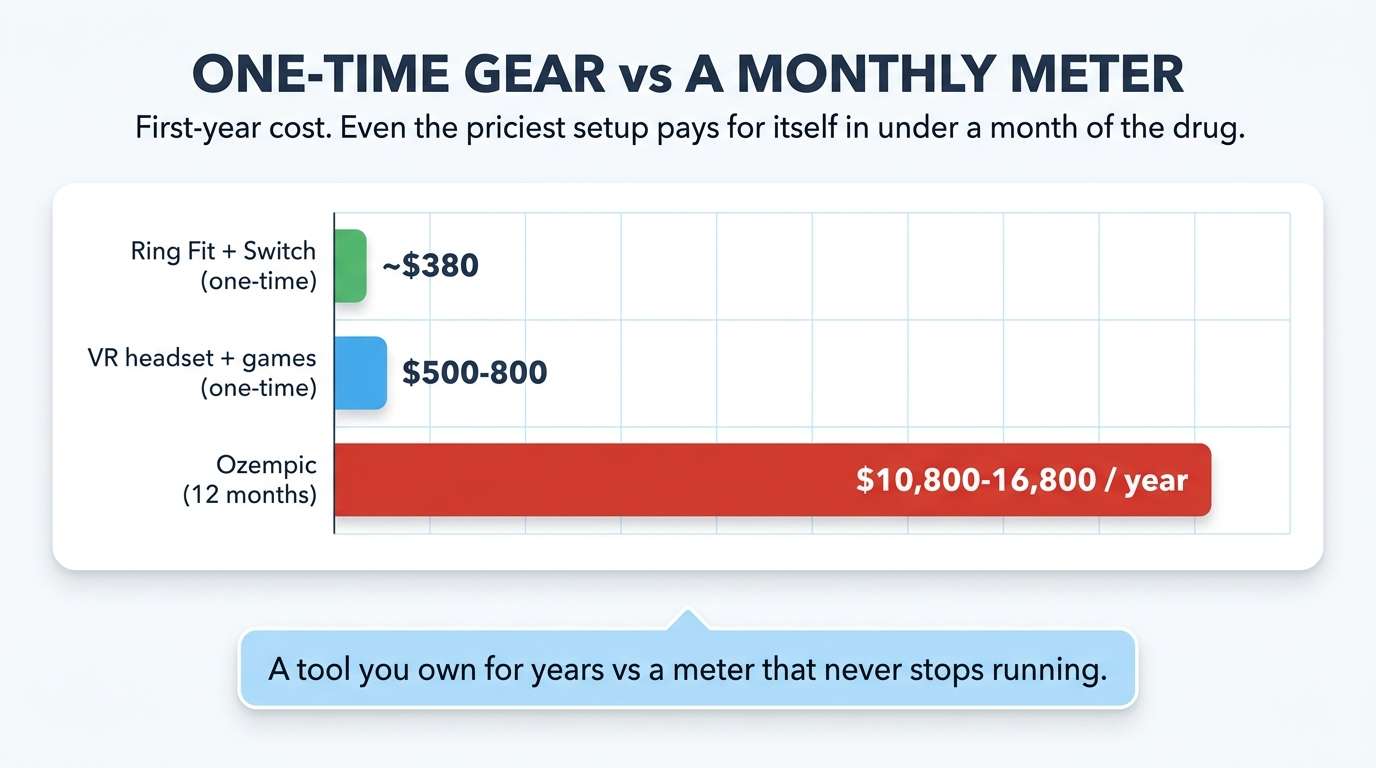
First, it’s far cheaper than Ozempic. A VR headset plus a few games runs about $500 to $800, one time. A Ring Fit setup costs less, though you’ll need a Nintendo Switch if you don’t already own one. Ozempic lists at $900 to $1,400 every single month, which is $10,800 to $16,800 a year at full price, and even the discounted 2026 programs charge $150 to $500 a month for as long as you stay on them. Even the priciest setup costs less than a single month at list price, and then it keeps working for years. One is a tool you own; the other is a meter that never stops running.
Second, it’s far healthier. The drug can cost you muscle and bone while it removes fat. Active play does the opposite. You build cardio, strength, and mobility, the exact tissue you want to protect as you age. There’s no nausea, no pancreatitis risk, no dependency, and your heart and mood get better as a side effect instead of your stomach getting worse. You end up fitter, with lighter as the side effect.
Third, you don’t even need the gadget. The headset is how I made movement fun, because games are my thing. The principle underneath it is what matters: make the activity something you’d happily do anyway, ideally with people you like. So find a daily sport with friends. Ultimate frisbee, badminton, basketball, real boxing, dancing, a hiking group, a pickup league. The cost is close to zero, and you get the most durable motivator there is, CD5, Social Influence and Relatedness. When your friends are waiting at the court, you show up on the days willpower alone would have lost. Find the version of play that fits you, and the gear becomes optional. And if you want to start with the phone already in your pocket, the best gamified fitness apps run the same play-to-win loop for free.
The Scoreboard So Far
This is the game I’m currently playing, with real stakes on a real scale.

So far, this approach has taken 9 kilograms off me. My next quest objective is another 15. And I’m confident about that number for the same reason I’m writing this: I’m not dreading any of it. There’s no day I’m counting down to, no finish line where I get to stop and watch the weight flood back. I built a way of living I actually enjoy, which means the progress is mine to keep. That’s the entire difference between renting a body and owning one.
Ozempic will get a lot of people to a lower number, and for some of them that’s the right call. But it’s a number you rent, at anywhere from $150 a month discounted to $1,400 at list price, with a real chance of side effects and a two-thirds refund of your progress the day you stop. Play-based weight loss asks more of you upfront. You have to design the game and match it to who you actually are, the way Mark and I built two different plans for two different players. Do that, and you get something the injection can never sell you: a body you earned, kept by a life you’d choose to live anyway.
Stop paying to win. Learn to play.
If you want to build your own version of this, start with the engine. Learn the eight Core Drives in the Octalysis Framework so you can design motivation around the player you actually are, then read 10,000 Hours of Play to turn any hard goal, weight loss included, into a game worth winning.
Frequently Asked Questions
Is play-based weight loss as effective as Ozempic?
For raw speed, GLP-1 drugs like Ozempic usually drop weight faster. The difference is durability. Studies show roughly two-thirds of drug-driven weight loss returns within a year of stopping, because nothing about how you live changed. Play-based weight loss is slower to start but compounds, because you’ve built habits you enjoy and won’t abandon. You’re optimizing for the weight you keep off.
How much weight can you really lose with VR fitness games?
VR fitness can burn 400 to 800 calories an hour, comparable to running or cycling. The bigger advantage is consistency: people stick with workouts that feel like play far longer than workouts that feel like chores, and consistency is the real predictor of weight-loss success. I’ve lost 9 kg combining VR exercise with intermittent fasting.
Isn’t a VR headset too expensive?
A headset plus a few games runs about $500 to $800, one time. Ozempic lists at $900 to $1,400 a month (2026 discount programs still run $150 to $500), indefinitely, so even the priciest setup costs less than a month or two of the drug and then lasts for years. If that’s too much, a Ring Fit setup is cheaper (you’ll just need a Switch), and a sport with friends is nearly free.
What are the best VR games for weight loss?
My rotation is Thrill of the Fight and Underdog Boxing for cardio, Pistol Whip for legs, Beat Saber for arms and shoulder mobility, Eleven Table Tennis for all-around movement, and Dungeons of Eternity for long, heart-rate-up sessions. Supernatural and FitXR are also popular. The best one is whichever you’ll actually keep playing.
Do I need a VR headset to do play-based weight loss?
No. The headset is just how I made movement fun. The principle is to pick an activity you’d happily do anyway, ideally social: ultimate frisbee, badminton, basketball, real boxing, dancing, or a hiking group. Friends waiting for you is one of the strongest motivators there is.
Is intermittent fasting required?
It’s not mandatory, but it’s the lever I found easiest to sustain because it only limits when I eat rather than what. My version is a big lunch, a no-carb second meal between 4 and 6pm, and nothing after. Start at the one-star level (an 11am–6pm eating window) and climb only if it feels easy.
How did Yu-kai’s approach differ from Mark Diaz’s?
Both are gamified, but they use opposite Core Drives. Mark has discipline, so he won with left-brain drives: SMART numeric goals, Fitbit tracking, scheduled workouts, and accountability. I lack discipline, so I won with right-brain drives: VR games, curiosity, and substituting fun for willpower. The lesson is to match the engine to the player.
Will the weight come back the way it does after stopping Ozempic?
That’s the core advantage. Drug-driven loss reverses for about two-thirds of people within a year because the underlying behavior never changed. With play-based weight loss, the behavior is the change, and it’s one you enjoy, so there’s no “stopping” moment that triggers regain, and you keep what you built.
Sources and Further Reading
- Yu-kai Chou & Mark Diaz, 10,000 Hours of Play — the 10K HP framework and Mark Diaz’s quest-list example (Chapter 8).
- The Octalysis Framework — the 8 Core Drives, including the left-brain and right-brain split.
- Columbia University Department of Psychiatry, “The Rise of Ozempic for Weight Loss Sparks Ethical Concerns” — cost ($900–$1,400/month list price) and access.
- Wilding et al. (2022), “Weight regain and cardiometabolic effects after withdrawal of semaglutide: the STEP 1 trial extension,” Diabetes, Obesity and Metabolism — roughly two-thirds of lost weight regained within a year of stopping; lean-mass loss.
- The VR Health Institute at San Francisco State University — metabolic-cart calorie ratings for VR games (active titles land in the 400–800+ cal/hour range).