

Short answer: The Hook Model is Nir Eyal’s four-step habit cycle: Trigger, Action, Variable Reward, and Investment. He formalized it in his 2014 book Hooked: How to Build Habit-Forming Products, drawing on Skinner, Duhigg, and BJ Fogg.
Run the loop enough times and users stop needing push notifications. Internal triggers like boredom and FOMO take over, and the product becomes a habit.
The Hook Model tells you what to build. Octalysis tells you why it works and when it will backfire, because the loop leans heavily on Black Hat Core Drives like Unpredictability and Loss.
Nir Eyal’s Hooked became one of the defining books of product-led growth, and platforms like TikTok show what happens when a habit loop is tuned for relentless repeat use. Compulsive social-media behavior is now common enough to be part of mainstream public-health conversations. The Hook Model explains how all of this happens: a four-step cycle that transforms casual users into compulsive ones.
But here’s what bothers me: the Hook Model tells you the mechanism of habit formation without telling you why each step actually works on a psychological level. It’s like handing someone a recipe without explaining which ingredients create the flavor — or which ones are quietly toxic.
I’ve spent over twenty years studying human motivation, and when I mapped the Hook Model’s four steps onto my Octalysis Framework, something clicked. Each step targets specific Core Drives — and more importantly, the Hook Model has blind spots that become obvious once you see which Core Drives it ignores entirely.
The Hook Model is far from the only framework I dissect this way. My Behavioral Framework Library gathers every model I reference when auditing habit loops, including a few that supply the ethical guardrails Eyal’s cycle leaves out. Browse it after this piece to see where the Hook Model sits in the bigger landscape of motivation science.
Let me walk you through what I found.
⚡ Speed Run Notes
- The Hook Model is a four-step loop — Trigger → Action → Variable Reward → Investment — that Nir Eyal formalized in his 2014 book Hooked after years of teaching product designers, including as a lecturer at Stanford’s Graduate School of Business.
- Each step maps onto specific Octalysis Core Drives: triggers run on Core Drive 8 (Loss & Avoidance) and Core Drive 5 (Social Influence), action is really about removing Anti-Core Drives, variable reward is pure Core Drive 7 (Unpredictability & Curiosity), and investment activates Core Drive 4 (Ownership) and Core Drive 3 (Creativity).
- The cycle self-sustains when investment becomes the next trigger. Users generate triggers for each other, which is why Facebook and TikTok do not need expensive marketing to keep you coming back. Groupon’s long customer decline shows what happens when a product never closes that loop.
- Habits form through neural plasticity in the basal ganglia. Variable-ratio reinforcement research helps explain why unpredictable rewards drive excessive engagement. It is the same family of mechanism that makes slot machines so hard to walk away from.
- The "vitamin to painkiller" transformation is Core Drive 8 doing its work. The product creates a discomfort it alone can relieve — structurally identical to what substance dependence does to the brain.
- The Hook Model’s biggest blind spot is the Black Hat awareness gap. Its reward and investment loop is dominated by Core Drive 7, Core Drive 4, and Core Drive 8 — intrinsic but Black Hat. Without the White Hat vs. Black Hat distinction, designers build addictive products without knowing they are building addiction.
- Nir Eyal’s Manipulation Matrix is a start on ethics but not a solution. A Facilitator can still build a product that leans hard on Black Hat motivation and leaves users drained.
- Habits cost almost nothing per user once formed — and compound. That is why investors, platforms, and venture capital obsess over "habit formation" and why the same mechanics that make Duolingo delightful are what make TikTok feel inescapable.
- The prescription: study the Hook Model for its elegant loop design, especially the investment-as-next-trigger mechanism. Then use Octalysis to decide which rewards, which investments, and when to deploy White Hat versus Black Hat motivation across the user journey.
Table of Contents
- What Is the Hook Model?
- The Four Steps of the Hook Model
- The Vitamin-to-Painkiller Transformation
- What Nir Eyal Got Right
- Where the Hook Model Falls Apart
- What’s Really Happening Inside the Brain
- The Hook Model vs. Other Theories
- The Hook Model in the Real World
- The Elephant in the Room
- How to Apply the Hook Model with the Octalysis Framework
- Practical Steps for Designing Ethical Hook Cycles
About the Creator of the Octalysis Framework

Yu-kai Chou created the Octalysis Framework after studying gamification since 2003 — years before the term entered mainstream vocabulary. As a Human-Systems Architect & Behavioral Designer, his framework has been applied by LEGO, Microsoft, Porsche, Coca-Cola, Salesforce, and MrBeast, impacting over 1.5 Billion Users.
Chou has taught the Octalysis methodology at Harvard, Stanford, Yale, Tesla, Google, BCG, and IDEO.
His work has been cited by Harvard, Stanford, MIT, Forbes, Wall Street Journal, Wired, US Department of Energy, NIST, NSF, NCBI, US Department of Education, ClinicalTrials.gov, and Google Scholar — with 3,700+ more academic publications. Explore his books here.

What Is the Hook Model?
The Hook Model is a four-step behavioral design loop — Trigger, Action, Variable Reward, Investment — that describes how products transform first-time users into people who open them on reflex. It was formalized by Nir Eyal, a former Stanford lecturer and Silicon Valley product consultant, in his 2014 bestseller Hooked: How to Build Habit-Forming Products.
Eyal did not invent habit research. Variable reinforcement schedules come out of B.F. Skinner’s operant-conditioning lab in the 1950s. The role of cue, routine, and reward in habit formation was popularized by Charles Duhigg in The Power of Habit. BJ Fogg’s Behavior Model (B = MAP) was the direct design framework Eyal drew from for his Action step.
What Eyal did was package the best of that research into a shape that product managers at Facebook, Instagram, X (formerly Twitter), and Slack could actually use at a Monday morning design review. Four steps. One loop. Put a diagram on a whiteboard. Ship.
The stated purpose in the book is to help makers build products that solve real problems for users. The actual usage over the last decade has been broader and darker than that. By the time Hooked hit mass-market audiences, "growth" teams at most consumer apps were reverse-engineering its four steps onto metrics dashboards — DAU, session frequency, retention curves — and the ethical framing in the book was often skipped.
The result is a framework that works and has almost certainly done more harm than its author intended, which is a pattern any serious behavioral designer needs to understand before they use it on other humans.
The Four Steps of the Hook Model
The Hook Model describes a four-step cycle: Trigger → Action → Variable Reward → Investment. Repeat this cycle enough times, and you have a habit. Simple, right?
Too simple. Each of these steps hides a complex motivational engine, and the Octalysis Framework reveals what is actually driving each one.
| Hook step | What it is really doing | Primary Octalysis drivers | Motivational skew |
|---|---|---|---|
| Trigger | Creates discomfort, curiosity, or social pull strong enough to restart the loop. | CD8, CD5, sometimes CD6 | Often drifts Black Hat when the product manufactures anxiety or FOMO. |
| Action | Removes friction until the reward feels close enough to grab. | Lower Anti-Core Drives, usually powered by anticipation from CD6 and CD7 | Neutral by itself. The reward behind it determines whether it feels healthy or manipulative. |
| Variable Reward | Delivers surprise, novelty, and the urge to check one more time. | CD7, plus situational bursts of CD5 or CD2 | This is where the loop most naturally slides into Black Hat compulsion. |
| Investment | Stores progress, identity, and user-generated value that makes leaving feel costly. | CD4 and CD3 | Feels productive on the surface, but it easily becomes lock-in when paired with Black Hat motivation. |
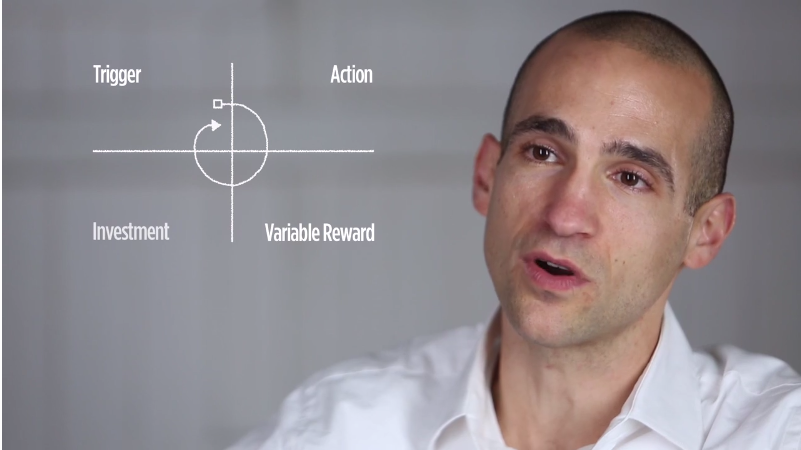
Step 1: Triggers — The Transition From External to Internal
Nir Eyal distinguishes between external triggers (push notifications, ads, emails, salespeople knocking on your door) and internal triggers (emotions or situations that prompt you to act without anyone asking).
External triggers are expensive and unsustainable. Every push notification is a company spending resources to remind you they exist. The real goal of the Hook Model is to graduate users from external triggers to internal ones, where they reach for your product on their own.
Here is a story that illustrates this perfectly. I had a friend who was already on Facebook. He was scrolling through his feed, got bored, instinctively opened a new tab, and typed "facebook.com" into the address bar. He was already there. But the internal trigger — boredom — fired so automatically that it bypassed any conscious awareness of his current state.
That is the power of an internal trigger. It is not a notification pinging your phone. It is a feeling in your body that your brain has learned to resolve with a specific product.
Through the Octalysis lens, internal triggers map primarily to Core Drive 8: Loss & Avoidance, the mild discomfort you feel when you are not using the product. It is that nagging itch. The sense that something is missing. Also at play is Core Drive 5: Social Influence & Relatedness, the social context triggers like "I need to share this with my friends" or "I wonder what people are saying."
There is also an important hybrid mechanism here: Appointment Dynamics. These are time-based internal triggers, like knowing the garbage truck comes on Tuesday, or that your favorite show drops new episodes on Friday. These are a Core Drive 6 (Scarcity & Impatience) and Core Drive 8 hybrid — you feel both anticipation for the scheduled event and mild anxiety about missing it.
The Groupon Warning
This is the story of Groupon’s long slide from 2014 to 2024. Groupon launched in 2008, went public on Nasdaq on November 4, 2011, and reported 53.9 million active customers at the end of 2014.
Consider what happened to Groupon. Their entire business model relied on external triggers: salespeople calling store owners to run the next campaign. Store owners would run one Groupon deal, spend months servicing bargain-hunting customers who never came back at full price, and never voluntarily returned to Groupon.
The trajectory tells the story. Groupon spent years shrinking across customers, revenue, and market confidence. It is a clean example of what happens when a business depends on expensive external triggers but never builds an internal reason to come back.
Why? Because Groupon never created internal triggers. Store owners did not wake up thinking "I should run a Groupon." They had to be called, persuaded, and sold, every single time. When the external trigger machine slowed down, the entire business collapsed. No Core Drive 8 discomfort from not using it. No habit loop. Just an expensive external trigger operation that ran out of fuel.
Groupon is still in business in 2026. Under Dusan Senkypl, who took over as CEO in 2023, it reported growth in both billings and revenue for 2025, its first such year in a decade.
Gross billings rose 7% to $1.7 billion and revenue rose 1% to $498.4 million, with 16.2 million active customers at the end of the year.
That is still about 70% fewer active customers than the 53.9 million it had at the end of 2014, and its revenue is a fraction of the $3.2 billion it reported for that year, so the recovery starts from a much smaller base.
The Hook Model question to ask of that growth is whether merchants and customers are now coming back on their own, or whether Groupon is simply running its external triggers harder.
Step 2: Action — Make It Absurdly Easy
The Hook Model borrows from BJ Fogg’s Behavior Model (B = MAT, now updated to B = MAP: Behavior equals Motivation times Ability times Prompt). The core idea: after the trigger fires, the action must require minimal effort. Fewer brain cycles, less money, less time, less social deviance, less physical effort.
Behavior-change research keeps landing on the same pattern, including recent review work in BMC Public Health. When the target behavior feels easier, outcomes improve even if motivation is only moderate. The bottleneck is usually friction, not desire.
Through Octalysis, I see this differently than most people. Reducing friction is more than making the button bigger or the form shorter. It means removing Anti-Core Drives — the forces that actively work against the desired behavior.
Fewer brain cycles means less Anti-Core Drive 2 (the effort undermines the feeling of accomplishment). Lower social deviance means less Anti-Core Drive 5 (you do not want to feel weird in front of peers). Less physical effort means less Anti-Core Drive 8 (pain avoidance kicks in).
But here is my real observation about "Action" in software products: most of the time, the action is just clicking a button. The click itself is trivially easy. The real design challenge is not making the click easy, it is making sure the user anticipates a reward before clicking. That anticipation comes from Core Drive 6 (Scarcity & Impatience) and Core Drive 7 (Unpredictability & Curiosity) — you cannot wait to see what is behind the door.
Step 3: Variable Reward — The Engine Room of Addiction
This is where the Hook Model earns its reputation. Nir Eyal did not just say "reward," he specifically said variable reward. Because the Skinner Box research proved decades ago that unpredictable outcomes drive excessive engagement even when the subject does not need the reward.
Think about pulling down to refresh your social media feed. Scientists have shown that this activates the same neural pattern as pulling a slot machine lever. "Did I win? Did I win? Oh, nothing interesting. How about now? Oh, this is so cool."
You can see the pattern most clearly in TikTok and every other infinite-scroll feed. Recent public-health writing increasingly treats compulsive scrolling as its own design problem, and variable reinforcement is a big reason why. The same reward circuitry that makes intermittent wins feel magical is also what makes these loops so hard to put down.
Nir Eyal classifies variable rewards into three types, and this is one of the book’s most useful contributions:
- Rewards of the Tribe. Social validation. Likes, comments, shares, replies — the human-to-human surprise that your tribe saw, noticed, approved. This is Core Drive 5 (Social Influence & Relatedness) delivered on a variable schedule.
- Rewards of the Hunt. The search for resources. Pinterest’s endless boards, Amazon’s "customers also bought," the TikTok For You Page. You never quite know what you will find — Core Drive 7 in its purest form.
- Rewards of the Self. Intrinsic mastery and progress. Unlocking the next level, completing the puzzle, seeing your streak go up. Core Drive 2 (Development & Accomplishment) with a twist of unpredictability.
Every time you visit Pinterest, the homepage shows different images. Your brain subconsciously anticipates: "I wonder what I will see this time." Every visit to TikTok’s For You Page delivers a different constellation of content. The design imperative is clear: after any user action, they should never see the same static dashboard. Something must be new, surprising, different.
Through Octalysis, variable reward maps directly to Core Drive 7: Unpredictability & Curiosity. And this is where it gets interesting. Core Drive 7 is both intrinsic (it creates genuine delight and wonder) AND Black Hat (it creates compulsion and addiction).
The same Core Drive that powers the joy of a surprise birthday party also powers gambling addiction. The same neural architecture that makes Christmas morning magical makes slot machines inescapable. This dual nature is something the Hook Model acknowledges (variable reward is compelling!) but does not provide a framework for navigating (when does compelling become destructive?).

Step 4: Investment — The Hidden Return Trigger
After the reward, the Hook Model asks you to get the user to put something back into the system. Upload a photo. Write a comment. Send a message to a friend. Rate something. Add items to your profile.
This is the most underrated step, and the one that reveals the Hook Model’s elegant self-sustaining architecture.
Through Octalysis, investment activates two Core Drives simultaneously. First, Core Drive 4: Ownership & Possession. The more you have customized, created, or contributed, the more you feel the platform is "yours." Your Spotify playlists. Your carefully curated Instagram aesthetic. Your Reddit karma. These are far more than data points. They are psychological ownership stakes.
Second, Core Drive 3: Empowerment of Creativity & Feedback. The more you have shaped your experience, the more invested you are in seeing the outcome of your creative choices.
But here is the part that makes the Hook self-perpetuating: investment frequently becomes the next trigger. You ask a friend a question on the platform. Your friend answers. A push notification arrives. You return to see the answer — that is a new variable reward. You are prompted to invest again (reply to their response). Each cycle’s investment seeds the next cycle’s trigger.
This is what makes the cycle so powerful. It does not need an external marketing team to restart it. The users generate their own triggers for each other.
I have a name for the gravitational pull this creates. Status Quo Sloth. Once a user has invested enough into your system, they don’t just keep coming back — they actively resist leaving, even when they know they should. The cost of starting over somewhere else feels physical. That weight is the Investment step doing its long-term work, and it is the same weight that turns a habit into something that looks more like dependency.
The Vitamin-to-Painkiller Transformation
Venture capitalists love to ask: "Is your product a vitamin or a painkiller?" Vitamins are nice-to-have. Painkillers are must-have. Investors want painkillers.
Nir Eyal’s most provocative insight is that when the Hook cycle runs enough times, the vitamin becomes its own painkiller. Users start feeling mild pain when they do not use the product. A fidgety feeling creeps in when you have not checked your phone. The feeds call to you when you have been away too long. Missing out on what happened feels like a low-grade ache.
Through Octalysis, this transformation maps precisely to Core Drive 8: Loss & Avoidance. The product did not solve a pre-existing pain — it created a new one and then positioned itself as the only relief.
I have described this honestly in my teaching: "So it is like drugs? You did not have a problem, but once you take it, it creates a problem and it satisfies its own problem." This is the central ethical tension of the Hook Model, and it is a tension that the model acknowledges but does not resolve.
This is why the shift matters so much. A product that solves a pre-existing need (a weather app, a calculator, a password manager) is a tool. A product that creates the need it then sells back to you is closer to a dependency. The Hook Model is agnostic about which one you build. Your brand, your career, and the long-term health of your user base are not.
There is one more piece of this I only talk about in workshops, because it does not fit cleanly into the named eight Core Drives. Addiction has a somatic pull. Call it the ninth hidden Core Drive: Sensation. The dopamine spike, the thumb-flick rhythm, the small physical relief of the notification arriving — these are body-level rewards layered on top of the psychological ones. When I have advised treatment programs working on substance and behavioral addiction, the staff there confirm what Octalysis predicts: you cannot reason a person out of a Sensation loop with a Core Drive 2 progress bar. You have to crowd it out with stronger doses of the other Core Drives — Core Drive 1 (Epic Meaning), Core Drive 5 (people who actually care about them), Core Drive 3 (a creative outlet for the same energy). The Hook Model never talks about Sensation. It is one of the reasons hook-built products often beat willpower so completely.
What Nir Eyal Got Right
It is easy to dunk on the Hook Model in 2026, with a decade of social-media mental-health research in the rear-view mirror. I want to be careful here. Before I unpack where the framework falls short, I want to be specific about what Eyal nailed — because anyone who dismisses the Hook Model wholesale is throwing away real insight.
He made habit research operational. Before Hooked, the science of habit formation lived in academic journals, Charles Duhigg’s popular-press writing, and BJ Fogg’s Stanford lab. Product managers did not use any of it. Eyal’s four-step diagram is simple enough to fit on a napkin, which is exactly why it became the default mental model at roughly every consumer software company that mattered between 2014 and 2020.
He elevated the Investment step. Duhigg’s cue-routine-reward model ends at reward. Eyal added a fourth step and correctly observed that this fourth step is what makes the loop self-sustaining. That observation alone explains why Facebook, Instagram, X, and TikTok did not need to pay for traffic after reaching critical mass: users generate each other’s triggers through their investments. It is the single most important mechanic in the platform era.
He separated external from internal triggers. A lot of marketing thinking treats all triggers as basically the same — ping the user, they come back. Eyal clarified that external triggers are expensive and temporary, and that the long-term game is transitioning users to internal emotional triggers. The Groupon-vs-Facebook contrast I describe above only makes sense through his lens.
He classified variable rewards into Tribe, Hunt, and Self. This is the single most useful taxonomy in the book. It forces a designer to ask whether a given reward is social validation, material acquisition, or intrinsic mastery — and that question genuinely changes the product. Most "variable reward" designers I consult with on Octalysis engagements have never seen this taxonomy, and their dashboards are usually drowning in Hunt-style rewards with almost no Tribe or Self rewards to balance them.
He addressed ethics, even if incompletely. Eyal’s Manipulation Matrix is not a perfect ethical framework, but he gets credit for including an ethics chapter at all in a product-design book written during an era when most of the industry just wanted to know how to boost retention. The 2019 follow-up, Indistractable, doubled down on that responsibility by teaching users how to defend against the mechanics his first book taught companies to build. Not every author in tech has that kind of arc.
When I teach Hook Model material in Octalysis workshops, I lead with all of this. The framework is a real contribution. The critique below is about the work that the Hook Model explicitly did not set out to do — work that an S-Tier behavioral designer has to do anyway.
Where the Hook Model Falls Apart
I want to be clear: I am not criticizing the Hook Model as a whole. Nir Eyal did important work making habit formation accessible to product designers. But the framework was specifically designed for B2C consumer software — websites, mobile apps, social media — and it has three limitations that become obvious when you overlay Octalysis.
Limit 1: Scope — It Only Describes Digital Products
The Hook Model targets habit formation in digital products. Octalysis applies to any human experience: classrooms, sales floors, parenting, physical spaces, government policy, health systems, fitness, finance.
If you are designing a corporate training program, a city’s recycling initiative, a hospital’s chronic-disease adherence protocol, or a school’s reading curriculum, the Hook Model’s digital-product assumptions do not transfer cleanly. "Variable reward" and "push notification" are not the native units of a classroom or a hospital ward. The underlying Core Drives absolutely are — which is why the Octalysis Framework generalizes and the Hook Model does not.
I teach Octalysis to governments rolling out savings programs, to pharmaceutical companies running adherence studies, to LEGO designing play experiences for children, and to Microsoft designing learning platforms. The Hook Model gives them almost nothing in those rooms. Octalysis gives them everything.
Limit 2: Motivation Depth — All Triggers Are Treated Equal
The Hook Model says "trigger leads to action" but does not classify why different triggers work for different people. Why does a push notification motivate one user and annoy another? Because they have different Core Drive profiles.
One user is driven by Core Drive 5 — they care what their friends are doing, so a social notification is gold. Another is driven by Core Drive 7 — they are curious about new content, so a "what is new" trigger works. A third is driven by Core Drive 8 — they are afraid of missing something important, so "your streak is about to break" is the right hook.
The Hook Model treats all triggers as functionally equivalent. Octalysis reveals they activate fundamentally different psychological machinery. You cannot do real personalization, segmentation, or lifecycle design without the Core Drive vocabulary.
Limit 3: The Black Hat Awareness Gap
This is the big one. The Hook Model’s variable reward + investment cycle is predominantly Core Drive 7 + Core Drive 4 + Core Drive 8 — a combination that is intrinsically engaging but almost entirely Black Hat.
Black Hat Core Drives create urgency, obsession, and compulsive behavior. They are effective at driving short-term engagement, wildly so. But without understanding the White Hat/Black Hat distinction, practitioners using the Hook Model end up building addictive products without even knowing they are building addiction.
White Hat Core Drives (1: Epic Meaning, 2: Accomplishment, 3: Creativity) make people feel powerful, fulfilled, and in control. Black Hat Core Drives (6: Scarcity, 7: Unpredictability, 8: Loss) make people feel urgent, anxious, and compelled.
A well-designed product transitions users from Black Hat hooks (which capture attention) to White Hat engagement (which sustains it). The Hook Model does not make this distinction at all, which is why it produces products that capture attention brilliantly but often leave users feeling drained, guilty, or trapped.

What’s Really Happening Inside the Brain
Before we compare the Hook Model to other theories, it is worth pausing on the biology. The Hook Model is effective because it maps onto a real neural circuit — not because Nir Eyal wrote a convincing book. Any serious designer working with this framework needs to understand what their cycle is actually doing to a user’s brain.
The trigger activates the anterior cingulate cortex. The ACC is the brain’s conflict-and-attention region. When an internal trigger fires — boredom, loneliness, mild anxiety — the ACC registers the state change and begins shopping for a resolution. If your product has been repeatedly paired with resolving that state, the ACC hands control to the basal ganglia, which runs the habit as a subcortical routine. You reach for your phone before you realize you reached.
The action step is where the prefrontal cortex gets bypassed. Conscious deliberation lives in the prefrontal cortex. Well-designed Hook Models move the user through the Action step before the PFC has time to weigh in. This is why tapping the app icon is frictionless but closing the app on purpose feels hard: one is a habit loop, the other requires executive function.
The variable reward fires the mesolimbic dopamine pathway. This is the critical piece. A landmark 1997 study by Wolfram Schultz showed that dopamine neurons in the ventral tegmental area respond most strongly not to the reward itself, but to the prediction of an uncertain reward. Dopamine is the "wanting" molecule, not the "liking" molecule. Pulling down to refresh your feed gives a bigger dopamine hit than actually reading what appears.
Variable-ratio reinforcement schedules (delivered at unpredictable intervals) keep this wanting system running at maximum output. It is exactly why slot machines exist. It is also why infinite-scroll feeds, randomized match results, and loot boxes are now regulated as gambling in jurisdictions like Belgium and the Netherlands, where the 2018 rulings were re-affirmed by the Antwerp Enterprise Court in January 2025 against Top War: Battle Game. The neural circuit does not care whether the "win" is a dollar coin, a like, or a rare Pokémon.
The investment step builds myelin on the loop. Each time you repeat the full cycle, the neural pathway becomes more efficient. Myelination makes the habit faster and more automatic. This is why early users can quit easily and long-term users cannot: the circuit has been physically insulated for speed.
Dopamine dysregulation from chronic variable-reward stimulation is not a theory. Andreassen and colleagues’ 2017 work on addictive social media use, the Christian Montag group’s research on Internet Use Disorders, and a growing line of work on Internet Gaming Disorder consistently show altered reward-prediction signaling and shifts in striatal dopamine receptor binding in heavy users — patterns that echo what is seen in substance use disorders.
The practical takeaway for designers: when you deploy variable reward at scale, you are physically rewiring brains. That is a responsibility, whether or not the Hook Model talks about it.
The Hook Model vs. Other Theories
The Hook Model is one of a dozen overlapping frameworks that describe human behavior. It does not exist in a vacuum, and every serious designer should know how it stacks up against the adjacent theories.
Hook Model vs. BJ Fogg’s Behavior Model (B = MAP)
The Hook Model’s Action step is literally imported from BJ Fogg. Fogg’s formula — Behavior equals Motivation times Ability times Prompt — describes whether a single behavior will occur. The Hook Model describes whether that behavior will become a habit over time.
Put differently: Fogg is a single-event model, Hook is a loop model. If you are designing a one-time sign-up flow, you want Fogg. If you are designing sustained engagement, you want Hook. If you want to know why either of them works on a given user, you want Octalysis.
Hook Model vs. Skinner’s Operant Conditioning
Everything the Hook Model says about variable reward is Skinner, rebranded for 2014 product designers. Skinner showed in the 1950s that variable-ratio reinforcement schedules (unpredictable rewards) produce the highest and most extinction-resistant response rates.
Hook is Skinner plus two additions: the Investment step (stickiness beyond reinforcement) and the explicit trigger taxonomy (external vs. internal). If you want the deepest history of where the variable-reward idea comes from, see my breakdown of Skinner and operant conditioning through Octalysis.
Hook Model vs. Self-Determination Theory (Ryan & Deci)
Self-Determination Theory says humans thrive when three psychological needs are met: autonomy, competence, and relatedness. It is a model of sustained wellbeing.
The Hook Model is a model of sustained usage. Those are not the same thing. You can satisfy Hook’s four steps while systematically violating SDT’s autonomy need (dark patterns that remove user choice) or competence need (infinite feeds that never feel "done"). This is the cleanest diagnostic for why a product can be wildly engaging and still leave users feeling empty — Hook is satisfied, SDT is starving. Our Self-Determination Theory guide goes deeper on this distinction.
Hook Model vs. Flow Theory (Csikszentmihalyi)
Flow is the state of total absorption in a well-matched challenge. It is the gold standard for intrinsic engagement — the kind of engagement a user walks away from feeling replenished, not drained.
The Hook Model does not aim for flow. It aims for return frequency. A perfectly Hooked user can be in a dissociative scroll state that looks like flow from the outside (time dilation, focus narrowing) but lacks the challenge-skill match, intrinsic mastery, and post-state sense of accomplishment that define real flow. See our Flow Theory guide for the distinction. The practical rule: if your engagement looks like flow and feels like regret, it is Hook, not Flow.
Hook Model vs. Cialdini’s Influence Principles
Cialdini describes short-term persuasion: reciprocity, commitment, social proof, authority, liking, scarcity, unity. These are cues that bias a single decision.
Hook describes long-term habituation. A well-designed product uses Cialdini cues at the acquisition and activation stages to drive the first few cycles, then hands off to Hook’s Investment-as-Trigger loop to keep the user returning. If you want the taxonomy of the short-term levers, my Cialdini through Octalysis breakdown covers each one.
The Hook Model in the Real World
The Hook Model has been applied, misapplied, and quietly used to design almost every consumer application you touch. A few worked examples, and what I would have done differently on each.
Social Media and Infinite Feeds
Instagram, TikTok, Twitter/X, and Facebook are the textbook Hook Model implementations. The external trigger is the push notification. The internal trigger is boredom or loneliness. The action is opening the app and scrolling. The variable reward is the next piece of content — social validation, a new meme, someone else’s envy-generating vacation photo. The investment is the like, the follow, the comment, the saved post.
These products are the clearest real-world demonstration that the Hook Model works. They are also the clearest real-world demonstration of the Black Hat Awareness Gap. A 2025 Pew Research study found 48% of US teens think social media has a mostly negative effect on people their age, up from 32% in 2022. That is not an accident. It is what happens when a Hook loop runs on Core Drives 7, 4, and 8 without a White Hat balancer.
Education and Duolingo
Duolingo is the Hook Model done closer to right. Triggers are time-based appointment dynamics (your streak notification at 7 PM). Action is a two-minute lesson, designed for maximum Ability. Variable reward is XP, progress bars, occasional "chest" openings. Investment is streak length, leaderboard ranking, and skill-tree completion.
What Duolingo gets right that Instagram gets wrong is the White Hat layer underneath. Core Drive 2 (Development & Accomplishment) runs parallel to Core Drive 8 (don’t break the streak) the whole way through. Users walk away feeling they learned something, not drained. Duolingo reported 37.2 million daily active users in Q3 2024, up 54% year-over-year, with retention metrics unusual for language-learning apps. That is Hook on top of a White Hat foundation.
I tell my Octalysis students: study Duolingo’s Hook, not TikTok’s. Same mechanics, very different brain outcomes.
Healthcare and Adherence Apps
Medication adherence, diabetes self-management, and chronic-disease behavior change are where the Hook Model genuinely saves lives — when it is designed with White Hat support rather than Black Hat pressure.
A 2024 Journal of Medical Internet Research systematic review of habit-formation techniques in digital behavior-change interventions found that the most effective adherence apps combined cue-based prompts with self-monitoring, rewards, and a sense of personal control over the experience — the digital equivalent of pairing Hook mechanics with autonomy-supportive framing from Self-Determination Theory. Pure Hook without the autonomy layer tends to degrade into guilt-inducing nags that patients disable. Pure autonomy support without the Hook mechanics fails to build the daily cue-response pattern.
The takeaway: in healthcare, you cannot ship a pure Hook Model. You ship Hook with Octalysis’s White Hat Core Drives woven through the reward structure.
Workplace Software and the Productivity Paradox
Slack, Microsoft Teams, Asana, Linear, and every other workplace collaboration tool now uses Hook mechanics. Notifications trigger you. The red-badge unread count is pure Core Drive 8. The variable reward is whatever conversation is happening. The investment is your channel memberships, your @-mentions, your work-identity-on-this-platform.
This is the category where the Hook Model has arguably done the most damage. Gloria Mark’s much-cited UC Irvine field study of office workers found that after an interruption, it took an average of 23 minutes and 15 seconds to return to the original task — workers typically processed about two intervening tasks first. The finding is widely cited in Harvard Business Review and across organizational-design literature. The Hook Model succeeded at making these tools unmissable. Octalysis would have designed them very differently — with Core Drive 1 (Epic Meaning) anchoring real work, Core Drive 2 (Development) measuring completion not activity, and Core Drive 3 (Creativity) surfacing the output, not the chatter.
The Elephant in the Room: Eyal Wrote the Spear and the Shield
There is an irony that perfectly captures the tension inside the Hook Model. Nir Eyal wrote Hooked in 2014, a book about how to create habits in users. Then in 2019, he wrote Indistractable, a book about how to defend against the exact mechanisms he taught companies to build.
The spear and the shield. Built by the same person.
I do not think this makes Nir Eyal a hypocrite. I think it means he saw the same thing I see: the behavioral architecture behind habit formation and habit defense is identical. The same Core Drives that hook you are the same Core Drives you need to understand in order to unhook yourself.
Every serious motivation theory ends up in this same place. Skinner’s operant conditioning explains both the trained rat and the techniques used to deprogram harmful conditioning. Self-Determination Theory explains both workplace engagement and workplace burnout. Flow Theory explains both the absorbed surgeon and the addicted gamer. BJ Fogg’s Behavior Model explains both "Tiny Habits" for positive behavior change and the exact mechanics of dark-pattern onboarding flows.
The same brain is being studied from every angle. The framework is not what makes a design ethical or destructive — the designer’s awareness of which Core Drives they are loading and what state they are leaving the user in is what makes it ethical or destructive.
That is what the Octalysis Framework provides that the Hook Model alone cannot: the vocabulary to distinguish between motivation that empowers and motivation that enslaves. Between the surprise birthday party and the slot machine. Between the product that enriches your life and the one that creates a problem just to sell you the solution.
If you only remember one thing from this post, remember that the Hook Model is morally neutral. What you put in it is not.
How to Apply the Hook Model with the Octalysis Framework
The real value of the Hook Model shows up when you stop using it as a blueprint and start using it as a diagnostic overlay on top of the Octalysis Framework. Hook tells you where the loop is. Octalysis tells you which Core Drive each step is firing, and whether that combination is sustainable.

Map Each Hook Step to Its Core Drives
Start with a Hook audit of your product. For each of the four steps, list the Core Drives that are actually doing the work:
- Trigger. External: typically Core Drive 5 (Social Influence — notifications from people) or Core Drive 8 (Loss — streak about to break). Internal: Core Drive 8 (boredom avoidance) or Core Drive 5 (social context).
- Action. Not a Core Drive by itself. This is about removing Anti-Core Drives: Anti-2 (effort cost), Anti-5 (social deviance), Anti-8 (physical friction).
- Variable Reward. Core Drive 7 (Unpredictability) is always present. Layer with Core Drive 5 (Tribe rewards), Core Drive 4 (Hunt / collection rewards), or Core Drive 2 (Self / mastery rewards).
- Investment. Core Drive 4 (Ownership) and Core Drive 3 (Creativity), plus a second-order Core Drive 5 when the investment is shared with others.
Check the White Hat / Black Hat Balance
Once you have the Core Drive map, classify each drive as White Hat (1, 2, 3) or Black Hat (6, 7, 8). A typical consumer social-media Hook scores roughly 80% Black Hat by activation weight. That is why it is addictive. It is also why users eventually turn on the product.
The S-Tier designer’s rule: use Black Hat to acquire attention, White Hat to keep it. A new user’s first 2–3 Hook cycles can lean heavily on Core Drive 7 and 8 because curiosity and FOMO do the acquisition work. By cycle 10–20, the balance should shift so that Core Drive 2 (genuine progress), Core Drive 3 (creative expression), and Core Drive 5 (meaningful connection) dominate. Users who stay in Black Hat territory past cycle 20 eventually quit, uninstall, or flame out with the product as a public villain.
Use the 4 Experience Phases to Time the Shift
Octalysis’s 4 Experience Phases — Discovery, Onboarding, Scaffolding, Endgame — give you the calendar for the White Hat shift.
- Discovery & Onboarding: Black-Hat-heavy Hook cycles are acceptable. The user does not yet know why your product matters.
- Scaffolding: White Hat Core Drives take over. The Investment step should compound into real mastery, real ownership, real meaning.
- Endgame: The Hook loop is almost vestigial. Users stay because the product is part of their identity (Core Drive 4) and purpose (Core Drive 1). Octalysis Endgame design is the antidote to the Hook Model’s tendency to produce "I use it but I hate it" outcomes.
Pair Hook With Octalysis’s Anti-Core Drives
Octalysis adds something the Hook Model completely ignores: the 8 Anti-Core Drives that resist every action. Every Hook you design should explicitly identify which Anti-Core Drives will fire at each step and neutralize them. This is the difference between "I launched a notification feature" and "I launched a notification feature that does not get muted."
Practical Steps for Designing Ethical Hook Cycles
Here is the workflow I give Octalysis clients when they ask me to review a Hook Model implementation:
- Write down your four steps explicitly. On one sheet of paper. Trigger — what is the external? What is the internal? Action — what is the user literally doing? Reward — which variable, which schedule, which Tribe/Hunt/Self type? Investment — what goes back in, and how does it seed the next trigger?
- Tag each step with its Core Drives. Use the mapping above. Write CD numbers next to each step. Do not let a step get by without identification.
- Compute the Black Hat percentage. Divide the Black Hat Core Drives by the total weighted activation. If you are above 60% Black Hat past the first few cycles, you are designing an addiction engine, not a product.
- Identify the missing White Hat layer. For every Black Hat Core Drive you are leaning on, pick a White Hat Core Drive to layer underneath. CD7 (Unpredictability) pairs well with CD2 (Accomplishment) — make the variable reward feel like progress, not randomness. CD8 (Loss) pairs well with CD1 (Epic Meaning) — make the thing the user does not want to lose feel meaningful, not manipulative. CD4 (Ownership) pairs well with CD3 (Creativity) — make the thing they own feel like a creative output, not a sunk cost.
- Design the Endgame on day one. Most Hook products fail because no one planned what happens after cycle 100. Design your Endgame phase before you ship your Discovery phase. Users will arrive; they will also become long-time power users if you earn it.
- Build a "put it down gracefully" affordance. This is the single most counter-cultural suggestion in this list. Let users leave your product without guilt. Apple’s Screen Time, Instagram’s daily-limit nudges, and Duolingo’s gentle streak pause all work as retention tools, not despite that they help users leave, but because they help users leave. The product that earns the trust of a user who left voluntarily is the product that earns the trust of that user’s next ten friends.
- Measure wellbeing, not just engagement. Add a quarterly user-wellbeing survey alongside your DAU/MAU dashboard. "Did this product make your life better, worse, or about the same this quarter?" Segment your cohorts by answer. Optimize toward "better." If your best engagement cohorts are your worst wellbeing cohorts, your Hook is running Black Hat and you have a ticking PR bomb.
None of these steps are optional if you want to build a habit-forming product that does not eventually make headlines for the wrong reasons.
One last thing for the designers reading this who have built a Hook loop and now suspect it is hooking them too. There is a workshop habit I teach that works almost every time. Do a dopamine cleanse. Delete the app for a week. Skip the daily quest on purpose. The first three days will feel like the fridge is haunted. Then something shifts. Real fruit starts tasting like fruit again. Reading is interesting. Writing is fun. Calling a friend feels meaningful instead of effortful. The hook products you built are chocolate cake — engineered, condensed dopamine that makes the fruit of ordinary life taste bland by comparison. Once your reset finishes, you will design the next product differently. You will understand from the inside why the White Hat layer is not optional.
The Hook Model Was the Beginning, Not the End
Everything we know about habit formation started somewhere. Skinner started it in the 1950s with operant conditioning. Duhigg popularized the cue-routine-reward model in 2012. Fogg formalized behavior change with B=MAP. Eyal put it all together for product teams in 2014. Each step built on the last.
The Hook Model is not the final word on habit design, just like Maslow was not the final word on motivation and Csikszentmihalyi was not the final word on engagement. It is a foundational contribution that does one thing very well — describe the shape of the loop — and leaves the rest of the work to the designer.
The rest of the work is what Octalysis does. Which Core Drives are loaded in each step. Whether those Core Drives are White Hat or Black Hat. Where the design sits across the 4 Experience Phases. Which Anti-Core Drives are blocking the behavior. Which Game Techniques will actually move the needle.
If you use the Hook Model as a single-framework answer to "how do I build a habit-forming product," you will build TikTok. If you use it as a diagnostic overlay on top of Octalysis, you can build Duolingo, Nike Run Club, LEGO Life, or the next generation of behavior-change healthcare apps that help people live better.
The Hook was the beginning. The question of what to hook people with — what Core Drives, what payoffs, what sustained sense of self — is the work that still lies ahead of every designer reading this.
Want the full Octalysis playbook the Hook Model leaves out?
My book Actionable Gamification: Beyond Points, Badges, and Leaderboards is the long-form version of what you just read — all 8 Core Drives, the White Hat / Black Hat layering rules, the 4 Experience Phases, and 100+ Game Techniques you can drop into a Hook loop without the addiction tax. Used as the Octalysis textbook by designers at LEGO, Google, Tesla, and the United Nations.
Frequently Asked Questions About the Hook Model
What is the Hook Model?
The Hook Model is a four-step habit formation cycle — Trigger → Action → Variable Reward → Investment — created by Nir Eyal and published in his 2014 book Hooked. When the cycle repeats enough times, users transition from responding to external triggers (push notifications, ads) to responding to internal emotional triggers (boredom, loneliness, FOMO). That shift is what converts a casual user into a habitual one.
Who created the Hook Model?
Nir Eyal, a former Stanford Graduate School of Business lecturer and Silicon Valley product consultant, formalized the Hook Model. He drew on B.F. Skinner’s operant conditioning research, Charles Duhigg’s habit work, and BJ Fogg’s Behavior Model, then packaged the synthesis into a diagram product managers could use. He followed up with Indistractable in 2019, which teaches users how to defend against the same mechanics the first book described.
Is it the Hook Model or the Hooked Model?
The Hook Model and the Hooked Model are the same framework. Nir Eyal’s book is titled Hooked, so readers say Hooked Model or Hooked Framework interchangeably. Eyal’s book text calls the cycle the Hook Model, while his own site titles it the Hooked Model. Either way, the four steps are identical: Trigger, Action, Variable Reward, Investment.
What are the four steps of the Hook Model?
Trigger (something cues the behavior), Action (the easiest possible version of the behavior itself), Variable Reward (an unpredictable outcome that fires the dopamine system), and Investment (the user puts something back into the system that seeds the next cycle’s trigger). The loop is self-sustaining because Step 4 generates Step 1 for the next iteration.
What is the difference between the Hook Model and Octalysis?
The Hook Model describes the mechanism of habit formation — the four-step cycle. The Octalysis Framework describes the psychology driving each step: the 8 Core Drives, the White Hat/Black Hat distinction, the 4 Experience Phases, the Anti-Core Drives, and the Game Techniques that target each drive. Hook tells you what to build. Octalysis tells you why it works, whether it is ethical, and when it will backfire.
Is the Hook Model ethical?
Nir Eyal addresses ethics directly through his Manipulation Matrix, which evaluates whether the maker uses the product and whether it improves users’ lives. That is a useful starting point but not a complete answer. The Hook Model’s reliance on Black Hat Core Drives (Core Drive 7: Unpredictability, Core Drive 4: Ownership, Core Drive 8: Loss) means even well-intentioned products can create addictive patterns without the designer realizing it. True ethical Hook design requires Octalysis’s White Hat layering.
What is the "vitamin to painkiller" transformation?
Eyal’s observation that a well-designed Hook cycle eventually transforms a nice-to-have product (vitamin) into a must-have one (painkiller). It does this by creating mild discomfort when the user is not using the product, then positioning itself as the only relief. Through Octalysis, this maps precisely to Core Drive 8 (Loss & Avoidance) — the product creates a loss state it alone can resolve, which is structurally similar to substance dependence.
How does the Hook Model compare to BJ Fogg’s Behavior Model?
BJ Fogg’s B=MAP (Behavior equals Motivation times Ability times Prompt) describes whether a single behavior will happen. The Hook Model uses Fogg’s logic for its Action step, then extends it into a repeating loop with the Variable Reward and Investment steps. If you are designing a single conversion event, use Fogg. If you are designing sustained engagement, use Hook. If you want to know why either of them works on a given user, use Octalysis.
Why did Groupon fail as an example of the Hook Model?
Groupon relied entirely on external triggers — salespeople calling merchants to run campaigns — and never created internal triggers in its merchants. Without Core Drive 8 discomfort from not using the platform, merchants had no habit loop. Groupon lost 70% of its customers between Q4 2014 and early 2024, and revenue collapsed 80% from peak. The collapse is the purest real-world demonstration that a product without an internal-trigger Hook cannot sustain growth. Groupon did not disappear, though: in 2025 it reported its first year of billings and revenue growth in a decade, while its 16.2 million active customers left it about 70% smaller than at the end of 2014.
Can you design a Hook Model without creating addiction?
Yes, but only by layering White Hat Core Drives underneath the Black Hat ones. Duolingo is the clearest example — it uses all four Hook steps (streak triggers, two-minute lessons, XP/chest variable rewards, streak/league investment) but anchors the loop in Core Drive 2 (Development & Accomplishment) so users walk away feeling they learned something. Pure Hook without White Hat balancing reliably produces the Instagram/TikTok pattern: huge engagement, worsening user wellbeing.
Is the Hook Model still relevant in 2026?
Yes, more relevant than when it was written. Every major consumer app, workplace tool, healthcare adherence product, and education platform now uses Hook mechanics either explicitly or by cultural transmission. The framework’s flaws have also become clearer — a decade of social-media mental-health data has made the Black Hat Awareness Gap impossible to ignore. The Hook Model remains the right starting point for thinking about habit formation. It is no longer sufficient on its own.
Updated 8 October 2026. Dated the Groupon case study to the years it describes (2014 to 2024), added what has happened to Groupon since, including its 2025 return to billings and revenue growth, from Groupon’s own 2014 and 2025 earnings releases, and changed a remaining "Twitter" to X.
References
- Eyal, Nir. Hooked: How to Build Habit-Forming Products. Portfolio, 2014.
- Eyal, Nir. Indistractable: How to Control Your Attention and Choose Your Life. BenBella Books, 2019.
- Skinner, B.F. Science and Human Behavior. Macmillan, 1953.
- Duhigg, Charles. The Power of Habit: Why We Do What We Do in Life and Business. Random House, 2012.
- Fogg, BJ. Tiny Habits: The Small Changes That Change Everything. Houghton Mifflin Harcourt, 2020.
- Schultz, W., Dayan, P., & Montague, P.R. "A Neural Substrate of Prediction and Reward." Science, 275(5306), 1997, pp. 1593–1599. DOI: 10.1126/science.275.5306.1593.
- Ryan, Richard M., & Deci, Edward L. Self-Determination Theory: Basic Psychological Needs in Motivation, Development, and Wellness. Guilford Press, 2017.
- Csikszentmihalyi, Mihaly. Flow: The Psychology of Optimal Experience. Harper & Row, 1990.
- Cialdini, Robert B. Influence: The Psychology of Persuasion. Harper Business, revised edition 2006.
- Chou, Yu-kai. Actionable Gamification: Beyond Points, Badges, and Leaderboards. Octalysis Media, 2015.
- Andreassen, C.S., et al. "The Relationship Between Addictive Use of Social Media, Narcissism, and Self-Esteem." Addictive Behaviors, 64 (2017), pp. 287–293. DOI: 10.1016/j.addbeh.2016.03.006.
- Montag, C., et al. "How to overcome taxonomical problems in the study of Internet use disorders and what to do with ‘smartphone addiction’?" Journal of Behavioral Addictions, 9(4) (2021), pp. 908–914. DOI: 10.1556/2006.8.2019.59.
- Pew Research Center. "Teens, Social Media and Mental Health." April 2025.
- Harris, Tristan. "How Technology Is Hijacking Your Mind." Thrive Global, 2016.
- Alter, Adam. Irresistible: The Rise of Addictive Technology and the Business of Keeping Us Hooked. Penguin Press, 2017.
- Sharpe, B.T. & Spooner, R. "Dopamine-scrolling: a modern public health challenge requiring urgent attention." Perspectives in Public Health, 145(4) (2025), pp. 190–191. DOI: 10.1177/17579139251331914.
- Sediva, H., et al. "Habit Formation Techniques in Digital Behavior Change Interventions: Systematic Review." Journal of Medical Internet Research, 26 (2024), e54375. URL: https://www.jmir.org/2024/1/e54375/
- Groupon, Inc. "Groupon Announces Fourth Quarter and Fiscal Year 2014 Results." Business Wire, February 12, 2015. URL: https://s22.q4cdn.com/731250486/files/doc_financials/quarterly/2014/q4/Groupon_4Q14_Earnings_Release.pdf
- Groupon, Inc. "Groupon Reports Fourth Quarter and Fiscal Year 2025 Results." March 10, 2026. URL: https://s22.q4cdn.com/731250486/files/doc_financials/2025/q4/GRPN-Q4-2025-Earnings-Press-Release.pdf
Related Reading
- The Octalysis Framework: Complete Gamification Framework
- Habit Formation Through Gamification Design
- Flow Theory: The Complete Guide to Csikszentmihalyi’s Psychology of Optimal Experience
- Self-Determination Theory: The Complete Guide to Ryan and Deci’s SDT Framework
- Cialdini’s 6 Principles of Influence Through Octalysis
- Core Drive 7: Unpredictability & Curiosity
- Core Drive 8: Loss & Avoidance
- White Hat vs. Black Hat Gamification
- BJ Fogg’s Behavior Model Through Octalysis