

Church has kept sustained engagement for two thousand years. Streak apps can’t keep it for ninety days.
Same mechanic on paper. Both tie behavior to a calendar. Both stack urgency. And both punish missing days. Yet one produces lifelong practitioners and the other produces people who rage-quit their own language goals at 3am because a notification made them feel guilty about letting a cartoon owl down.
The difference isn’t discipline. It isn’t even stakes. It’s architecture. Most designers who reach for an Appointment Dynamic only design half the mechanic — the urgency side, the black hat side. They forget the second half: the moment the user actually shows up, the whole experience has to flip from pressure into pride. Without that flip, you don’t have a ritual. You have a guilt trap with a calendar on it.
This post is about the phase shift most designers miss — and how to build it in on purpose.

Speed Run Notes
- Appointment Dynamic (Game Technique #21) anchors desired behavior to absolute time windows, every Monday, every Sunday morning, every July 4th. Unlike countdown timers, the appointment does not drift with the user.
- The mechanic has two halves and only works when both are designed: urgency BEFORE (Core Drive 6: Scarcity & Impatience plus Core Drive 8: Loss & Avoidance) and accomplishment AFTER (Core Drive 2: Development & Accomplishment). Most designers only build the first half.
- This before/after shift is the phase transition. It converts black hat pressure into white hat pride at the moment of follow-through. That conversion is why church still works and why most streak apps quietly burn out.
- The Appointment has to matter downstream. A Sunday fishing rod that unlocks rare fish, cooking recipes, and stat buffs is worth ten times its face value. Cascading value is what separates a bare appointment from a sticky one.
- A lone Appointment Dynamic is weak. Layer it with Streak Design (GT #78), Collection Sets (GT #16), or a social cohort, or it becomes another reminder notification people learn to ignore.
In This Article
- Why Streak Apps Burn Out While Church Sustains
- The Phase Transition: Black Hat Before, White Hat After
- Appointment Dynamic vs. Torture Break (GT #66)
- One-Time vs. Recurring Appointments
- Cascading Value: The WoW Sunday Fishing Contest
- Layering: Why a Bare Appointment Is Always Weak
- Five-Step Design Application
- FAQ
About the Creator of the Octalysis Framework
Yu-kai Chou created the Octalysis Framework after studying gamification since 2003 — years before the term entered mainstream vocabulary. As a Human-Systems Architect & Behavioral Designer, his framework has been applied by LEGO, Microsoft, Porsche, Coca-Cola, Salesforce, and MrBeast, impacting over 1.5 Billion Users.
Chou has taught the Octalysis methodology at Harvard, Stanford, Yale, Tesla, Google, BCG, and IDEO.
His work has been cited by Harvard, Stanford, MIT, Forbes, Wall Street Journal, Wired, US Department of Energy, NIST, NSF, NCBI, US Department of Education, ClinicalTrials.gov, and 3,700+ more academic publications. Explore his books here.
Why Streak Apps Burn Out While Church Sustains
Think about the last streak app you quit. Maybe it was a language app. A meditation app. Or a fitness app that kept congratulating you for opening it.
Now think about the day you quit. You didn’t quit because you stopped caring about the skill. You quit because missing a day started to feel worse than practicing the skill. The streak had inverted on you. Opening the app wasn’t a reward anymore. It was a tax you paid to avoid a worse feeling.
That feeling is the signature of an Appointment Dynamic that only has its front half. All pressure. No payoff. The designer built the urgency and forgot the conversion.
Now think about someone who has gone to the same church every Sunday for twenty years. Ask them why they still go. They won’t say “because I’d feel guilty if I missed.” They’ll say something closer to: “Because Sunday is when I remember who I’m trying to be.” The appointment is a reset, not a punishment. Missing a week doesn’t destroy anything. Showing up doesn’t just prevent a loss. It delivers an actual feeling — renewal, community, realignment with Core Drive 1: Epic Meaning & Calling.
Two things built on the same mechanical chassis. One extracts, one renews. Same calendar. Different architecture.
The Phase Transition: Black Hat Before, White Hat After
An Appointment Dynamic is a two-phase mechanic, and both phases use different Core Drives. If you only design the first phase, the whole thing eats your users.
Phase 1: Before the appointment. This phase runs on black hat motivation. Black hat is the family of drives that push you through tension, pressure, and the feeling that something will be lost if you don’t act. Two Core Drives carry the weight here:
- Core Drive 6: Scarcity & Impatience: “This only happens at this specific time. If I’m not here, I can’t participate.”
- Core Drive 8: Loss Avoidance: “If I miss, I lose the streak, the event, the limited window, the opportunity.”
This is why the day before Sunday service a churchgoer feels a faint pull toward attending. It’s why the day before Christmas a shopper feels they need to have bought the gift already. It’s why the hour before a weekly team meeting people start tying up the thing they promised to finish.
Black hat is effective but corrosive. If you leave users there, you burn them out. Guilt compounds. Every missed day makes the next day’s urgency heavier, not lighter. This is the exact failure mode of most daily-streak apps.
Phase 2: After showing up. This is where the mechanic is supposed to flip. The moment the user follows through, a completely different motivational pattern should take over:
- Core Drive 2: Development & Accomplishment: “I planned something hard to commit to and I actually did it. That’s a me I’m proud of.”
The phase transition is the conversion from Core Drive 6 plus Core Drive 8 into Core Drive 2. Pressure becomes pride. Avoidance becomes affirmation. Black hat hands the user off to white hat.
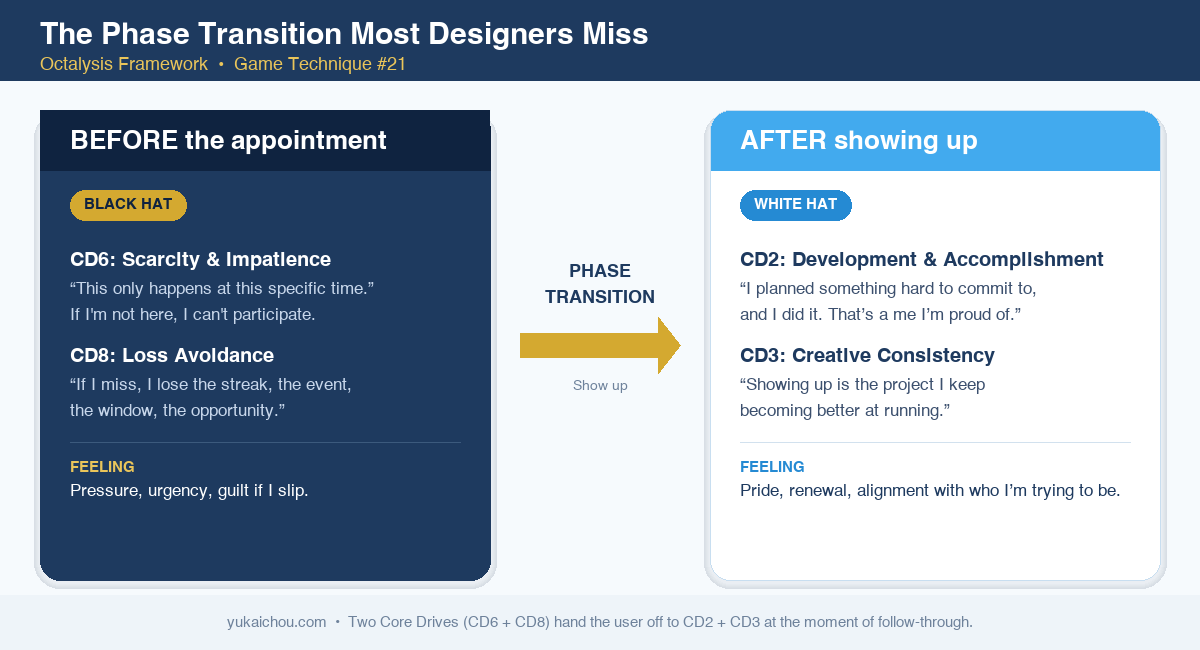
When the handoff works, the appointment earns a reputation. Users start to look forward to the moment of showing up because the moment of showing up is where the dose of pride lives. You can see this pattern cleanly in a well-designed workout class, a well-run weekly team ritual, or a religious service. The reader of this post can probably name one appointment in their own life that flips like this. The ones that flip are the ones that last.
When the handoff doesn’t work, the user lives in the black hat half of the mechanic permanently. The appointment becomes all tax, no dividend. That is the streak-app graveyard.
This is the part I want you to sit with. A countdown by itself can only ever live in phase one. A real appointment is a two-phase engine. Design phase two or don’t ship the mechanic.
Appointment Dynamic vs. Torture Break (GT #66)
Two mechanics get conflated all the time, and conflating them is how designers accidentally ship a Torture Break when they meant to ship an Appointment Dynamic. They are different tools.
| Feature | Appointment Dynamic (GT #21) | Torture Break (GT #66) |
|---|---|---|
| Trigger | Absolute time (every Monday, every July) | User action starts a countdown |
| Timer type | Calendar-based, shared across users | Relative, unique per user |
| Example | Church on Sundays, WoW weekly reset | Daily chest that re-opens 24h after you last claimed it |
| Habit formation | Strong — anchored to an external rhythm | Weaker — the anchor drifts with the user |
| Social cohort | Everyone shows up at the same time; natural community | Everyone is on a different clock; isolated experience |
If you want people to build real life rhythm around your product, if you want them scheduling weddings, vacations, and work calls around your mechanic, you need an Appointment Dynamic, not a Torture Break. The calendar is what lets the social cohort form. The moment everyone’s clock drifts individually, the community vanishes and you’re back to isolated users staring at isolated timers.
For the complementary mechanic and more examples on the urgency-countdown cousin, my earlier post on the mechanics of Appointment Dynamics covers the basics from a different angle. This post layers on the phase-transition view, which is where design attention should actually go.
One-Time vs. Recurring Appointments
Appointment Dynamics come in two flavors, and they build completely different user relationships.
One-time appointments are product launches, movie premieres, conference opening nights, annual holidays. The phase-transition math is simple and intense. Core Drive 6 (scarcity, “this only happens once”) runs at maximum wattage before the event. The moment people attend, they get a payoff of Core Drive 2 (“I was at the first day of the Apple Vision Pro launch”) plus Core Drive 4: Ownership & Possession if they walked away with something — the jersey, the signed book, the limited-edition release. The drawback is obvious: a one-time appointment fires once and then it’s spent. You rebuild the anticipation next year from scratch.
Recurring appointments are where the real long-term retention lives. Weekly, monthly, seasonal, it almost doesn’t matter which, as long as the rhythm is strict. Recurring appointments build habit loops: people start to organize the week around the appointment rather than fitting the appointment into the week. Sunday morning is already committed. Wednesday raid night is already committed. First-of-the-month finance review is already committed. The calendar re-wires around the ritual.
One concrete sign that a recurring appointment is working: users start to protect the time slot against other things. They decline meetings that conflict. They plan around it when they travel. If your product’s mechanic is strong enough that users decline other offers to keep the appointment, the phase transition is landing.
Cascading Value: The WoW Sunday Fishing Contest
World of Warcraft is the cleanest case study I know for appointment design, and the Sunday Fishing Contest is the cleanest sub-example inside that case study. Let me walk through the architecture because every piece of it is a design choice, not an accident.
The mechanic: every Sunday, in a specific in-game location, a fishing contest runs. Only the winner gets the Legendary Fishing Pole. So far this is a bare Appointment Dynamic. Interesting, maybe, but not interesting enough to reorganize someone’s Sunday morning.
What makes it actually reorganize Sunday morning is the cascading value chain the designers hung off it:
- Winning the contest gets you the Legendary Fishing Pole.
- The pole lets you catch rare fish that no regular pole can catch.
- The rare fish are ingredients for cooking recipes that nobody without those fish can make.
- Those recipes produce food buffs that give temporary stat increases.
- Those stat increases materially improve performance in end-game raids and dungeons.
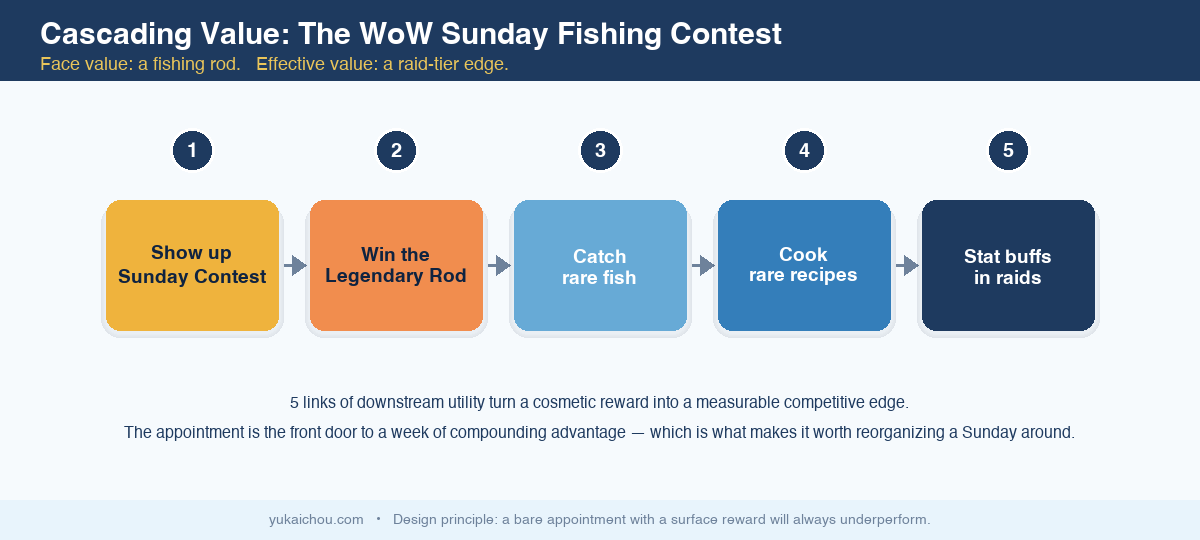
Notice what happened. Face value, the reward is a fishing rod. Effective value, the reward is a measurable edge in the most competitive content the game has. Five links of cascading utility convert a cosmetic-looking reward into something that materially affects the player’s ranking against their peers, which itself activates Core Drive 5: Social Influence & Relatedness every time the player shows up to a raid with that food buff.
The design principle is portable. A bare appointment with a surface-level reward will always underperform. Build the reward into a cascade where the payoff keeps mattering for days after the appointment ends. The appointment then becomes the front door to a week of compounding advantage, not an isolated event.
A more mundane version of this principle: a weekly team retro where the output is written down, the next sprint’s priorities are set, and the retro becomes load-bearing for the following five workdays. The retro isn’t a meeting — it’s the front door to the week, and the architecture is the same one the WoW Sunday contest uses, in a different domain.
Layering: Why a Bare Appointment Is Always Weak
I want to say this plainly: a bare Appointment Dynamic is not strong enough to carry a product. Designers discover the mechanic, ship a weekly event, and then wonder why retention didn’t move. The mechanic requires layering to become powerful.
Here are the four layers I reach for first, in order of how often I use them:
- Streak Design (Game Technique #78): count consecutive on-time attendances. Every streak turn adds Core Drive 2 accomplishment and a growing Core Drive 8 loss-avoidance cost if the user misses. This is the most common layer and also the one most often over-dialed. Too much streak pressure and you rebuild the burnout trap.
- Collection Sets (Game Technique #16): tie attendance to a time-gated collectible. “This is the Winter 2026 badge, and the only way to have it forever is to have been at the Winter 2026 appointment.” Activates Core Drive 4 (Ownership) and creates a permanent record of each appointment kept.
- Social Cohort Bonding: when everyone shows up on the same calendar rhythm, relationships form in the appointment’s negative space, people recognize the regulars, in-jokes develop, meta-conversations start. The appointment becomes a community node, not just a time trigger. This is Core Drive 5 at work.
- Magnetic Cap (Game Technique #68): limit what’s available per appointment window. “Only 50 of these per Sunday” turns every appointment into a micro-scarcity event and stacks Core Drive 6 on top of the appointment’s base Core Drive 6. Use sparingly. It’s powerful but easy to abuse.
If your product’s appointment has none of these layers, no streak, no collectible, no community, no in-window scarcity, it is almost certainly a bare appointment, and users will treat it the way they treat every other calendar reminder: something to snooze.
Five-Step Design Application
Here is the sequence I walk clients through when we’re designing an Appointment Dynamic from scratch. Follow it in order. Each step closes a gap most implementations leave open.
Step 1: Find the natural cadence. What rhythm does your user’s real life already run on? Daily is aggressive and often too frequent outside gaming and fitness. Weekly is the sweet spot for most products because it lines up with how the brain already chunks time. Monthly works for financial, reflective, or community products. Pick the rhythm that matches, not the rhythm that’s easiest to measure.
Step 2: Anchor to an existing habit. Do not ask users to invent a new time slot. Attach your appointment to a time they’re already doing something, then ride the momentum of the existing habit. Sunday mornings are already claimed by rest; weekly meal planning rides on top of that. Friday evenings are already claimed by end-of-week decompression; weekly games ride on top of that. First-of-the-month is already claimed by bills; monthly reviews ride on top of that.
Step 3: Design the phase transition on purpose. Write down, literally, what changes for the user the moment they show up. “Before the appointment they feel _____. After they show up they feel _____.” If your answers don’t include something that reads as pride, accomplishment, or renewal, stop and redesign. The mechanic has no phase two. You will burn users out.
Step 4: Layer immediately. Pick at least one of: streak, collection set, cohort, or magnetic cap. The default single layer I recommend for most products is cohort. People showing up together create community, community produces reciprocity, reciprocity is what actually sustains engagement after the novelty fades.
Step 5: Build cascading value downstream. Ask: “What does the user get from this appointment that keeps mattering for the next six days?” If the honest answer is “nothing, the appointment ends when it ends,” you have a one-shot event, not a compounding ritual. Add at least one downstream utility chain, a buff, a piece of context, a permission, a social capital gain, that survives the appointment and makes the next one feel more valuable.
If you walk through these five steps honestly on your product’s weekly ritual, whatever it is, you will find the weakest step. That’s where to spend the next sprint.
FAQ
What is an Appointment Dynamic in gamification?
An Appointment Dynamic (Game Technique #21 in the Octalysis Framework) is a mechanic that ties a desired user action to an absolute, calendar-anchored time window, every Monday, every Sunday morning, every July 4th. It creates urgency before the window (Core Drive 6: Scarcity and Core Drive 8: Loss Avoidance) and accomplishment after the window is honored (Core Drive 2: Development & Accomplishment). The appointment is fixed, not countdown-based.
How is Appointment Dynamic different from a Torture Break?
A Torture Break (Game Technique #66) is a countdown that starts from a user action, for example, a chest that re-opens 24 hours after you last claimed it. Every user is on a different clock. An Appointment Dynamic is calendar-based, every user is on the same clock, showing up at the same absolute time. That shared clock is what lets social cohorts and community form around the ritual, which is why Appointment Dynamics produce stronger long-term habits than Torture Breaks.
Why do streak apps burn users out?
Streak apps commonly implement only the first half of the Appointment Dynamic, the black hat urgency of Core Drive 6 and Core Drive 8. They do not build the phase transition into Core Drive 2 accomplishment that the mechanic requires to be sustainable. Without the flip from pressure to pride at the moment of showing up, the user lives permanently in the pressure phase. Guilt compounds, the streak becomes a tax instead of a reward, and eventually the user quits the app to escape the feeling.
Can I use Appointment Dynamics outside of games?
Yes, and most of the strongest examples are outside games. Sunday church, weekly team retros, monthly finance reviews, Happy Hour at a restaurant, weekly trash pickup, and annual holidays are all real-world Appointment Dynamics. Any domain where you need a user or participant to build an ongoing rhythm with your product or institution is a candidate. The mechanic is not game-specific, it’s human-calendar-specific.
How many appointment layers should I stack?
At least one, rarely more than three. The single most useful layer is social cohort, because everyone shares the calendar, community forms naturally and produces reciprocity effects that persist between appointments. Collection sets and streak design are strong secondary layers. Magnetic Cap should be used sparingly. Stacking too many layers creates a baroque experience where users feel manipulated instead of invited.
Related Reading
- The Octalysis Framework, the full eight Core Drives that Appointment Dynamics tap into.
- The Achievement Treadmill: Why We Chase Progress (And When It Breaks), deeper on Core Drive 2, the white hat half of the phase transition.
- The Irrational Power of Scarcity, deeper on Core Drive 6, the black hat engine that powers the before-phase.
- Why the Hook Model Creates Addicts, Not Habits, the contrast case: a habit architecture that, unlike well-designed Appointment Dynamics, deliberately avoids the pride phase.
- Exploring Appointment Dynamics: A Key Tool in Gamification, the companion post on the broader mechanics.
Three ways to take this further:
- Map your own product’s appointment. Walk through the five-step design application above on whatever weekly ritual your product already has. The weakest step is where to spend the next sprint.
- Get the full taxonomy. Appointment Dynamic is one of 107 Game Techniques. Actionable Gamification is the map that tells you which techniques to layer against it for your specific user, product, and cadence.
- Go deeper with the framework. The mechanic lives inside the Octalysis Framework — all eight Core Drives, with worked examples for designing the white-hat half of every mechanic, not just this one.