


Short answer: An implementation intention is a plan of the form “If situation X happens, then I will do behavior Y,” written down in advance. Goals specify the outcome you want; implementation intentions specify exactly when, where, and how you will act.
Peter M. Gollwitzer introduced the construct in a 1993 book chapter and formalized it in his 1999 American Psychologist paper “Implementation Intentions: Strong Effects of Simple Plans.”
The evidence base is unusually strong: Gollwitzer and Sheeran’s 2006 meta-analysis pooled 94 studies with over 8,000 participants and found a mean effect size of d = 0.65, robust to publication-bias correction. The mechanism is automaticity, not motivation: the if-then plan binds cue and response together, so the response fires without a fresh conscious decision.
What are implementation intentions?
Implementation intentions are specific if-then plans that tie a concrete situational cue to a goal-directed response: “When situation X happens, I will do Y.” Introduced by psychologist Peter Gollwitzer in 1993, they make people measurably more likely to follow through on their goals by deciding the exact moment of action in advance, before willpower is tested.
The gap between what a user says they will do and what they actually do is the single most expensive problem in applied behavioral design. The fitness app user swears she will exercise three times this week. The productivity user promises himself he will stop checking email before coffee. The loyalty-program member commits to redeeming his points before they expire. Two weeks later the honest engagement logs show how little of any of this happened.
Peter Gollwitzer ran the experiment that explains this gap and, more importantly, the experiment that closes it. In 1999 he published a paper in American Psychologist arguing that a tiny rewording of a goal (from “I will exercise more” to “When I finish lunch on Monday, I will put on my running shoes and run for twenty minutes”) makes the behavior more likely to actually happen. He called the rewording an implementation intention, and the academic literature also calls it if-then planning. Behavioral designers who have internalized it treat it as one of the cheapest levers they have.
I have spent two decades building motivation frameworks and advising teams at MrBeast, LEGO, Microsoft, Tesla, Coca-Cola, and multiple national governments on how to turn the intentions their users declare into the behaviors their products depend on. Implementation intentions are, on a pure effort-to-leverage ratio, the single best-replicated finding in the applied goal-pursuit literature. They are also almost universally misunderstood and under-designed, buried under the fluff of more fashionable behavioral-economics concepts that deliver smaller effect sizes with more noise. That is exactly what this post exists to correct.
In the rest of this post I will walk through the theory the way I walk it through with a client: the original Gollwitzer research, the meta-analytic evidence that made the theory boring enough to trust, the places it honestly falls apart, the brain-level account of why it works, and a full integration with the Octalysis Framework that turns if-then plans from a self-help trick into a production design primitive. If your product lives or dies by follow-through, as most products do, this is one of the two or three psychological frameworks you cannot afford to misunderstand.
If-then planning is one entry in my Behavioral Framework Library, where I index every framework a behavioral designer needs, from Prospect Theory to Self-Determination Theory. Grab the full map there if you want context before this deep dive.
Updated 14 October 2026. Re-checked against Sheeran, Listrom and Gollwitzer’s 2025 meta-analysis of 642 tests: the effect sizes and publication-bias findings now reflect it, a new chart compares the 2006 and 2025 estimates, and several study details and references were corrected.
Speed Run Notes
- An implementation intention is a plan with the structure “If situation X occurs, then I will perform behavior Y,” pre-committed before the situation arrives.
- Peter Gollwitzer introduced the construct in 1993 and formalized it in a widely-cited 1999 American Psychologist paper.
- The mechanism is automaticity: the plan fires the behavior on cue, without a fresh decision in the moment.
- Implementation intentions bridge the intention-behavior gap that goal-setting theory alone cannot.
- Strong if-then plans specify three things concretely: a cue that is hard to miss, a response simple enough to execute on a single cue, and the if-then form itself, pre-committed before the cue arrives.
- The behavioral-design applications run from health and education to voter turnout, product onboarding, and habit formation.
In This Article
- Implementation Intentions Defined: Goals vs If-Then Plans
- The Core Findings
- What Gollwitzer Got Right
- Where Implementation Intentions Fall Apart
- The Brain on If-Then Plans
- Implementation Intentions vs Other Theories
- Implementation Intentions in the Real World
- The Elephant in the Room
- How to Apply Implementation Intentions with the Octalysis Framework
- Practical Steps to Apply Implementation Intentions
- Closing Thoughts & FAQ
Author Credibility: Yu-kai Chou

Yu-kai Chou created the Octalysis Framework after studying gamification since 2003 — years before the term entered mainstream vocabulary. As a Human-Systems Architect & Behavioral Designer, his framework has been applied by LEGO, Microsoft, Porsche, Coca-Cola, Salesforce, and MrBeast, impacting over 1.5 Billion Users.
Chou has taught the Octalysis methodology at Harvard, Stanford, Yale, Tesla, Google, BCG, and IDEO.
His work has been cited by Harvard, Stanford, MIT, Forbes, Wall Street Journal, Wired, US Department of Energy, NIST, NSF, NCBI, US Department of Education, ClinicalTrials.gov, and Google Scholar — with 3,700+ more academic citations. Explore his books here.

Implementation Intentions Defined: Goals vs If-Then Plans
An implementation intention is a pre-specified plan of the form “If situation X occurs, then I will perform behavior Y,” formed in advance of the situation and held in memory until the cue is encountered. The construct was introduced by Peter M. Gollwitzer, a social psychologist at New York University and Konstanz, in a 1993 book chapter and formalized in a 1999 American Psychologist article titled “Implementation Intentions: Strong Effects of Simple Plans.”
The distinction that makes the theory work is the difference between a goal intention and an implementation intention. A goal intention specifies an outcome the person wants to achieve: “I want to exercise more,” “I want to lose weight,” “I want to finish this course.” An implementation intention specifies the when, where, and how of the behavior that will produce the outcome: “When I get home from work on Monday, Wednesday, and Friday, I will immediately change into my running clothes and go for a 20-minute run before sitting down.” The first tells you the destination. The second tells your feet where to move when the bus pulls in.
The idea that planning helps had been folk wisdom for centuries. Gollwitzer’s original contribution was the specific psychological mechanism he identified and the specific structural form he showed produced the effect. Planning in general does not help much. Planning that binds a concrete situational cue to a concrete response does help, because the binding creates what Gollwitzer called strategic automaticity: a pre-loaded readiness for the cue that fires the behavior without requiring a fresh decision in the moment.
The canonical form and three variations
- Initiation if-then: “If I encounter situation X, then I will start doing Y.” The original form. Used when the problem is getting started.
- Shielding if-then: “If I encounter temptation X, then I will ignore it and continue with Y.” Developed for guarding an ongoing behavior against competing pulls.
- Disengagement if-then: “If the current approach produces outcome X (failure, dead-end, diminishing returns), then I will switch to strategy Y.” Developed for goal-pursuit flexibility, especially in contexts where escalation of commitment (sunk-cost behavior) is the failure mode.
All three variations share the if-then structure. What varies is the content: what kind of cue you bind to what kind of response. The initiation form is the one most applied-design work uses. The shielding form is the one cognitive-behavioral therapists use for impulse control. The disengagement form is the one startup coaches should teach founders and seldom do.
Why the form matters more than the content
Early replications of Gollwitzer’s work quickly established a pattern that surprised even the original research team. The if-then linguistic form carried much of the effect independently of the content. Participants who phrased their plan as a true if-then sentence (“If it is 3 p.m., then I will take the questionnaire out of my bag and fill it in”) outperformed participants who phrased the same plan as a regular intention (“I will fill out the questionnaire at 3 p.m.”) by a clear margin in follow-through. The form does something the content does not. It fuses the cue and the response into a single memory representation that the cue itself can retrieve without a fresh decision process. The content provides the behavior; the form provides the automaticity.
This is the point practitioners miss most often when they try to apply the theory. Saying “I will exercise tomorrow at 7 a.m.” is not an implementation intention. Saying “If my alarm goes off at 7 a.m., then I will immediately put on my running shoes and walk out the front door” is one. The second sentence is more specific, and it also has the if-then structure that the brain stores as a single linked cue and response.
The Core Findings
Gollwitzer’s research program on implementation intentions has been running since 1987 and has produced one of the largest, most replicated effect sizes in applied social psychology. Here are the findings most relevant to design practice.
Finding 1: A medium-to-large pooled effect across 94 studies (d = 0.65 in 2006)
The definitive quantitative summary is Gollwitzer and Sheeran’s 2006 meta-analysis, published in Advances in Experimental Social Psychology, which pooled 94 independent studies with a total of over 8,000 participants. The mean effect size on goal attainment, Cohen’s d = 0.65, sits in the medium-to-large range by Cohen’s own conventions. The 2006 bias check was simple: published and unpublished studies came out nearly identical (d = 0.65 versus 0.67). The same team ran much stricter corrections in 2025, and the number moved.
What does that look like in a real study? In Gollwitzer and Brandstätter’s 1997 experiment, students who named a difficult personal project completed it 62 percent of the time when they had formed an if-then plan, versus 22 percent without one. For easy projects the plan barely mattered (84 versus 78 percent), because people were already following through. That pattern is the useful part: if-then plans earn their keep where follow-through is hard.
Gollwitzer and Sheeran have since re-measured that number on a much larger base. In 2025, with Olivia Listrom, they published a meta-analysis of 642 tests in the European Review of Social Psychology, and if-then plans improved cognitive, affective, and behavioral outcomes across the board.
The behavioral figure came in lower than the 2006 headline. Across 301 tests of behavior change the effect was d = 0.27, and the sample-weighted average across all 642 tests was d = 0.36.
The authors also found strong evidence of publication bias and corrected for it in two ways. Trim-and-fill left the average at d = 0.35, while a stricter Robust Bayesian Meta-Analysis estimated d = 0.15 and still found extreme evidence that the effect is real.
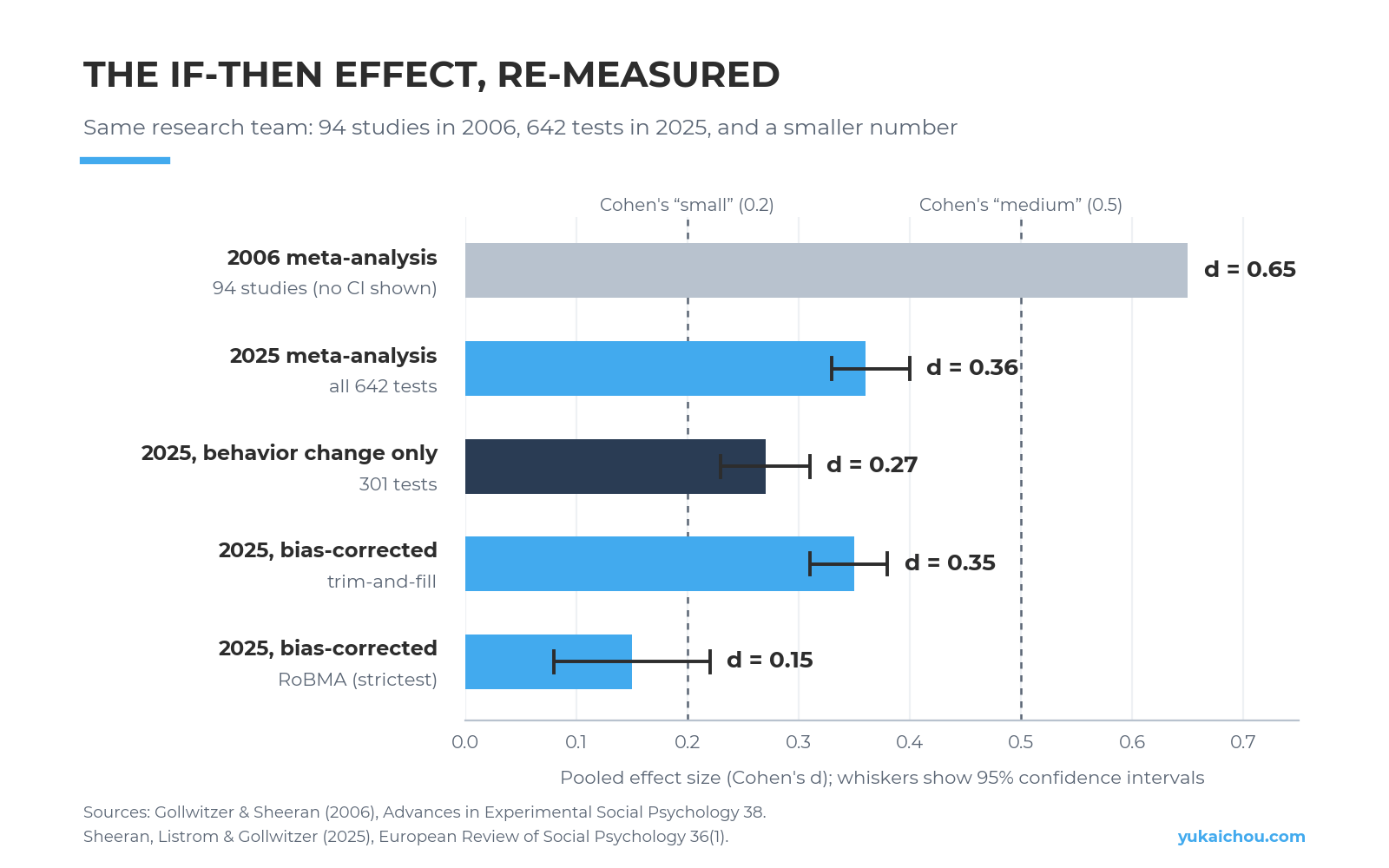
For a product team, the practical read is to budget for an effect closer to d = 0.3 than 0.65 and to spend design effort on the moderators that moved the number. Plans written in a true if-then format beat simple schedules (d = 0.43 versus 0.29), and plans people rehearsed at least once beat plans they never rehearsed (d = 0.45 versus 0.33).
Finding 2: The effect runs on automaticity, even under cognitive load
Experiments by Brandstätter, Lengfelder and Gollwitzer (2001) dissociated two possible explanations. One possibility was that if-then plans worked simply by encouraging more thinking about the goal (rehearsal, elaboration, deliberation). The other was that they worked by a different mechanism: the pre-formed cue-response link fires automatically when the cue is encountered, without reengaging deliberation. The crucial test used cognitive-load manipulations: participants had to respond to their planned cue while a demanding memory or tracking task occupied their attention.
Even under heavy cognitive load, participants with implementation intentions responded to their planned cue faster than participants with goal intentions alone, and the speed-up did not hurt their performance on the demanding task. That pattern points to an automatic mechanism, where the cue fires the response even when the person is not thinking about the goal at all. This is why the technique works in high-stress, low-attention conditions where pure willpower predictably fails.
Finding 3: The cue works even below conscious awareness
A series of follow-up studies by Gollwitzer, Anja Achtziger, and colleagues used reaction-time paradigms to show how tightly the plan binds cue to response. When a participant has formed an if-then plan, presenting the cue (the “if” part) automatically speeds recognition of, and preparation for, the response (the “then” part). The speed-up is measurable in milliseconds, and in Bayer, Achtziger, Gollwitzer and Moskowitz’s 2009 studies it showed up even when the cue was flashed too briefly to be consciously seen. This is exactly the signature you would expect if cue and response are stored as one linked unit in memory, which is the prediction Gollwitzer made from the start.
Finding 4: Domain breadth — the effect replicates across 14+ applied areas
The meta-analytic evidence now spans physical exercise, dietary change, medication adherence, cancer screening uptake, exam preparation, voter turnout, safe-sex behavior, smoking cessation, racial-stereotype suppression, anger regulation, sunscreen use, recycling behavior, financial saving, and homework completion in children. The size of the effect varies a lot by domain. The 2006 meta-analysis put health behaviors near d = 0.59, while later reviews of physical activity landed far lower, roughly d = 0.15 to 0.3. Breadth is not the same as uniform strength. The domain breadth is one of the reasons the theory has become a default recommendation in public-health behavior-change interventions.
Finding 5: Implementation intentions shield goal pursuit from competing goals
A 2008 paper by Achtziger, Gollwitzer and Sheeran showed that if-then plans with a shielding structure (“If temptation X arises, then I will not engage and will continue doing Y”) protect ongoing goal pursuit from competing urges. Dieters who formed a shielding plan against junk-food cravings cut their snacking more than dieters with a goal alone, and tennis players who planned how to handle disruptive thoughts and feelings in competition performed better. In both cases the plan had pre-decided the response, so the moment of temptation needed no fresh deliberation. This finding matters for habit-formation work, because a new habit that has already started can still erode under competing pulls. Shielding if-then plans are one of the cheapest mechanisms for protecting against erosion.
Finding 6: Who writes the plan matters less than you’d think
Designers love the idea that a plan the user writes will beat a plan the product hands them. The evidence is thinner than that. In Armitage’s 2009 alcohol-reduction trial, self-generated and experimenter-provided if-then plans both cut drinking, with no significant difference between them, and the 2025 meta-analysis did not find an advantage for plans built around cues participants chose themselves. What moved the number there was format and rehearsal (Finding 1). For product design, that means you can hand users strong starter plans without apology, as long as each one is a true if-then sentence the user commits to.
What Gollwitzer Got Right
Gollwitzer’s theory has aged better than most 1990s social-psychology constructs. Four things he got right stand out, and they are the things designers should internalize.
He separated goal intentions from implementation intentions
Before Gollwitzer, the applied goal-pursuit literature mostly treated “having a goal” as a single construct. Goal-setting theory (Locke and Latham) specified how to set a good goal — specific, difficult, committed — but said relatively little about how the good goal gets converted into action. Gollwitzer’s move was to carve out a distinct construct for the action-specification step and show that it carries an effect size comparable to, and independent of, the goal-setting step. This was a clean theoretical contribution that gave behavioral designers a second lever to pull, with its own mechanism and its own metrics. Most modern behavior-change interventions now stack goal-setting and implementation-intention planning as two separate moves, exactly as Gollwitzer’s model predicted.
He identified automaticity as the mechanism
A surprising number of psychological interventions work but their proponents cannot say why. Gollwitzer named the mechanism up front (the cue-response link in memory fires without deliberation), and the subsequent reaction-time, cognitive-load, and fMRI evidence has supported that story. For product design, the mechanism matters because it tells you the failure modes. If the effect comes from automaticity, it fails when the cue is ambiguous (the automatic firing does not know what to fire on), when the response is not a specific pre-formed action (there is nothing for the cue to fire), or when the person does not actually hold the underlying goal (the if-then plan has no motivational substrate to drive). All three failure modes follow directly from the automaticity account.
He proved the effect is robust to cognitive load
This is the applied finding that matters most in practice. Most psychological interventions that require conscious effort collapse under real-world stress, whether the person is a sleep-deprived parent, an overbooked executive, or a depressed patient. Implementation intentions do not collapse, because their mechanism does not require conscious effort once the plan is formed. This robustness is what allows the technique to translate from the lab to the clinic to the app to the loyalty program without the usual degradation that hits motivational interventions when they leave the lab.
He built the shielding and disengagement extensions deliberately
Gollwitzer extended the original initiation if-then to shielding (“guard against competing pulls”) and disengagement (“switch when the current path is failing”) in follow-up work during the 2000s. Each extension was backed by its own empirical program. This matters because real goal pursuit is a long sequence of initiating, shielding, and occasionally disengaging across months or years. A theory that only covered initiation would have been useful but fragile; Gollwitzer’s full architecture covers the lifecycle, which is why it has become the default framework in self-regulation research.
Where Implementation Intentions Fall Apart
The honest version of the theory names the places it does not work. Three critiques matter most for design practice.
Critique 1: No goal, no effect (the motivational prerequisite)
The most important limit of implementation intentions is that they require the underlying goal intention to be real. A user who does not actually want to exercise will not start exercising because you helped them write an if-then plan. The plan presupposes the goal and has no way to create it. Multiple studies have shown that when goal commitment is weak, implementation intentions produce null effects.
This is a problem for behavioral products that assume planning technology can substitute for motivation work, because planning cannot do that job. The practical implication is that implementation-intention interventions need to sit downstream of a motivational layer (an onboarding flow that surfaces the user’s real reason for being in the product, a values-clarification step, a visible identity commitment) instead of being deployed as a generic “plan your week” widget. Gollwitzer himself is explicit about this in his later writing: if-then planning is a volitional instrument. It converts motivation the person already has into behavior.
Critique 2: Fuzzy cues produce zero effect
The second predictable failure mode is cue fuzziness. An if-then plan of the form “If I have some free time, then I will work on the project” produces no measurable benefit over a simple goal intention, because “some free time” is not a specific enough cue to fire automaticity. The cue has to be concrete, noticeable, and hard to miss: a specific time of day, a specific location, a specific other behavior that precedes it, a specific emotional state. When the cue is fuzzy, the brain has nothing to bind the response to, and the plan degrades into ordinary intention.
In product contexts, this is the reason most user-written if-then plans in the wild are weaker than they should be. Users default to vague cues (“when I have energy,” “when I am ready,” “when work slows down”) because vague cues feel safer: they preserve the option to defer. A well-designed product forces cue specificity: pick a time, pick a place, pick an antecedent behavior. That forcing function decides whether the plan fires at all.
Critique 3: Complex, sequenced behaviors resist single-cue triggering
Implementation intentions work cleanly for behaviors that can be initiated with a single trigger: put on running shoes, open the app, dial the phone number, pick up the paperwork. They work much less cleanly for behaviors that are themselves sequences of sub-decisions with their own branching logic. “When I sit down at my desk on Monday, then I will write a chapter of my book” is a very weak plan, because writing a chapter is not a single action but a week of sub-actions each with its own sub-goals. The cue fires the sitting-down and leaves the chapter itself unplanned.
The fix is to decompose complex behaviors into single-cue-triggerable atomic actions and stack if-then plans around each. This is doable but it is harder than the literature often admits, and it is one of the reasons implementation-intention interventions produce smaller effects on complex behaviors (finishing a thesis, starting a company, learning a language to fluency) than on simple behaviors (taking a pill, attending a screening, going for a walk). For product designers this is a critical caveat: if-then plans are a cheap primitive, and multi-month behavior change needs them composed with other techniques.
The Brain on If-Then Plans
The neuroscience on implementation intentions is much thinner than the behavioral record, but what exists fits what Gollwitzer predicted from behavioral evidence in the 1990s.
Cue-driven control replaces effortful control
An fMRI study by Sam Gilbert, Gollwitzer and colleagues (2009) compared acting on an intention you have to remember to trigger yourself with acting on one tied to an external cue. Self-initiated action leaned on lateral regions at the front of the prefrontal cortex, the machinery of effortful, top-down control. Cue-tied action leaned on medial prefrontal regions instead. A 2015 review by Wieber, Thürmer and Gollwitzer reads the wider evidence the same way: if-then plans shift action control from effortful top-down processing to bottom-up, cue-driven processing. That is the neural signature of automaticity the behavioral studies predicted.
If-then plans can turn down the emotional alarm
Hallam, Webb, Sheeran and colleagues (2015) scanned people regulating their reactions to upsetting images. Those using an if-then plan down-regulated the amygdala more effectively than those using a plain goal to stay calm, and they did it without the dorsolateral prefrontal effort that goal-based regulation recruited. That study was about emotion regulation, not temptation, so applying it to shielding plans is an inference. The design read is still useful: an if-then plan can lower how loud a reaction feels instead of asking the user to fight it.
What the replication era did to this finding
Much of the ego-depletion literature (Baumeister’s willpower-as-finite-resource model) has failed to replicate reliably. If-then plans came through in better shape, but not untouched. The 2025 meta-analysis found clear evidence of publication bias, and its strictest correction cut the average effect to d = 0.15 while still finding strong evidence that the effect is real. The structural argument holds: if-then plans move the cost of self-control forward to the planning moment, where the person is calm and rested, so the execution moment asks for far less willpower. Just budget for a smaller payoff than the 1990s papers promised.
Implementation Intentions vs Other Theories
A framework earns its place by being more useful than the neighbors. Here is where Implementation Intentions sit relative to the adjacent goal-pursuit theories most designers have heard of.
Versus Goal-Setting Theory (Locke and Latham)
Goal-setting theory says specific and difficult goals produce more performance than vague or easy goals. Implementation intentions say specific and binding if-then plans produce more follow-through on any given goal. The two are complementary: set a good goal with Locke and Latham, then plan the execution with Gollwitzer. The combined effect size in stacked interventions routinely exceeds what either technique achieves alone. In my own practice I do not recommend choosing between them; I recommend always stacking both, with goal-setting as the upper layer and implementation intentions as the execution layer directly under it. Our pillar on goal-setting theory covers the upper layer in depth.
Versus Habit Formation (Duhigg, Wood)
Habit research describes how cue-routine-reward loops form over repeated exposure and eventually run without conscious deliberation. Implementation intentions are the deliberate shortcut to the same endpoint. If you form an if-then plan that binds a cue to a response and execute it repeatedly in the same context, you have engineered the cue-routine part of a habit loop by intent, without waiting for passive repetition to do the binding. Wendy Wood and Dennis Rünger draw the line precisely in their 2016 review: an if-then plan is an automated goal that still runs on your motivation, while a true habit keeps firing after the motivation fades. The plan is the trellis; the habit is the vine that can grow on it with repetition.
Versus Fogg Behavior Model (B = MAP)
Fogg’s model says behavior happens when Motivation, Ability, and a Prompt converge at the same moment. Implementation intentions are, in Fogg terms, a way of pre-specifying the prompt so that when the moment arrives the ability-side of the equation requires almost no friction. The if-then plan binds a prompt to a high-ability response. Fogg’s Tiny Habits work, in which a new behavior is anchored to an existing daily event (“After I pour my morning coffee, then I will…”), is implementation-intention methodology packaged for consumer use. The two frameworks are closely compatible and often cited together.
Versus Self-Determination Theory
Self-Determination Theory (SDT) is about where motivation comes from: the three universal needs for autonomy, competence, and relatedness. Implementation intentions are about what to do with motivation once you have it. SDT answers “why does this user care about the goal?” Implementation intentions answer “how does the user turn caring into behavior?” The two operate at different layers of the motivation-to-behavior chain and do not compete; they stack.
Versus Nudge Theory (Thaler and Sunstein)
Nudge theory restructures the choice environment so that the desired option is easier, more salient, or the default. Implementation intentions restructure the mental representation of the chosen behavior so that execution requires no choice at all. Nudges change the environment around the person, while if-then plans change how the person has already decided to respond. The two are complementary levers, and modern public-health interventions often use both: the nudge sets up the environmental affordance, and the if-then plan locks in the person’s response to that affordance.
Implementation Intentions in the Real World
The applied evidence is where implementation intentions have done their most visible work. Four domains are especially instructive for designers.
Health behavior
The largest applied literature sits in public health. A 2011 systematic review by Adriaanse, Vinkers, De Ridder, Hox, and De Wit examined 23 studies applying implementation intentions to healthy-eating and weight-loss outcomes and found an effect of d = 0.51 for eating more healthy food and a smaller d = 0.29 for cutting unhealthy food. Exercise studies have tended to come in smaller still. Cancer-screening uptake, notoriously hard to move because the behavior is unpleasant and the payoff distant, shows how uneven the record is: Sheeran and Orbell (2000) raised cervical-screening attendance from 69 to 92 percent with a simple planning questionnaire, while some large recent booklet trials found no gain at all.
For health-tech products, the practical application is straightforward: every product that asks users to change a health behavior should replace its “set a goal” flow with a “set an if-then plan” flow that forces specification of a concrete cue, a concrete behavior, and a concrete context. The implementation cost is modest. Measure the lift against your current goal flow instead of assuming it.
Education and academic performance
The education evidence is real but narrower than people assume. The strongest work comes from Angela Duckworth, Gabriele Oettingen and colleagues, who paired if-then planning with mental contrasting (the method Oettingen later packaged as WOOP). In a 2013 trial, schoolchildren taught the combined strategy improved their report-card grades, attendance, and conduct.
For education-tech products, the implication is that the study-habit feature most worth building next is a well-designed if-then plan-builder that gets users to specify when they will study, where, and for how long, and makes that commitment visible to themselves and (optionally) to accountability partners. Even Duolingo’s public-facing prompts are still mostly timed practice reminders and streaks rather than true if-then plans, which leaves this lever open for most learning products.
Civic behavior and voter turnout
A 2010 field experiment by David Nickerson and Todd Rogers, published in Psychological Science, recruited thousands of likely voters in the 2008 U.S. presidential primaries and randomly assigned some to receive an implementation-intention prompt before election day: “What time will you vote? How will you get to the polling place? What will you be doing before you go?” The prompt increased turnout in single-eligible-voter households by 9.1 percentage points. The intervention was a single short phone call, so its cost was trivial. Across everyone the call reached, turnout rose 4.1 points, a strong result for a single phone script.
The finding generalizes: when the behavior has a narrow action window and a concrete physical requirement (show up somewhere, at some time), implementation-intention prompts produce disproportionate lift. Vaccine campaigns, tax-filing reminders, and course-enrollment workflows all fit the pattern. A product designer looking to move a one-shot compliance behavior should treat this as the default intervention and not the last-resort one.
Product onboarding and habit formation
The consumer-product evidence is thin, and it pays to be honest about that. Fitness apps such as Strava, Apple Fitness+, and Peloton offer goals, schedules, and custom plans, but their public documentation does not show true cue-based if-then builders. No major app has published a clean retention number for one. Most of the hard if-then evidence still comes from health, education, and civic trials. That gap is the opportunity: the mechanism is well supported, and most products have not built it properly yet.
The design lesson is to replace the open-ended goal-setting field with a structured if-then plan-builder that forces cue specification and makes the plan a first-class visible object the user can refer back to. A generic planning surface will not produce the effect on its own, because the effect comes from that structure.
The Elephant in the Room
The honest thing about implementation intentions, and the thing the academic summaries almost always omit, is that the intervention is asymmetric in who it helps. It helps people who already hold the goal, already have the capacity to act, and already have the executive function to remember and execute a pre-formed plan. For people without these prerequisites, such as people in poverty with chaotic schedules, people with severe executive-function deficits, or people whose active addiction overrides cognitive plans, the effect size shrinks or disappears.
This asymmetry comes from how the technique works. Implementation intentions are a volitional instrument: they assume the person wants something, can do something, and can plan in advance. They are optimized for the cognitively able, modestly resourced, already-motivated user. For populations outside that envelope, additional interventions (environmental restructuring, financial incentives, clinical support) are needed before the planning layer produces its usual effect.
The implication for designers is that if-then plans are a high-yield intervention for the top two quartiles of your user base: the engaged users and goal-holders who have told you in some way that they want the outcome. For the bottom quartiles, the follow-through problem is a different problem, and it requires different tools. Designing as if implementation intentions would save everyone is a predictable way to overbuild the planning layer and underbuild the motivational layer that most of your struggling users actually need.
The second elephant is that implementation intentions are boring, and boring interventions lose funding battles against more fashionable ones. A team choosing between building a social-proof feature, a dopamine-loop feature, or an if-then-plan-builder will usually pick one of the first two because the story sounds better. The if-then-plan-builder has a smaller marketing surface. It is a text-input UI with structured scaffolding. It does not look impressive in screenshots. Its evidence in applied goal pursuit is deep, though, and a team that skips it for the showier feature may be leaving follow-through on the table. The cheap way to find out is to build the plain if-then builder first and compare follow-through a month later against whatever the showier feature delivers.
How to Apply Implementation Intentions with the Octalysis Framework
Gollwitzer gave us the structural form that converts intention into behavior. The Octalysis Framework tells us which Core Drives the behavior ultimately has to activate if it is going to produce sustained engagement. Line the two up and the if-then plan stops being a self-help technique and starts being a design primitive with a clear place in the motivation-to-behavior pipeline.

In Octalysis terms, implementation intentions work as a transmission mechanism that takes motivation from one of several Core Drives and converts it into executed behavior without leaking energy in the intention-behavior gap. The drives that feed motivation into the plan also shape which drives the completed plan reinforces afterward.
CD2 Development & Accomplishment — the primary activation
The most direct engagement is with Core Drive 2 (Development & Accomplishment). Every completed if-then plan is a small, visible accomplishment: the user made a promise to themselves and kept it. Stack enough completed plans and you have the behavioral record of measurable progress, which is the native fuel of CD2. Game Techniques that pair especially well with implementation-intention infrastructure include Progress Bars (Game Technique #4, or GT#4), Status Points (GT#1), Achievement Symbols (GT#2), and Step-by-Step Tutorials (GT#54) that guide users through building a first plan so the barrier to the first completion is removed.
The design principle is to make completion of an if-then plan a first-class accomplishment object in the product. Do not bury it in an activity log. Surface it the way Duolingo surfaces a completed lesson or Strava surfaces a completed ride. The accomplishment signal feeds back into CD2 and increases the probability that the next plan will also be formed and executed.

CD4 Ownership & Possession — the authorship effect
A strong secondary activation is Core Drive 4 (Ownership & Possession). A user who has authored their own if-then plan owns the plan in a way that a user who has been assigned a plan does not. Be precise about what that buys you. The lab evidence does not show self-written plans beating good assigned ones (Finding 6), so treat CD4 here as a product lever without lab backing: ownership keeps users attached to the plan and to the product that holds it. Design implication: start users from strong templates, then let them edit, name, and own the plan.
Game Techniques that reinforce the ownership path include Avatar customization (GT#8) applied to the plan (users naming their own plans and choosing an icon), Collection Sets (GT#14) if users accumulate a set of plans over time, and Plant-and-Cultivate (GT#71) patterns where the plan visually grows or strengthens with each execution.
CD8 Loss & Avoidance — the visibility lever
The third activation is Core Drive 8 (Loss & Avoidance), engaged when the plan is made visible and potentially public. An if-then plan that only lives inside the user’s head is easy to break. An if-then plan that has been written down in a product, shared with an accountability partner, or made visible on a dashboard becomes harder to break, because breaking it now involves a visible loss: the streak resets, the commitment appears publicly abandoned, the plan’s status badge turns grey. Loss aversion does the last mile of enforcement that pure accomplishment motivation does not.
This is a place to design with care. CD8 is a Black Hat Core Drive: it creates urgency and action, but people do not feel good about being driven by it for long. Over-engaging CD8 with aggressive loss framings, public shame mechanics, or harsh streak resets produces users who execute plans but hate the product that makes them execute. The right CD8 intensity is low: a small visible consequence for breaking, a gentle recovery path for rebuilding, a clear acknowledgment that breaking is normal and not catastrophic. Done right, the CD8 layer adds the last push of follow-through without producing the churn that heavy CD8 design predictably generates.

CD1 Epic Meaning & Calling — the upstream motivational source
Implementation intentions do not generate motivation; they require a pre-existing goal. The cleanest source of that goal in an Octalysis-designed product is Core Drive 1 (Epic Meaning & Calling): the user’s connection to something larger than themselves that makes the goal matter. A user who has articulated why the goal connects to their identity and values brings a stronger goal intention into the if-then-plan step, and Critique 1 above shows why that matters: when goal commitment is weak, if-then plans produce null effects.
Secondary activations: CD3 and CD5
Two secondary drives matter. Core Drive 3 (Empowerment of Creativity & Feedback) is engaged when users iterate their if-then plans based on what worked and what did not. The disengagement form of Gollwitzer’s theory is exactly the CD3 “try, observe, adjust” loop applied to planning. Core Drive 5 (Social Influence & Relatedness) is engaged when plans are shared with accountability partners or visible to a small trusted community, which increases both commitment (CD4 ownership is reinforced) and shielding (CD8 loss is made concrete).
The design routing table
Taken together, here is the exact table I use with clients when the problem is an intention-behavior gap.
| Pipeline stage | Octalysis Core Drive | Design surface | What to build |
|---|---|---|---|
| 1. Goal creation | CD1 Epic Meaning & Calling | Onboarding values flow | Surface the user’s real “why” before any planning step. Tie the goal to identity or a larger mission. |
| 2. Plan authoring | CD4 Ownership & Possession | If-then plan builder | Structured form forcing cue-specification, behavior-specification, context-specification. User writes it in their own words. |
| 3. Plan execution | CD2 Development & Accomplishment | Completion loop | Visible accomplishment signal on each execution. Progress bars, streaks, achievement badges tied to the plan. |
| 4. Plan shielding | CD8 Loss & Avoidance (light touch) | Visible plan status | Plan visible in dashboard. Small loss signal on break. Graceful recovery path. Never harsh. |
| 5. Plan iteration | CD3 Empowerment of Creativity & Feedback | Plan revision tool | Let users edit plans based on what worked. Show them the data — which plans got executed, which did not, why. |
| 6. Social reinforcement | CD5 Social Influence & Relatedness | Optional accountability layer | Optional sharing with a trusted partner or small group. Never default-public. |
The table describes a complete pipeline. A product that implements only stages 2 and 3 produces an isolated planner that does not carry its user through the full motivation-to-behavior conversion. A product that implements all six stages is the version worth testing, and day-30 and day-60 retention are where to look, because that is where the intention-behavior gap usually does its damage.
Practical Steps to Apply Implementation Intentions
What follows is the seven-step workflow I run with clients when implementation intentions are the right tool for their follow-through problem.
Step 1: Diagnose the problem as an intention-behavior gap, not a motivation gap
Before deploying if-then infrastructure, verify the problem is actually a gap between declared intention and executed behavior, not a prior gap between no intention and any intention. The diagnostic question is: when I ask users whether they want the outcome, do they say yes? If the answer is no, the problem is motivational and needs upstream work (identity, values, benefit clarity). If the answer is yes but the behavior does not happen, the problem is volitional and if-then plans are the right tool. Misdiagnosis here wastes quarters of work.
Step 2: Replace the open-ended goal field with a structured if-then builder
Most products that ask users to set a goal present an open-ended text field, and that field is the first thing to replace. Build a three-field structured form that separately captures the cue (“When _____”), the behavior (“I will _____”), and the context (“_____ for [duration] at [location]”). Provide starter templates drawn from the product’s most common successful plans, but require the user to edit them to their own situation. The structural scaffolding is what converts a user’s vague intention into a Gollwitzer-compliant if-then plan with a measurable effect size.
Step 3: Force cue specificity ruthlessly
The most predictable failure mode in user-written plans is cue fuzziness. Enforce concreteness with soft validation: if the cue contains words like “sometime,” “soon,” “when I have,” “when I feel,” flag it and prompt a rewrite. Offer a short list of canonical cue categories (specific time, specific location, specific preceding behavior, specific emotional state) and let the user pick from them. A little friction is worth it here, because this check is the step that catches a fuzzy cue before the plan goes live.
Step 4: Make the plan a first-class visible object
The plan should not live in an activity log. It should be a named, dated, visible object on the user’s dashboard with its own icon, its own status, and its own completion history. When the user returns to the product, the plans should be the first thing they see, not the fifth. Visibility is what converts a plan held in memory to a plan held in the environment, and environmental plans survive real-world distraction better than memorial ones.
Step 5: Celebrate completions visibly, log non-completions quietly
Every execution of the plan should produce a visible, rewarding signal: a check, a progress-bar advance, a small animation, an accumulated streak. Every non-execution should be logged but not visually punished. The asymmetry is deliberate: completions build the cue-response link; non-completions are normal and do not deserve the kind of visible shame that would predict user churn. To see whether it holds in your own product, test this quiet-logging version against a louder loss signal and compare 30-day retention.
Step 6: Build disengagement paths as first-class features
Most product designers think about initiating plans and shielding plans. Few think about disengagement: the if-then plan that says “if the current approach is not producing results after N attempts, then I will revise or abandon it.” This is the Gollwitzer variant that protects against sunk-cost behavior. Build an explicit revision path: after a plan has been attempted five or ten times with a low completion rate, surface a revision prompt. Do not force it; do not penalize refusing it; just surface it. Users who revise will build better plans, and users who decline will at least have seen their own data.
Step 7: Measure the intention-behavior gap directly as a product metric
The most important measurement for an implementation-intention product is the delta between plans authored and plans executed, measured at the individual level and aggregated. A healthy product pushes this gap down over time as users learn to author more realistic plans. An unhealthy product lets the gap widen as users feel they are declaring intentions they cannot execute. This metric is worth more than any engagement-funnel report because it speaks to whether your product is making users effective or making them feel bad about their own intentions.
Step 8 (optional): Teach the technique explicitly
If your users are likely to benefit from understanding the psychology behind the feature, teach it. A 90-second onboarding explanation of why if-then plans beat plain goals is cheap to build and easy to test: check whether users who see it write more specific cues and more actionable behaviors. Most products skip this step entirely.
Closing Thoughts & FAQ
Implementation intentions are not a flashy finding. Gollwitzer’s 1999 paper does not appear in the airport behavioral-economics shelf next to Thinking, Fast and Slow or Nudge. That absence is the reason the technique remains under-deployed in commercial product work, and it is also the opportunity for any team willing to pick it up. An effect that held up across 94 studies in 2006 and 642 tests by 2025 is not a rounding error. Few behavior-change tools carry evidence this broad, and it is cheap to build and cheap to maintain.
Every time your product asks a user to declare an intention (a goal, a plan, a commitment, a next step), you have a choice. You can ask for the intention alone, in which case the user will disappoint themselves later and your retention curve will pay the price. Or you can ask for the intention plus a concrete if-then plan that binds the behavior to a specific cue, in which case the user is measurably more likely to actually do the thing they said they would. The cost of adding the plan field is hours of development, and the lift is easy to measure in your own 30-day retention. Of the hundreds of levers a behavioral design team can pull, few match its effort-to-impact ratio.
The theory will not replace upstream motivational work or good goal-setting, and it will not fix users whose problem is something else. What three decades of research support is narrower and more useful: a low-cost bridge between what users say they want and what they actually do. In most products, the thing I would test first is the goal field itself, swapped for a three-part if-then builder, while watching whether day-30 follow-through moves.
Want the full Octalysis treatment of motivation design? The Octalysis Prime masterclass walks through all 8 Core Drives in depth, with the same design rigor applied in this post. If this piece was useful, Prime is the systematized version.
Prefer a book? Actionable Gamification is where I lay out all 8 Core Drives in full, with the design examples behind the routing table above.
Frequently Asked Questions
What is an implementation intention in simple terms?
An implementation intention is a plan of the form “If situation X happens, then I will do behavior Y,” written down in advance. It is not a goal — goals specify the outcome you want, while implementation intentions specify exactly when, where, and how you will act. Decades of research, most recently a 2025 meta-analysis of 642 tests, show that adding an if-then plan to a goal makes the behavior reliably more likely to happen, though the average effect is smaller than early studies suggested.
Who invented implementation intentions?
The construct was introduced by Peter M. Gollwitzer, a social psychologist at New York University and Konstanz, in a 1993 book chapter and formalized in a 1999 American Psychologist paper titled “Implementation Intentions: Strong Effects of Simple Plans.” Gollwitzer and his frequent collaborator Paschal Sheeran (long at the University of Sheffield, now at UNC Chapel Hill) have run most of the subsequent research program, including the definitive 2006 meta-analysis that established the pooled effect size of d = 0.65.
How are implementation intentions different from goals?
Goals specify what you want to achieve — “I want to exercise more,” “I want to save money,” “I want to finish this course.” Implementation intentions specify the mechanical pathway by which the goal becomes behavior — “When my alarm goes off at 7 a.m., I will immediately put on my running shoes and leave the house for a 20-minute run.” Goals are the destination. Implementation intentions are the pre-loaded movement toward it. Good practice stacks both, because each addresses a different part of the motivation-to-behavior chain.
Do implementation intentions really work, or is this just another self-help fad?
They really work. The evidence base is unusually strong for social psychology: 94 studies pooled in Gollwitzer and Sheeran’s 2006 meta-analysis, totaling over 8,000 participants, with a mean effect size of d = 0.65. A 2025 meta-analysis of 642 tests by the same research team found a smaller effect for behavior change (d = 0.27) and clear publication bias, and the effect still held after correcting for it. The technique has produced measurable effects across exercise, diet, medication adherence, cancer screening, voter turnout, stereotype suppression, and over a dozen other applied domains.
Why do if-then plans work better than regular intentions?
The mechanism is automaticity, not motivation. When you form an if-then plan, the brain binds the cue (the “if” part) and the response (the “then” part) together in a single memory representation. When the cue appears in the world, the response fires without requiring a fresh conscious decision. This is why implementation intentions do not collapse under cognitive load or emotional stress — the execution does not need the deliberative system that willpower-based strategies rely on.
What makes a good cue in an if-then plan?
A good cue is concrete, noticeable, and hard to miss. The best cues are specific times (“when my 3 p.m. alarm goes off”), specific locations (“when I walk into the kitchen”), specific preceding behaviors (“right after I brush my teeth”), or specific emotional states (“when I feel anxious about an email”). Fuzzy cues like “when I have free time” or “when I feel motivated” produce no measurable benefit over a simple goal, because the brain has nothing concrete to bind the response to.
When do implementation intentions fail?
They fail in three predictable cases: when the underlying goal is weak or absent (the plan presupposes motivation, it does not create motivation), when the cue is too vague to trigger automaticity, or when the behavior is a complex multi-step sequence that cannot collapse into a single triggered response. For complex behaviors, the fix is to decompose them into single-cue-triggerable sub-actions and stack if-then plans around each, which requires more care than the pop-psychology treatments of the technique suggest.
How do implementation intentions relate to habit formation?
Habits form through the repeated pairing of a cue with a response until the pairing runs without conscious deliberation. Implementation intentions are the deliberate engineering version of the same process — you write down the cue-response pairing in advance rather than waiting for passive repetition to build it. Habit researcher Wendy Wood draws a useful line here: an if-then plan still depends on your motivation, while a habit keeps running once repetition has done its work. The plan supplies the structure up front; the habit forms through weeks of repeated execution.
Should every goal-setting product add implementation intentions?
Most goal-setting products would benefit substantially. The single highest-yield change is replacing an open-ended “what is your goal?” text field with a structured if-then plan builder that forces specification of cue, behavior, and context. No major app has published a clean retention number for this change, so test it yourself: run the builder against your current goal field and watch day-30 retention.
What is the single biggest design mistake people make with if-then plans?
Allowing cue fuzziness. A user-written plan of “When I have some free time, I will work on the project” produces no benefit over a simple goal, and most users default to exactly this kind of language because fuzzy cues preserve the option to defer. The fix is structural: force cue specificity with soft validation, provide canonical cue categories, and reject or flag plans that contain hedge words like “sometime,” “eventually,” or “when I am ready.” Without that structural enforcement, the feature ships but the effect size does not.
References
- Gollwitzer, P. M. (1999). Implementation Intentions: Strong Effects of Simple Plans. American Psychologist, 54(7), 493–503.
- Gollwitzer, P. M. (1993). Goal Achievement: The Role of Intentions. European Review of Social Psychology, 4(1), 141–185.
- Gollwitzer, P. M., & Sheeran, P. (2006). Implementation Intentions and Goal Achievement: A Meta-Analysis of Effects and Processes. Advances in Experimental Social Psychology, 38, 69–119.
- Sheeran, P., & Webb, T. L. (2016). The Intention-Behavior Gap. Social and Personality Psychology Compass, 10(9), 503–518.
- Gollwitzer, P. M., & Brandstätter, V. (1997). Implementation Intentions and Effective Goal Pursuit. Journal of Personality and Social Psychology, 73(1), 186–199.
- Achtziger, A., Gollwitzer, P. M., & Sheeran, P. (2008). Implementation Intentions and Shielding Goal Striving from Unwanted Thoughts and Feelings. Personality and Social Psychology Bulletin, 34(3), 381–393.
- Adriaanse, M. A., Vinkers, C. D. W., De Ridder, D. T. D., Hox, J. J., & De Wit, J. B. F. (2011). Do Implementation Intentions Help to Eat a Healthy Diet? A Systematic Review and Meta-Analysis. Appetite, 56(1), 183–193.
- Nickerson, D. W., & Rogers, T. (2010). Do You Have a Voting Plan? Implementation Intentions, Voter Turnout, and Organic Plan Making. Psychological Science, 21(2), 194–199.
- Webb, T. L., & Sheeran, P. (2007). How Do Implementation Intentions Promote Goal Attainment? A Test of Component Processes. Journal of Experimental Social Psychology, 43(2), 295–302.
- Gollwitzer, P. M., & Oettingen, G. (2011). Planning Promotes Goal Striving. In K. D. Vohs & R. F. Baumeister (Eds.), Handbook of Self-Regulation (2nd ed., pp. 162–185). Guilford Press.
- Gilbert, S. J., Gollwitzer, P. M., Cohen, A.-L., Oettingen, G., & Burgess, P. W. (2009). Separable Brain Systems Supporting Cued Versus Self-Initiated Realization of Delayed Intentions. Journal of Experimental Psychology: Learning, Memory, and Cognition, 35(4), 905–915.
- Wood, W., & Rünger, D. (2016). Psychology of Habit. Annual Review of Psychology, 67, 289–314.
- Duckworth, A. L., Kirby, T. A., Gollwitzer, A., & Oettingen, G. (2013). From Fantasy to Action: Mental Contrasting With Implementation Intentions (MCII) Improves Academic Performance in Children. Social Psychological and Personality Science, 4(6), 745–753.
- Oettingen, G., & Gollwitzer, P. M. (2010). Strategies of Setting and Implementing Goals: Mental Contrasting and Implementation Intentions. In J. E. Maddux & J. P. Tangney (Eds.), Social Psychological Foundations of Clinical Psychology (pp. 114–135). Guilford Press.
- Milkman, K. L., Beshears, J., Choi, J. J., Laibson, D., & Madrian, B. C. (2011). Using Implementation Intentions Prompts to Enhance Influenza Vaccination Rates. Proceedings of the National Academy of Sciences, 108(26), 10415–10420.
- Sheeran, P., Listrom, O., & Gollwitzer, P. M. (2025). The When and How of Planning: Meta-Analysis of the Scope and Components of Implementation Intentions in 642 Tests. European Review of Social Psychology, 36(1), 162–194.
- Brandstätter, V., Lengfelder, A., & Gollwitzer, P. M. (2001). Implementation Intentions and Efficient Action Initiation. Journal of Personality and Social Psychology, 81(5), 946–960.
- Bayer, U. C., Achtziger, A., Gollwitzer, P. M., & Moskowitz, G. B. (2009). Responding to Subliminal Cues: Do If-Then Plans Facilitate Action Preparation and Initiation Without Conscious Intent?. Social Cognition, 27(2), 183–201.
- Armitage, C. J. (2009). Effectiveness of Experimenter-Provided and Self-Generated Implementation Intentions to Reduce Alcohol Consumption in a Sample of the General Population. Health Psychology, 28(5), 545–553.
- Wieber, F., Thürmer, J. L., & Gollwitzer, P. M. (2015). Promoting the Translation of Intentions into Action by Implementation Intentions: Behavioral Effects and Physiological Correlates. Frontiers in Human Neuroscience, 9, 395.
- Hallam, G. P., Webb, T. L., Sheeran, P., et al. (2015). The Neural Correlates of Emotion Regulation by Implementation Intentions. PLoS ONE, 10(3), e0119500.
- Sheeran, P., & Orbell, S. (2000). Using Implementation Intentions to Increase Attendance for Cervical Cancer Screening. Health Psychology, 19(3), 283–289.
Related Reading
- The Complete Octalysis Framework — all 8 Core Drives
- Goal-Setting Theory: SMART Goals and Beyond
- Self-Determination Theory: Autonomy, Competence, Relatedness
- Prospect Theory: Loss Aversion for Designers
- Nudge Theory: Thaler, Sunstein, and Choice Architecture
- Self-Efficacy Theory: Bandura on Belief and Behavior