
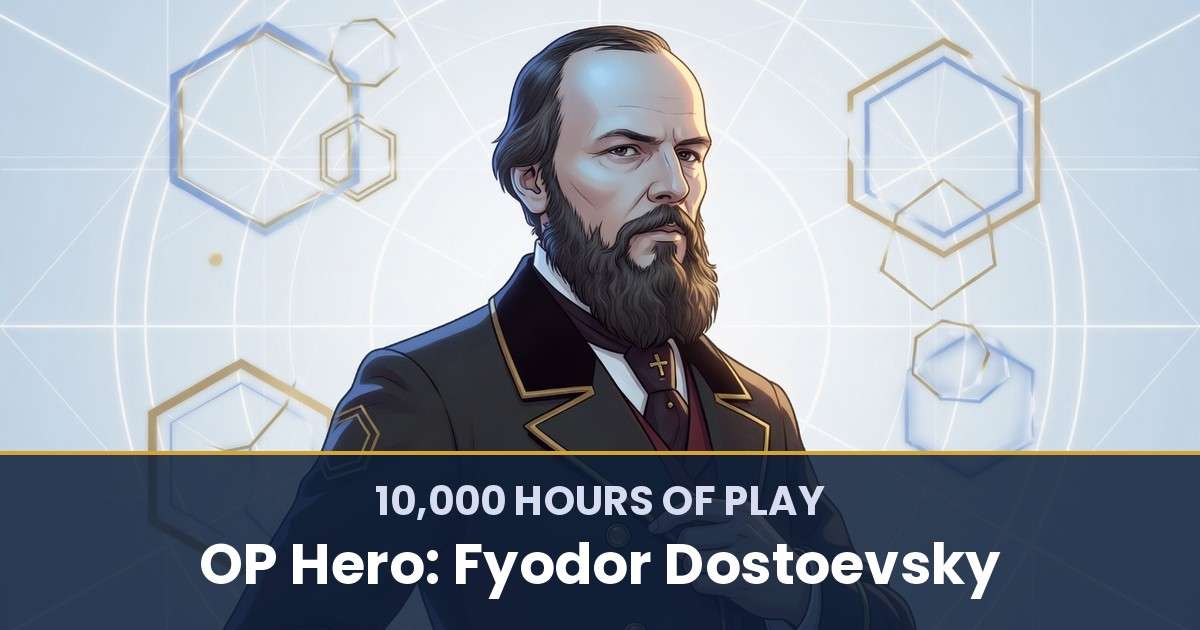


On the morning of December 22, 1849, Fyodor Dostoevsky stood in a St. Petersburg square in a thin shirt, waiting to be shot. He was 28 years old. The death sentence had been read aloud, the first prisoners were already tied to the posts, and Dostoevsky stood in the group scheduled to die next. By his own later account, he had only minutes left.
Then a messenger rode in. The whole execution was theater, staged on the Tsar’s orders to terrify the condemned before commuting their sentences at the last possible second. Dostoevsky was marched off to four years of hard labor in a Siberian prison camp instead.
Most people would spend the rest of their life recovering from that morning. Dostoevsky spent his mining it. Almost everything that made him one of the most important novelists who ever lived, the lifelong obsession with guilt, freedom, faith, and what a person becomes at the very edge of everything, traces back to the man who was handed his life back at the last second and decided he owed something enormous for it.
Run that life through the 6-Step framework and you get a specific, stealable answer to a hard question: what do you do with the worst thing that ever happened to you?
⚡ Speed Run Notes
- Dostoevsky’s real game was never “write great novels.” It was to test, on the page, whether a broken and guilty person can still find freedom and meaning. Every book runs that experiment again.
- The 1849 mock execution and four years in a Siberian camp didn’t derail his career. They became the raw material for it. The setback was the reforging.
- He dictated The Gambler in about 26 days in 1866 to escape a ruinous contract, met his future wife doing it, and turned a financial trap into his most durable alliance.
- His gambling addiction nearly destroyed him. The same all-or-nothing wiring that ruined him at the roulette table is what let him push characters and ideas to the absolute limit on the page.
- He treated suffering as a problem to solve rather than a wound to nurse. That single reframe is the most portable thing in his entire build.
Table of Contents
- Step 1: The Game Fyodor Dostoevsky Was Actually Playing
- Step 2: Attributes, the Innate Stats
- Step 3: Role(s) Across Chapters
- Step 4: Skills He Mastered
- Step 5: Allies Who Multiplied Him
- Step 6: Quests That Shaped the Saga
- What You Can Steal From Fyodor Dostoevsky’s Build
- Where this framework comes from
- Related Reading
About Yu-kai Chou

Yu-kai Chou is the author of 10,000 Hours of Play — the book that treats your life as the most important game you’ll ever build a character in, and gives you the 6-Step framework (Game · Attributes · Role · Skills · Allies · Quests) to play it on purpose. He has spent two decades developing the system through which this post analyzes its OP Hero, and applies it to his own life and to the lives of the people he advises around the world.
Chou’s other framework, the Octalysis Framework, has been applied by LEGO, Microsoft, Porsche, Coca-Cola, Salesforce, and MrBeast, impacting over 1.5 Billion Users. He has taught the methodology at Harvard, Stanford, Yale, Tesla, Google, BCG, and IDEO, and has advised governments in eight nations including Ukraine, the United Kingdom, the Kingdom of Bahrain, Singapore, Taiwan, the Netherlands, Kazakhstan, and South Korea.
His work has been cited by Harvard, Stanford, MIT, Forbes, Wall Street Journal, Wired, US Department of Energy, NIST, NSF, NCBI, US Department of Education, ClinicalTrials.gov, and Google Scholar — with 3,700+ more academic publications. Explore his books here.

What keeps pulling me back to Dostoevsky is that he refused to let the worst day of his life stay wasted. The mock execution and the prison years could have been the end of the story. He turned them into the source material for everything that came after. If you steal one thing from his build, steal the instinct to treat your hardest experience as data for the work rather than a reason to stop making it.
Step 1: The Game — What Fyodor Dostoevsky Was Actually Playing
It is easy to say Dostoevsky’s game was literature. It wasn’t. Literature was the equipment.
The game he actually played, for close to four decades, was a single question run over and over under harsher and harsher conditions: can a person who is guilty, doubting, and half-destroyed still find freedom and meaning? Every major novel is that question staged as an experiment. Crime and Punishment asks it of a murderer. The Idiot asks it of a man too good for the world. The Brothers Karamazov asks it of a whole family, and lets one brother argue that if God is dead, “everything is permitted,” just to see whether anyone can answer him.
This is what it looks like to treat your life as a game you play on purpose instead of a career you happen to have. Dostoevsky wasn’t collecting bestsellers. He was collecting evidence for a case he cared about more than his own comfort, and he was willing to write himself into debt and illness to keep gathering it.
Define your game as “produce good work” and you drift the moment the work gets hard. Define it as a question you cannot stop needing the answer to, and the hard parts stop being obstacles. They become the next chapter of the investigation.
Step 2: Attributes — The Innate Stats
Attributes are the stats you show up with. You don’t learn them; they’re the dice you were handed before you started building a character.
Dostoevsky’s first stat was a raw sensitivity to human suffering. He grew up on the grounds of the Mariinsky Hospital for the Poor in Moscow, where his father worked, and saw sickness and poverty at close range as a child. That early exposure shows up in his very first novel, Poor Folk, which fixates on the humiliations of the powerless with a tenderness most 24-year-olds can’t fake.
His second stat was a compulsive habit of self-analysis. After his mother died when he was 15, contemporaries describe him turning sharply inward and withdrawn. That microscope never switched off. The narrator of Notes from Underground dissects his own motives to the point of self-torture, and reading a person’s innate attributes against the roles they choose shows how directly Dostoevsky pointed that inward gaze at the page.
The third stat is the dangerous one: an all-or-nothing risk appetite. It wrecked him at the roulette tables of Europe, where his gambling addiction ran deepest in the 1860s. But the same wiring is why his characters never settle for moderation. Raskolnikov, Stavrogin, Ivan Karamazov all push an idea until it breaks. Their creator was built to do the same.
Step 3: Role(s) — The Character Class Across Chapters
Dostoevsky respecced his class several times, and life forced most of the changes.
He started as an army engineer in training. He enrolled at the Nikolayev Military Engineering Institute in 1838 and briefly served in the engineering corps, then abandoned the whole track for writing when Poor Folk appeared in 1846 and the powerful critic Vissarion Belinsky championed it. Player one: reluctant technician turned literary novice.
Then the state reclassed him by force. As a member of the Petrashevsky Circle, a group that met to discuss banned anti-Tsarist writing, he was arrested in April 1849, sentenced to death, and sent to a Siberian prison camp. For nearly a decade, from 1849 to 1858, his class was convict and then conscripted soldier. This is the chapter that rebuilt his worldview around suffering and faith.
His third class was the one most writers would recognize: professional novelist working under brutal financial pressure. Through the 1860s and 1870s he wrote to survive debt, often against contract deadlines. It is the same class Charles Dickens played under serialized deadlines, and the constraint sharpened both men rather than dulling them.
By 1880 he had earned a final class: moral authority of Russian letters. Same person, four character sheets, and he never got stuck defending the role that first made him famous.
Step 4: Skills — The Real-Life Game Skills Fyodor Dostoevsky Mastered
Attributes are the dice. Skills are the moves you drill until they fire under pressure, and Dostoevsky’s story is unusually clear about which ones cracked open his results.
The first is Loremaster (Druid): weaving a compelling story that carries a heavy idea without collapsing under it. His trick was to smuggle philosophy inside a page-turner. Crime and Punishment works as a crime thriller and as a moral argument at the same time, which is why people who came for the murder stayed for the ideas.
The second is Elemental Transposition (Mage): reframing every problem as a puzzle to be solved. Dostoevsky took the biggest questions he had, about God, guilt, and free will, and turned each into a novel-shaped experiment with characters as the variables. Where that skill sits on the specialist-to-master skills spectrum depends on how relentlessly you apply it, and he applied it to the end of his life.
The third is Lich Grind (Warlock): intense, secluded periods of output. In 1866, cornered by a contract, he dictated the entire short novel The Gambler in roughly 26 days while also finishing Crime and Punishment. That is not talent alone. That is a person who could disappear into the work and produce at inhuman speed when the stakes were real.
The fourth is Phoenix Rebirth (Paladin): recovering from a devastating failure and coming back stronger. The mock execution and Siberia are the textbook case, and they earn their own section below.
The fifth is Locked Heart (Warlock): pain contrasting, comparing your current suffering to something worse to convert it into gratitude. Facing a firing squad and then being spared reset his entire baseline. A writer who has genuinely believed he had minutes to live does not flinch at a bad review, a hard deadline, or a difficult chapter. Prolific novelists from Stephen King’s recovery-fueled output onward tend to share this refusal to be stopped by ordinary friction.
Step 5: Allies — The People Who Multiplied Fyodor Dostoevsky
No writer works alone, and Dostoevsky needed his allies more than most.
The first was Vissarion Belinsky, the most influential Russian critic of the era. In 1846 Belinsky read the manuscript of Poor Folk and hailed the unknown 24-year-old as a major new voice, which launched his reputation overnight. One reader with the right authority turned a nobody into a name.
The second was his older brother, Mikhail Dostoevsky. From the early 1860s, Mikhail co-founded and published the journals Vremya (Time) and Epokha (Epoch), giving Fyodor a steady outlet and income after Siberia. When Mikhail died in 1864, Fyodor took on his brother’s debts along with his grief, and the financial hole that followed shaped the desperate decade to come.
The most important ally arrived in October 1866. Anna Grigoryevna Snitkina was hired as a stenographer to help him dictate The Gambler against that impossible deadline. They finished in about 26 days, he proposed soon after, and they married in February 1867. Anna then became the practical engine of his life: she managed his finances, eventually his publishing, and steadied the household through his gambling and epilepsy. He supplied the genius. She supplied the structure that kept the genius from destroying itself.
Step 6: Quests — The Milestones That Shaped the Saga
Strip Dostoevsky’s life to its load-bearing quests and a pattern appears: nearly every breakthrough sits right next to a catastrophe.
The opening quest was Poor Folk in 1846, the debut that made his name. The failure quest came almost immediately: arrest in 1849, the staged execution that December, and four years of hard labor in Omsk from 1850 to 1854. He entered prison a liberal idealist and came out with the questions that would drive every later book. In the camp he read the New Testament, one of the few texts allowed, and that reading reorganized his convictions for good.
The comeback quest was the 1866 sprint. Buried in debt and bound by a contract that would have handed a publisher the rights to his future work, he dictated The Gambler in about 26 days, met Anna in the process, and escaped the trap. The same year he published Crime and Punishment, and the mature run began: The Idiot, Demons, and finally The Brothers Karamazov, serialized in 1879 and 1880.
The private quests were the hardest. His first wife, Maria, died in 1864. His young son Alyosha died in 1878, and Dostoevsky poured that grief into the gentle brother who anchors The Brothers Karamazov. The final public quest was his Pushkin Speech in June 1880, which made him a moral authority across Russia. He died about eight months later, in February 1881, at 59. Anyone working through the wider OP Hero catalog of builders who turned pain into work will recognize the shape of it.
What You Can Steal From Fyodor Dostoevsky’s Build
You are not going to face a firing squad, and you are probably not going to write The Brothers Karamazov. Neither is the transferable part.
The transferable part is what he did with the worst thing that happened to him. Most people file a trauma under “reasons I am the way I am.” Dostoevsky filed his under “material.” The prison years, the epilepsy, the gambling, the dead son, all of it went into the work instead of sitting beside it as an excuse. Viktor Frankl built an entire psychology out of the same move, and it is available to anyone willing to make it.
Steal his definition of the game: not “produce good work” but “answer a question I cannot stop needing answered,” because that framing survives the hard years when a career goal wouldn’t. Steal his reframe of suffering as a puzzle rather than a wound. And steal the humbler lesson hiding in the Anna story, which is that raw genius almost always needs an ally who supplies the structure it can’t build for itself.
He believed a person could stand at the absolute bottom, guilty and ruined, and still choose meaning. Coming from a man who was measured for a coffin at 28 and then wrote for another 32 years, that is not a comforting slogan. It is a field report.
Where this framework comes from

Want the full system this profile is built on?
Every OP Hero piece runs through the same 6-Step framework from 10,000 Hours of Play: Unlock Your Real-Life Legendary Success. The book covers the full system, walks through Yu-kai’s own life run as the first applied case study, and gives you the worksheets to audit your own build.
Related Reading
- All OP Hero Profiles: the full roster of legendary builds run through the 6-Step framework.
- OP Hero: Viktor Frankl: the psychiatrist who turned unimaginable suffering into a system for finding meaning.
- OP Hero: Charles Dickens: another novelist who did his best work under relentless serialized deadlines.
- OP Hero: Stephen King: prolific output and a hard-won recovery, run through the same framework.
- The 10K HP Framework: 6 Steps to Gamify Your Life: the system this profile is built on.
- The OP Talent Triangle Method: how to map your own innate attributes against your roles.