
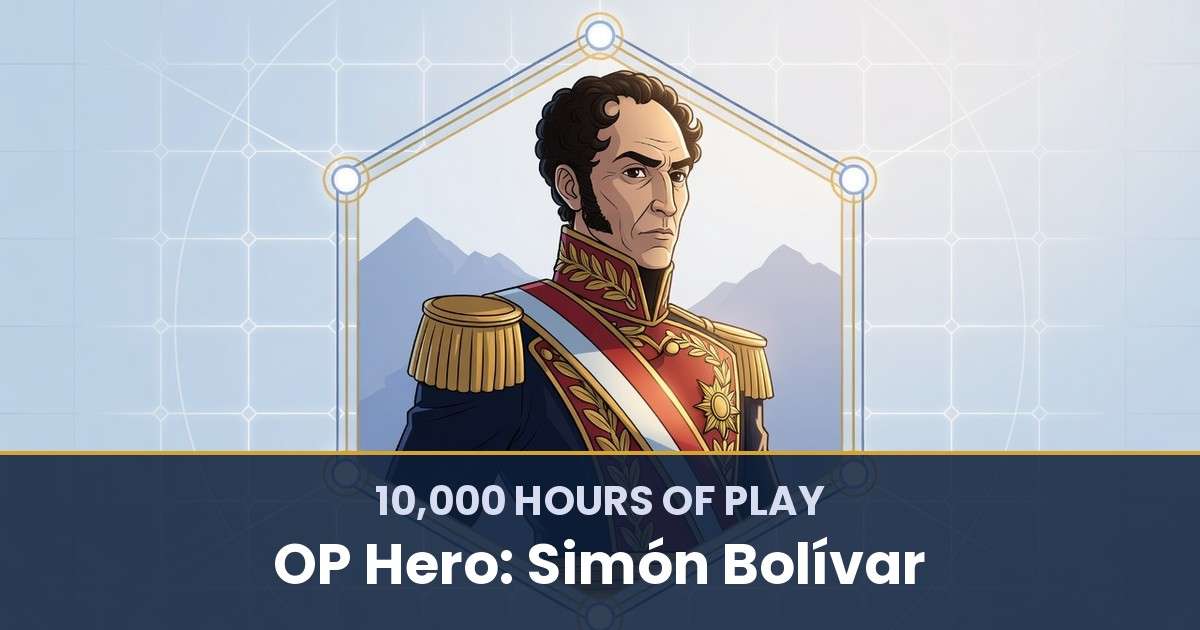


In the middle of 1819, Simón Bolívar marched an army off the flooded plains of Venezuela, up into the Andes, and over a freezing pass called the Páramo de Pisba. Men and horses died in the cold. The soldiers who came down the other side were exhausted and half-starved.
They were also standing behind the Spanish army, exactly where no one expected them.
Days later, on August 7, 1819, Bolívar’s ragged force broke the royalists at the Boyacá River and took the capital of New Granada, the territory we now call Colombia. One brutal shortcut had liberated a country.
That is the Bolívar pattern in miniature: bet everything on a move too reckless for a cautious general, and keep making that bet until a continent changes hands. If you treat your life as a game worth playing on purpose, his run is a masterclass in one hard question — what is worth risking everything for, and how many times will you get up after it goes wrong?
⚡ Speed Run Notes
- Bolívar played one enormous game for over two decades: break Spanish rule across northern South America, then fuse the freed territories into one durable republic he called Gran Colombia.
- His main quest was never just “defeat Spain.” It was “defeat Spain and build a continental union that does not tear itself apart,” and that second half is the one he lost.
- His edge was audacity plus vision: he attacked when others waited, and imagined a nation the size of a continent when most rebels were thinking one province at a time.
- He was crushed and exiled more than once. The 1814 collapse of his second republic sent him fleeing to Jamaica in 1815, where he wrote his way back into the fight instead of quitting.
- His allies won the endgame: Sucre closed out the war at Ayacucho, Santander ran the state, Páez held the cavalry, and Manuela Sáenz literally saved his life in 1828.
- He freed six modern nations and died in 1830 watching his union fracture, proof that liberating a people and governing them are two different games.
Table of Contents
- Step 1: The Game Simón Bolívar Was Actually Playing
- Step 2: Attributes, the Innate Stats
- Step 3: Role(s) Across Chapters
- Step 4: Skills He Mastered
- Step 5: Allies Who Multiplied Him
- Step 6: Quests That Shaped the Saga
- What You Can Steal From Simón Bolívar’s Build
- Where This Framework Comes From
- Related Reading
About Yu-kai Chou

Yu-kai Chou is the author of 10,000 Hours of Play — the book that treats your life as the most important game you’ll ever build a character in, and gives you the 6-Step framework (Game · Attributes · Role · Skills · Allies · Quests) to play it on purpose. He has spent two decades developing the system through which this post analyzes its OP Hero, and applies it to his own life and to the lives of the people he advises around the world.
Chou’s other framework, the Octalysis Framework, has been applied by LEGO, Microsoft, Porsche, Coca-Cola, Salesforce, and MrBeast, impacting over 1.5 Billion Users. He has taught the methodology at Harvard, Stanford, Yale, Tesla, Google, BCG, and IDEO, and has advised governments in eight nations including Ukraine, the United Kingdom, the Kingdom of Bahrain, Singapore, Taiwan, the Netherlands, Kazakhstan, and South Korea.
His work has been cited by Harvard, Stanford, MIT, Forbes, Wall Street Journal, Wired, US Department of Energy, NIST, NSF, NCBI, US Department of Education, ClinicalTrials.gov, and Google Scholar — with 3,700+ more academic publications. Explore his books here.

What pulls me to Bolívar is that he was elite at the half of the game most people fear and shaky at the half most people crave. He could win the impossible campaign and imagine the impossible nation, but holding a fractious union together bored and defeated him. The lesson I lift from his build: the skill that wins the war is rarely the skill that keeps the peace, and a wise player either learns the second one or hands it early to an ally who has it.
Step 1: The Game — What Simón Bolívar Was Actually Playing
Bolívar was born in 1783 into one of the wealthiest Creole families in Caracas, a boy who inherited estates and mines and every advantage the colony could offer. The game he chose to play with all of it was the largest one available.
From roughly 1807 until his death, he chased a single objective: use war, law, and political engineering to drive Spain out of northern South America and weld the liberated lands into one big republican federation. He named that hoped-for super-state Gran Colombia.
Notice the shape of the goal. Most rebels of his era were fighting to free a single province. Bolívar was trying to free a continent and then govern it as one country spanning Venezuela, New Granada, Quito, and later Peru and Upper Peru.
The tell is how he died. In 1830, ruined and dying, he grieved the breakup of Gran Colombia far more than any lost battle, which shows the real end-state he was playing for was lasting union, not military glory. Like Abraham Lincoln, who staked everything on holding one union together, Bolívar’s deepest quest was not conquest but cohesion. The war was only the opening act.
Step 2: Attributes — The Innate Stats
Some players are built to hold ground and some to charge it. Bolívar’s raw stats point almost entirely at the charge.
His highest attribute was audacity. He repeatedly bet everything on long-shot campaigns through mountains and flooded plains when a more careful commander would have waited for spring, and the 1819 crossing of the Andes to strike behind the enemy is the purest expression of that reflex.
The second was personal magnetism. He attracted followers across class and racial lines and rallied troops after disasters that would have scattered another army, and contemporaries granted him the title “El Libertador,” the Liberator, which he adopted as his own.
The third was strategic vision at continental scale. As a young exile he studied European politics, watched Napoleon crown himself in Paris, and came home imagining not a free province but a free hemisphere organized into a durable state, a picture far larger than what most of his peers could hold in their heads.
The last was sheer willpower. Orphaned young and widowed within a year of marriage when his wife María Teresa died in 1803, he kept returning to the fight through defeat, exile, and mutiny rather than retreating into his comfortable inheritance. If you want a structured way to find your own top stats, the Talent Triangle Method is a good place to start.
Step 3: Role(s) — The Character Class Across Chapters
Bolívar respecced his character several times, but every version kept the same core stat of audacity.
He began as a wealthy Creole heir and student, a young aristocrat with high resources and low responsibility, sent to Spain to finish an elite education. After his wife’s death in 1803 he turned into a grieving wanderer, traveling through France and Italy, and, by tradition, swearing an oath in Rome to devote his life to freeing his homeland. That vow is the moment he switched from noble bystander to player character.
By 1810 he had respecced again into an insurgent commander and pamphleteer, joining the independence movement in Caracas, earning fame in the “Admirable Campaign” of 1813 that briefly restored the republic, and writing the Cartagena Manifesto in 1812 to explain why the first attempt had failed.
His final and defining class was the liberating general who doubled as a founding statesman. From 1817 onward he built bases on the Orinoco, ran the campaigns that freed one territory after another, and then tried to write the constitutions that would hold them together. Like Frederick Douglass, who turned words into weapons in the fight for freedom, Bolívar fought with the pen as hard as with the sword.
Step 4: Skills — The Real-Life Game Skills Simón Bolívar Mastered
Bolívar’s victories trace to a tight set of concrete, repeatable skills.
The signature one is Courageous Heart (Paladin): charging into uncharted, hostile territory that stops other people cold. The 1819 march over the Páramo de Pisba is the textbook case, an assault route so punishing that the royalists never fortified it, which is exactly why appearing on the far side won him New Granada in a single stroke.
Guiding that audacity was Foresight (Ranger): projecting a future that others could not yet see. While most rebels planned province by province, Bolívar designed Gran Colombia as a continental-scale republic, sketching a state and a set of institutions years before the territory to fill them even existed.
His political survival ran on Loremaster (Druid): weaving compelling, inspiring arguments that moved people. The Cartagena Manifesto of 1812 and the Jamaica Letter of 1815 were not just essays; they diagnosed why independence had failed and made the case for a continental republic so persuasively that they recruited belief and backing when he had almost no army left.
He also had Phoenix Rebirth (Paladin): recovering from devastating failure and coming back stronger. And the skill that turned his personal daring into an empire was Tactical Command (Ranger), making people of very different talents work in harmony. He fused Sucre’s field generalship, Santander’s administration, and Páez’s plains cavalry into one machine, and none of these are mystical gifts. They sit on a spectrum you can climb deliberately, which is exactly what the Skills Spectrum is for.
Step 5: Allies — The People Who Multiplied Simón Bolívar
Bolívar’s story is one of the clearest proofs in the whole OP Hero library that liberating a continent is a team sport. Alone, he was a brilliant general who kept losing his own republics.
His first ally was his tutor, Simón Rodríguez, who fed the young Bolívar the Enlightenment ideas of Rousseau and others, and helped convince him that Spanish rule was illegitimate and that America should form its own republics. That intellectual seed became the whole mission.
His sharpest sword was Antonio José de Sucre, the lieutenant who commanded the patriot army to victory at the Battle of Ayacucho on December 9, 1824, the fight that shattered the last major royalist army and effectively ended Spanish rule on the South American mainland. Sucre then became the first president of the new republic of Bolivia in 1826.
His statecraft came from Francisco de Paula Santander, who as vice president of Gran Colombia turned battlefield wins into a working government of taxes, courts, and conscription while Bolívar rode off to the next campaign. His cavalry came from José Antonio Páez, whose hardened plainsmen were decisive at Carabobo in 1821. And his life itself was saved by Manuela Sáenz, who during the assassination attempt of September 25, 1828, in Bogotá warned him and helped him escape through a window, earning the title “La Libertadora del Libertador,” the Liberator of the Liberator.
Step 6: Quests — The Milestones That Shaped the Saga
Bolívar’s career reads like a quest log where the grandest victories and the deepest failure sit right next to each other.
His early quests ended in defeat. His second republic collapsed under a royalist resurgence in 1814, and by 1815 he was a beaten exile in Jamaica with almost nothing left but a pen. That low point set up everything that followed.
The comeback quest was the 1819 crossing of the Andes and the Battle of Boyacá on August 7, which liberated New Granada and gave him the money, men, and base to build outward. Then came the Battle of Carabobo on June 24, 1821, which secured Venezuelan independence, followed by the founding of Gran Colombia through the Congress of Angostura, fusing Venezuela and New Granada into the union he had imagined.
The southern quests finished the war. Ecuador fell in 1822, Peru was secured through the victory at Ayacucho in 1824, and in 1825 a grateful Upper Peru renamed itself Bolivia in his honor and adopted a constitution he drafted. Six future nations owed their independence in part to his campaigns.
Then came the failure that outweighed them all. The union would not hold. Regional rivalries pulled at it, Páez led Venezuela toward separation, and by 1830 Gran Colombia was dissolving even as Bolívar lay dying in December of that year, grieving the collapse of the very thing he had built the wars to create. You will find that same pattern of triumph shadowed by an unfinished dream all over the OP Hero library.
What You Can Steal From Simón Bolívar’s Build
The first steal is that audacity is a strategy, not just a temperament. Bolívar won because he attacked where the map said it was impossible, and the enemy’s certainty that no one would try became his opening. When everyone has ruled out a move, that move is often the only one still worth making.
The second is that setbacks are the setup. The exile in Jamaica looked like the end of his run, and it turned out to be the pause before he liberated a continent. A crushing defeat and a launch pad can look identical from the inside.
The third is to know which game you are actually good at. Bolívar was elite at winning the war and weak at keeping the peace, and his tragedy is that he did not hand the second game to others soon enough. Naming the skill you lack is what lets you recruit an ally who has it before the gap costs you everything.
The last steal is that a vision can outlive its defeat. Gran Colombia broke apart, yet Bolívar’s dream of a united, self-governing Latin America still moves people two centuries later. Like Winston Churchill, who spent years in the political wilderness before his defining fight, Bolívar proves that a build can fail its final quest and still change the world.
Where this framework comes from

Want the full system this profile is built on?
Every OP Hero piece runs through the same 6-Step framework from 10,000 Hours of Play: Unlock Your Real-Life Legendary Success. The book covers the full system, walks through Yu-kai’s own life run as the first applied case study, and gives you the worksheets to audit your own build.
Related Reading
- The full OP Hero profiles library: every legendary life run through the 6-Step framework.
- The 10,000 Hours of Play framework: the 6 Steps of Game, Attributes, Role, Skills, Allies, and Quests.
- Abraham Lincoln: OP Hero: another leader who bet everything on holding a single union together.
- Frederick Douglass: OP Hero: the liberator who turned words into weapons for freedom.
- Winston Churchill: OP Hero: proof that years in the wilderness can precede a defining fight.
- The Talent Triangle Method: how to map your own innate attributes.