
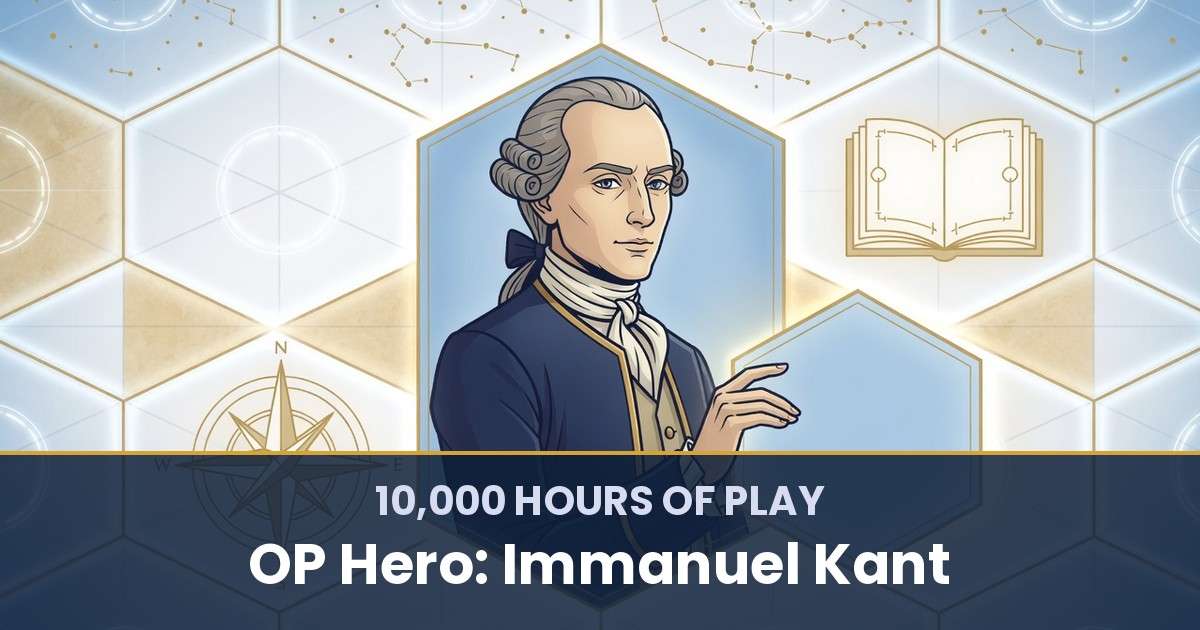


In 1781, a 57-year-old professor in the Prussian port city of Königsberg published a book so dense that even sympathetic readers complained they could not finish it. He had barely published anything of substance for roughly a decade before it. Colleagues assumed his best thinking was behind him. The book was the Critique of Pure Reason, and it quietly rewrote what philosophy was allowed to ask.
Immanuel Kant did not have early wins. He spent years as an unsalaried lecturer, paid by the head like a street performer, teaching everything from logic to geography to make rent. His breakthrough landed in his late fifties, after most of his peers had already coasted into their legacies.
That is the part worth stealing. Kant is proof that a slow, disciplined, decades-long build can beat raw early talent, and that the most valuable move in a long game is sometimes to go quiet and rebuild the whole engine. Here is his run through the six steps of the game.
⚡ Speed Run Notes
- Kant’s edge was not speed. He published his masterwork at 57 after a near-silent decade of rebuilding, proving a patient compounding build can outlast early talent.
- His core game: map the limits of human reason so science, freedom, and morality all stay possible. One question, chased for six decades.
- Reading David Hume “awakened him from his dogmatic slumber.” Kant treated a devastating critique of his own beliefs as a gift, not a wound.
- His famous discipline was the multiplier. Legendarily regular daily habits turned raw analytical talent into a finished system nobody else could assemble.
- The 1794 royal order banning him from writing on religion is the setback: even a giant of reason got censored, and kept his integrity anyway.
Table of Contents
About Yu-kai Chou

Yu-kai Chou is the author of 10,000 Hours of Play — the book that treats your life as the most important game you’ll ever build a character in, and gives you the 6-Step framework (Game · Attributes · Role · Skills · Allies · Quests) to play it on purpose. He has spent two decades developing the system through which this post analyzes its OP Hero, and applies it to his own life and to the lives of the people he advises around the world.
Chou’s other framework, the Octalysis Framework, has been applied by LEGO, Microsoft, Porsche, Coca-Cola, Salesforce, and MrBeast, impacting over 1.5 Billion Users. He has taught the methodology at Harvard, Stanford, Yale, Tesla, Google, BCG, and IDEO, and has advised governments in eight nations including Ukraine, the United Kingdom, the Kingdom of Bahrain, Singapore, Taiwan, the Netherlands, Kazakhstan, and South Korea.
His work has been cited by Harvard, Stanford, MIT, Forbes, Wall Street Journal, Wired, US Department of Energy, NIST, NSF, NCBI, US Department of Education, ClinicalTrials.gov, and Google Scholar — with 3,700+ more academic publications. Explore his books here.

What I find instructive about Kant’s build is that he won the long game with the least glamorous stat on the sheet: consistency. He had no prodigy story, no lucky patron, no early hit. He had a system for using every single day, and he ran it for decades until the compounding became undeniable. If you feel behind, Kant is the OP Hero to study, because his most transferable skill is simply refusing to waste ordinary time.
Step 1: The Game — What Kant Was Actually Playing
Most people who chase big ideas jump between them. Kant did the opposite. For roughly six decades he chased a single, enormous question: what are the real limits and powers of human reason?
He wanted to show how finite, error-prone creatures like us can genuinely know the world through science and still be free, responsible, moral agents inside it. His mature project organized itself around three questions that are almost embarrassingly direct: What can I know? What should I do? What may I hope?
Seen through a life-as-a-game lens, that is an unusually clean win condition. Kant was not trying to be prolific or famous. He was trying to build one coherent rule-set for reality that let rational players be both knowers and free agents, without collapsing into skepticism on one side or empty dogma on the other. Nearly everything he wrote was a move toward that single objective.
The lesson is that a narrow, stubbornly-held game beats a scattered one. When you know exactly what you are playing for, decades of small moves start pointing in the same direction.
Step 2: Attributes — The Innate Stats
Attributes are the base stats you show up with. Kant’s were visible long before his fame.
The first was structural pattern detection. From his schooling at the Pietist Collegium Fridericianum through the University of Königsberg, he gravitated toward mathematics, physics, and logic, disciplines that reward spotting hidden structure in ordinary things. His signature adult move, inferring the necessary preconditions of experience, only works if you naturally see the scaffolding behind everyday facts.
The second was raw intellectual stamina. Kant could hold a difficult, unresolved problem open for years without forcing a cheap answer. That tolerance for delayed payoff is the trait behind his near-silent decade of preparation before 1781.
The third was an architect’s temperament. Even his early scientific essays tried to fuse Newtonian physics with Leibnizian metaphysics into one unified structure rather than a pile of separate takes. If you want to map your own base stats before you start leveling skills, the OP Talent Triangle Method is the tool I’d point you to. Kant’s triangle was analytical, patient, and systematic, and he built directly on top of it.
Step 3: Role(s) — The Character Class Across Chapters
Kant did not start as “Kant.” He respecced several times.
His first class was the underemployed scholar. After university he spent years as a private tutor to Prussian families, low on status and money but soaking up how the world actually worked outside the lecture hall.
In 1755 he qualified as a Privatdozent, an unsalaried lecturer at Königsberg paid directly out of student fees. For fifteen years he was effectively a freelance natural philosopher, teaching a punishing course load while writing on cosmology and physics. This was his grind class, high output, low security.
In 1770 he finally earned the chair of logic and metaphysics, and his class shifted to tenured system-builder. Then, after 1781, he became something rarer: the meta-designer who redraws the rules other thinkers play by. Like fellow philosophers Marcus Aurelius and Aristotle, Kant shows that a “thinker” is not one static role but a sequence of them, each unlocking the next.
Step 4: Skills — The Real-Life Game Skills Kant Mastered
Attributes are potential. Skills are what he trained. Four canon Real-Life Game Skills carried Kant’s build.
The first is Nethermind (Mage) — intense, sustained focus on hard intellectual problems. Kant could sink into a single conceptual knot and stay there for years, which is exactly the ability the Critique of Pure Reason demanded.
The second, and the one that actually cracked his breakthrough, is Elemental Transposition (Mage) — reframing a stuck problem as a solvable puzzle. Kant’s celebrated “Copernican turn” did this: instead of asking how our minds manage to conform to objects, he flipped it and asked how objects must conform to the structure of our minds. That single reframe unlocked the whole critical system.
The third is Lich Grind (Warlock) — intense, secluded work periods. His near-silent decade in the 1770s was one long Lich Grind: publishing little, showing little, quietly assembling the machine. If you want to understand how deliberate practice actually compounds into mastery, the Skills Spectrum maps the journey from dabbler to master that Kant walked in private.
The fourth is Ninja Focus (Rogue) — relentless daily discipline. Kant’s regularity was so famous that the anecdote about neighbors setting their clocks by his walks survived him, and while it is probably apocryphal, it captures something true: he converted ordinary days into output with almost mechanical reliability.
Step 5: Allies — The People Who Multiplied Kant
A hermit’s reputation hides how much Kant borrowed from others. His allies were mostly minds, some in the room and some only on the page.
His teacher Martin Knutzen handed him the two toolkits he would spend a lifetime reconciling: Isaac Newton’s physics and the Leibniz-Wolff rationalist tradition. Newton mattered doubly, because Kant’s bold 1755 nebular hypothesis about how the solar system formed was built directly on Newtonian mechanics.
The most important ally never met him. Reading David Hume, Kant later wrote, “awakened him from his dogmatic slumber.” Hume’s attack on cause and effect demolished Kant’s comfortable assumptions and forced the entire critical project into being. Rousseau shifted him too, pulling his focus from natural science toward human dignity and the idea that people are ends in themselves.
And Marcus Herz, a former student, became the correspondent Kant used as a sounding board through the 1770s, the person he tested half-formed critical ideas on before the world ever saw them. Every serious build has a Herz: someone you think out loud to before you ship.
Step 6: Quests — The Milestones That Shaped the Saga
Kant’s quest log is short but heavy. In 1755 he published Universal Natural History and Theory of the Heavens, proposing that the solar system condensed out of a rotating cloud of matter, a genuinely visionary cosmological guess for its time.
His 1770 inaugural dissertation and professorship marked the turn toward his life’s real work. Then came the great gamble: the silent decade, where he risked his reputation by going quiet, the same kind of patient, long-horizon bet that Charles Darwin would later make in a different field.
The payoff arrived as a trilogy. The Critique of Pure Reason in 1781, revised heavily for its 1787 second edition, mapped what we can know. The Groundwork of the Metaphysics of Morals in 1785 gave the world the categorical imperative. The Critique of Practical Reason (1788) and the Critique of Judgment (1790) completed the system.
Then the setback. His 1793 book Religion within the Bounds of Bare Reason provoked the Prussian state, and in 1794 King Friedrich Wilhelm II formally ordered him to stop writing on religion. Kant, near seventy and at the height of his fame, complied while the king lived but never recanted his views, a quiet act of integrity that belongs in the OP Hero record as much as any of his books.
What You Can Steal From Kant’s Build
You are probably not going to rewrite metaphysics. But three moves from Kant’s run transfer directly to any life.
First, pick one game and stay in it. Kant’s power came from pointing decades of small daily moves at a single objective. Scattered effort never compounds; concentrated effort does.
Second, treat your best critic as your best ally. Hume did not flatter Kant, he wrecked him, and that wreckage produced the greatest work of Kant’s life. When someone dismantles a belief you were comfortable with, that is the moment your build can level up.
Third, trust the quiet years. The silent decade looked like failure from the outside and turned out to be the most productive stretch of his life. If you are grinding in obscurity right now, you may simply be in your own silent decade. Study how other OP Heroes ran the same play, then keep building.
Where this framework comes from

Want the full system this profile is built on?
Every OP Hero piece runs through the same 6-Step framework from 10,000 Hours of Play: Unlock Your Real-Life Legendary Success. The book covers the full system, walks through Yu-kai’s own life run as the first applied case study, and gives you the worksheets to audit your own build.
Related Reading
- The Full OP Hero Profiles Hub: every hero run through the 6-Step framework, in one place.
- The 10,000 Hours of Play Framework: the 6 steps (Game, Attributes, Role, Skills, Allies, Quests) explained.
- OP Hero: Marcus Aurelius, another philosopher who turned duty and discipline into a life system.
- OP Hero: Charles Darwin, the patient, long-horizon build that mirrors Kant’s silent decade.
- OP Hero: Isaac Newton, the physicist whose system Kant spent a lifetime building on.
- The OP Talent Triangle Method: how to map your own innate attributes before leveling skills.