

On July 28, 2026, Tô Lâm signed Resolution 19-NQ/TW, the Communist Party of Vietnam’s blueprint for a renovated development model running to 2035.1 It is the newest pillar in the boldest economic order any Leninist party has issued since Deng Xiaoping went south: average growth of 10 percent a year through 2030, pledged at the 14th Party Congress in January, written into the National Assembly’s planning resolutions in spring, and now wired into the party’s own doctrine.24 The near-term arithmetic is already brutal. By the government’s own numbers, Vietnam needs roughly 11.9 percent growth in the second half of 2026 to make this year’s slice of the target.3 Only a handful of economies in modern history have sustained a decade at that pace, and every one did it with young demographics and an open export runway. Vietnam has ordered itself to join them on schedule.
The order deserves to be taken seriously, because the state issuing it is one of the most capable mobilization machines on earth. In a single administrative year it merged 63 provinces into 34 and deleted an entire tier of district government.8 It approved a $67 billion high-speed rail spine from Hanoi to Ho Chi Minh City.9 It compressed its own Party Congress to five days, the leadership question settled before the opening gavel.2 When this party decides, things move.
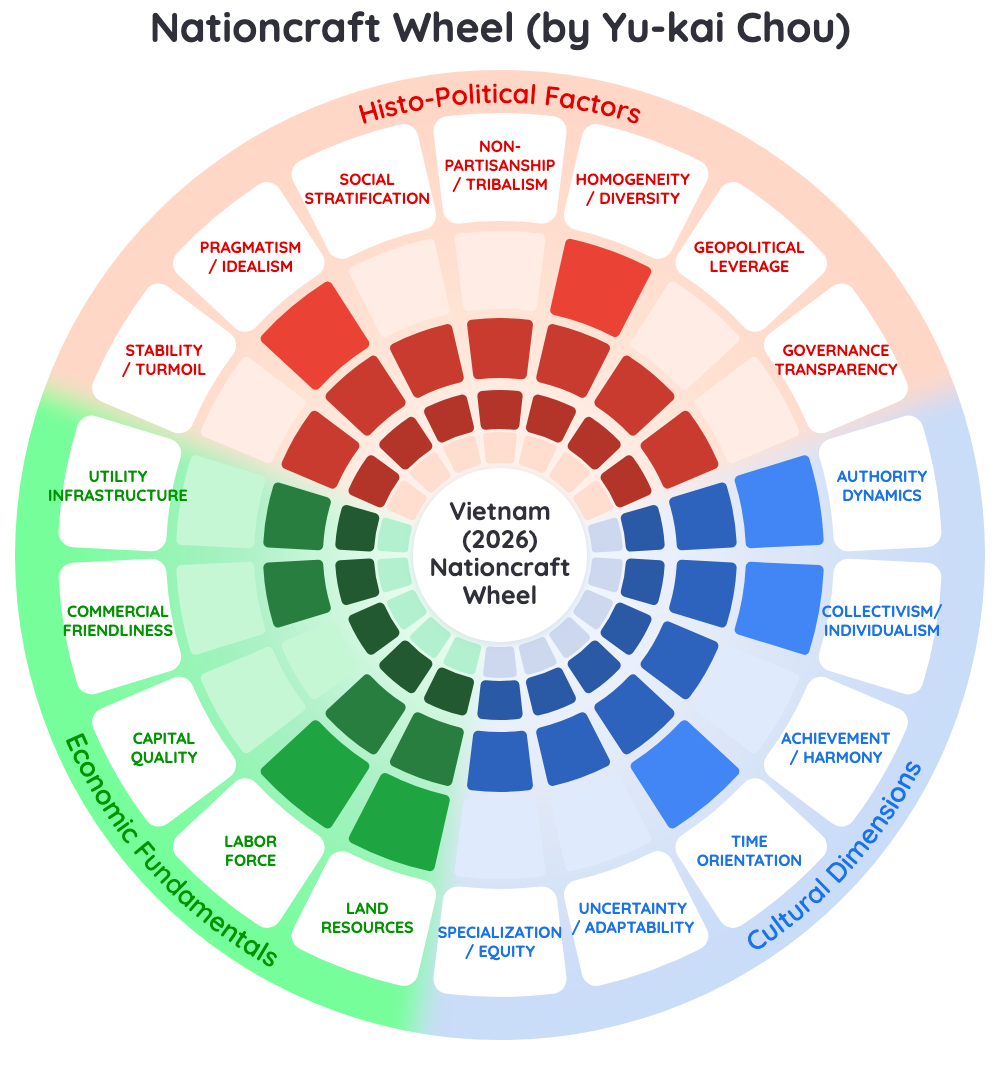
Call it the Double-Digit Decree Trap. A growth target is a command, and Vietnam’s command engine is nearly unmatched: in the 147-country Nationcraft corpus, only Singapore and China score higher on the combined command quad of Authority Dynamics (V1=9), Collectivism (V2=9), Pragmatism (V8=9), and Time Orientation (V4=8). But the inputs of double-digit growth are grants. Credit that flows on price signals rather than connections. Courts that enforce a contract against a well-connected insider. Firms that are free to scale and free to fail. Grids that deliver power to a factory the state never heard of. On exactly those variables, Vietnam’s profile bottoms out: Capital Quality V16=3, Commercial Friendliness V17=4, Utility Infrastructure V18=4, Governance Transparency V13=4. The instrument the party trusts most is structurally unable to reach the deficits that decide the outcome.
Vietnam’s own history is the proof that a different instrument exists. Đổi Mới, the 1986 reform that turned a starving command economy into this century’s export story, worked because the party commanded less: it withdrew from the rice paddy, the price board, and the border, and output exploded. The sequel now being decreed requires the same withdrawal in capital, courts, and corporate control, the three domains where a security-led leadership is currently tightening its grip. This analysis runs Vietnam through the eighteen-variable Nationcraft Framework, locates the trap in the specific variable interactions, and then separates the reform playbooks that would fail against this profile from the three worth studying. The clock matters: Vietnam’s workforce is aging faster than it is getting rich, and the decade the decree covers is the last one demography subsidizes.
⚡ Speed Run Notes
- Vietnam decreed a double-digit decade: 10% average growth to 2030, set at the 14th Congress, renewed by Resolution 19 in July 2026. Hitting 2026’s slice alone requires ~11.9% growth in the second half of the year.
- The Nationcraft read: V1=9 authority, V2=9 collectivism, V8=9 pragmatism, V4=8 horizon. Only Singapore and China out-score this command quad in the 147-country corpus. The deficit quad: V16=3, V17=4, V18=4, V13=4.
- Growth targets are commands. Growth inputs are grants: market-priced credit, enforceable contracts, firms free to fail. Đổi Mới (SP-018) grew by commanding less; the sequel demands that where control is tightest.
- Reject the seductive packets: Park’s chaebol credit (SP-008) fed through V16=3 banks builds SCB-scale cronyism; re-running Deng (SP-003) re-runs the finished half; shock therapy (FP-016, SP-005) shreds against V13=4.
- Study instead: Taiwan’s SME-distributed miracle (SP-009), Singapore’s CPF capital machine (SP-002), and Đổi Mới’s own sequencing logic. Each converts command-withdrawal into growth without surrendering the regime.
Table of Contents
- Understanding Vietnam’s Governance Landscape Through Nationcraft
- What Is the Nationcraft Framework?
- Why This Vietnam Variables Analysis Matters
- The 18 Vietnam Nation Variables
- The Double-Digit Decree Trap
- Detailed Justifications: Reading the Variables
- Reformer Playbooks Vietnam Should Reject
- Reformer Playbooks Vietnam Should Actually Study
- Strategic Implications and Sequencing
- The Nationcraft Framework in Practice
- Explore More Nationcraft Analyses
- Frequently Asked Questions
- Related Reading
- Footnotes
About Yu-kai Chou

Yu-kai Chou is a Human-Systems Architect & Behavioral Designer and the creator of the Nationcraft Framework — an 18-variable diagnostic for matching a country’s structural profile to the reform packets that have historically worked under similar conditions. He has consulted for governments in eight nations, including Ukraine, the United Kingdom, the Kingdom of Bahrain, Singapore, Taiwan, the Netherlands, Kazakhstan, and South Korea, and has worked directly with President Zelenskyy’s team on post-war reconstruction priorities for Ukraine.
Chou’s prior framework — the Octalysis Framework — has been applied by LEGO, Microsoft, Porsche, Coca-Cola, Salesforce, and MrBeast, impacting over 1.5 Billion Users. He has taught the methodology at Harvard, Stanford, Yale, Tesla, Google, BCG, and IDEO.
His work has been cited by Harvard, Stanford, MIT, Forbes, Wall Street Journal, Wired, US Department of Energy, NIST, NSF, NCBI, US Department of Education, ClinicalTrials.gov, and Google Scholar — with 3,700+ more academic publications. Explore his books here.

This Vietnam analysis reads one of Asia’s most consequential open questions through the Nationcraft lens: whether a Leninist party-state can order its way into the ranks of high-income nations. Chou’s advisory work spans both sides of Vietnam’s dilemma: Singapore and Taiwan, whose Success Packets Vietnam’s planners study line by line, and post-Soviet Kazakhstan, where he saw first-hand how a command apparatus struggles to release the capital allocation it controls. Vietnam is where those two experiences collide in real time.
Understanding Vietnam’s Governance Landscape Through Nationcraft
Vietnam enters August 2026 with the most centralized leadership configuration it has had since Lê Duẩn. Tô Lâm, the career security man who ran the Ministry of Public Security for eight years, was re-elected General Secretary at the 14th Party Congress in January and then added the State Presidency in April, holding two of the four pillars of the Vietnamese system simultaneously.6 The Congress itself was cut short because there was nothing left to contest.2 Under him, the state has been reorganized at a tempo Vietnamese administration has never seen: 63 provinces merged into 34, the district tier abolished outright, and a mass civil-service reduction attached to the same reorganization.8
The economic record this machine inherits is the strongest in the region. GDP grew 7.09 percent in 2024, beating the National Assembly’s target, and accelerated to roughly 8 percent in 2025.52 Foreign manufacturers kept arriving through the tariff turbulence; the July 2025 deal with Washington settled Vietnamese exports at a 20 percent tariff, with 40 percent reserved for goods deemed transshipped from China.7 Against that record, the leadership has stacked a pyramid of targets: 10 percent average growth through 2030, high middle-income status by 2030, high-income status by the state’s 2045 centenary, two million private enterprises by 2030, twenty Vietnamese firms of global scale.21715
A Nationcraft diagnosis asks a colder question than whether the targets are inspiring: which variables does this specific nation have to work with, and does the chosen strategy match them? Vietnam’s answer is the most lopsided configuration in Southeast Asia. The cultural engine is nearly perfect for directed development. The economic transmission is among the weakest of any country growing this fast. Everything interesting about Vietnam’s next decade lives in that gap.
What Is the Nationcraft Framework?
The Nationcraft Framework is an 18-variable diagnostic system for nation-state strategy. It scores a country across three families (Cultural V1–V6, Histo-Political V7–V13, Economic V14–V18) and then matches that profile against a corpus of 140 Success Packets: documented cases where a specific reform sequence worked, or failed, under specific variable preconditions. The Nationcraft premise is that policy quality is overrated and context-fit is underrated. Shock therapy built Poland and shredded Russia. The same directed-credit model that industrialized South Korea produced kleptocracy where its preconditions were absent. Packets transfer only when the receiving country’s variables can run them.
Nationcraft grew out of two decades of behavioral systems design: the same architecture thinking behind the Octalysis Framework, applied to the hardest motivation problem there is: moving an entire population through structural reform without losing it. Readers coming from the gamification side can see the bridge in how the Octalysis Framework applies to nation-building and public policy. The short version: nations, like products, fail less from bad features than from misreading what actually drives their users, and a reform that ignores a nation’s motivational structure gets abandoned at the first painful quarter.
Why This Vietnam Variables Analysis Matters
Three reasons this specific country, this specific year. First, scale: Vietnam is a hundred-million-person economy sitting at the center of the US-China supply-chain realignment, and the world’s manufacturers have made it their default second address. Whether it becomes the next Korea or the next stalled middle-income case will shape Asia’s economic map for a generation. Its neighbors illustrate both branches: Thailand’s judicial veto trap shows what three decades of arrested reform look like, while Cambodia’s patronage ceiling shows command without transmission at its terminal stage.
Second, the experiment is theoretically clean. Vietnam 2026 is the purest live test of a question the Nationcraft corpus keeps circling: can a state with maximal command variables and minimal market-infrastructure variables buy the second set with the first? The party has now committed, in writing, to the most ambitious answer any government has given this decade. Resolution 68 declares the private sector “the most important driving force of the national economy,” a doctrinal reversal of forty years of official hierarchy.1516 Resolution 19 rebuilds the development model around it.1 If decrees could do this, these are the decrees.
Third, the window is closing. Vietnam’s median age is already above 33 and its old-age dependency ratio is climbing at a pace few middle-income peers have ever managed at the same income level. The demographic subsidy that carried Đổi Mới’s first sequel has one decade left. That is precisely the decade the 10 percent decree covers. A wrong playbook choice here does not cost a planning cycle; it costs the country’s one shot at getting rich before it gets old.
The 18 Vietnam Nation Variables
The table below is Vietnam’s 2026 Nationcraft V-vector, drawn from the 147-country corpus and sanity-checked against current Freedom House, Transparency International, GSO statistical releases, and the 2026 policy record. Scores run 1–10. Remember the framework’s cardinal rule: configuration is strategy, and scores are never averaged. A nation of straight 6s and a nation with four 9s and a 3 are different machines entirely, even when the arithmetic agrees.
| Variable | Score | 2026 Reading |
|---|---|---|
| V1 Authority Dynamics | 9 | Single-party command with deep Confucian-Leninist deference; Tô Lâm holds General Secretary + State President; directives execute |
| V2 Collectivism vs Individualism | 9 | Among the corpus’s highest; national mobilization capacity proven from wartime through COVID to the 2025 administrative overhaul |
| V3 Achievement vs Harmony | 6 | Ferociously achievement-oriented in education and commerce, moderated by face-preservation norms inside hierarchy |
| V4 Time Orientation | 8 | Decade-scale planning is native: codified 2030 and 2045 centenary goals, five-year congress rhythm, high household savings |
| V5 Uncertainty Adaptability | 6 | Bamboo diplomacy absorbed the 2025 tariff shock (46% threatened, 20% negotiated); institutional improvisation moderate |
| V6 Specialization vs Equity | 6 | Socialist equity legacy coexists with deepening FDI-cluster specialization around Hanoi, Hai Phong, and Ho Chi Minh City |
| V7 Stability vs Turmoil | 6 | Regime-level stability high; apex-level churn severe: two presidents exited in 2024, purge politics continuous since |
| V8 Pragmatism vs Idealism | 9 | Đổi Mới lineage: doctrine bends to growth without regime crisis; “socialist-oriented market economy” is the license plate, results are the engine |
| V9 Social Stratification | 5 | Gini ~36 with widening urban-rural and North-South gaps; no rigid caste structure blocking mobility |
| V10 Non-Partisanship vs Tribalism | 4 | No competitive parties, but security-versus-technocrat factions and regional balancing are live; the anti-corruption furnace doubles as a factional instrument |
| V11 Homogeneity vs Diversity | 7 | Kinh ~85% with 54 recognized groups; unified national narrative available; highland minority tensions contained |
| V12 Geopolitical Leverage | 4 | Courted by every bloc yet a terms-taker when it counts: the 2025 tariff structure was Washington’s number, accepted |
| V13 Governance Transparency | 4 | CPI 2025 score 41/100 (rank 81), improved from 31 in 2012, but party discipline still substitutes for institutional transparency |
| V14 Land Resources | 7 | 3,000+ km coastline on the world’s busiest sea lanes, twin rice deltas, significant rare-earth reserves, declining crude |
| V15 Labor Force Quality | 7 | PISA-strong basic education and 96%+ literacy; the high-end engineering and management gap is the constraint Resolution 19 itself names |
| V16 Capital Quality | 3 | The profile’s floor: SCB’s ~$12B fraud and open-ended state rescue, a bond market still recovering from 2022, banks lending on connection, equities reaching emerging-market status only in September 2026 |
| V17 Commercial Friendliness | 4 | World-class for foreign investors in zones; red tape, licensing, land access, and informal costs for the domestic firms Resolution 68 champions |
| V18 Utility Infrastructure | 4 | The 2023 northern power cuts idled global factories; grid transmission lags generation; high-speed rail unbuilt (2027 target); logistics costs among the region’s highest |
The Double-Digit Decree Trap
Every Nationcraft country profile hides one interaction that explains the rest. Vietnam’s is the cleanest split in the corpus: the four variables a command system uses to issue orders are nearly maxed, and the four variables that determine whether a modern economy can execute those orders are nearly floored.
The command quad: V1=9 Authority Dynamics, V2=9 Collectivism, V8=9 Pragmatism, V4=8 Time Orientation. Across 147 corpus countries, only Singapore (36) and China (36) sum higher on these four than Vietnam’s 35. This is the configuration that let the party merge half its provinces in a year, reverse forty years of private-sector doctrine in a single resolution, and pledge a growth decade no democracy would dare put in writing. Command capacity of this order is rare and real, and the framework treats it with respect: it is the variable set behind Meiji Japan (SP-001), Park’s Korea (SP-008), and Deng’s China (SP-003).
The deficit quad: V16=3 Capital Quality, V17=4 Commercial Friendliness, V18=4 Utility Infrastructure, V13=4 Governance Transparency. These are the transmission variables — the machinery that converts a directive into ten million uncoordinated decisions to invest, hire, build, and ship. Vietnam’s transmission is the weakest of any economy growing above 7 percent. The SCB case put a number on it: one conglomerate network quietly controlled a top-five bank and drained roughly $12 billion, about 3 percent of GDP, over a decade in which the banking supervisor noticed nothing.10 The victims are still owed some $27 billion.11
Here is the trap’s exact mechanism. Commands operate on what the state controls: budgets, provinces, ministries, SOEs, congress agendas. Double-digit growth, at Vietnam’s income level, must come from what the state does necessarily control less: total factor productivity, private capital formation, and the reallocation of labor and credit toward firms nobody planned. The decree instrument lands on the wrong half of the economy. Worse, using it harder makes the deficit quad worse. Directed credit through V16=3 banks deepens the connection-lending habit. Campaign-style enforcement with V13=4 transparency teaches every bureaucrat that initiative is a liability. Vietnamese officialdom’s documented paralysis during the anti-corruption furnace years, when approvals froze because no one wanted to sign anything, is the trap operating in miniature.4
The escape route is written in Vietnam’s own founding packet. Đổi Mới (SP-018) did the one thing a command system finds hardest: it converted command capacity into credible withdrawal. The party used its authority to bind itself: to stop setting rice prices, stop criminalizing private trade, stop allocating what markets could allocate. Output responded within seasons. The Double-Digit Decree Trap is, at bottom, the temptation to forget that lesson at the exact moment it applies to the harder half of the economy: banks instead of rice, land instead of prices, conglomerates instead of family shops. Withdrawal at that level feels, to a security-trained leadership, indistinguishable from losing control. That feeling is the trap’s enforcement mechanism.
Detailed Justifications: Reading the Variables
Scores without evidence are astrology. This section walks the eighteen variables in their three Nationcraft families and shows the 2026 reading behind each number that carries weight in the diagnosis.
Cultural variables (V1–V6): the engine
V1 Authority Dynamics scores 9 because Vietnamese authority is both concentrated and obeyed. Tô Lâm’s consolidation (General Secretary re-elected in January, State President added in April, a Congress compressed to five days because the outcome was settled) met no visible institutional resistance.62 Freedom House scores Vietnam 20/100, Not Free; the score is a civil-liberties indictment and, simultaneously, evidence of how little friction the command channel carries.14 V2 Collectivism sits at 9 on the same evidence base from the other side: the provincial merger eliminated more than half the country’s provincial identities, the kind of change that triggers years of localist revolt elsewhere, and it executed in months.8
V4 Time Orientation at 8 reflects a system that thinks in decades natively: the 2030 party centenary and 2045 state centenary structure all current planning, and households back the orientation with one of Asia’s higher savings rates. V8 Pragmatism at 9 is the variable that separates Vietnam from every ideological command state in the corpus: this is the party that legalized what it had collectivized, normalized relations with the enemy it defeated, and now courts the capitalists it once expropriated, each time without a legitimacy crisis. The pairing of V8=9 with V1=9 is why the reform question in Vietnam is never whether the party can change doctrine. It demonstrably can, in one resolution. The question is what the doctrine change is worth downstream, and that is decided by the transmission variables.
V3 Achievement (6) and V5 Uncertainty Adaptability (6) round out the engine at moderate settings: an education culture that tops PISA tables at its income level, and a diplomatic corps whose bamboo flexibility absorbed a threatened 46 percent tariff down to 20.7 V6 Specialization vs Equity (6) records the widening gap between globalized FDI clusters and the equity-minded interior.
Histo-political variables (V7–V13): the operating system
V7 Stability vs Turmoil scores 6, and the number needs both halves read. Regime stability is absolute: no coups, no mass unrest, no organized opposition. Apex stability is another matter. Two state presidents resigned inside 2024, and the purge machinery that removed them has run continuously since, consuming Politburo members at a rate the Vietnamese system has never sustained before. A state that changes heads this often while changing course this rarely earns exactly a 6: turbulence quarantined at the top.
V10 Non-Partisanship vs Tribalism at 4 names the quarantined conflict. Vietnam has no competing parties; it has competing networks: public-security cadres versus economic technocrats, north versus south, patronage chains around each Politburo faction. The anti-corruption “blazing furnace” is simultaneously a genuine cleanup and the sharpest factional weapon in the system’s history, and every actor knows it is both.4 V13 Governance Transparency at 4 completes the picture: Transparency International scores Vietnam 41/100, rank 81, a real and statistically significant improvement from 31 in 2012, driven by exactly that enforcement campaign. Yet the improvement is discipline-based, revocable, and personal, where durable transparency is institutional and impersonal.13 A system that fights corruption by furnace rather than by audit can lower corruption while leaving opacity intact. That distinction will decide whether foreign capital trusts Vietnamese contract enforcement enough to fund the next decade.
V11 Homogeneity (7) supplies the unified-narrative capacity the mobilization state runs on. V12 Geopolitical Leverage (4) is the sober reading of bamboo diplomacy’s limits: courted by Washington, Beijing, Moscow, and Tokyo simultaneously, Vietnam still took the tariff number it was given in July 2025, because a fifth of its export economy crosses the Pacific and no partnership substitutes for that market.7 V9 Social Stratification (5) stays mid-scale; inequality is rising but not yet caste-hardening.
Economic variables (V14–V18): the transmission
V16 Capital Quality at 3 is the diagnosis’s center of gravity. The evidence stack: a top-five bank operated for a decade as the private treasury of one property network, with losses near $12 billion and a state rescue whose cost remains unpublished1011; a corporate bond market that froze in 2022 and still prices party connections alongside cash flows; credit-to-GDP above 130 percent, deep by volume and shallow by quality; and an equity market that only reaches FTSE Secondary Emerging status on September 21, 2026.12 The upgrade is genuine progress and the state earned it with real market-infrastructure reform. It is also a reminder of the baseline: the world’s most-watched manufacturing economy spent the entire boom classified alongside frontier markets.
V17 Commercial Friendliness at 4 requires holding two truths. For a foreign manufacturer entering a zone with provincial sponsorship, Vietnam is world-class; that is what the FDI numbers measure. For the domestic entrepreneur Resolution 68 now celebrates, the daily texture is licensing queues, land-access negotiations, inspection visits, and informal costs: the precise frictions the resolution’s own text catalogs as what must end.15 The state publishing an official list of its own commercial frictions is the most credible V17=4 evidence available.
V18 Utility Infrastructure at 4 was measured empirically in mid-2023, when northern power shortages idled Samsung, Foxconn, and Canon lines and taught every supply-chain planner the difference between generation capacity and grid delivery. The state’s response validates the score from the other direction: a $67 billion rail spine, emergency transmission lines, revived nuclear plans: a capital-expenditure confession that the transmission physical layer lags the economy running on it.9 V14 Land Resources (7) and V15 Labor Force Quality (7) are the genuine endowments: coastline on the world’s main trade artery, twin deltas, literate disciplined labor, with the caveat Resolution 19 itself concedes, that the top of the skills pyramid is thin for an economy claiming a technology decade.1
Reformer Playbooks Vietnam Should Reject
Countries at decision points attract packet salesmen, and Vietnam’s situation makes certain pitches sound inevitable. The method here follows the corpus discipline established in the Venezuela reform playbooks analysis: run each candidate packet’s preconditions against the actual V-vector and let the mismatch do the arguing. Five packets fail the fit test, and the failures are instructive because every one of them succeeded somewhere.
| Packet | Case | Core move | Why it breaks against Vietnam’s vector |
|---|---|---|---|
| SP-008 | South Korea 1961–79 (Park) | State-directed credit to national champion conglomerates | Requires banks the state can discipline and an open US export market; Vietnam’s V16=3 banks turn directed credit into connection credit, and the 20%/40% tariff wall removed Park’s market precondition7 |
| SP-003 | China 1978–2000 (Deng) | Gradualist opening under party control, zone experiments | Already executed: Đổi Mới was its adaptation; what remains is the SOE-and-banking half that China itself never solved, so re-running the packet re-runs the finished part |
| FP-016 | Russia 1991–99 (Yeltsin) | Big-bang privatization before institutions | The corpus’s canonical failure: at V13=4 transparency, auctioning SOEs and land converts public assets into oligarch collateral; Vietnam would run the asset-stripping with better logistics |
| SP-005 | Poland 1990–2004 (Balcerowicz) | Shock therapy anchored by EU accession | Poland ran on a discredited old regime, electoral legitimacy, and an EU anchor paying for pain; Vietnam’s party is legitimacy-rich with no external anchor, so the shock arrives without the absorber |
| SP-109 | Sweden 1990–96 | Transparent bad-bank resolution of a banking collapse | The obvious V16 cure, but it ran on V10=9 cross-party consensus and V13=9 transparency; at Vietnam’s V10=4/V13=4 the “bad bank” becomes one more opaque balance sheet |
SP-008: Park’s directed-credit miracle (the seductive one)
This is the packet Vietnam’s planners want. The parallels flatter: a poor, disciplined, Confucian nation; a strong leader personally chairing growth meetings; national champions groomed to conquer export markets. Vingroup’s arc (property empire, then cars, then a bid to build the national railway) reads like Hyundai’s biography translated into Vietnamese, and the state’s visible affection for its largest conglomerates says the Korean template is already half-adopted. The Nationcraft objection is mechanical, and it has two parts.
Part one is V16. Park’s directed credit worked because the banks were nationalized instruments wielded against measurable targets: hit your export number in the monthly meeting Park personally chaired, or your credit line died. The discipline was the packet. Vietnam’s V16=3 banking system just demonstrated, at $12 billion scale, that it cannot supervise a bank against its own controlling shareholder, let alone run performance-contingent credit across an economy.10 Directed credit minus credit discipline equals subsidy capture: conglomerates optimized for absorbing state support rather than surviving export competition. Part two is the vanished precondition. Park’s Korea sold into an America that wanted Cold War allies rich and kept its market open. Vietnam’s export lane now carries a 20 percent toll with a 40 percent transshipment penalty aimed straight at its China-linked supply chains.7 The South Korea analysis in this series carries the epilogue Korea itself wrote: the chaebol structure that Park’s packet built became the concentration problem Korea has spent forty years failing to unwind. Importing the packet imports the sequel.
SP-003: Re-running Deng (the finished playbook)
“Do what China did” is the default advice for Vietnam, and it misreads the calendar. Vietnam already ran the Deng packet: Đổi Mới (SP-018) was its explicit adaptation: household agriculture first, price liberalization, FDI zones, WTO accession, party control throughout. The gradualist opening phase is complete on both sides of the border. What SP-003 never contained is the next phase, because China never executed it: subordinating state enterprises to market discipline and letting banks price risk. China’s post-2008 answer was more state, more directed credit, more national champions, and its corporate debt mountain and property implosion are the invoice. Copying China’s current phase means copying the part of the model currently failing, with one-thirtieth the fiscal depth to absorb the losses and none of the reserve-currency insulation. The gradualism pattern (ET-005) remains valid for Vietnam: experiment in zones, evaluate, expand. The content that must flow through that pattern now is precisely the content Beijing keeps deferring.
FP-016: Shock privatization (the corpus’s cautionary masterpiece)
Somewhere in every finance ministry lives a memo proposing to fix the SOE sector in one heroic auction. The corpus verdict on big-bang privatization under weak institutions is unambiguous, and Russia is its exhibit: voucher privatization plus loans-for-shares under V13=2 transparency created not a market economy but an extraction class, and the packet’s own canon lesson reads “market reforms require strong institutions and rule of law before liberalization.” Vietnam at V13=4 with V10=4 factional networks would improve on Russia’s execution only in efficiency of capture; each faction already knows which SOEs it would like. Poland’s analysis shows the one configuration where speed worked: a fully discredited old system, competitive politics to legitimize pain, and an EU anchor dispensing rewards on schedule. Those are SP-005’s preconditions, and Vietnam holds none of them. Fujimori’s Peru (SP-033) rounds out the family from the other side, shock plus autogolpe, and Peru’s carousel trap displays the institutional wreckage three decades on.
SP-109: The Swedish bank rescue (right diagnosis, wrong preconditions)
Sweden 1992 is the textbook answer to a V16 crisis: guarantee deposits, wipe out shareholders, move toxic assets into transparent bad banks, resolve and re-privatize. Vietnam’s SCB rescue is the anti-Sweden in every load-bearing detail: the guarantee is implicit and open-ended, the shareholders were the perpetrators, the resolution vehicle is the central bank’s balance sheet, and the numbers are state secrets. The Swedish packet ran on V10=9 cross-party unity and V13=9 radical disclosure; the government published the losses to make the guarantee credible. At V13=4, disclosure of the true SCB hole is treated as a stability risk, which converts the rescue from a two-year resolution into a permanent overhang. The mechanics of Securum are worth studying; the political preconditions that made them work cannot be imported by memo.
The isolation temptation: FP-018 as the boundary case
No one in Hanoi is proposing Juche. The packet earns its place here as the boundary condition that defines the trap’s far wall: North Korea (FP-018) is what maximal command variables produce when the market-transmission variables are driven to 1: total control, terminal stagnation, collapse deferred only by subsidy. The instructive detail is how similar the two countries’ command quads are and how completely the transmission quad decides their divergence. Myanmar’s command trap sits on the same spectrum: a junta with near-total authority commanding an economy that no longer responds. Command without transmission does not produce slow growth. It produces no growth. Vietnam’s distance from that wall is exactly its V16+V17+V18 score, which is to say: not far enough to relax.
Reformer Playbooks Vietnam Should Actually Study
The fit test is symmetric: which packets converted a strong command engine into market transmission without regime suicide, under variable configurations Vietnam actually has? Three qualify, and they share a signature. Each used state authority to build institutions that then constrained the state: command spent on credible withdrawal.
| Packet | Case | Core move | Variable fit to Vietnam 2026 |
|---|---|---|---|
| SP-018 | Vietnam 1986–2010 (Đổi Mới) | Command-withdrawal: party authority spent on binding itself out of allocation | Perfect by construction: same country, same party, same V1/V2/V8 engine; the unfinished half (banks, SOEs, land) is today’s agenda |
| SP-009 | Taiwan 1949–90 (KMT) | SME-distributed industrialization, technocrats insulated from the security state | Matches Resolution 68’s two-million-firm target; V1/V2/V8 preconditions align; avoids the V16=3 chaebol-credit failure lane |
| SP-002 | Singapore 1965–90 (LKY) | Forced-savings capital pool (CPF) + one-stop investment machinery (EDB) | CPF answers V16=3 without foreign debt; EDB answers V17=4 by collapsing friction into one accountable door; V8=9 pragmatism is the shared operating system |
SP-018: Đổi Mới, read correctly (the sequel is the hard half)
The most important packet for Vietnam is its own, provided the leadership reads what actually worked. The 1986 reforms did no mobilizing, built no champions, directed no credit. They withdrew: de-collectivized agriculture into household contracts, freed prices, legalized private enterprise, opened the border to investment. The party’s contribution was to use its V1=9 authority to make the withdrawal credible — farmers believed the surplus was theirs to keep, so they produced it. Within a decade the country went from famine to the front rank of the world’s rice exporters; the packet’s canon record calls the mechanism “China model adapted: gradualism with Party control.” The canon’s lessons column also lists, with unusual honesty, what the packet left undone: “state enterprises remain inefficient,” “corruption endemic,” “middle-income trap risk emerging.” That 1986 postscript is the 2026 agenda, verbatim. Đổi Mới II means running the identical command-withdrawal maneuver on the assets the party actually cares about: letting banks price credit and fail, letting SOEs face hard budgets, letting land markets clear. Resolution 68’s language says the leadership understands this on paper.15 The test is whether V1=9 authority will be spent making the withdrawal believable, because entrepreneurs, like farmers, invest only in what they believe they will keep.
SP-009: Taiwan’s distributed miracle (the structural template)
Of every packet in the corpus, Taiwan’s fits Vietnam’s declared goals most precisely. The KMT arrived commanding everything and chose, deliberately, to grow the economy it did least control: land reform converted landlords into industrial shareholders, and policy channeled growth through tens of thousands of small and medium exporters rather than a handful of champions. The result was the developed world’s most broadly distributed industrial wealth, an economy resilient because no single firm’s capture could bend it — the exact structural opposite of the chaebol lane. Two design details matter for Hanoi. First, technocrat insulation: the KMT ran economic policy through agencies deliberately shielded from the security apparatus, a direct answer to Vietnam’s V10=4 problem of security cadres outranking economists. Second, sequencing: agriculture, then light industry, then heavy, then technology, each stage funding the next, with the Hsinchu semiconductor bet arriving only after three decades of capability building. Vietnam’s two-million-enterprise target in Resolution 68 is, whether its drafters know it or not, a commitment to the Taiwanese distribution rather than the Korean concentration.15 The Taiwan Silicon Shield analysis shows where that road leads, including its geopolitical bill.
SP-002: Singapore’s capital machine (extract the instruments, skip the mimicry)
Singapore is over-cited and under-extracted. Vietnam is not a city-state and cannot run one’s playbook whole; what it can lift are the two instruments Lee Kuan Yew’s packet aimed at exactly the deficits Vietnam scores lowest on. Instrument one: the Central Provident Fund, which solved V16 capital scarcity by forcing domestic savings into a state-governed but rule-bound pool: capital accumulation without foreign debt, and without discretionary allocation by connected banks. A Vietnamese CPF-analog channeling the country’s high household savings into transparent infrastructure and housing finance would fund the $67 billion rail program without leaning on the banking system that produced SCB.9 Instrument two: the Economic Development Board: V17 friction collapsed into a single accountable door, one agency with real authority answering for every investor’s licensing, land, and utilities in one place. The Singapore LKY packet stress test in this series documents the deeper precondition: a bureaucracy paid and promoted for outcomes. That is the part Vietnam’s civil-service overhaul could deliver, if the current staffing cuts are matched with the pay-and-accountability half of the bargain.8
Strategic Implications and Sequencing
A Nationcraft diagnosis ends in sequencing, because packets fail as often from wrong order as wrong content. Vietnam’s constraint structure implies a specific order of operations for the decree decade, and the ordering logic follows Meiji’s canon lesson (SP-001): institutional bindings before economic bets.
| Sequence | Move | Variables addressed | Why this order |
|---|---|---|---|
| 1 | Resolve SCB transparently and publish the banking system’s true balance sheet; force provisioning | V16, V13 | Nothing downstream prices correctly while the largest known hole is a state secret; the FTSE upgrade window makes 2026 the natural disclosure moment12 |
| 2 | Charter an insulated economic council with real authority over credit-policy rules (the KMT/EDB move) | V10, V17 | Technocrat insulation must precede allocation reform, or the security-faction veto reappears inside every bank |
| 3 | Launch the CPF-analog savings vehicle to fund rail, grid, and housing | V16, V18 | Redirects infrastructure funding away from connection-lending banks while they are being repaired; converts V4=8 savings culture into transmission assets |
| 4 | Hard budget constraints on the top-50 SOEs; exit via Taiwanese-style broad distribution, never voucher auctions | V16, V17 | Only executable after steps 1–2 create pricing and insulation; doing it first re-runs FP-016 |
| 5 | Convert campaign-based anti-corruption into audit-based institutions | V13, V7 | The furnace got CPI from 31 to 4113; only institutionalization gets it past 50, and it ends the initiative-freeze that campaigns create |
Two implications sharpen the stakes. First, the growth target itself should be treated as an instrument rather than a forecast: 10 percent is not achievable as an average, and the leadership’s own economists know the arithmetic3 — but a target missed at 7.5 percent with the transmission rebuilt is a success that compounds, while a target hit once at 10 through credit stimulus is a failure that invoices later. The Nationcraft frame reframes the KPI: measure the decade in V16 movement. Second, the external clock is favorable and short. The tariff regime punishes transshipment and rewards genuine domestic value-add7; the FTSE upgrade opens the door to index capital in September12; the demographic subsidy runs another decade. Every one of those pushes the same direction: build the domestic transmission now, while the world is still paying premium prices for Vietnamese participation. Indonesia’s strongman-trap analysis shows the regional counterfactual: a growth-target presidency spending its political capital on control rather than transmission, and watching the target recede.
The Nationcraft Framework in Practice
This analysis demonstrates the Nationcraft method end to end: diagnose the 18-variable profile, locate the paradox in the variable interactions, then filter the historical packet corpus by precondition fit rather than by outcome envy. Vietnam’s case shows the framework’s core discipline at its sharpest: the packets Vietnam should reject (Park’s Korea above all) are more superficially similar to Vietnam than the ones it should study, and only variable-level analysis catches the difference. Success stories are not templates; they are conditional programs, and the conditions are the V-vector. The full methodology, the 18 variables, and the packet corpus live at the Nationcraft Framework hub, and every published country diagnosis is indexed in the Nationcraft country analyses library.
Explore More Nationcraft Analyses
The library of published Nationcraft country analyses grows with daily diagnoses. For Vietnam’s reference class, the three Asian command-heritage economies cited as packets above (Singapore, Taiwan, and South Korea) each have full profiles linked in the sections where their packets appear. For the regional middle-income set, Malaysia’s reformasi coalition trap examines an ASEAN neighbor stuck one income tier above Vietnam, and the Thailand and Cambodia diagnoses linked earlier bracket the cautionary range. For long-horizon command states elsewhere in the corpus, Japan’s long-horizon trap examines where Meiji’s descendants ended up.
Frequently Asked Questions
What is the Double-Digit Decree Trap in Vietnam?
It is the structural bind where Vietnam’s command engine, among the corpus’s three strongest with V1=9 authority, V2=9 collectivism, and V8=9 pragmatism, can order a 10 percent growth decade and mobilize everything the state controls, while the four variables that decide whether 10 percent is reachable sit at the profile’s floor: V16=3 capital, V17=4 commercial friction, V18=4 utilities, V13=4 transparency. Those four cannot be decreed. They require the party to release allocation control, the one instrument it has never surrendered.
How does the Nationcraft Framework score Vietnam in 2026?
The profile pairs a near-maximal command quad (V1=9, V2=9, V8=9, V4=8; only Singapore and China sum higher across 147 countries) with a deficit quad of V16=3, V17=4, V18=4, and V13=4. Mid-scale scores fill the rest: V7=6 stability with apex churn, V15=7 labor quality, V14=7 land resources, V11=7 homogeneity. The configuration reads as a superb driver operating a broken transmission.
Why should Vietnam not copy South Korea’s chaebol model?
Park Chung-hee’s packet (SP-008) ran directed credit through banks the state disciplined with monthly export scoreboards, selling into an open Cold War American market. Vietnam’s V16=3 banking system just proved, at $12 billion SCB scale, that it cannot supervise banks against their own controlling shareholders, and the 2025 tariff regime closed the open-market precondition. Directed credit through captured banks produces subsidy-seeking conglomerates rather than export discipline.
Which reform playbooks actually fit Vietnam’s profile?
Three: Đổi Mới itself (SP-018), read as a command-withdrawal playbook whose unfinished half is banks, SOEs, and land; Taiwan’s KMT miracle (SP-009), which distributed growth across SMEs and insulated economic technocrats from the security state; and the extractable instruments of Singapore’s LKY packet (SP-002): the CPF forced-savings answer to V16=3 and the EDB one-door answer to V17=4.
What is the single most important reform lever for Vietnam?
Capital allocation. Resolve the SCB overhang transparently, force banks to price credit on repayment rather than connection, and let the bond and equity markets intermediate as Vietnam enters emerging-market indices in September 2026. Every headline target (two million firms, twenty global champions, 10 percent growth) is downstream of whether capital flows to productivity. At V16=3, it flows to connection.
Related Reading
- The Nationcraft Framework: the 18 variables, 9 nation goals, and the Success Packet corpus this analysis runs on.
- Nationcraft Country Analyses Library: every published country diagnosis, indexed with its Nationcraft wheel.
- Nationcraft Analysis: Singapore LKY Stress Test 2026: the packet Vietnam’s planners cite most, tested against its own 2026 conditions.
- Nationcraft Analysis: Taiwan Silicon Shield 2026: where the SME-distributed miracle road leads, including its geopolitical bill.
- Nationcraft Analysis: South Korea Post-Martial 2026: the chaebol packet’s long sequel, and why concentration outlives its architect.
- Nationcraft Analysis: Cambodia Patronage Ceiling 2026: Vietnam’s neighbor as the terminal case of command without transmission.
Footnotes
- VietnamPlus, “Resolution outlines Vietnam’s new development model to 2035”: Resolution 19-NQ/TW, signed by General Secretary Tô Lâm on July 28, 2026.
- NPR, “Vietnam leader To Lam consolidates power as country targets 10% growth”, January 23, 2026.
- Vietnam Investment Review, “Economy needs 11.9 per cent growth in H2 to achieve 10 per cent GDP target for 2026”.
- Al Jazeera, “Vietnam’s To Lam vows to fight corruption, pledges 10% economic growth”, January 20, 2026.
- General Statistics Office of Vietnam, “Socio-economic situation in the fourth quarter and 2024”: 2024 GDP growth 7.09%, above the National Assembly target.
- The Diplomat, “Vietnam Communist Party Chief To Lam Appointed as State President”, April 2026.
- CNBC, “Trump says U.S. struck trade deal with Vietnam that imposes 20% tariff on its imports”, July 2, 2025: 20% baseline, 40% on transshipped goods, zero tariffs on US imports.
- Vietnam Briefing, “Vietnam Officially Consolidates from 63 to 34 Provinces and Cities”: Resolution 60/NQ-UBTVQH15, effective July 1, 2025; two-tier local government replacing the district level.
- Việt Nam News, “Transport ministry vows readiness to implement $67-billion North-South high speed railway”: VNĐ1.7 quadrillion, 1,541 km, construction targeted from 2027.
- Al Jazeera, “Vietnam tycoon Truong My Lan sentenced to death in $12.5bn fraud case”, April 11, 2024.
- CNN, “A jailed billionaire’s Birkin bags are going on sale. It won’t be enough to repay her victims”, June 18, 2026: roughly $27 billion owed; sentence commuted to life under Vietnam’s 2025 abolition of the death penalty for embezzlement.
- The Investor / FTSE Russell, “FTSE Russell confirms Vietnam’s market status upgrade to secondary emerging from Sept 21”: reclassification effective September 21, 2026.
- Transparency International, Vietnam country page: CPI 2025 score 41/100, rank 81; statistically significant improvement from 31 in 2012.
- Freedom House, Vietnam country profile: Freedom in the World 2026 score 20/100, Not Free.
- VietnamPlus, “Resolution 68 expected to spur growth model renewal”: Resolution 68-NQ/TW of May 4, 2025; private sector roughly half of GDP and over 80% of employment.
- Việt Nam News, “Resolution 68, a new dawn for domestic private sector: VinaCapital”.
- Council on Foreign Relations, “Vietnam’s most important party congress in years entrenches repression, but is unclear how to boost growth”, January 2026.