
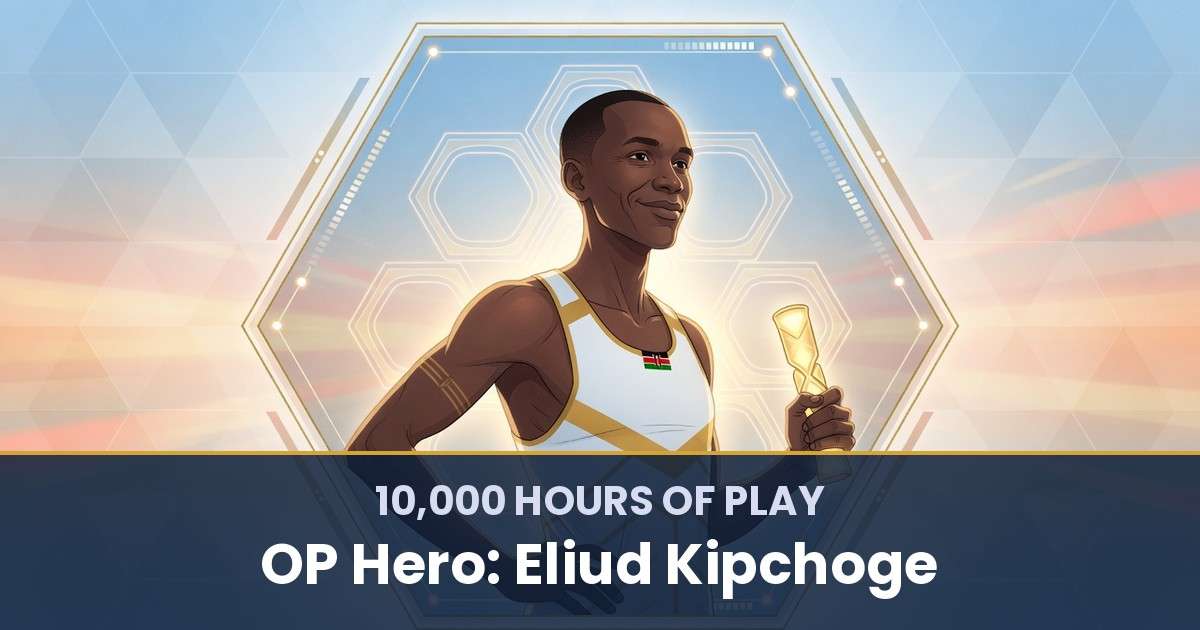
10,000 Hours of Play by OP Hero: Eliud Kipchoge
1:59:40 was the headline; the build was the story. Eliud Kipchoge's Game, Attributes, Roles, Skills, Allies, and Quests, decoded with the 10K HP framework.


On the morning of October 12, 2019, a runner from the village of Kapsisiywa stood at a start line in Vienna, with 41 of the world’s best distance runners assigned to pace him, preparing to attempt something no human had ever done.
One hour, 59 minutes and 40 seconds later, Eliud Kipchoge had covered 42.195 kilometers faster than anyone in history.
The clock made the headline. The build behind the clock is the part you can actually use.
Run his life through the 10,000 Hours of Play framework and the miracle dissolves into something more practical: one Game held for decades, a short list of honest stats, a brutal mid-career class change, five trainable Skills, and a small circle of Allies who compressed twenty years of trial and error into one.
Here is his character sheet.
⚡ Speed Run Notes
- Kipchoge ran the first sub-2-hour marathon (1:59:40, Vienna 2019) six years after his marathon debut. The result looks superhuman; the build behind it is a copyable system.
- His Game was never medals. From 5 km school runs in Nandi County to 16 marathon wins, he kept playing one game: find the limit of human endurance, then move it.
- One coach since 2002. Patrick Sang turned an 18-year-old who logged his runs with a stick into a world champion inside a year, proof that the right Ally compresses decades.
- His superpower is boring: Ninja Focus (Rogue), practiced for 20+ years. Weekdays in a spartan camp, chores included, family on weekends. Discipline, in his words, is freedom.
- Failure sits inside the build: missed Kenya’s 2012 Olympic team, missed sub-2 by 25 seconds in 2017, dropped out in Paris 2024. Each reset became the setup for the next quest.
Table of Contents
- About Yu-kai Chou
- Step 1: The Game Kipchoge Was Actually Playing
- Step 2: Attributes, the Innate Stats
- Step 3: Role(s) Across Chapters
- Step 4: The Real-Life Game Skills He Mastered
- Step 5: The Allies Who Multiplied Him
- Step 6: The Quests That Shaped the Saga
- What You Can Steal From Kipchoge’s Build
- Where this framework comes from
- Related Reading
About Yu-kai Chou

Yu-kai Chou is the author of 10,000 Hours of Play — the book that treats your life as the most important game you’ll ever build a character in, and gives you the 6-Step framework (Game · Attributes · Role · Skills · Allies · Quests) to play it on purpose. He has spent two decades developing the system through which this post analyzes its OP Hero, and applies it to his own life and to the lives of the people he advises around the world.
Chou’s other framework, the Octalysis Framework, has been applied by LEGO, Microsoft, Porsche, Coca-Cola, Salesforce, and MrBeast, impacting over 1.5 Billion Users. He has taught the methodology at Harvard, Stanford, Yale, Tesla, Google, BCG, and IDEO, and has advised governments in eight nations including Ukraine, the United Kingdom, the Kingdom of Bahrain, Singapore, Taiwan, the Netherlands, Kazakhstan, and South Korea.
His work has been cited by Harvard, Stanford, MIT, Forbes, Wall Street Journal, Wired, US Department of Energy, NIST, NSF, NCBI, US Department of Education, ClinicalTrials.gov, and Google Scholar — with 3,700+ more academic publications. Explore his books here.
What draws me to Kipchoge’s build is that none of it hides. He names his targets in advance, trains in plain sight, and smiles through the hardest kilometers; the moat is twenty years of focus applied to a single Game. The lesson I’d lift first is his Ally discipline: one coach for over two decades, one management team, one camp. When progress slows, the tempting move is to change systems. Kipchoge changed distances, never his people, and the compounding did the rest.
Step 1: The Game — What Eliud Kipchoge Was Actually Playing
Watch only the podiums and you’d guess his Game was collecting medals. He collected them, certainly: a world title at 18, Olympic medals on both track and road, two marathon world records.
But medals are checkpoints, and checkpoints don’t explain a man who kept racing into his forties. The Game underneath has two linked win conditions.
First: find the outer limit of human endurance and move it. That quest line runs from a 5 km school commute in Nandi County to a 12:46 five-thousand, to 2:01:09 in Berlin, to 1:59:40 in Vienna. Each level completed unlocked a harder one.
Second: hand the proof to everyone else. His slogan since the sub-2 projects has been “no human is limited,” and he has spent the years since treating it as a job description.
In a November 2025 interview he described wanting to turn this world into a running one, and laid out the next expansion pack: seven marathons on seven continents over two years, libraries across Kenya with an ambition of one in every African capital, and trees planted through East and Central Africa.
Notice what that Game selection did for him. A player chasing trophies retires when the trophies stop. A player chasing the limit of the species keeps leveling long after the sponsors would forgive him for logging off.
Step 2: Attributes — The Innate Stats
Attributes are the stats you spawn with. Kipchoge’s file, born November 5, 1984, in Kapsisiywa, shows five that were visible before any coach touched him.
A deep engine. As a teenager he ran roughly 5 km to school and back every day. The volume that breaks most aspiring runners was his commute before anyone called it training.
A discipline temperament. Before he owned a training journal, he tracked his runs with a stick. The instinct to measure and repeat showed up before the system did.
Calm under load. Profiles across two decades describe the same unbothered temperament, whether he is defending a world record or losing one. Raised by a single mother, he describes his childhood simply as normal.
Community orientation. He gravitates toward collective structures: a camp where champions mop floors, a mission expressed in libraries and planted trees.
Long-horizon vision. He spent nearly a decade mastering shorter distances before touching the marathon, a patience curve almost nobody holds.
If you want to run this audit on yourself, the Talent Triangle Method is the tool: separate what came installed from what you trained, and stop grinding stats you were never going to max.
Step 3: Role(s) — The Character Class Across Chapters
Kipchoge’s career is a study in deliberate class changes, four of them, each triggered by the state of the meta.
The village prodigy (1990s–2001). No structure, huge base mileage, races entered on instinct. Raw stats, unassigned class.
The apprentice (2002). World steeplechase medalist Patrick Sang put the 18-year-old on a structured program. Within a year the apprentice beat Hicham El Guerrouj and Kenenisa Bekele for the 5000m world title in 12:52.79.
The track specialist (2003–2011). Olympic bronze in Athens 2004, silver in Beijing 2008, a 12:46.53 personal best. A high-DPS class built on finishing speed.
The forced re-spec (2012–2013). He failed to make Kenya’s 2012 Olympic track team. Instead of grinding a fading class, he changed builds entirely: a 59:25 half marathon, then a marathon debut at Hamburg in April 2013, won in a course-record 2:05:30.
The marathon sovereign (2013–2022) and the ambassador (2020s). Sixteen marathon wins, then a gradual shift into the mentor-statesman class. You can see the same total-immersion arc in Michael Phelps’s build: one discipline, fully inhabited, then converted into a platform.
The transferable move is the 2012 chapter. His worst season as a track athlete became the doorway to his real class.
Step 4: Skills — The Real-Life Game Skills Eliud Kipchoge Mastered
Attributes are dealt; Skills are trained. Five canon Skills from the 10,000 Hours of Play system carry most of Kipchoge’s file.
Ninja Focus (Rogue) — sustained discipline and focus on the task in front of you. Every session since Sang’s first plan in 2002 has been logged in a training journal. His most-quoted line is the philosophy behind it: “Only the disciplined ones are free in life. If you are undisciplined, you are a slave to your moods and your passions.”
Lich Grind (Warlock) — intense, secluded work periods. He spends weekdays at the Kaptagat high-altitude camp in a spartan dorm, sharing cleaning and cooking duties, and sees his family on weekends. It’s the same seclusion pattern that powered Osamu Tezuka’s impossible page counts, run at altitude instead of at a drawing desk.
True Aim (Ranger) — lock onto a precise target and commit. When Breaking2 at Monza in May 2017 came up 25 seconds short, he held the same sub-2 target for another 29 months until Vienna paid it off.
Bind Fate (Warlock) — borrow institutional power you don’t personally own. The sub-2 attempts ran on Nike’s and INEOS’s money and machinery: pace cars, laser guides, 41 rotating pacemakers. He converted sponsor spectacle into a personal quest completion.
Revive (Paladin) — recover from failure and take new action toward the next Quest. The 2012 trials miss became Hamburg 2013. An eighth place in London 2020, run on an ear and hip problem, became a second Olympic gold within a year.
Where should you sit with each of your own skills? The Skills Spectrum covers when to specialize, when to dabble, and when to push for mastery.
Step 5: Allies — The People Who Multiplied Eliud Kipchoge
Kipchoge’s Ally roster is short, old, and almost never edited. That is the design.
Patrick Sang. They met in 2001; the structured plan came in 2002. Sang has coached him from the 2003 world title through both world records and both Olympic marathon golds. Athletes change coaches the way they change shoes; Kipchoge has kept one for more than two decades. He operates as a builder of people in the John Wooden mold, developing the person so the athlete follows.
Jos Hermens and the NN Running Team. Global Sports Communication handles the machinery around the miracle: race selection, sponsorships, and the pacing squads behind the sub-2 projects. Structure is a force multiplier most solo performers never acquire.
The Kaptagat brotherhood. His daily training group shares dorms, chores, and pain. For the sub-2 attempts, 41 elite pacemakers, Bernard Lagat among them, spent their own fitness to carry his pace. Nobody breaks a species-level barrier alone.
Grace Sugutt and their three children. The weekend home near Eldoret is the recovery zone that makes the weekday monk sustainable.
Count the roster: a coach, a manager, a camp, a family. Four slots, held for decades. An Alliance of four that never changes will outbuild a network of four hundred that does.
Step 6: Quests — The Milestones That Shaped the Saga
Quest 1: Paris, August 2003. The 18-year-old apprentice outkicks El Guerrouj and Bekele for 5000m world gold in 12:52.79. First boss defeated.
Quest 2: The 2012 re-spec. Failing to qualify for London on the track forces the class change. Hamburg, April 2013: marathon debut, victory, course record 2:05:30.
Quest 3: Breaking2, Monza, May 2017. Nike’s closed-course experiment ends at 2:00:25. A failed quest by 25 seconds, and the most valuable tutorial level of his career.
Quest 4: Berlin, twice. September 2018: world record, 2:01:39. September 2022, at age 37: world record again, 2:01:09.
Quest 5: Vienna, October 12, 2019. The INEOS 1:59 Challenge, with rotating pacers in an arrow formation and a laser line on the road. 1:59:40. The time was never eligible for ratification. The barrier stayed broken anyway.
Quest 6: Back-to-back Olympic gold. Rio 2016 in 2:08:44; Sapporo 2021 in 2:08:38, the title defended five years apart.
The saga keeps its dark levels. Eighth in London 2020. Sixth in Boston 2023 at 2:09:23. A first-ever DNF at the Paris 2024 Olympics. Through late 2025 the ledger reads 24 marathon starts, 16 wins, and no retirement announcement, the same refusal to let a bad level end the run that defines Terry Fox’s profile.
What You Can Steal From Eliud Kipchoge’s Build
Strip the singlet and the story is a template.
Pick a Game with two win conditions: one that tests your limit, one that hands the proof to others. A Game that ends at a trophy retires you early.
Fill four Ally slots and stop editing the roster. A coach-figure, an operations layer, a daily brotherhood, a recovery zone. Kipchoge’s slots have held since 2002; that stability is the quiet half of 1:59:40.
Your Lich Grind goes on a calendar, with an exit built in. Monastic weekdays work because the weekend home exists.
And when you fail a qualifier the way he did in 2012, read it as the game prompting a re-spec. His fading track class hid a sovereign marathon class one honest audit away. The other OP Hero profiles show the same pattern across wildly different lives: the build survives the bad level.
This week, write down the one target you’d still be chasing in 2046. That answer is your Game. Everything else in this profile is just how you run it.
Where this framework comes from

Want the full system this profile is built on?
Every OP Hero piece runs through the same 6-Step framework from 10,000 Hours of Play: Unlock Your Real-Life Legendary Success. The book covers the full system, walks through Yu-kai’s own life run as the first applied case study, and gives you the worksheets to audit your own build.
Related Reading
- All OP Hero Profiles: the 10,000 Hours of Play character library
- 10,000 Hours of Play by OP Hero: Jack Nicklaus
- 10,000 Hours of Play by OP Hero: Jesse Owens
- 10,000 Hours of Play by OP Hero: Roger Federer
- 10,000 Hours of Play by OP Hero: Muhammad Ali