
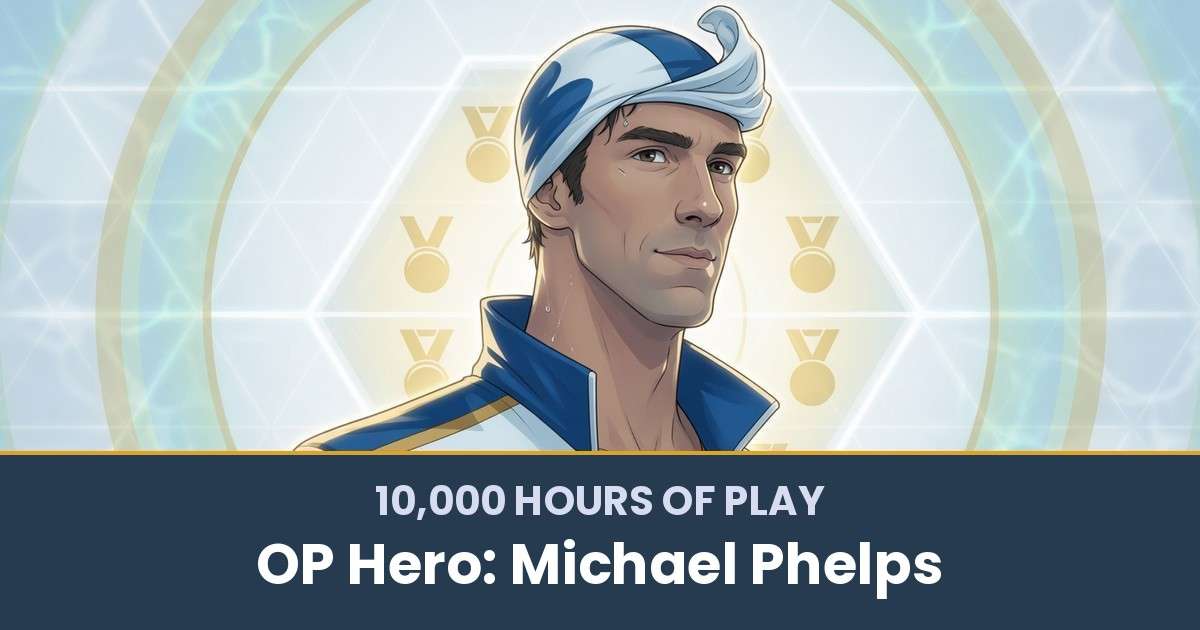


Twenty-eight Olympic medals. Twenty-three gold. Eight gold in eight events at a single Games. Those are the numbers most people know about Michael Phelps. They are also the least interesting thing about his build.
The more useful story sits underneath the medal count. It is the story of an eleven-year-old kid with an ADHD diagnosis and a teacher’s note saying he would never be able to focus, becoming the most-decorated Olympian in history — and then, after retirement, talking openly about lying on the floor of his bedroom for five days in 2014 contemplating suicide. The medals are the receipts. The build is the through-line that produced them, and the build is what the 10,000 Hours of Play framework was made to read.
What follows is Phelps’s run analyzed across the same 6 Steps every OP Hero gets — Game, Attributes, Role, Skills, Allies, Quests. The lesson at the bottom is not “train harder.” It is something harder to swallow, and more useful if you do.
⚡ Speed Run Notes
- Phelps’s Game was never “win medals.” It was “find out how far a human can push the pool” — then, after 2016, “use that platform to save a life from depression and from drowning.”
- His breakthrough Attribute was tolerance for monotony — he trained seven days a week for almost five straight years, not because he loved it, but because his ADHD brain could finally settle in the water.
- Beijing 2008 is the most famous moment, but Athens 2004 is the more diagnostic one. At 19 he won 6 gold and immediately sat down with his coach to design the 4-year strategic plan for 8-for-8 in Beijing. The Skill was not swimming. It was periodization.
- The 2014 DUI and the five days curled up in his bedroom were not a failure of the build. They were the failure mode of a Role that had outlived its Game. Rio 2016 is what Phoenix Rebirth looks like at the highest stake.
- The lesson for your own build: pick a Game your Attributes are biased toward, design the Quests in long arcs (not single sprints), and remember that the post-Quest crash is part of the Game design — not a personal failure.
Table of Contents
- Step 1: The Game — What Michael Phelps Was Actually Playing
- Step 2: Attributes — The Innate Stats
- Step 3: Role(s) — The Character Class Across Chapters
- Step 4: Skills — The Real-Life Game Skills Michael Phelps Mastered
- Step 5: Allies — The People Who Multiplied Michael Phelps
- Step 6: Quests — The Milestones That Shaped the Saga
- What You Can Steal From Michael Phelps’s Build
- Where this framework comes from
- Related Reading
About Yu-kai Chou

Yu-kai Chou is the author of 10,000 Hours of Play — the book that treats your life as the most important game you’ll ever build a character in, and gives you the 6-Step framework (Game · Attributes · Role · Skills · Allies · Quests) to play it on purpose. He has spent two decades developing the system through which this post analyzes its OP Hero, and applies it to his own life and to the lives of the people he advises around the world.
Chou’s other framework, the Octalysis Framework, has been applied by LEGO, Microsoft, Porsche, Coca-Cola, Salesforce, and MrBeast, impacting over 1.5 Billion Users. He has taught the methodology at Harvard, Stanford, Yale, Tesla, Google, BCG, and IDEO, and has advised governments in eight nations including Ukraine, the United Kingdom, the Kingdom of Bahrain, Singapore, Taiwan, the Netherlands, Kazakhstan, and South Korea.
His work has been cited by Harvard, Stanford, MIT, Forbes, Wall Street Journal, Wired, US Department of Energy, NIST, NSF, NCBI, US Department of Education, ClinicalTrials.gov, and Google Scholar — with 3,700+ more academic publications. Explore his books here.
What I find instructive about Michael Phelps’s build is the second half of it. The first half — the medals — is the part everyone copies, mostly badly. The second half — the 2014 crisis, the rehab, the Rio comeback, then the post-retirement mental-health advocacy and the Michael Phelps Foundation — is the part you actually want to study. The single lesson I’d lift from his run is at Step 1: pick a Game that survives the end of the Role. He had to learn that one the hard way; the framework lets you learn it sooner.
Step 1: The Game — What Michael Phelps Was Actually Playing
Reduce his run to one sentence and you get this: find out how far a human can push the pool, then convert the platform that creates into impact on the two things that almost killed him — depression and drowning.
Phelps has said the first half out loud since he was eleven. He told his coach Bob Bowman, around 2001, that his goal was not to win swim meets — it was to change the sport of swimming. Bowman has retold the conversation in dozens of interviews. The frame matters: a kid who treats a single race as a sub-problem inside a long Game is operating on a different timeline than the one his sport is set up for.
The second half of the Game is the part that took longer to surface and is the part most casual fans miss. After Rio 2016, Phelps has consistently reframed his mission around mental health and water safety, saying publicly on several occasions that saving a life would mean more to him than winning a gold medal. The Michael Phelps Foundation, founded in 2008 and scaled aggressively after his 2016 retirement, anchors that work in two specific bets — the “IM” program that teaches kids to be safe and confident in water, and his public-platform work normalizing therapy and depression for athletes and men in general.
Read against the 6-Step framework, that is one Game in two chapters, not two Games. Both halves ask the same question — what is the largest impact a human can have on the water and on the people in it? — and both halves use the same instrument. The Role changed; the Game survived. That distinction is what kept him buildable after retirement, and it is the single most useful lesson the medal counters miss.
Step 2: Attributes — The Innate Stats
Five Attributes show up early enough in the record to read as starting stats rather than coached moves.
The five Attributes below sit at a tight overlap point — exactly the kind of intersection the Talent Triangle Method is designed to surface. The trick is not having any one of them. It is having all five in the same body.
Biomechanical outlier. Phelps is 6’4″ tall with a 6’7″ wingspan. His ankles and elbows are hyper-mobile — coaches and broadcasters routinely show clips of him sitting with his feet pointed almost flat behind him, the same position dolphins assume in a kick. His torso is long relative to his legs. Biomechanically he is, at rest, closer to the species of fish than to the species of land athlete. That is not a learnable trait. It is the starting roll.
Repeat-load tolerance. Bowman has said in multiple interviews that by age eleven, Phelps was already absorbing volumes of training that older swimmers struggled to finish. The capacity to do the same set, the same way, in the same pool, day after day for years, is its own kind of physiological gift — most kids burn out long before it pays. Phelps did not. He swam roughly 80,000 meters a week at peak, and famously did not take a single day off from training between 2003 and 2008 — five straight years, including Christmas, his birthday, and the day after the Athens 2004 closing ceremony.
Hyperfocus inside one domain. Phelps was diagnosed with ADHD at age nine. A teacher reportedly told his mother Debbie that he would never be able to focus on anything. The pool was the one place he could. He has said that water “calmed” him in a way no classroom ever did — the same energy that made him disruptive at his desk became fuel in the water. The Attribute is not “ability to focus.” It is a more specific stat: a brain that finds quiet only inside one specific environment, and a willingness to spend most of his waking hours inside it.
Pattern recognition under pressure. From his early teens, Bowman noticed that Phelps could remember splits, count strokes, and read the body language of competitors mid-race in a way most peers could not. That cognitive map of pace and tactic is what made the goggles-full-of-water moment in Beijing 2008 possible — he had pre-counted the strokes between the wall and the touchpad, so when his goggles flooded thirty seconds into the 200-meter butterfly final and he could no longer see, he finished by feel and still set a world record. That is not training. That is a starting Attribute that training amplified.
Compulsive competitive drive. At fifteen, in his first Olympic final at Sydney 2000, Phelps finished fifth in the 200-meter butterfly. Most teenagers handed a fifth-place Olympic finish would frame it as a win. He treated it as failure and broke the world record in the same event a few months later, becoming the youngest male world-record holder in swimming in almost seven decades. The Attribute is the disposition to treat fifth-in-the-world as a problem statement. You cannot teach that one; you can only direct it once it shows up.
Step 3: Role(s) — The Character Class Across Chapters
Seven Roles in roughly three decades.
From age seven to about thirteen, he ran the Hyperactive Pool Rat Role. ADHD diagnosis at nine. A teacher who told his mother he would never focus. A single mom — Debbie, a middle-school principal — who decided that the pool would be the place her son was allowed to be loud. Local age-group competition at Meadowbrook in Baltimore. The Role is mostly survival; the medals are still a decade away.
From 1995 to 2000, he played the Prodigy Specialist Role. He met Bob Bowman at the North Baltimore Aquatic Club when he was eleven. He set his first national age-group record at ten. By fifteen he had qualified for the Sydney 2000 Olympics, the youngest male U.S. Olympic swimmer in 68 years. The Role is “raw talent inside one event, with growing national attention.”
From 2001 to 2004, he became the Multi-Event World-Record Hunter. He broke the 200-meter butterfly world record in March 2001 at fifteen years and nine months. At the 2003 World Championships in Barcelona he won 4 gold and 2 silver and broke multiple world records. At Athens 2004 he took 6 gold and 2 bronze. The Role expanded from butterfly specialist to medley polymath capable of carrying a national program by himself.
From 2004 to 2008, he ran the highest-stakes Role of his career — the Olympic Super-Collector. The four-year arc was the explicit Mark Spitz hunt: match or exceed Spitz’s 1972 record of seven gold at a single Games. Beijing delivered eight gold in eight events, seven world records, one Olympic record. He left Beijing the most-decorated single-Games Olympian in history.
From 2008 to 2014, he occupied the Global Brand & Troubled Champion Role. The Speedo deal, the Visa endorsement, the Subway commercials, the global magazine covers. London 2012: 6 medals (4 gold, 2 silver), all-time medal leader. He retired the first time after London. The same window also includes the 2009 bong photo controversy and a second DUI in late 2014. The Role had outgrown its Game; the Game had no place for the new Role to keep playing.
From late 2014 through Rio 2016, he ran a brief and brutal Fallen Hero in Crisis Role. The September 2014 DUI. The suspension from the 2015 World Championships team. The five days curled up in his bedroom not eating, not answering the door, contemplating suicide. The intervention from Ravens linebacker Ray Lewis. Six weeks at The Meadows in Arizona. Therapy that he kept publicly committing to. A reconciliation with his father, Fred, after years of distance. The Role was internally focused, not competitive — a respec away from output and toward the operating system underneath.
From 2016 onward, he has run the Elder Champion & Mental Health Advocate Role. He returned to Rio at thirty-one as Team USA captain, won 5 gold and 1 silver, retired with 28 Olympic medals (23 gold). He scaled the Michael Phelps Foundation, anchored its IM water-safety program, partnered with the Talkspace therapy platform on the “Permission” campaign, and appears in the HBO documentary The Weight of Gold (2020) about the post-Olympic depression epidemic. The Role is finally aligned with the second-chapter Game.
Step 4: Skills — The Real-Life Game Skills Michael Phelps Mastered
Six canon Real-Life Game Skills do the heavy lifting in his build. Each one has a moment you can point to.
Vision Manifestation (Warlock). Mental rehearsal so vivid it shapes reality. Bowman drilled this into Phelps from his early teens with a ritual the two of them called “watch the tape.” Every night before sleep and every morning on waking, Phelps was supposed to play the race in his head — the dive, the first turn, the stroke count, every split, the touch at the wall, and just as importantly, every plausible failure: goggles full of water, a flat dive, a fingernail miss at the wall. When the 200-meter butterfly goggles actually flooded in Beijing on August 13, 2008, Phelps did not panic. He had already swum the race blind, in his head, hundreds of times. He counted strokes, hit the wall on stroke 21, looked up at the board, and saw a world record — 1:52.03. That is the canon Skill at its largest stake. The same Warlock-class Skill is the through-line in many of the long-haul builds in the OP Hero catalog, including builds that look nothing like a pool.
Ninja Focus (Rogue). Sustained discipline and focus on tasks. The five-year unbroken training streak from 2003 to 2008 is the cleanest evidence. Phelps did not take a single day off in that window — not Christmas, not his birthday, not the day after winning six golds in Athens. He estimated in interviews that training every day for five years gave him roughly a 260-practice lead on competitors who took weekends. That is not love of training. It is the canon Rogue Skill of sustained discipline pushed past what most peers will tolerate. The same Skill anchors many of the build patterns we have audited around specialists who refuse to dabble, including athletes like Tiger Woods — the streak is not about love of work, it is about reframing repetition until the reps stop costing what they used to cost.
Lich Grind (Warlock). Intense, secluded work periods. Phelps trained for long stretches at altitude in Colorado Springs and at Bowman’s pools in Ann Arbor and Baltimore, deliberately cutting himself off from press, friends, and most of his social life in the run-ups to Athens, Beijing, London, and Rio. He has said publicly that during the heaviest Beijing build, he was sleeping eight hours, training six, eating, and sleeping again — and almost nothing else. The same canon Skill at higher dosage — the Lich Pact polyphasic-sleep variant — is a different move, but the Lich Grind base Skill is the one that built the Beijing engine.
Mastermind (Ranger). Create, adapt, and execute complex plans. The single most diagnostic moment in Phelps’s build is not a race. It is a meeting. Within days of his last race in Athens 2004, the nineteen-year-old Phelps sat down with Bob Bowman and his agent Peter Carlisle and the three of them mapped out a four-year strategic plan with the explicit goal of winning gold in every event Phelps would enter at Beijing 2008. The plan covered event selection, periodization across four years, body-composition targets, recovery cycles, media exposure, sponsorship pacing, and altitude blocks. Most nineteen-year-olds, having just won six gold medals, would have spent the night celebrating. He spent it designing the next 1,460 days. That is Ranger-class strategic planning under the most public pressure imaginable. The physical gift, the deliberate practice, and the strategic design had to occupy the same calendar — and the meeting was where the calendar started.
Aegis (Paladin). Ignore public criticism and naysayers while pushing the Quest. Phelps absorbed three rounds of public criticism that would have ended most careers. The 2004 DUI at nineteen. The February 2009 photo of him with a bong, which lost him his Kellogg’s sponsorship and produced a three-month USA Swimming suspension. The 2014 DUI and reckless-driving arrest. He returned to top-level competition after each one. The canon Skill is not “ignore criticism” — it is the more specific move of refusing to let media-cycle pushback rewrite his long-arc Game plan. The same Aegis-class Skill shows up in similar form in the run of Simone Biles and Serena Williams, both of whom built through public scrutiny most observers underestimate.
Phoenix Rebirth (Paladin). Recover from devastating failure and come back stronger. The September 2014 chapter is the highest-stake instance. Second DUI. Six-month USA Swimming suspension. Dropped from the 2015 World Championships team. Five days curled up in his bedroom, not eating, not talking to anyone, contemplating ending his life. Ray Lewis flew to Baltimore and reportedly urged him not to shut down, telling him that real character shows up in moments like this. Phelps checked into The Meadows in Arizona for six weeks of inpatient treatment. He started seeing a therapist regularly for the first time. He reconciled with his father. Twenty-two months after the lowest point of his life, he stood on the deck at Rio as the U.S. Olympic captain, and won 5 gold and 1 silver. That is the canon Paladin Skill at its largest stake — not bouncing back from a setback, but rebuilding the operating system that produces the next chapter of the Game.
Step 5: Allies — The People Who Multiplied Michael Phelps
Bob Bowman. Bowman started coaching Phelps at the North Baltimore Aquatic Club in 1996 when Phelps was eleven. He has been the single longest-running relationship in Phelps’s competitive career — through all five Olympics, the 2014 crisis, and into Phelps’s post-retirement coaching of his own kids. Bowman is the author of the “watch the tape” mental-rehearsal protocol, the architect of the periodization that made eight-for-eight possible, and the first person Phelps called when he checked into rehab. He is what an Ally multiplier looks like when the bet is decades long instead of years long. He is now head coach at the University of Texas, where he has continued the same long-arc thinking he ran with Phelps.
Debbie Phelps. A middle-school principal in Baltimore, a single mother after she and Phelps’s father separated when Michael was nine, and the constant under everything else. She kept him in the pool when his ADHD diagnosis made every other environment harder. She drove him to two-a-days for years. She sat with him after the 2014 arrest. She has said in interviews that her job through the Beijing run was to keep his off-pool life simple enough that the pool could stay complicated. Debbie is the Ally who created the conditions every other Ally relied on.
Peter Carlisle. Phelps’s agent at Octagon since the early 2000s, and the third chair in the post-Athens 2004 strategic-plan meeting that designed the Beijing run. Carlisle managed the sponsorship pacing that funded the eight-event Olympic program, steered Phelps through the 2009 and 2014 controversies, and has stayed the long-arc brand architect through Phelps’s transition into post-retirement advocacy and the Foundation. The Ally pattern is “business operator who treats the athlete as a decades-long build, not a four-year endorsement cycle.”
Ray Lewis. The Hall of Fame Baltimore Ravens linebacker and a personal friend. After Phelps’s September 2014 arrest, Lewis flew to Baltimore, sat with him in the bedroom Phelps had not left in five days, and reportedly urged him to fight through it rather than shut down — telling him this was the moment real character shows up. Lewis stayed long enough to talk Phelps into entering treatment. He has since been credited by Phelps in multiple interviews as the person who pulled him back from the edge. The Ally pattern is the high-stakes intervention friend most builds never need — and almost no builds survive without when they do.
Ryan Lochte and the U.S. national team. Lochte and Phelps trained and raced as U.S. teammates and rivals from the early 2000s through Rio 2016. Backstroke specialists like Aaron Peirsol added another layer of training-partner intensity on relay sets and across the medley events. The same pool that produced Phelps produced multiple individual world records from his teammates, because the daily training standard was set by people who would not let each other coast. The Ally pattern is “team of peers whose presence raises the daily floor without you having to raise it.”
Step 6: Quests — The Milestones That Shaped the Saga
1985, June 30 — born in Baltimore, Maryland. Youngest of three children of Debbie and Fred Phelps. His parents separated when he was nine and divorced when he was eleven. Older sisters Hilary and Whitney were already competitive swimmers; he started lessons at seven, in part as a way to burn off energy a classroom could not absorb.
1994 — diagnosed with ADHD at age nine. A teacher reportedly told his mother he would never be able to focus on anything. Debbie pushed him toward the pool as the place where the diagnosis became less of a constraint and more of a fuel. The same year, he became fascinated with the older swimmers at his club, and started staying for the longer practice sets.
2000, September — Sydney Olympics at age fifteen. Youngest male U.S. Olympic swimmer in 68 years. Finishes fifth in the 200-meter butterfly final. Walks out of the meet convinced he has unfinished business in that event. Five months later he breaks the world record in the same event at fifteen years and nine months — the youngest male world-record holder in swimming since 1933.
2004, August — Athens Olympics. Wins 6 gold and 2 bronze at nineteen, becoming the first swimmer in 32 years to win at least six gold at a single Games. Within days of the closing ceremony, sits down with Bowman and Carlisle to design the four-year Beijing plan. Same year, arrested for DUI in Salisbury, Maryland — the first warning sign that the off-pool life had no Game design behind it.
2008, August — Beijing Olympics and 8-for-8. The Olympic and historical centerpiece. Eight gold in eight events. Seven world records. One Olympic record. Goggles full of water in the 200-meter butterfly final on August 13; he counts strokes and still sets a world record. The 100-meter butterfly final on August 16 ends with a 1/100th-of-a-second margin over Milorad Čavić of Serbia, captured by Omega’s high-speed cameras. He leaves Beijing the most-decorated single-Games Olympian in history.
2009, February — the bong photo and the first failure chapter. A British tabloid publishes a photograph of Phelps with a marijuana pipe at a University of South Carolina party. Kellogg’s drops his sponsorship. USA Swimming suspends him for three months. He apologizes publicly and returns to training. The chapter is small in retrospect, but it is the first visible sign that the Role had outgrown the Game.
2012, August — London Olympics and first retirement. Wins 6 medals (4 gold, 2 silver) at twenty-seven, becomes the all-time Olympic medal leader, and announces his retirement immediately after. The Role had reached its natural ceiling. There was no Game left for the Role to play.
2014, September — second DUI, five days in the bedroom, intervention, rehab. Arrested for DUI and reckless driving in the Fort McHenry Tunnel in Baltimore at 1:40 a.m. on September 30. Suspended for six months by USA Swimming. Dropped from the 2015 World Championships team. Spends five days isolated in his bedroom not eating, contemplating suicide. Ray Lewis intervenes. Phelps enters The Meadows in Arizona for six weeks of inpatient treatment. He has called this period the lowest of his life and the one without which Rio would not have happened. This is the failure chapter every honest build has, and the one the framework asks you not to skip.
2016, August — Rio Olympics and the Phoenix Rebirth. Returns at thirty-one as Team USA captain. Wins 5 gold and 1 silver, retires for the second time with 28 Olympic medals (23 gold). Marries Nicole Johnson in June 2016 and welcomes their first son Boomer just before the Games. The Rio run is the proof point that the Role can come back online when the Game is healthy underneath — a pattern that also shows up in Michael Jordan’s first comeback at a similar career-stage inflection.
2016 onward — Michael Phelps Foundation, the IM program, and the Weight of Gold. The Foundation, founded in 2008, scales aggressively after Rio. The IM water-safety program reaches tens of thousands of kids. He partners with Talkspace on the “Permission” therapy campaign in 2018 and 2019. He executive-produces and narrates HBO’s The Weight of Gold (2020), about post-Olympic depression and the suicides of several U.S. Olympians. The second chapter of the Game is now larger than the first.
What You Can Steal From Michael Phelps’s Build
If you take only one move from his run, take this one. Pick a Game that survives the end of the Role. Most of the world’s hardest career problems are not about losing the Quest. They are about winning the Quest and then discovering that the Game underneath was never specified, so the next Role has nowhere to plug in. Phelps won the largest Quest in Olympic history at twenty-three, retired at twenty-seven, and immediately walked into a void because the Game had been “win medals” and there were no more medals to win. The 2014 crisis is what that void looks like at the highest stake. The Rio run, the Foundation, and the mental-health work happened because he finally found a second-chapter Game — water safety, athlete mental health, the post-medal life — that the Role of “retired Olympian” could actually play.
If you take two moves, take a second one. Build the daily Quest schedule as if your starting Attributes were the ones you actually have. Phelps did not become Phelps by overriding the ADHD. He became Phelps because his mother, his coach, and eventually his agent built an environment that converted the ADHD into a feature instead of a bug. The pool was the one place the hyperactivity made him faster, not slower. The seven-days-a-week streak was possible because the underlying brain found the pool calming, not draining. If your build is currently exhausting you, the question is rarely “should I push harder.” The more useful question is “is the daily environment converting my Attributes into output, or fighting them?” The rest of the OP Hero catalog is full of the same lesson, in different domains and different decades.
Where this framework comes from

Want the full system this profile is built on?
Every OP Hero piece runs through the same 6-Step framework from 10,000 Hours of Play: Unlock Your Real-Life Legendary Success. The book covers the full system, walks through Yu-kai’s own life run as the first applied case study, and gives you the worksheets to audit your own build.
Related Reading
- All OP Hero Profiles — the running hub of every 10K HP hero we’ve audited so far.
- 10,000 Hours of Play by OP Hero: Simone Biles — another generational Olympian whose post-Tokyo Twistie pivot extended the same Phoenix Rebirth Skill into a different sport.
- 10,000 Hours of Play by OP Hero: Tiger Woods — a parallel decades-long specialist build where the Ninja Focus Skill ran for the same kind of unbroken streak, then crashed on a similar Role-versus-Game gap.
- 10,000 Hours of Play by OP Hero: Serena Williams — another Mastermind-class Olympic build where strategic planning over decades produced the medal count.
- 10,000 Hours of Play by OP Hero: Kobe Bryant — the closest cultural sibling to the Phelps work-ethic story, with the same Lich Grind Skill at similar intensity.
- Turning Life Into a Game — the framework’s first principles, in case you want to apply the 6 Steps to your own build right now.