
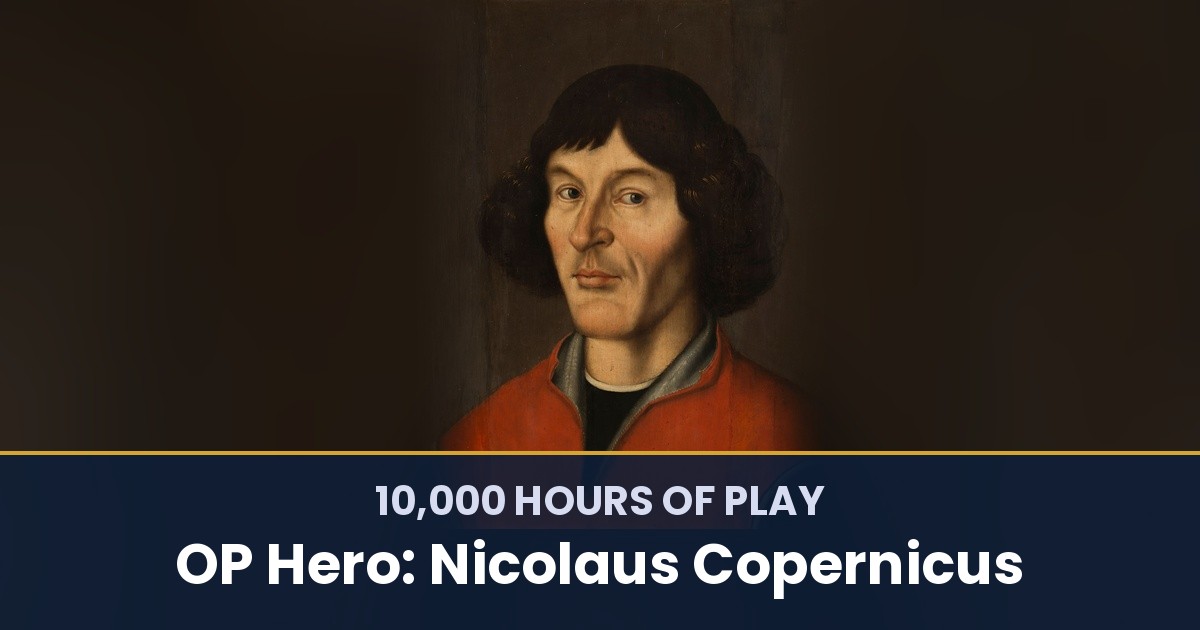


In May 1539 a twenty-five-year-old mathematics professor from Wittenberg, Georg Joachim Rheticus, arrived in the small cathedral town of Frombork on the Baltic coast to meet a sixty-six-year-old church canon named Nicolaus Copernicus.
Copernicus had been working on one idea for about three decades. In a short manuscript he passed around privately before 1514, he had argued that the Earth moves around the Sun.
The full book that worked the idea out in detail had still not gone to a printer.
Rheticus stayed in Frombork for about two years, published the first printed account of the theory in 1540, and helped get the finished manuscript to a printer in Nuremberg.
That book, De revolutionibus orbium coelestium, came off the press in 1543, the year Copernicus died.
The six Steps below follow his run from a boy in Toruń who lost his father at about ten to the canon who moved the Earth away from the center of the universe on paper.
⚡ Speed Run Notes
- Copernicus played a long game of making astronomy more orderly by putting the Sun near the center and treating the Earth as one of the planets.
- He did most of that work alongside other careers: church canon, physician to his uncle, administrator of church estates and adviser on currency reform.
- His canon Skills: True Sight (Ranger), Elemental Transposition (Mage), Arcane Wisdom (Mage), Ninja Focus (Rogue) and Foresight (Ranger).
- His Allies included an uncle who paid for his education, a Bologna astronomer who trained his eye, and a young professor from Wittenberg who got his book printed.
- His setbacks were real ones: a war that reached the castle he was running in 1521, decades of holding back his book, and an unsigned preface that changed how readers took it.
Table of Contents
About Yu-kai Chou

Yu-kai Chou is the author of 10,000 Hours of Play — the book that treats your life as the most important game you’ll ever build a character in, and gives you the 6-Step framework (Game · Attributes · Role · Skills · Allies · Quests) to play it on purpose. He has spent two decades developing the system through which this post analyzes its OP Hero, and applies it to his own life and to the lives of the people he advises around the world.
Chou’s other framework, the Octalysis Framework, has been applied by LEGO, Microsoft, Porsche, Coca-Cola, Salesforce, and MrBeast, impacting over 1.5 Billion Users. He has taught the methodology at Harvard, Stanford, Yale, Tesla, Google, BCG, and IDEO, and has advised governments in eight nations including Ukraine, the United Kingdom, the Kingdom of Bahrain, Singapore, Taiwan, the Netherlands, Kazakhstan, and South Korea.
His work has been cited by Harvard, Stanford, MIT, Forbes, Wall Street Journal, Wired, US Department of Energy, NIST, NSF, NCBI, US Department of Education, ClinicalTrials.gov, and Google Scholar — with 3,700+ more academic publications. Explore his books here.

Nicolaus Copernicus belongs in this series because his build shows how far a side Quest can travel when the player keeps it alive for decades alongside a full-time church office. If I could lift one move from his character sheet, it would be his decision, at sixty-six, to open his unpublished manuscript to a twenty-five-year-old Lutheran mathematician from Wittenberg.
Step 1: The Game — What Nicolaus Copernicus Was Actually Playing
Copernicus’s Game was order. He wanted an account of the heavens in which the motions of the planets fit together as one coherent system.
The astronomy he inherited, built on Ptolemy, placed a motionless Earth at the center and handled each planet with its own set of circles.
In the dedication of his book he compared the astronomy of his day to a figure put together from hands, feet and a head taken from different bodies, so that the result looked more like a monster than a man.
His move was to change the viewpoint. In the Commentariolus, the manuscript he circulated before 1514, he set out a short list of assumptions, commonly counted as seven, including that the Earth turns daily on its axis and travels around the Sun.
Once the Earth is treated as a moving planet, the others fall into order by how long each takes to circle the Sun, from Mercury closest in to Saturn farthest out.
The same change explained why planets such as Mars sometimes seem to drift backwards across the sky. In his system that backward drift is an effect of watching them from a moving Earth.
He spent the rest of his life turning that sketch into a full mathematical system, and the result was De revolutionibus, published in 1543 in six books.
Step 2: Attributes — The Innate Stats
Attributes are the stats a player brings before any training, and the shape of Copernicus’s life makes several of his easy to see.
He was born on 19 February 1473 in Toruń, in Royal Prussia. His father died around 1483, when Nicolaus was about ten, and his maternal uncle Lucas Watzenrode, who became bishop of Warmia in 1489, took charge of his education.
The first attribute is patience, and it shows in how long he stayed with one question. He worked on the same problem from the early 1500s until the year he died, and he held the full book back for decades after the idea first circulated.
The second attribute is pattern recognition, the ability to see a single structure behind scattered evidence. He saw that several separate puzzles in the sky, from the order of the planets to their backward loops, could be connected by one change in where the observer stands.
The third attribute is caution about how and when to go public. He shared the theory first in a private manuscript, and the first printed account of it appeared in 1540 under his student’s name rather than his own.
The OP Talent Triangle Method asks you to find your edge strength, the ability that sets your build apart from the people around you.
For Copernicus that edge was the patience to keep one hard question open for decades while his working days were filled with other duties.
Step 3: Role(s) — The Character Class Across Chapters
Copernicus held at least five Roles, and what actually transferred across all of them was a habit of careful record-keeping and calculation.
His first Role was the student, and it lasted about twelve years. He studied at the University of Kraków from 1491 to 1495 and left without a degree, then studied canon law at Bologna from 1496, medicine at Padua from 1501 to 1503, and received a doctorate in canon law at Ferrara on 31 May 1503.
His second Role was secretary, adviser and physician to his uncle at Lidzbark Castle, a post he held until about 1510.
His third Role was the church canon, a position that gave him a steady income for life. He had been elected to the cathedral chapter of Warmia in 1497, and the chapter’s business at Frombork became his long-term base.
His fourth Role was the administrator of church property, and it put him in charge of a castle. He managed the chapter’s estates at Olsztyn from 1516 to 1519 and again from 1520 to 1521, and in early 1521, during the Polish–Teutonic War, he organized the defense of Olsztyn Castle against the Teutonic Knights.
His fifth Role was the adviser on money. He presented proposals on currency reform to the Prussian diet at Grudziądz in 1522, and his treatise on coinage, Monetae cudendae ratio, is dated to 1526.
Astronomy ran underneath all five Roles as the work he kept returning to.
Step 4: Skills — The Real-Life Game Skills Nicolaus Copernicus Mastered
Skills are what a player trains on top of the starting stats. Each Real-Life Game Skill carries its Class in brackets, and five of them explain most of Copernicus’s run.
The first is True Sight (Ranger): noticing details others miss. In Bologna he lived with the astronomer Domenico Maria Novara and assisted with his observations, and on 9 March 1497 they watched the Moon pass in front of the star Aldebaran.
He went on recording the sky himself, and about 27 of his own observations appear in De revolutionibus.
The second is Elemental Transposition (Mage): reframing a problem as a puzzle that can be solved. He asked what the heavens would look like if the observer were moving, and that single question reorganized the whole system.
The third is Arcane Wisdom (Mage): absorbing a wide range of data and turning it into a clear output. He compared his own observations with records from ancient and medieval astronomers and used all of them as constraints on one mathematical model.
The fourth is Ninja Focus (Rogue): sustained discipline on a task. From the Commentariolus before 1514 to the printed book in 1543, he kept the project moving through war, administration and church business.
The fifth is Foresight (Ranger): seeing a risk before it arrives. In his writing on coinage he warned that when debased coins and good coins circulate at the same face value, the bad money drives the good money out of circulation, a principle later known as Gresham’s law.
On the Skills Spectrum, Copernicus reads as a Master whose core craft was mathematical astronomy, with canon law, medicine and estate management stacked around it.
Step 5: Allies — The People Who Multiplied Nicolaus Copernicus
Copernicus worked with a small circle of Allies, and the book exists in print largely because of two of them.
The first was his uncle, Lucas Watzenrode. As bishop of Warmia he paid for his nephew’s education, secured him a place in the cathedral chapter and kept him close as secretary and physician.
The second was Domenico Maria Novara in Bologna, who gave the young law student practical experience in checking astronomical claims against the sky.
The third was Tiedemann Giese, a fellow canon and close friend who later became a bishop and pressed Copernicus to publish.
The fourth was Georg Joachim Rheticus, the young mathematics professor from Wittenberg. He arrived in Frombork in May 1539, stayed about two years, published the Narratio prima in Gdańsk in 1540 as the first printed account of the theory, and took the manuscript to the printer Johannes Petreius in Nuremberg.
The theologian Andreas Osiander saw the printing through to the end. He also added an unsigned preface that presented the theory as a mathematical hypothesis rather than a description of the real heavens, and many readers took that preface for Copernicus’s own view.
The fifth Ally arrived after he was gone. Johannes Kepler, a committed Copernican, publicly named Osiander as the author of that preface in 1609, the same year his Astronomia nova replaced the old circles with elliptical orbits.
Step 6: Quests — The Milestones That Shaped the Saga
Copernicus’s Quests run from a long education to a book whose story continued for centuries after his death, and several of them are setbacks.
Quest 1 was the education, twelve years across Kraków, Bologna, Padua and Ferrara that ended with his doctorate in canon law on 31 May 1503.
Quest 2 was the first sketch of the theory. He wrote the Commentariolus and let it circulate in manuscript, and a 1514 inventory of the books of the Kraków scholar Matthew of Miechów is early evidence that his ideas about the arrangement of the heavens were already known.
Quest 3 was a setback that arrived at his own door. The Polish–Teutonic War of 1519 to 1521 reached Olsztyn, and in early 1521 he organized the defense of the castle he was administering.
Quest 4 was currency reform, which took him to the Prussian diet at Grudziądz in 1522 and produced his treatise on coinage in 1526.
Quest 5 was publication, and it came close to arriving too late. De revolutionibus was printed in Nuremberg in 1543 with a dedication to Pope Paul III, and Copernicus died in Frombork on 24 May 1543.
Quest 6 played out after his death. In March 1616 the Congregation of the Index suspended De revolutionibus until it was corrected, in the same weeks that Galileo Galilei was told by Cardinal Bellarmine to abandon the view that the Earth moves, and the corrections followed in 1620.
Over the following centuries the book still found serious readers. The historian Owen Gingerich examined about 600 surviving copies of the first and second editions for his 2004 book The Book Nobody Read.
Copernicus himself lay in an unmarked grave in Frombork Cathedral until remains found there in 2005 were matched by DNA to hairs from a book he had owned, a result announced in 2008, and he was reburied there on 22 May 2010.
What You Can Steal From Nicolaus Copernicus’s Build
First, try changing where you stand before you add more machinery. Copernicus kept most of the mathematics of his day and moved the observer, and a long list of separate problems started to look like one problem.
Second, test the idea small before you build it big. The Commentariolus let a few readers see the theory around three decades before the full book appeared.
Third, carry your strongest skill into more than one arena. The careful work with numbers behind his astronomy also shows up in his treatise on coinage, where it produced a warning about debased money that is still taught today.
Fourth, pay attention to who writes the frame around your work. Osiander’s unsigned preface shaped how readers took De revolutionibus for more than sixty years, until Kepler named him as its author in 1609.
Where this framework comes from

Want the full system this profile is built on?
Every OP Hero piece runs through the same 6-Step framework from 10,000 Hours of Play: Unlock Your Real-Life Legendary Success. The book covers the full system, walks through Yu-kai’s own life run as the first applied case study, and gives you the worksheets to audit your own build.
Related Reading
- All OP Hero Profiles — the full hub
- 10,000 Hours of Play by OP Hero: Galileo Galilei
- 10,000 Hours of Play by OP Hero: Johannes Kepler
- 10,000 Hours of Play by OP Hero: Isaac Newton
- 10,000 Hours of Play by OP Hero: Ibn Sina (Avicenna)