
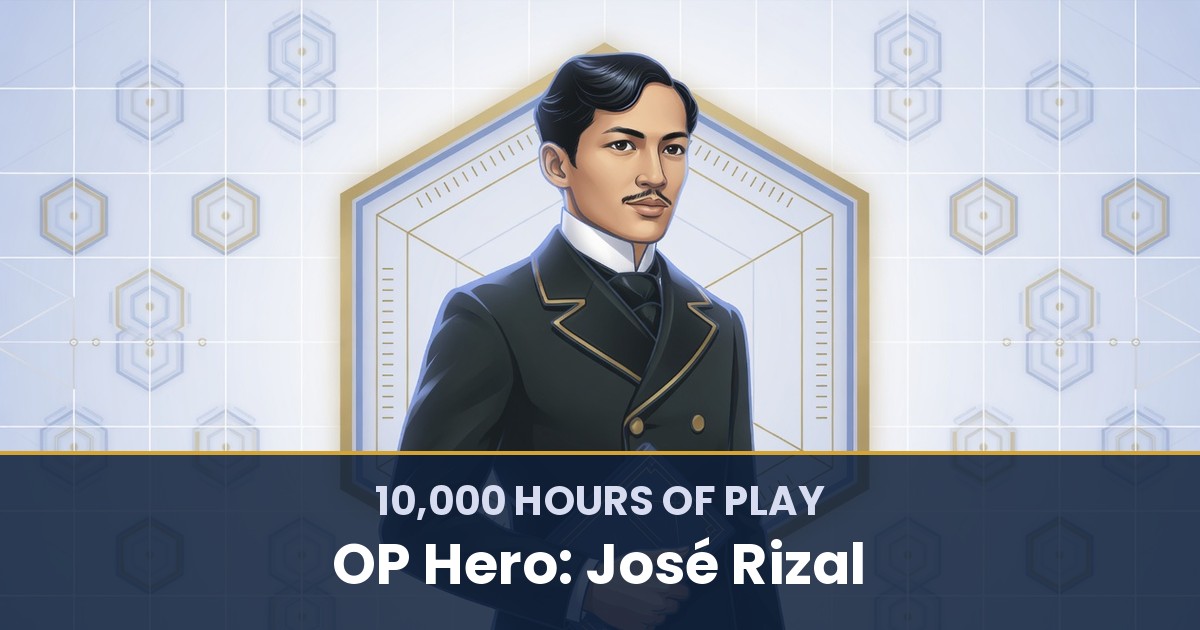


On the evening of 29 December 1896, in a cell in Fort Santiago, a 35-year-old eye doctor handed his sister an alcohol cooking stove and told her in English that there was something inside.
Folded inside the stove was an untitled poem of fourteen stanzas that Filipino schoolchildren now learn as Mi Último Adiós.
Shortly after seven the next morning, a firing squad shot him on the field at Bagumbayan in Manila for a rebellion he had publicly refused to join.
Two weeks earlier, on 15 December, he had written a manifesto telling his countrymen that he had not authorized the uprising and urging them to abandon it, and the Spanish judge advocate had suppressed it.
The man was José Rizal: an ophthalmologist trained in Paris and Heidelberg, the author of two novels that a colonial government treated as contraband, the annotator of a seventeenth-century Spanish history, and an exile who helped a town design its water system.
Run through the six Steps, his life asks a question most of us never have to face directly: what happens when the Game you choose can only be played in the open, under your own name, against an opponent who can end it?
⚡ Speed Run Notes
- José Rizal’s Game was to prove, in public and under his own name, that a Filipino stood as the equal of any European, and to win reform for the Philippines through books, science and example rather than arms.
- His innate stats: an early reader with a memory for languages, a curiosity that ran across medicine, history and zoology, and a small frame he trained with fencing, marksmanship and gymnastics.
- Canon Skills on the sheet: Ley Line Infusion (Mage), Loremaster (Druid), Arcane Wisdom (Mage), Batcave Crafting (Ranger) and Divine Shield (Paladin).
- His allies funded and sheltered the work: a brother who paid for his secret departure, two friends who financed his novels, and an Austrian ethnologist he met in person once and wrote to for a decade.
- The Quest log runs from an 1887 novel printed on borrowed money to a family eviction, a four-year exile that became a civic project, and an execution in 1896 that turned a reform program into a revolution’s banner.
Table of Contents
About Yu-kai Chou

Yu-kai Chou is the author of 10,000 Hours of Play — the book that treats your life as the most important game you’ll ever build a character in, and gives you the 6-Step framework (Game · Attributes · Role · Skills · Allies · Quests) to play it on purpose. He has spent two decades developing the system through which this post analyzes its OP Hero, and applies it to his own life and to the lives of the people he advises around the world.
Chou’s other framework, the Octalysis Framework, has been applied by LEGO, Microsoft, Porsche, Coca-Cola, Salesforce, and MrBeast, impacting over 1.5 Billion Users. He has taught the methodology at Harvard, Stanford, Yale, Tesla, Google, BCG, and IDEO, and has advised governments in eight nations including Ukraine, the United Kingdom, the Kingdom of Bahrain, Singapore, Taiwan, the Netherlands, Kazakhstan, and South Korea.
His work has been cited by Harvard, Stanford, MIT, Forbes, Wall Street Journal, Wired, US Department of Energy, NIST, NSF, NCBI, US Department of Education, ClinicalTrials.gov, and Google Scholar — with 3,700+ more academic publications. Explore his books here.

José Rizal belongs in this series because he ran the Loremaster problem at the highest stakes I know of: he picked a Game in which every move had to carry his signature, against an empire that eventually killed him for it, and he played it with two novels, a scalpel and a water pipe. The move I would lift from his character sheet is the Divine Shield he raised on 21 June 1896, when a revolution’s envoy asked for his blessing and he said no, then repeated the refusal in writing six months later as a prisoner awaiting trial.
Step 1: The Game — What José Rizal Was Actually Playing
José Rizal’s Game is easy to misread as revolution, because a revolution is what followed his death.
The Game he actually chose was a proof. Spanish colonial society filed Filipinos under the word indio, and from his student years onward Rizal set out to show, through his own record, that an indio could match any European in medicine, letters, science and conduct.
The second half of the Game was reform inside the Spanish system: representation, equality before the law, protection against friar abuses, and the freedom to write and associate. He pursued it with novels, journalism, historical scholarship and a medical practice, and for most of his public career he opposed a premature, unprepared armed revolt.
When an envoy from the Katipunan visited him in exile on 21 June 1896 carrying Andrés Bonifacio’s message about the planned uprising, Rizal advised against launching it without arms, money, preparation and broad support.
Six months later, as a prisoner, he wrote the manifesto of 15 December 1896 stating that he had not authorized the revolt and urging Filipinos to abandon it.
What made the Game lethal was the combination of its two rules, and the comparison that shows it is Fukuzawa Yukichi, who worked in Japan in the same decades on an educator’s program that his own government tolerated: Rizal’s program could only be answered by his government with censorship, exile or a firing squad, and he put his own name on both novels and on the Morga edition anyway.
There was a third, quieter Game that only appeared when the first two were taken away. In four years of exile in Dapitan, on the north coast of Mindanao, he turned reform from an argument into a working model: a clinic, a school, a water system, farmland and a stream of specimens sent to European museums.
Step 2: Attributes — The Innate Stats
Attributes are the stats a player carries in before any training, and Rizal’s first one showed up before school did.
He was born on 19 June 1861 in Calamba, Laguna, the seventh of eleven children of Francisco Mercado and Teodora Alonso, in a prosperous tenant family on the Dominican hacienda there. His mother taught him his letters at about three, by family account he was reading and writing by four or five, and his notebooks and letters show a memory for words that later carried him through Spanish, Latin, French, German, English and several more languages.
The popular claim that he knew twenty-two languages is a later estimate rather than a documented list of fluent ones, and his proficiency varied widely across them. What the record does support is a working command of enough languages to study medicine in Spanish, correspond with scholars in German, and read sources in several others.
The second attribute was a curiosity that refused to stay in one field. His correspondence shows him moving between ophthalmology, philology, ethnography, history, zoology, botany, engineering, agriculture, drawing and sculpture, and most of what follows in this profile is the list of projects that came out of it.
The third was physical, and it ran the other way. Biographical accounts put his height at roughly five feet two or three inches, and he answered that with disciplined training in fencing, marksmanship, gymnastics and long walks, partly because he was determined to disprove colonial stereotypes of Filipino weakness in his own body.
The fourth attribute was sensitivity to injustice, and two childhood events sharpened it. His mother was arrested in 1871 on charges the family regarded as abusive and spent roughly two years under legal persecution, and on 17 February 1872, when he was ten, three Filipino priests known as Gomburza were executed at Bagumbayan, the same field where he would die.
In the Talent Triangle Method, the question is which Edge Strength gives you an unfair advantage in the right environment. Rizal’s was the pairing of the first two attributes: a language memory that opened European archives and clinics to him, and a curiosity wide enough to notice what was inside.
Step 3: Role(s) — The Character Class Across Chapters
Rizal changed Roles roughly every three years, and each Role supplied the next one with its tools.
The first Role, student, ran for a decade. He entered the Ateneo Municipal de Manila in 1872 and completed the Bachelor of Arts in 1877 with the highest marks, then studied philosophy and medicine at the University of Santo Tomas from 1877 to 1882.
The second Role began on 3 May 1882, when he left Manila in secret for Spain, financed and arranged by his elder brother Paciano. At the Universidad Central de Madrid he took the Licentiate in Medicine on 21 June 1884 and the Licentiate in Philosophy and Letters on 19 June 1885, and he never completed the formal doctorate in medicine, a gap biographers attribute to unpaid fees and an unsubmitted dissertation.
The third Role was ophthalmologist in training: roughly four months in Louis de Wecker’s clinic in Paris in 1885 and 1886, then the university eye clinic in Heidelberg under Otto Becker in 1886.
The fourth Role, novelist, is the one that produced the two books. Noli Me Tángere came off the press in Berlin on 21 March 1887, and El Filibusterismo followed from Ghent on 18 September 1891, dedicated to the three priests executed in 1872.
Novelist is a dangerous class under a censoring state because the work itself becomes the evidence, and at Rizal’s court-martial the prosecution used his writings against him.
Alongside the novelist ran a fifth Role, historian: his annotated edition of Antonio de Morga’s Sucesos de las Islas Filipinas, researched at the British Museum in London in 1888 and 1889 and published in Paris in 1890.
The sixth Role was organizer, and it lasted three days. He founded La Liga Filipina in Tondo, Manila on 3 July 1892, was arrested on 6 July, and was ordered into exile on 7 July by Governor-General Eulogio Despujol.
The seventh Role was exile in Dapitan from 17 July 1892 to 31 July 1896, where he worked as physician, teacher, engineer, farmer and naturalist at once. The eighth, volunteer military doctor bound for Cuba, ended with his arrest in October 1896 before he reached the front.
Step 4: Skills — The Real-Life Game Skills José Rizal Mastered
Attributes are inherited; Skills are the trained, repeatable moves on the character sheet, drawn here from the canon list of Real-Life Game Skills. Five of them are legible in Rizal’s record.
Ley Line Infusion (Mage) is quickly absorbing a large amount of knowledge in a subject, and his German is the cleanest example. He began corresponding with the Austrian scholar Ferdinand Blumentritt on 31 July 1886, and within a year he could read German scientific literature, publish a novel in Berlin, and bring his work on Tagalog verse before German scholarly circles.
Loremaster (Druid) is weaving compelling, inspiring stories, and the two novels were built as instruments. Noli Me Tángere was printed in Berlin in a first edition of 2,000 copies, funded by a loan of 300 pesos from his friend Máximo Viola, and Spanish authorities and clerical interests treated it as heretical and subversive from the start.
The sequel was financed the same way, by a friend at the last moment. He finished El Filibusterismo in Biarritz on 29 March 1891, pawned personal belongings to pay the printer, and completed publication in Ghent only after Valentín Ventura covered the remaining cost.
Arcane Wisdom (Mage) is absorbing wide data and synthesizing it into clear outputs, and the Morga edition is the proof. Rizal took a seventeenth-century Spanish account of the islands and annotated it to recover evidence of precolonial Filipino trade, government, writing and social organization, using a Spanish source to argue against the claim that civilization arrived with Spain.
Batcave Crafting (Ranger) is redesigning the environment you are placed in, and Dapitan was a forced placement he rebuilt from the inside. In September 1892 a lottery ticket he shared with the local commandant, Ricardo Carnicero, and a local resident named Francisco Equilior won a second prize of 20,000 pesos, and his share of about 6,200 pesos bought farmland at Talisay, near the town.
On that base he ran a clinic and a school for boys taught in exchange for work, built a relief map of Mindanao in the town plaza and coconut-oil street lamps, and helped the Jesuits and the townspeople design a gravity-fed water system about two kilometers long, inaugurated in 1895.
Divine Shield (Paladin) is saying no regardless of how persuasive the other side is. The Katipunan’s envoy in June 1896 carried the backing of an organized movement that wanted his name on its uprising, and Rizal still refused to endorse a revolt he judged unprepared, then put the refusal in writing in December while his own life depended on the court’s reading of his loyalty.
On the Skills Spectrum, Rizal ran deep and wide at once: a Specialist in ophthalmology, with a Dabbler’s working reach across history, engineering and natural science that produced finished projects in each.
Step 5: Allies — The People Who Multiplied José Rizal
Rizal’s Allies share one pattern: almost every major Quest in his log was paid for, sheltered or published by someone else.
The first Allies were in the family house in Calamba. His mother, Teodora Alonso, was his first teacher, and her prosecution in the 1870s shaped the sensitivity to injustice that drove the whole Game. His elder brother Paciano financed and arranged the secret departure of 3 May 1882 and later became a general in the revolution Rizal had refused to endorse.
Ferdinand Blumentritt, an Austrian ethnologist who never visited the Philippines, became the longest-running Ally. Their correspondence began in 1886, they met in person at Leitmeritz in Bohemia for four days in May 1887, and Blumentritt supplied scholarly introductions, criticism and a friendship that outlasted every political setback.
Two friends turned his manuscripts into printed books at the moments he could not pay for them. Máximo Viola lent the 300 pesos that printed the Noli in 1887 and traveled with Rizal to meet Blumentritt that spring, and Valentín Ventura financed the completion of the Fili in 1891.
In Europe’s learned circles, Rudolf Virchow and Adolf Bernhard Meyer connected his linguistic and natural-history work with scholarly institutions, and in London the lawyer Antonio Regidor and the orientalist Reinhold Rost helped with the Morga research at the British Museum.
The Propaganda Movement was a working alliance with a fault line. Graciano López Jaena founded La Solidaridad in Barcelona in February 1889, Marcelo H. del Pilar edited it, and Rizal published essays there, until a leadership vote among the Filipinos in Madrid in February 1891 split him from del Pilar’s faction.
In Dapitan the Alliances took on a different and more local character. The Jesuit Francisco de Paula Sánchez helped him build the relief map in 1892, the commandant Carnicero shared the lottery ticket, and Josephine Bracken, who first came in February 1895 with her blind adoptive father as a patient and returned that summer to live with him, became his companion.
Most of these Allies were chosen for a specific Quest, and nearly all of them held a resource Rizal lacked at that moment, whether money, access or a printing press.
Step 6: Quests — The Milestones That Shaped the Saga
Rizal’s Quest log alternates between completed works and the price the colonial government charged for each one.
The first completed Quest was the secret departure of 3 May 1882, which took him out of a monitored colony and into the universities of Madrid, Paris and Heidelberg.
The second was the Noli, finished in Berlin in February 1887 while he was close to destitute, off the press on 21 March on Viola’s loan, and carried home that August. He arrived in Manila on 5 August 1887, practiced medicine in Calamba, and left again on 3 February 1888 under pressure from the authorities.
The third Quest ended in a defeat he could not reverse. In 1888 he helped draft the tenants’ complaint about rents on the Dominican hacienda at Calamba, the tenants lost in the Manila courts, and from August 1890 evictions and house demolitions went ahead while an appeal to the Supreme Court in Madrid was still pending; Paciano and three of Rizal’s brothers-in-law were deported.
The fourth was the Fili, off the press in Ghent on 18 September 1891, and the fifth was La Liga Filipina, founded on 3 July 1892 and ended by his arrest three days later. The Katipunan, the secret society that would launch the 1896 revolution, was founded on 7 July 1892, the day his deportation order was signed.
The sixth Quest was Dapitan, which also carried a medical milestone from the same year: in Hong Kong in 1892, where he had set up an ophthalmology practice, he operated on his mother’s cataract, and her sight improved.
The last Quest was the attempt to serve as a volunteer army doctor in Cuba. He left Dapitan on 31 July 1896, sailed from Manila on 3 September, was held in Spain in October, the revolution having broken out in the Philippines while he waited in Manila for his ship, and was returned to Manila on 3 November.
His court-martial sat on 26 December 1896, with a Spanish lieutenant, Luis Taviel de Andrade, as his defense counsel, and he was executed on 30 December. Species named after him by European naturalists between 1897 and 1900, among them a beetle, a frog and the flying lizard Draco rizali, outlasted the government that shot him.
The Game he refused to play then claimed him as its emblem. In 1898 the revolutionary government declared 30 December a day of national mourning, the American colonial commission created Rizal Province in 1901 and made the date a public holiday in 1902, and a 1956 law required his two novels in Philippine schools.
What You Can Steal From José Rizal’s Build
Rizal’s build is a lesson in Skills that turn a constraint into output: a language learned for access, two novels financed by friends, and an exile rebuilt as a town project.
The first thing to steal is the Ley Line Infusion pattern. He learned German because the clinics, printers and scholarly societies he needed in 1886 and 1887 operated in it, and within a year the language had paid for itself in a published novel.
The second is the funding model behind Loremaster. Both novels exist because Rizal asked specific friends for specific sums at the moment the work was finished and the money was gone.
The third is Batcave Crafting under constraint. Handed a four-year exile with no appeal, he treated the town as the Quest and left it a school, a plaza map and a share in a working water system, and the lottery share of 1892 went into land and public works.
The fourth lesson is the Skill his character sheet needed more of: Cloak (Rogue), gathering information or executing without being noticed, which is the Skill Chiune Sugihara used in Kaunas in 1940 when he wrote transit visas for thousands of refugees against his own ministry’s instructions. Rizal put his name on both novels, founded the Liga in public and sailed for Cuba on a Spanish ship days after a revolution he had refused to join had broken out, and each of those choices followed from his Game while making his arrest easy.
The habit that survived him was the one from the first paragraph of this profile: finish the work, hand it to someone who can carry it out, and trust that the record will argue for you when you no longer can.
Where this framework comes from

Want the full system this profile is built on?
Every OP Hero piece runs through the same 6-Step framework from 10,000 Hours of Play: Unlock Your Real-Life Legendary Success. The book covers the full system, walks through Yu-kai’s own life run as the first applied case study, and gives you the worksheets to audit your own build.
Related Reading
- All OP Hero Profiles — the full hub
- 10,000 Hours of Play by OP Hero: Fukuzawa Yukichi
- 10,000 Hours of Play by OP Hero: Václav Havel
- 10,000 Hours of Play by OP Hero: Frederick Douglass
- 10,000 Hours of Play by OP Hero: Simón Bolívar
- Real-Life Game Skills: The 96-Skill System Behind 10,000 Hours of Play