
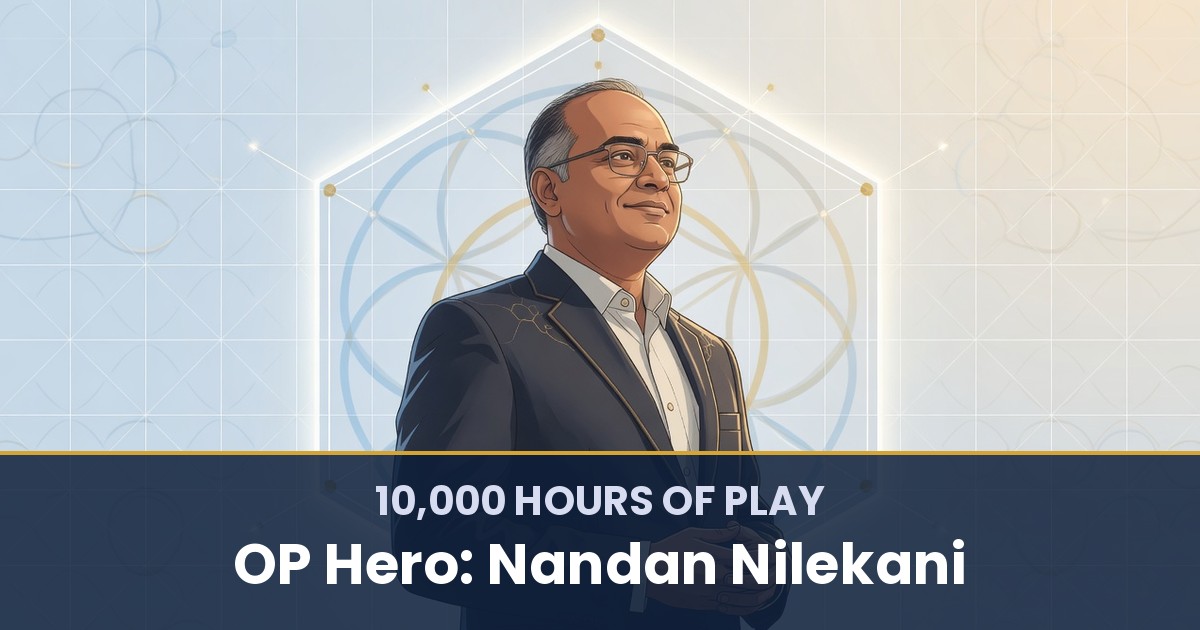


In July 2009, Nandan Nilekani gave up the co-chairmanship of Infosys, the company he had helped build from US$250 of starting capital, to take a government job that came with the rank of a cabinet minister and almost nothing else.
The Unique Identification Authority of India had been constituted that January as an office attached to the Planning Commission. Its mandate was to give every resident of India a number, and it had issued none.
Nilekani was 54 years old at the time. He later described the move as doing a startup at 54, inside the government, and admitted that when he arrived he did not know how to move a file through the bureaucracy.
By the time he left in March 2014, roughly 600 million people had been enrolled, and the system he set up went on to cross a billion numbers in April 2016.
Run through the six Steps, his record is the rare case of a player who won one Game outright and then chose a second one sized for a country.
⚡ Speed Run Notes
- Nandan Nilekani’s Game was building systems that work at the scale of India: a software exporter first, then a national identity layer, then open platforms for payments and children’s learning.
- His innate stats: a head for systems, an optimism about India he grew up with, an ease moving between the private and public worlds, and a stated need to stay relevant.
- Canon Skills on the sheet: Foresight (Ranger), Mastermind (Ranger), Cosmic Alignment (Mage), Concord of Elements (Druid), Terraform (Warlock) and Revive (Paladin).
- His Allies ran from N.R. Narayana Murthy, who interviewed him for his first job in 1978, to a prime minister, an architect named Pramod Varma, and his wife Rohini, who co-founded EkStep with him.
- The Quest log: Infosys from 1981, a Nasdaq listing in 1999, Aadhaar from 2009, an election lost by 228,575 votes in 2014, and a return to a company in crisis in 2017.
Table of Contents
About Yu-kai Chou

Yu-kai Chou is the author of 10,000 Hours of Play — the book that treats your life as the most important game you’ll ever build a character in, and gives you the 6-Step framework (Game · Attributes · Role · Skills · Allies · Quests) to play it on purpose. He has spent two decades developing the system through which this post analyzes its OP Hero, and applies it to his own life and to the lives of the people he advises around the world.
Chou’s other framework, the Octalysis Framework, has been applied by LEGO, Microsoft, Porsche, Coca-Cola, Salesforce, and MrBeast, impacting over 1.5 Billion Users. He has taught the methodology at Harvard, Stanford, Yale, Tesla, Google, BCG, and IDEO, and has advised governments in eight nations including Ukraine, the United Kingdom, the Kingdom of Bahrain, Singapore, Taiwan, the Netherlands, Kazakhstan, and South Korea.
His work has been cited by Harvard, Stanford, MIT, Forbes, Wall Street Journal, Wired, US Department of Energy, NIST, NSF, NCBI, US Department of Education, ClinicalTrials.gov, and Google Scholar — with 3,700+ more academic publications. Explore his books here.

Nandan Nilekani belongs in this series because he has worked in all four boxes of his own map, thinking and doing, public and private, and that range is what let him stand up a national identity system without ever having run a ministry. The move I would lift from his character sheet is the deliberate crossing from the private-doer box into the public one at 54, with a date and a number attached.
Step 1: The Game — What Nandan Nilekani Was Actually Playing
From the outside, Nilekani’s first Game looked like a software services company, and for twenty-eight years that is what he worked on.
Infosys was incorporated in Pune on 2 July 1981 by seven engineers with US$250 of capital, and it moved to Bangalore in 1983. The founders wrote plans that ran far ahead of the business, and Nilekani has described the habit plainly: when Infosys was a three-to-five-million-dollar company, the founders were already talking about becoming a hundred-million-dollar company.
The planning stack he has described from Infosys had three layers: a five-year scenario plan, a three-year strategic plan, and a one-year operating plan. That is a Game with a scoreboard, and he has said that execution without a strategic plan is also a bad thing.
The later chapters follow the same pattern. Aadhaar was a number for every resident of India. EkStep set out to reach 200 million children. The committee he chaired for the Reserve Bank of India in 2019 was about digital payments for the whole country.
He has also been explicit about why the identity project appealed to him: it was time bound, he could measure success, and it was not vague.
His 2008 book Imagining India runs on the same engine. The TED talk he gave in 2009 sorted India’s ideas into four bins, the ones that had arrived, the ones in progress, the ones in conflict and the ones still being anticipated.
So the Game, stated in his own terms, was to build institutions and platforms that could serve a population of more than a billion people, with a target you could measure and a date by which it had to be hit.
Step 2: Attributes — The Innate Stats
Attributes are the stats a player carries in before any training, and Nilekani’s first one, a bias toward public purpose, was in the house he grew up in.
He was born in Bangalore on 2 June 1955 to Durga and Mohan Rao Nilekani, a Konkani-speaking family with roots in Sirsi in northern Karnataka. His father was the general manager of the Mysore and Minerva Mills and held Fabian Socialist ideals.
The second attribute was adaptability, and his schooling shows where it came from. He went to Bishop Cotton Boys’ School in Bangalore, then to St. Joseph’s High School in Dharwad, and finished his pre-university studies at Karnatak College in Dharwad, which meant changing cities and classrooms as a teenager.
He joined IIT Bombay in 1973 and graduated in electrical engineering in 1978. He also met Rohini Soman at a quizzing event there, and the two married in 1981, the same year Infosys was founded.
The third attribute is comfort in every quadrant. He has described a four-by-four matrix, with public and private sector on one axis and thinking and doing on the other, and said that having played in all four quadrants gives him a fuller understanding of things.
The fourth is restlessness about his own relevance. He has spoken repeatedly about the need to stay relevant and to keep learning, and his record after 50 is the evidence.
In the Talent Triangle Method, those four stats sit on the innate side of the triangle, and the Skills in Step 4 were built on top of them.
Step 3: Role(s) — The Character Class Across Chapters
Nilekani’s first Role was engineer. In 1978 he joined Patni Computer Systems in Mumbai, where the man who interviewed him was N.R. Narayana Murthy.
Three years later he was one of seven co-founders of Infosys. By the time of the company’s 1999 annual report he was managing director, president and chief operating officer, and that March Infosys listed American Depositary Shares on Nasdaq, the first India-registered company to list on a US exchange.
From March 2002 to June 2007 he played the chief executive Role. Infosys’s revenue grew roughly sixfold during his tenure, to about US$3 billion, and by the end of the 2007 fiscal year the company and its subsidiaries employed more than 72,200 people. He then handed the CEO job to Kris Gopalakrishnan, effective 22 June 2007, and became co-chairman.
The 2009 switch to chairman of UIDAI reads at first like a career change, and the way to test that reading is to set it beside another player who moved this late. Morris Chang left a 25-year career at Texas Instruments and founded TSMC in Taiwan in 1987, at 55; his Game, semiconductors, stayed fixed while his class moved from executive to founder. Nilekani’s move passes the same test: the Game stayed country-scale systems, and the class moved from executive to institution-builder, with the rank of a cabinet minister attached because, in his own framing, a doer in the public sector is a minister.
In 2014 he tried on the Role of politician, as the Congress candidate for Bangalore South in the Lok Sabha election. The Role lasted exactly one campaign before he set it aside.
From 2015 the Role became philanthropist and platform builder, through EkStep, which he co-founded with his wife Rohini and with Shankar Maruwada. On 24 August 2017 he added one more: non-executive chairman of Infosys, brought back to the company he co-founded during a governance crisis.
In each chapter he designed the system, assembled the team, and then handed the operating job to someone else: to Kris Gopalakrishnan at Infosys in 2007, to the civil service at UIDAI in 2014, and to Shankar Maruwada at EkStep from 2015.
Step 4: Skills — The Real-Life Game Skills Nandan Nilekani Mastered
Six of the canon Real-Life Game Skills show up in his record with a dated moment attached.
Foresight (Ranger): projecting and predicting future trends and risks. In 2004 Thomas Friedman visited the Infosys campus outside Bangalore, and Nilekani told him that the playing field was being leveled. On the drive back Friedman realised the operative word was flattened, wrote “the world is flat” in his notebook, and published a book with that title in 2005.
Mastermind (Ranger): creating, adapting and executing complex plans. Aadhaar’s design was a plan of that kind: a twelve-digit random number with no demographic meaning built into it, backed by a photograph, ten fingerprints and two iris scans, with de-duplication across the whole population and online authentication as the service.
Cosmic Alignment (Mage): optimising complex logistics and how moving parts come together. UIDAI deliberately kept its administrative and political team in Delhi and its technology team in Bangalore, and the machine it built had issued 10 million numbers by 30 June 2011 against a target of 600 million by 2014.
Concord of Elements (Druid): bringing parties with different interests together. He has said he had to create a team that was an amalgamation of government talent and tech talent, and the roster shows it: a career civil servant, Ram Sewak Sharma, as director general, and a technologist, Pramod Varma, as chief architect.
Terraform (Warlock): influencing rule-makers and regulators to change the terrain. The identity bill introduced in December 2010 was rejected by a parliamentary standing committee a year later, and Nilekani kept working the machinery anyway; the Aadhaar Act passed in March 2016, and in 2019 he chaired the Reserve Bank of India’s committee on deepening digital payments.
Revive (Paladin): recovering from a failure and taking new action toward the next Quest. Within a year of losing the 2014 election he had co-founded EkStep, having concluded that the literacy mission could be pursued from outside government.
On the Skills Spectrum, this is a Specialist build. Every Skill on the list serves the same job of making large systems work, and he has described the discipline behind it in one line: he is generous with his money and stingy with his time.
Step 5: Allies — The People Who Multiplied Nandan Nilekani
The first Ally was the man across the interview table in 1978. N.R. Narayana Murthy hired him at Patni, co-founded Infosys with him three years later, and handed him the CEO role in 2002.
The other five co-founders, Kris Gopalakrishnan, S.D. Shibulal, K. Dinesh, N.S. Raghavan and Ashok Arora, shared the US$250 and the twenty-year climb that followed. Gopalakrishnan took the CEO job from him in 2007 in a planned handover.
Rohini Nilekani has been an Ally for longer than any company. A former journalist, she is the founder-chairperson of the water foundation Arghyam and a co-founder of Pratham Books in 2004; she co-founded EkStep with him in 2015, and in 2017 the two signed the Giving Pledge, committing at least half their wealth to philanthropy.
Prime Minister Manmohan Singh invited him to head UIDAI in 2009, and on 29 September 2010 Singh handed the first Aadhaar letter to Ranjana Sonawane in Tembhli, a village in Nandurbar district, Maharashtra.
Inside UIDAI the multipliers were Ram Sewak Sharma, director general and mission director from 2009 to 2013, Pramod Varma as chief architect, and Srikanth Nadhamuni, who led the early technology build. Shankar Maruwada played the equivalent part at EkStep as co-founder and chief executive.
Thomas Friedman turned one of Nilekani’s sentences into the title of a bestselling book and, with it, into a shorthand that millions of readers associated with Bangalore.
And in 2017 a group of twelve major institutional investors called for his return to the Infosys board, six days before the company named him chairman.
Step 6: Quests — The Milestones That Shaped the Saga
Quest 1 was the climb out of US$250, from 1981 to 1999. Infosys went public in February 1993 at ₹95 a share, and the offer was initially undersubscribed until Morgan Stanley stepped in and took a 13 percent stake. Six years later, on 11 March 1999, the company listed on Nasdaq.
Quest 2 was the CEO chapter, from 2002 to 2007. Revenue grew roughly sixfold to about US$3 billion, the company added close to a billion dollars of revenue in the final fiscal year alone, and the headcount passed 72,200.
Quest 3 was Aadhaar, from 2009 to 2014. The first number was issued on 29 September 2010. In December 2011 the parliamentary standing committee on finance, chaired by Yashwant Sinha, rejected the bill meant to give the authority a statutory footing, and the privacy fight that followed lasted years. The system crossed one billion numbers on 4 April 2016, the Aadhaar Act passed as a money bill in March 2016, and on 26 September 2018 the Supreme Court upheld the programme by a 4 to 1 majority while striking down its use by private companies and barring mandatory linking to bank accounts and mobile SIMs.
Quest 4 was the defeat of 2014. Nilekani resigned from UIDAI in March 2014 and ran for Bangalore South. Ananth Kumar of the BJP polled 633,816 votes to his 405,241, a margin of 228,575, and his election affidavit, declaring assets of about ₹7,710 crore, made him the most widely reported “richest candidate” of that election.
Quest 5 has been EkStep and DIKSHA, from 2015 onward. The first product was Genie, an app of gamified learning content, and the work then moved to QR codes printed in textbook chapters and to Sunbird, the open-source platform on which DIKSHA, the Ministry of Education’s teacher and student platform, was built and launched on Teacher’s Day 2017. DIKSHA is now used across more than 35 states and union territories and has recorded more than 60 billion minutes of learning.
Quest 6 was the return to Infosys in 2017. Vishal Sikka resigned as Infosys CEO on 18 August 2017 after a public dispute between the board and the founders over his pay, the US$200 million Panaya acquisition and a severance package. Six days later Nilekani was named non-executive chairman, chairman R. Seshasayee resigned, and Salil Parekh took over as CEO on 2 January 2018. As of March 2026 the company employed 328,594 people.
One more entry belongs on the log. In June 2023 he gave ₹315 crore to IIT Bombay, taking his lifetime giving to the institute to ₹400 crore, and called it a tribute to the place that had given him so much.
What You Can Steal From Nandan Nilekani’s Build
The first thing to steal is the acceptance test he applied before taking the UIDAI job: he could say what success was and the date by which it was due.
The second is his reading of a lost election. The 2014 defeat changed his Role and left his Game intact, and within a year the same mission was being pursued through a foundation instead of a ministry. Mikhail Gorbachev made the same move at a larger scale: when the Soviet Union dissolved in December 1991 he founded the Gorbachev Foundation in Moscow that same month and kept working on the same questions from outside the state. EkStep was Nilekani’s version of that move.
The third is how he builds a team for a system he does not yet understand. He has admitted he did not know how to move a file when he arrived in government, so he hired people who did and paired them with engineers who could build.
The fourth thing to steal is the habit of planning on three clocks at once, a five-year scenario, a three-year strategy and a one-year operating plan, with each one checked against the other two.
Where this framework comes from

Want the full system this profile is built on?
Every OP Hero piece runs through the same 6-Step framework from 10,000 Hours of Play: Unlock Your Real-Life Legendary Success. The book covers the full system, walks through Yu-kai’s own life run as the first applied case study, and gives you the worksheets to audit your own build.
Related Reading
- All OP Hero Profiles — the full hub
- 10,000 Hours of Play by OP Hero: Ratan Tata
- 10,000 Hours of Play by OP Hero: A.P.J. Abdul Kalam
- 10,000 Hours of Play by OP Hero: Sundar Pichai
- 10,000 Hours of Play by OP Hero: Satya Nadella
- Real-Life Game Skills: The 96-Skill System Behind 10,000 Hours of Play