
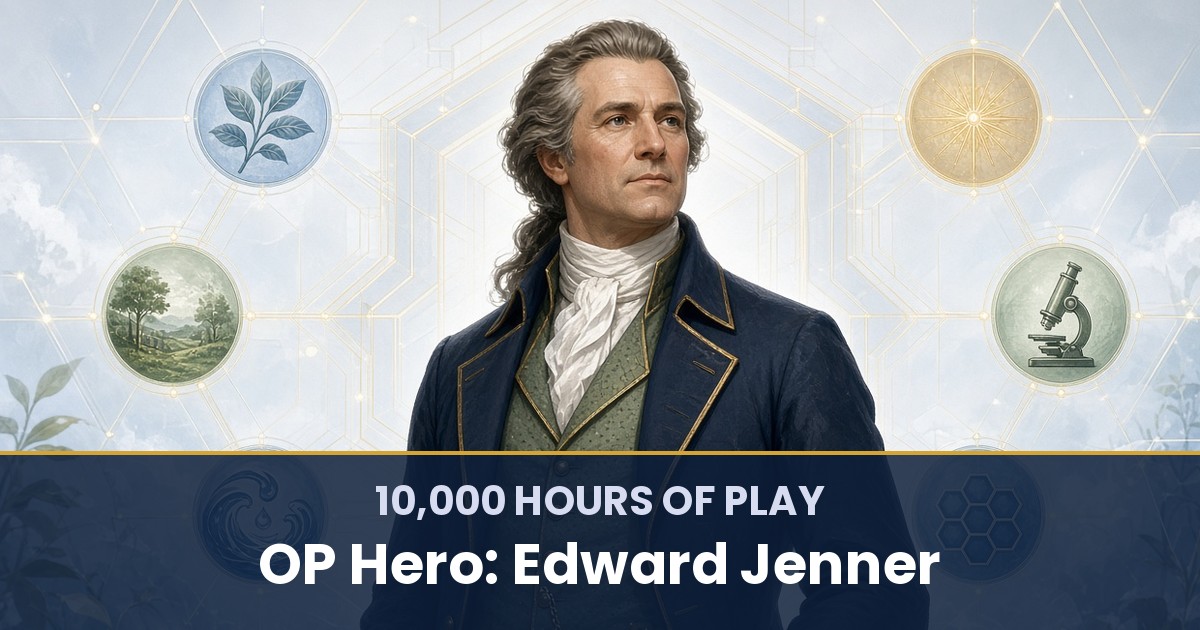


On the morning of May 14, 1796, a country doctor in Berkeley, Gloucestershire scratched material from a milkmaid’s cowpox blister into the arm of an eight-year-old boy named James Phipps.
There was no precedent for what Edward Jenner was doing. There was only a hypothesis he had carried for decades: that the folk belief about milkmaids never catching smallpox was a biological rule hiding in plain sight.
Smallpox was the deadliest recurring killer of his era. In 1980, the World Health Assembly declared it eradicated, making it the only human disease we have ever erased on purpose.
Every piece of that outcome traces back to choices Jenner made about his mission, his talents, his roles, his skills, his allies, and his milestones. That makes him a perfect candidate for a full character-sheet breakdown through the 6-Step framework, so let’s run the build of the man who ended a plague.
⚡ Speed Run Notes
- Jenner’s Game was pattern-to-proof: take a rural folk observation everyone else dismissed and turn it into a repeatable medical intervention the whole world could adopt.
- His edge came from decades of naturalist observation. Fellowship of the Royal Society in 1789, earned for natural-history work, trained the pattern recognition that later spotted immunity before the word existed.
- The Royal Society rejected his vaccination manuscript. He self-published the 1798 Inquiry instead, a textbook case of Reflect Damage (Paladin).
- Allies multiplied him: John Hunter’s maxim “Why think? Why not try the experiment?” became the operating system behind the Phipps test of 14 May 1796.
- Steal this: Jenner’s twenty quiet years of observation practice ended up deciding his biggest Quest, and the same usually holds for yours.
Table of Contents
About Yu-kai Chou

Yu-kai Chou is the author of 10,000 Hours of Play — the book that treats your life as the most important game you’ll ever build a character in, and gives you the 6-Step framework (Game · Attributes · Role · Skills · Allies · Quests) to play it on purpose. He has spent two decades developing the system through which this post analyzes its OP Hero, and applies it to his own life and to the lives of the people he advises around the world.
Chou’s other framework, the Octalysis Framework, has been applied by LEGO, Microsoft, Porsche, Coca-Cola, Salesforce, and MrBeast, impacting over 1.5 Billion Users. He has taught the methodology at Harvard, Stanford, Yale, Tesla, Google, BCG, and IDEO, and has advised governments in eight nations including Ukraine, the United Kingdom, the Kingdom of Bahrain, Singapore, Taiwan, the Netherlands, Kazakhstan, and South Korea.
His work has been cited by Harvard, Stanford, MIT, Forbes, Wall Street Journal, Wired, US Department of Energy, NIST, NSF, NCBI, US Department of Education, ClinicalTrials.gov, and Google Scholar — with 3,700+ more academic publications. Explore his books here.

Edward Jenner’s build stands out to me for how long his observational stats were compounding before the world saw any payoff. He watched birds, fossils, and farm diseases for decades, and that unglamorous practice became the exact Skill that cracked smallpox. For your own character sheet, your defining Quest will usually call on the Attribute you exercised quietly for decades, so treat that quiet practice as the main storyline rather than a hobby.
Step 1: The Game — What Edward Jenner Was Actually Playing
Plenty of physicians in the 1790s treated smallpox. Jenner chose a different Game entirely: prevent it, reproducibly, for everyone.
His mission held steady across decades and had three moves. Observe natural patterns in disease, test the promising ones experimentally, and convert whatever survived testing into a method other practitioners could repeat.
Gloucestershire farming communities kept telling him the same story: milkmaids who had caught cowpox seemed to shrug off smallpox. Where his colleagues heard an old wives’ tale, Jenner heard a potentially general biological rule that nobody had bothered to verify.
In his 1798 Inquiry, he framed the project in exactly those terms, an investigation into the “causes and effects” of cowpox and its protective relationship to smallpox. He had defined his win condition before anyone else agreed it existed: a world where the deadliest disease of his century simply could not spread.
He already had a comfortable village practice, and he still spent his reputation on a question his profession’s most prestigious institution would initially reject.
Step 2: Attributes — The Innate Stats
Strip away the training and the famous experiment, and four innate stats show up early in Jenner’s life.
Pattern recognition sat at the top of his character sheet. His signature move was connecting repeated reports that nobody else treated as data. Milkmaids resisting smallpox was background noise in rural England until Jenner treated the pattern as a hypothesis worth staking a career on.
Empirical curiosity ran just as deep through everything he touched. Long before vaccination made him famous, he was investigating animal biology, fossils, birds, and disease processes purely because the questions pulled at him. That breadth earned him Fellowship of the Royal Society in 1789, years before the Phipps experiment.
Risk tolerance showed up whenever the work demanded it. Testing the cowpox hypothesis meant a direct human inoculation, followed by a deliberate smallpox challenge. He accepted stakes most of his peers would never touch.
Persistence under institutional resistance rounded out the stat line. When the Royal Society declined his manuscript, he kept going and published the evidence himself.
If you are auditing your own innate stats, the Talent Triangle Method walks you through exactly this exercise. Jenner’s triangle leaned hard into observation, and he had the self-awareness to build his entire Game on top of it.
Step 3: Role(s) — The Character Class Across Chapters
Jenner respec’d his class several times, and each Role set up the next one.
Chapter one cast him as an apprentice surgeon and naturalist. He trained in surgery under Daniel Ludlow at Sodbury, then under the great surgeon and naturalist John Hunter in London during the 1770s. Hunter gave him the experimental mindset that defined everything after.
Chapter two sent him home as a country physician. Returning to Berkeley put him inside the exact community where cowpox and smallpox observations lived. A London specialist would never have heard the milkmaid reports; a village doctor heard them constantly.
Chapter three widened him into a natural-history investigator. His studies of birds, fossils, and animal disease widened his attention beyond routine clinical work and sharpened the observational toolkit.
Chapter four made him an experimental immunologist before the field existed. From 1796 onward he ran inoculation and challenge testing to probe acquired protection.
Chapter five turned him into an author and advocate. After 1798 he defended the method against critics, promoted vaccination, and helped turn one experiment into an international public-health practice.
The sequencing matters more than any single Role. Each class change kept his core observational stats in play while adding new capabilities on top.
Step 4: Skills — The Real-Life Game Skills Edward Jenner Mastered
Attributes come installed; Skills get earned through reps. The canon list runs from everyday Tier I habits up to extreme Tier III commitments like the Lich Pact (Warlock), and where a hero’s Skills cluster tells you how they actually played. Jenner’s five documented Skills spread across four Classes and cluster hard around patient observation.
True Sight (Ranger): observing keen details others miss. The milkmaid pattern sat in plain view of every doctor in Gloucestershire. Jenner alone registered the pattern as a signal worth testing.
Clairvoyance (Mage) — exploring your surroundings for knowledge. His decades of natural-history investigation, the bird studies and fossil work that earned the 1789 Royal Society Fellowship, built the comparative reasoning he later aimed at cowpox variants.
Courageous Heart (Paladin) — charging into uncharted territory. The Phipps inoculation of 14 May 1796, followed by the deliberate smallpox challenge, took him somewhere no experimenter had gone with such a clear protocol.
Reflect Damage (Paladin) — converting negative feedback into growth. The Royal Society’s rejection could have buried the discovery. Jenner used it as the push to assemble a stronger case and self-publish the 1798 Inquiry, with case narratives and procedures other practitioners could evaluate and reproduce.
Floral Blossom (Druid): educating and mentoring others. The Inquiry reads as a teaching document. He arranged what he called a series of inoculations, documented the technique for distinguishing genuine vaccine material from unrelated eruptions, and trained the early vaccinators who carried the method worldwide.
Jenner concentrated his build as a specialist on purpose. On the Skills Spectrum, he concentrated his points in observation-class Skills and let allies cover the rest, which is a legitimate and often superior build strategy.
Step 5: Allies — The People Who Multiplied Edward Jenner
No solo player eradicates a disease. Jenner’s alliance roster did specific, traceable work.
John Hunter was the mentor who installed the operating system. He handed Jenner the line “Why think? Why not try the experiment?”, and vaccination came out of taking that advice literally.
Daniel Ludlow gave him the practical surgical foundation at Sodbury before the London years, the unglamorous base layer under everything.
Sarah Nelmes, the milkmaid whose cowpox lesion supplied the material for the Phipps experiment, made the decisive test physically possible.
James Phipps and his parents accepted the test that made the experiment possible. The boy’s resistance to the later smallpox challenge was the experiment’s central result.
George Jenner, his nephew, handled medical and vaccination work as demand exploded, the trusted operator who scaled what the founder started.
Hunter’s London circle and the early vaccinators turned a Gloucestershire experiment into a movement. Practitioners who replicated and circulated the method gave it a reach no single doctor could have managed alone.
Each ally covered a gap in Jenner’s own build: credibility, materials, test subjects, operations, and reach.
Step 6: Quests — The Milestones That Shaped the Saga
Quest 1 was forging the method (1760s–1770s). He apprenticed under Ludlow, then absorbed Hunter’s experimental naturalism in London, and the reward was a working experimental mindset.
Quest 2 earned him scientific standing (1770s–1789). Years of natural-history investigation culminated in election as Fellow of the Royal Society in 1789, which banked credibility before he needed it.
Quest 3 demanded a real hypothesis (before 1796). He collected the milkmaid reports, separated durable protection from coincidence and misdiagnosis, and committed to a test, which turned folk wisdom into a falsifiable claim.
Quest 4 was the Phipps experiment (14 May 1796). He inoculated the boy with cowpox material from Sarah Nelmes, then challenged with smallpox, and Phipps stayed protected through the challenge, giving Jenner his proof of concept.
Quest 5 took him from one result to a series (1796–1798). He repeated and extended the inoculations, characterized the vaccine material, and assembled the clinical evidence that made the method reproducible.
Quest 6 brought the setback and the counterattack (1798 onward). The Royal Society rejected the manuscript he submitted, so Jenner self-published the Inquiry, absorbed waves of criticism and procedural disputes, and watched vaccination spread internationally anyway. Reward: a method the world could not ignore.
The chain kept compounding after his death. When Louis Pasteur generalized vaccination to other diseases decades later, he was extending the quest line Jenner opened, all the way to the 1980 eradication declaration.
What You Can Steal From Edward Jenner’s Build
First, let your strongest innate stat choose your Game. Jenner picked a mission his pattern recognition could actually win, rather than a fashionable one it couldn’t.
Second, bank credibility before you need to spend it. The 1789 Fellowship, earned on bird studies, meant the medical world had to engage with his vaccination evidence even after one rejection.
Third, treat institutional rejection as a damage-reflection opportunity. The self-published Inquiry reached the practitioners who mattered faster than the official channel would have.
Fourth, recruit allies for the stats you lack. Nelmes, Phipps, George Jenner, and the early vaccinators each covered a slot Jenner never could.
Where this framework comes from

Want the full system this profile is built on?
Every OP Hero piece runs through the same 6-Step framework from 10,000 Hours of Play: Unlock Your Real-Life Legendary Success. The book covers the full system, walks through Yu-kai’s own life run as the first applied case study, and gives you the worksheets to audit your own build.
Related Reading
- All OP Hero Profiles (the full hub)
- 10,000 Hours of Play by OP Hero: Louis Pasteur
- 10,000 Hours of Play by OP Hero: Mary Seacole
- 10,000 Hours of Play by OP Hero: Shinya Yamanaka
- What’s Your Edge Strength? The Talent Triangle Method
- The Skills Spectrum: Specialist, Dabbler, or Master?