
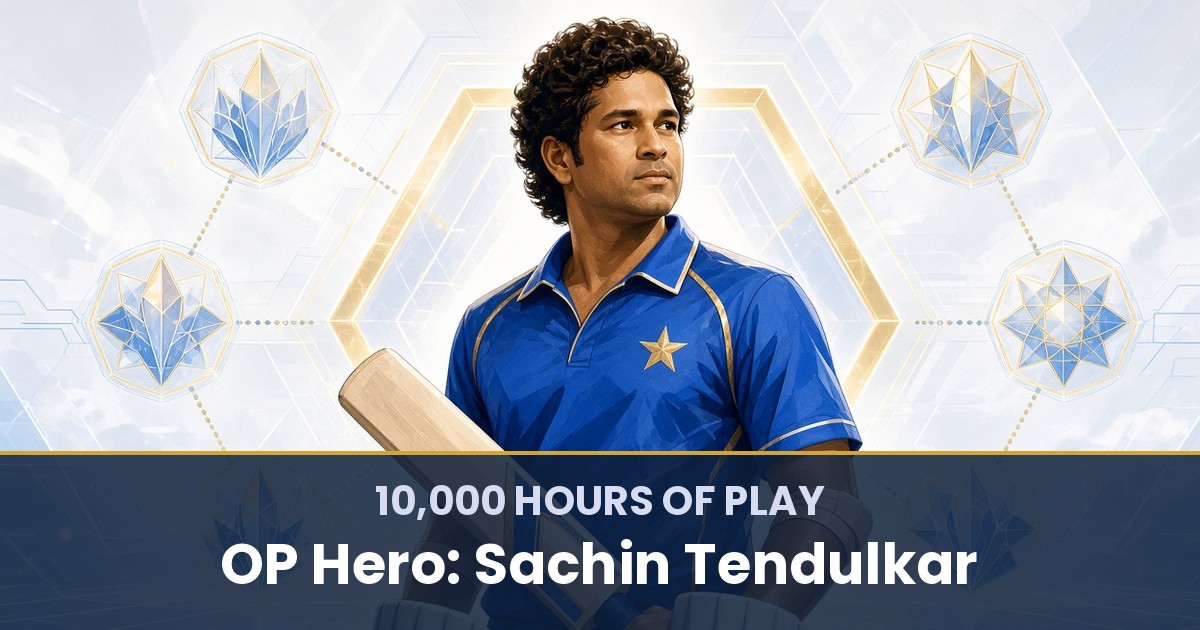


On November 15, 1989, a sixteen-year-old walked out to bat for India against Pakistan in Karachi, facing Pakistan’s frontline fast bowlers away from home.
Twenty-four years later, that teenager retired after his 200th Test match holding 34,357 international runs and 100 international centuries, the highest aggregate the sport has ever recorded.
Between those two dates sits one of the longest runs of sustained mastery that modern sport has recorded. Sachin Tendulkar played 664 international matches, carried the batting hopes of over a billion people, and kept producing into his late thirties while three generations of bowlers tried to solve him.
A career that long and that consistent is never an accident of talent. It is a character build, and running it through the 6-Step framework shows exactly which choices made it work.
⚡ Speed Run Notes
- Tendulkar’s Game was milestone pursuit: carry India’s batting through every era while chasing whichever summit remained unclimbed, from a Test debut at 16 to the 2011 World Cup at 37.
- His innate stats surfaced at 14, when an unbeaten 326 inside a then world-record 664-run school partnership announced the hand-eye coordination and concentration before any international coach touched his game.
- Five canon Skills defined the build: Lich Grind, Ninja Focus, True Aim, Blink, and Revive.
- Ramakant Achrekar’s camp turned an eleven-year-old’s raw gifts into repeatable technique; the 2011 World Cup squad converted his longest-running quest into a title.
- Steal this: he always aimed at the next incomplete milestone, and the scoreboard compounded for 24 years because the target kept renewing.
Table of Contents
About Yu-kai Chou

Yu-kai Chou is the author of 10,000 Hours of Play — the book that treats your life as the most important game you’ll ever build a character in, and gives you the 6-Step framework (Game · Attributes · Role · Skills · Allies · Quests) to play it on purpose. He has spent two decades developing the system through which this post analyzes its OP Hero, and applies it to his own life and to the lives of the people he advises around the world.
Chou’s other framework, the Octalysis Framework, has been applied by LEGO, Microsoft, Porsche, Coca-Cola, Salesforce, and MrBeast, impacting over 1.5 Billion Users. He has taught the methodology at Harvard, Stanford, Yale, Tesla, Google, BCG, and IDEO, and has advised governments in eight nations including Ukraine, the United Kingdom, the Kingdom of Bahrain, Singapore, Taiwan, the Netherlands, Kazakhstan, and South Korea.
His work has been cited by Harvard, Stanford, MIT, Forbes, Wall Street Journal, Wired, US Department of Energy, NIST, NSF, NCBI, US Department of Education, ClinicalTrials.gov, and Google Scholar — with 3,700+ more academic publications. Explore his books here.

Tendulkar’s character sheet pairs a famous Attribute with an unglamorous habit: the hand-eye gift that produced an unbeaten 326 at fourteen, and the twenty years of deliberate net practice that kept the gift sharp across 664 international matches. The lesson I lift from it is to pick targets that renew themselves, because a Quest that ends with one trophy also ends your progression.
Step 1: The Game — What Sachin Tendulkar Was Actually Playing
Plenty of cricketers play to win matches. Tendulkar’s Game ran deeper: keep improving as India’s decisive run-scorer while pursuing the next incomplete milestone.
The mission changed form across chapters while keeping that same engine. As a child in Mumbai, the goal was converting an intense fascination with cricket into elite competence.
As a teenager, it became proving he belonged at Test level, which he did by debuting against Pakistan at 16 and scoring his first Test century against England at 17.
In his prime, the Game turned into becoming the batting resource India could depend on across both Tests and ODIs, year after year, attack after attack.
Late in his career, two unfinished summits defined everything: winning the World Cup and reaching 100 international centuries. He completed both, then closed the save file after his 200th Test in November 2013.
The evidence for this mission is behavioral rather than rhetorical. A 24-year international career, continued production into his late thirties, and a World Cup pursuit that ran until India finally won it in 2011 all trace the same pattern: the win condition kept renewing, so the player kept playing.
Step 2: Attributes — The Innate Stats
Before any coach shaped his technique, four innate stats were already visible on Tendulkar’s character sheet.
Exceptional hand-eye coordination and ball judgment headlined the build. At 14, he scored an unbeaten 326 inside a 664-run school partnership, at the time a world record. Timing and control at that level, at that age, come installed rather than taught.
Competitive obsession ran underneath every other stat on his sheet. He moved from recreational cricket into Ramakant Achrekar’s intensive coaching camp at around age 11, and within five years he was facing Test-match fast bowling.
Composure under accelerated exposure showed the moment the stakes spiked. The stakes spiked early, because his on-ramp was Pakistan’s pace attack at 16, and a year later he became India’s youngest Test centurion.
Concentration over long durations became his signature stat. A total of 51 Test centuries and 15,921 Test runs requires repeated multi-hour execution, innings after innings, for decades.
Tendulkar’s triangle leaned into coordination and concentration, and he built his entire Game on those two corners. If you want to run this audit on yourself, the Talent Triangle Method walks through the exercise.
Step 3: Role(s) — The Character Class Across Chapters
Tendulkar changed class five times, and each Role fed the next.
Chapter one cast him as the prodigy. Mumbai school cricket gave him unusually demanding match volume, and the 1988 school season with its record 664-run partnership established him nationally before he had an international cap.
Chapter two made him the apprentice in Achrekar’s nets. Under Achrekar’s structured coaching from around age 11, raw gifts became repeatable technique.
Chapter three sent him out as the teenage challenger. The 1989 debut against Pakistan and the 1990 century against England turned a domestic phenomenon into a credible international run-maker.
Chapter four settled him into the frontline batter. For the better part of two decades he served as India’s primary run accumulator in both formats, finishing as the leading run-scorer in Tests and ODIs alike.
Chapter five turned him into the senior statesman and legacy builder. The elder of the dressing room kept scoring heavily, anchored the 2011 World Cup campaign, and finished as the first player to reach 100 international centuries and 200 Tests.
The sequencing matters as much as any single chapter, because he never abandoned the core batting class. Each new Role stacked a capability onto the same foundation, which is why his experience kept carrying forward instead of resetting with every change.
Step 4: Skills — The Real-Life Game Skills Sachin Tendulkar Mastered
Attributes come installed; Skills get earned through reps. Tendulkar’s five documented Skills cluster around one theme, which is converting obsession into repeatable output.
Lich Grind (Warlock) is the Skill of intense, secluded work periods. Where the Lich Pact pushes seclusion to the extreme of restructuring sleep itself, Tendulkar’s grind was humbler and far longer: every available hour in Achrekar’s nets while his classmates played for fun. The unbeaten 326 at age 14 gave the public its first receipt for thousands of those private hours.
Ninja Focus (Rogue): sustained discipline and focus on tasks. Fifty-one Test centuries means fifty-one separate occasions of batting for hours without a lapse large enough to end the innings. No stat in his career depends more on this Skill.
True Aim (Ranger): locking onto a precise target and committing. Tendulkar’s late career was goal-setting made visible, with the World Cup and the 100-century mark operating as explicit, named objectives he kept pursuing until each fell.
Blink (Rogue): quickly adapting between roles and contexts. He shifted between long-form accumulation and one-day acceleration for 24 years, and in 2010 he became the first player to score 200 in a men’s ODI, at an age when most batters have already retired from the shorter format.
Revive (Paladin): recovering from failures and taking new action toward the next Quest. The most public test came at the very end, in the long gap between his 99th and 100th centuries, covered below in Step 6.
Ichiro Suzuki built his baseball career on the same Ninja Focus discipline, grinding one swing for decades the way Tendulkar ground one cover drive. On the Skills Spectrum, both men sit at the deep-specialist end, pouring every point into one discipline.
Step 5: Allies — The People Who Multiplied Sachin Tendulkar
No batter, however prolific, scores a single run outside a team context. Tendulkar’s alliance roster did specific, traceable work.
Ramakant Achrekar was the foundational mentor of the whole build. Tendulkar entered his camp at around age 11, and the structured environment Achrekar built converted early ability into the repeatable technique that produced school records within three years.
The Mumbai school-cricket system served as his developmental platform. It gave him demanding match volume no private coach could simulate, and the 664-run partnership it staged made him a national name before his international debut.
India’s Test and ODI teams were the sustained operating system. Playing 664 international matches across 24 years required selectors, captains, and teammates who kept building around him through every era of his career.
The 2011 World Cup squad acted as the collective multiplier. Tendulkar was India’s leading run-scorer in the tournament, and the team converted his longest-running personal quest into a shared title.
Yao Ming carried the same scale of national expectation in basketball, and he survived it the same way Tendulkar did, by letting allies absorb the weight that one player never could.
Step 6: Quests — The Milestones That Shaped the Saga
Quest 1 was breaking into India as a teenager (1989). He debuted against Pakistan on 15 November 1989, aged 16, converting record-setting junior performance into international status against a seasoned Test attack.
Quest 2 established him in Test cricket (1990). His first Test century, against England at 17, made him India’s youngest Test centurion and transformed a promising debutant into a fixture.
Quest 3 ran for two decades: become the format’s statistical leader. He finished with 15,921 Test runs and 18,426 ODI runs, the leading totals in both formats, a quest measured in durability rather than single performances.
Quest 4 broke the one-day ceiling (2010). The first double century in men’s ODI history arrived in his 21st year as an international, proof the build was still gaining capabilities late in the game.
Quest 5 was the World Cup (2011). After multiple failed campaigns across two decades, India won it with the 37-year-old Tendulkar as the team’s leading run-scorer in the tournament.
Quest 6 brought the setback and the finish (2011–2012). He reached 99 international centuries and then the hundredth refused to come, through innings after innings of global scrutiny, until it finally arrived against Bangladesh in March 2012. The wait was the hardest test of his Revive (Paladin) Skill, and he passed it in public before retiring in November 2013, after his 200th Test, with every named objective on the quest log complete.
What You Can Steal From Sachin Tendulkar’s Build
First, structure your Game around milestones that replace themselves. Tendulkar always had another summit queued behind the one he had just reached, so his motivation never ran out of road across 24 years.
Second, buy yourself match volume as early as you can. The Mumbai school system gave him more real reps by 16 than most players log by 25, and volume is what converts innate stats into Skills.
Third, keep your core class while adding chapters. Every Role change stacked onto the same batting foundation, so experience carried forward instead of resetting.
Fourth, let allies carry the weight your build cannot. A coach, a school system, and ten teammates each covered a slot that raw talent alone would have left empty, and any long build you attempt will need the same kind of roster behind it.
Where this framework comes from

Want the full system this profile is built on?
Every OP Hero piece runs through the same 6-Step framework from 10,000 Hours of Play: Unlock Your Real-Life Legendary Success. The book covers the full system, walks through Yu-kai’s own life run as the first applied case study, and gives you the worksheets to audit your own build.
Related Reading
- All OP Hero Profiles (the full hub)
- 10,000 Hours of Play by OP Hero: Ichiro Suzuki
- 10,000 Hours of Play by OP Hero: Yao Ming
- 10,000 Hours of Play by OP Hero: Jamsetji Tata
- What’s Your Edge Strength? The Talent Triangle Method
- The Skills Spectrum: Specialist, Dabbler, or Master?