
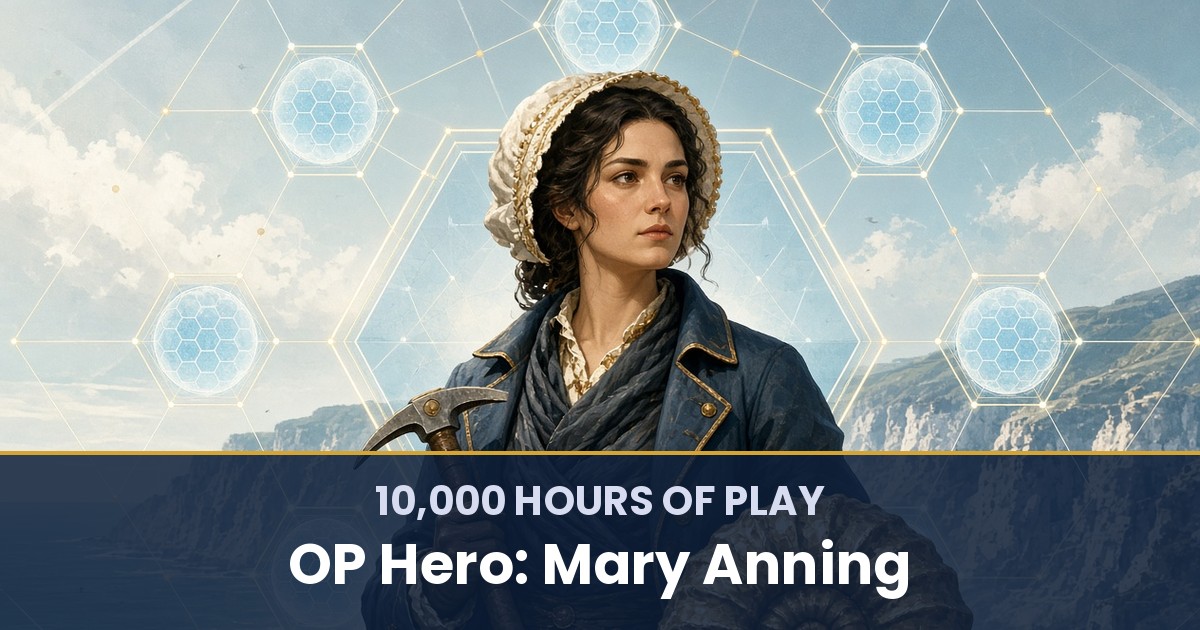


Around 1811, on the storm-beaten coast of Lyme Regis, a girl of about twelve began uncovering a skeleton roughly five metres long. She would spend close to a year working it out of the rock.
The animal she exposed was an ichthyosaur, a marine reptile that science barely had words for yet. Her name was Mary Anning, and she had no formal training, no wealthy patron, and no institution behind her.
Over the next three and a half decades she pulled discovery after discovery from those cliffs: the plesiosaur that anchored a new species description, one of the first pterosaurs reported outside Germany, and the field evidence behind an entirely new category of fossil.
Run her life through the 6-Step framework and you get something more useful than a story about luck on a beach. You get a repeatable build, with choices you can copy at every one of the six Steps.
⚡ Speed Run Notes
- Anning’s Game was working the collapsing cliffs of Lyme Regis into the ground that produced landmark ichthyosaur, plesiosaur, and pterosaur finds, while making a living from it for close to four decades.
- Her build ran on pattern recognition, anomaly-hunting curiosity, and a working tolerance for collapsing cliffs and storm weather.
- Five canon Skills defined the run: True Sight, Track Treasure, Lich Grind, Arcane Wisdom, and Courageous Heart.
- She supplied the specimens and field insights behind landmark work on ichthyosaurs, plesiosaurs, and coprolites, while the Geological Society stayed closed to women her entire life.
- Steal this: your most valuable territory may be the dangerous ground everyone else avoids. Anning owned the storm season.
Table of Contents
About Yu-kai Chou

Yu-kai Chou is the author of 10,000 Hours of Play — the book that treats your life as the most important game you’ll ever build a character in, and gives you the 6-Step framework (Game · Attributes · Role · Skills · Allies · Quests) to play it on purpose. He has spent two decades developing the system through which this post analyzes its OP Hero, and applies it to his own life and to the lives of the people he advises around the world.
Chou’s other framework, the Octalysis Framework, has been applied by LEGO, Microsoft, Porsche, Coca-Cola, Salesforce, and MrBeast, impacting over 1.5 Billion Users. He has taught the methodology at Harvard, Stanford, Yale, Tesla, Google, BCG, and IDEO, and has advised governments in eight nations including Ukraine, the United Kingdom, the Kingdom of Bahrain, Singapore, Taiwan, the Netherlands, Kazakhstan, and South Korea.
His work has been cited by Harvard, Stanford, MIT, Forbes, Wall Street Journal, Wired, US Department of Energy, NIST, NSF, NCBI, US Department of Education, ClinicalTrials.gov, and Google Scholar — with 3,700+ more academic publications. Explore his books here.

Mary Anning’s build fascinates me for how little of it depended on permission; compounding field hours did the work that credentials usually claim. The pairing worth training from her character sheet is True Sight plus Track Treasure: notice what others walk past, in places others refuse to go.
Step 1: The Game — What Mary Anning Was Actually Playing
Strip away the bonnets-and-beaches imagery and Anning’s Game becomes concrete: find scientifically important organisms in the unstable cliffs around Lyme Regis, get them out of the rock intact, and work out what they actually were.
That one Game held three objectives at once.
The first objective was survival. After her father died, fossil sales kept the Anning family fed, so every specimen carried rent and bread inside it.
The second was discovery. She kept going after the rare, anatomically informative finds: the complete skeletons, the strange outliers, the specimens that could teach science something new.
The third was interpretation. When she noticed fish bones and scales inside the lumpy “bezoar stones” she kept finding, she held the field evidence that these were fossilized droppings, an observation William Buckland would publish in 1829 under a new name: coprolites.
Plenty of collectors stopped at the first objective. Anning kept all three running for most of her life, and that stacking is what makes her Game worth studying step by step.
Step 2: Attributes — The Innate Stats
Attributes are the stats you spawn with. Training sharpens them, but nobody teaches them to you. Anning’s character sheet shows at least four.
Persistence under physical risk came first. The cliffs she worked could collapse without warning, and storm weather, when the hunting was best, was also when the ground was most treacherous. She kept returning anyway, year after year.
Pattern recognition came next. She noticed regularities that formally educated naturalists walked past, like the link between those lumpy stones and the gut contents of the ichthyosaurs she excavated.
Visual-spatial reasoning ran underneath everything. Rebuilding a fragmented skeleton into a coherent animal is three-dimensional puzzle-solving at an expert level, and her nearly complete ichthyosaur and plesiosaur preparations are the proof she had it.
And then there was curiosity aimed at anomalies. She pursued the weird finds, including ones with no obvious buyer, because the weird finds were where the knowledge lived.
If you want to run this audit on yourself, the Talent Triangle Method walks you through it: separating what you were born with from what you trained, so you stop competing on stats you do not have.
Step 3: Role(s) — The Character Class Across Chapters
In RPG terms, Anning multi-classed, and each chapter of her life added a class instead of replacing one.
She began as a child gatherer around 1809 to 1811, searching the foreshore with her brother Joseph and selling curiosities to visitors. After the first ichthyosaur, she leveled into a field excavator who could read fresh exposures and time the storm seasons.
Then came the technician class. A skeleton has little scientific value as a jumble of fragments, and her careful preparation work is what made the finds legible to anatomists.
Layered on top were two more roles: independent dealer, the commercial class that financed everything else, and informal comparative anatomist, the class that let her discuss structure with the leading geologists of her era.
Compare that stack with Charles Darwin’s build. He could afford to play gentleman naturalist first and theorist second. Anning had to be merchant, laborer, technician, and scientist in the same body, every single day.
The lesson for your own Role selection is that your class covers more than your job title: it is the full stack of functions you actually perform, and you can expand that stack deliberately.
Step 4: Skills — The Real-Life Game Skills Mary Anning Mastered
Attributes set the ceiling, and Skills are what you grind. Five canon Skills show up across Anning’s entire run.
True Sight (Ranger) — observing keen details others miss. The coprolite breakthrough started as pure noticing: fish remains inside stones that everyone else treated as curiosities. She had made that connection in the field by 1824, five years before Buckland’s 1829 paper.
Track Treasure (Ranger) — identifying hidden opportunities others overlook. Anning treated storms as opportunity windows. Fresh slides exposed new rock, so the worst weather marked the best hunting, and she built her prospecting rhythm around that inversion.
Lich Grind (Warlock) — intense, secluded work periods. The first ichthyosaur took about a year of patient excavation by a girl of roughly twelve, much of it alone on a cold foreshore chiseling rock.
Arcane Wisdom (Mage) — absorbing wide information and synthesizing clear outputs. With no formal scientific schooling, she taught herself enough geology and anatomy that her 1829 letter to Charlotte Murchison could list several ichthyosaur forms with working precision.
Courageous Heart (Paladin) — charging into uncomfortable and hostile territory. For Anning that meant literal cliff faces, and it also meant the social territory of a science that offered her no institutional seat.
On the Skills Spectrum, she sat at the Master end of fossil fieldwork: one domain, compounding depth, decades of reps.
Step 5: Allies — The People Who Multiplied Mary Anning
Nobody completes a run like this solo, and Anning’s ally roster shaped everything about hers.
Joseph Anning, her brother, shared in the find that started it all: the first major ichthyosaur, located when Mary was about twelve.
William Buckland turned her bezoar-stone evidence into the 1829 paper that named coprolites, carrying her field inference into the scientific record.
William Conybeare used her December 1823 plesiosaur, with its strange long neck and four flippers, to complete the description of Plesiosaurus dolichodeirus. Henry De la Beche had earlier worked with Conybeare on the 1821 analysis of ichthyosaur material that Anning and others collected.
Charlotte Murchison and the network around her kept Anning’s expertise circulating by letter; the Geological Society still preserves Anning’s 1829 letter in its archive.
These allies amplified her reach into institutions she could not enter, and the same arrangement routed much of the published credit to them. An alliance can multiply you and shortchange you at the same time.
Audit your own alliances for both effects. The amplification is loud, and the cost is quiet.
Step 6: Quests — The Milestones That Shaped the Saga
Quests are the milestones that give a Game its structure. Six define Anning’s saga.
The first ichthyosaur, around 1811 to 1812. Found with Joseph and excavated by Mary over about a year, the roughly five-metre skeleton established her reputation and fed the early scientific study of ichthyosaurs.
The iteration run, 1815 to 1819. She recovered more nearly complete ichthyosaurs of different sizes, handing science comparative material instead of one freak specimen.
The plesiosaur, December 1823. Nearly complete, anatomically bizarre, and decisive for recognizing a new kind of marine reptile.
The pterosaur, 1828. It was the first reported from the Lyme Regis area and, by standard accounts, the first found outside Germany. Her scope expanded from the sea to the air.
The coprolite investigation, roughly 1824 to 1829. Her contents-analysis of the bezoar stones became the field evidence for a whole new category of trace fossil.
Then there is the quest she could not complete: institutional recognition. The Geological Society of London admitted no women during her lifetime, and her discoveries often entered science under other people’s names. That setback was structural, and it belongs in the record the same way a failed raid belongs in a guild’s log.
Her response is the actionable part. She kept shipping discoveries anyway: the setback changed the route, and the player kept playing.
What You Can Steal From Mary Anning’s Build
Three things are worth lifting from this character sheet.
First, uncontested ground compounds. Because nobody fought her for those cliffs, every year of field hours stacked on the last without a rival resetting the board. Your version might be an unglamorous market, a dataset nobody wants to clean, or a problem everyone agrees is important and nobody wants to touch.
Second, pair extraction with interpretation. Anning found fossils and then worked out what they meant, and the interpretation is what made her finds matter to science. Whatever you produce, build the Skill of explaining why it matters.
Third, negotiate credit early. In her century the naming rights traveled with whoever held the institutional pen, and by the time that became obvious it was too late to claim them back. Settle who gets credited for what while an alliance is still forming, because the terms only harden from there.
Mary Anning spent her life pulling monsters out of a cliff with cold hands, and the specimens she prepared became reference material for a science that was still naming itself. The cliffs near you are whatever everyone else has decided is too hard, and that is where the skeletons are.
Where this framework comes from

Want the full system this profile is built on?
Every OP Hero piece runs through the same 6-Step framework from 10,000 Hours of Play: Unlock Your Real-Life Legendary Success. The book covers the full system, walks through Yu-kai’s own life run as the first applied case study, and gives you the worksheets to audit your own build.
Related Reading
- All OP Hero Profiles: the full roster
- 10,000 Hours of Play by OP Hero: Lise Meitner
- 10,000 Hours of Play by OP Hero: Chien-Shiung Wu
- 10,000 Hours of Play by OP Hero: Florence Nightingale
- 10,000 Hours of Play by OP Hero: Jane Goodall
- The OP Talent Triangle Method
- Real-Life Game Skill: The Lich Pact