
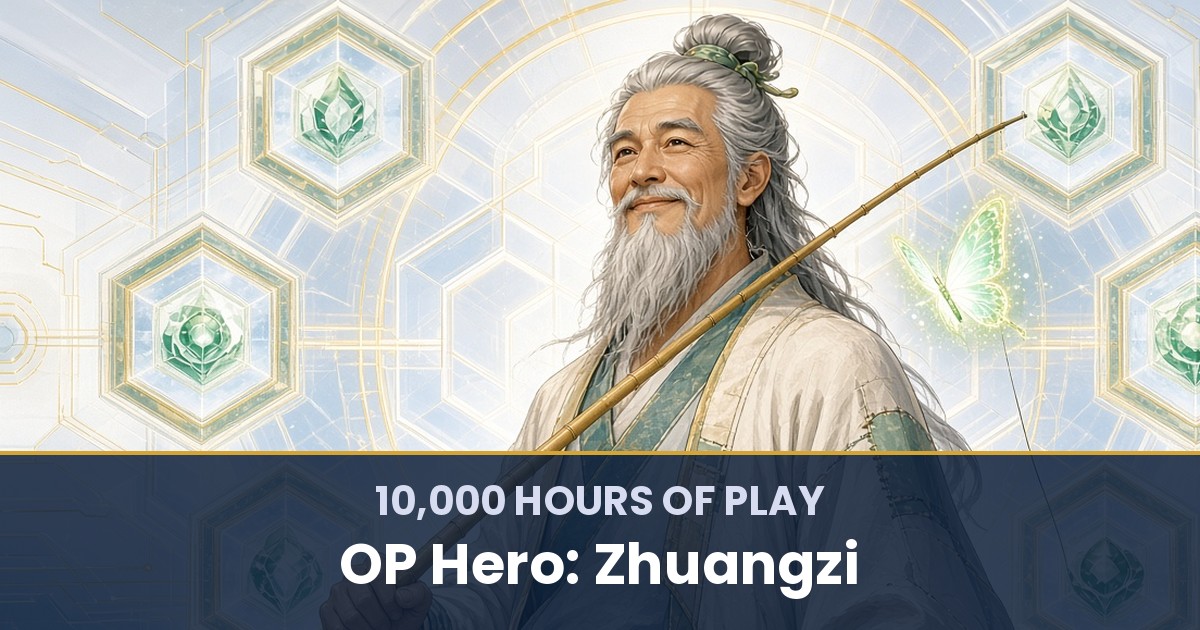


Sometime in the late fourth century BCE, two envoys from the king of Chu walked up to a man fishing on the Pu River and offered him the most powerful administrative post in the kingdom.
The man kept his line in the water. He asked the envoys about the sacred tortoise the king kept enshrined: would that tortoise rather be venerated as a dead shell, or alive and dragging its tail through the mud?
The envoys admitted it would rather be alive. So the fisherman told them he would keep dragging his tail in the mud, and the premiership of Chu went unfilled that day.
That fisherman was Zhuangzi. This profile breaks down his build through the 6 Steps: the game he was really playing, the stats he was born with, and the skills that let a poor clerk from a small town out-position kings.
⚡ Speed Run Notes
- Zhuangzi’s game was never rank or wealth. He played to stay unconfined, and he treated every prestige offer as a trap dressed in embroidery.
- His defining move was declining the Chu premiership. The Shiji tells it with a sacrificial ox; the Zhuangzi text tells it with a sacred tortoise. Same refusal, twice transmitted.
- His core skills were refusal, perspective inversion, and parable-telling. The butterfly dream and Cook Ding are skill demonstrations, with a philosophy attached.
- His one irreplaceable ally was his debate rival Hui Shi, the logician who pressure-tested every argument before posterity got it.
- The build ran on poverty the whole time. Patched clothes and borrowed grain never stopped it, because he defined failure as losing your way, never as lacking money.
Table of Contents
- Step 1: The Game Zhuangzi Was Actually Playing
- Step 2: Attributes, the Innate Stats
- Step 3: Role(s), the Character Class Across Chapters
- Step 4: The Real-Life Game Skills Zhuangzi Mastered
- Step 5: The Allies Who Multiplied Zhuangzi
- Step 6: The Quests That Shaped the Saga
- What You Can Steal From Zhuangzi’s Build
- Where this framework comes from
- Related Reading
About Yu-kai Chou

Yu-kai Chou is the author of 10,000 Hours of Play — the book that treats your life as the most important game you’ll ever build a character in, and gives you the 6-Step framework (Game · Attributes · Role · Skills · Allies · Quests) to play it on purpose. He has spent two decades developing the system through which this post analyzes its OP Hero, and applies it to his own life and to the lives of the people he advises around the world.
Chou’s other framework, the Octalysis Framework, has been applied by LEGO, Microsoft, Porsche, Coca-Cola, Salesforce, and MrBeast, impacting over 1.5 Billion Users. He has taught the methodology at Harvard, Stanford, Yale, Tesla, Google, BCG, and IDEO, and has advised governments in eight nations including Ukraine, the United Kingdom, the Kingdom of Bahrain, Singapore, Taiwan, the Netherlands, Kazakhstan, and South Korea.
His work has been cited by Harvard, Stanford, MIT, Forbes, Wall Street Journal, Wired, US Department of Energy, NIST, NSF, NCBI, US Department of Education, ClinicalTrials.gov, and Google Scholar — with 3,700+ more academic publications. Explore his books here.

The part of Zhuangzi’s build I keep coming back to is the alliance ledger: one rival he never converted and never dismissed, who pressure-tested every argument he is now remembered by. Audit your own roster for that person, and treat them as a core stat rather than a social accident.
Step 1: The Game — What Zhuangzi Was Actually Playing
Most ambitious men of the Warring States period were playing the court game: climb the administrative ladder, attach yourself to a king, and convert loyalty into rank. Zhuangzi looked at that game and declined to install it.
His game, visible across every chapter attributed to him, was to stay unconfined. He wanted freedom from political coercion, from social scorekeeping, and from the rigid categories that make people easy to control.
Sima Qian’s Shiji records him as a minor official in Meng, in the state of Song, who turned down the chief ministership of Chu. The historian preserved his reasoning: a sacrificial ox gets fattened and dressed in embroidered trappings, and then it gets led into the temple.
By the time the ox understands the trade, it cannot return to being an uncared-for calf. Zhuangzi saw office as that exact bargain, with better catering.
His win condition was a mode of living where confinement loses its grip: suspend fixed distinctions, follow the grain of reality instead of forcing it, and accept transformation, death included. Everything else in this profile is the toolkit he built to win that game.
Step 2: Attributes — The Innate Stats
Four stats show up so consistently across the record that they read as innate rather than learned.
Immunity to prestige incentives. The Shiji scene is the cleanest evidence: offered the top job in Chu while poor, he declined without hesitation. Status rewards simply did not register as rewards in his motivation system.
Structural perception. His favorite image of mastery, the butcher Cook Ding, works by seeing the hidden spaces and natural seams inside an ox. Zhuangzi noticed the openings other people hacked straight through.
Perspective-shifting imagination. The butterfly dream dissolves the boundary between waking identity and dreamed identity in four sentences.
Tolerance for ambiguity. He ends the butterfly story without answering it. Where other thinkers rushed to a verdict, he could hold an open question indefinitely and let it keep teaching.
If you run yourself through the Talent Triangle Method, the exercise is the same one Zhuangzi aced: find the traits that were already there before anyone trained you, and build the game around those.
His attributes pointed away from accumulation and toward perception. He built accordingly.
Step 3: Role(s) — The Character Class Across Chapters
Zhuangzi’s role evolved across four distinct chapters of life, each one a step further from the standard career tree.
The clerk. The Shiji has him begin as a minor official in Meng. He started inside the administrative system, which means his later refusals were informed choices by someone who had seen the machine from the inside.
The relativist diagnostician. In the Inner Chapters he examines how language and standpoint manufacture disputes, taking apart the fixed oppositions of right and wrong that his contemporaries fought over.
The recusant sage. After the Chu refusal, his public role became the man who would not be hired. That stance itself did philosophical work: it proved his doctrine was priced in real opportunity cost.
The parable master. His mature role was storyteller. Butchers, fish, tortoises, and dreams carried his arguments further than treatises could, and they still do twenty-three centuries later.
The lineage he worked within is usually traced back to Laozi, whose build also treated withdrawal as a power move. Zhuangzi took that inheritance and gave it characters, jokes, and plot.
One caution for your own Step 3: the text we have is composite, with 33 chapters assembled over centuries. His posthumous role as “founder of a school” was assigned by editors, which is itself a lesson in how little control you keep over your late-game class designation.
Step 4: Skills — The Real-Life Game Skills Zhuangzi Mastered
Mapped against the Real-Life Game Skills system, Zhuangzi’s loadout centers on five canon Skills.
Divine Shield (Paladin): say no, regardless of how persuasive others are. The Chu premiership was the most persuasive offer his world could construct, delivered with gifts by royal envoys, and he declined it while fishing.
Vision of the Wild (Druid): see things from multiple perspectives. The butterfly dream is a perspective inversion so complete that the reader finishes unsure which standpoint is primary, which was precisely the training effect he wanted.
Loremaster (Druid): weave compelling stories. Asked for a grain loan and fobbed off with a future promise, he answered with the parable of a fish dying in a wheel rut that needs a cup of water now, and the parable did the arguing for him.
Instinctual Pathfinding (Ranger): trust the practiced gut to find the right move. Cook Ding’s blade stayed sharp for nineteen years because he followed the ox’s natural openings, while ordinary butchers who hacked through bone changed knives monthly. Zhuangzi held that scene up as his entire theory of skill.
Spirit of Nature (Druid): meaning-making under stress. When his wife died, he grieved, then reframed her death as one more turn in the seasonal cycle of transformations, and Hui Shi found him drumming on a basin and singing.
Where do these sit on the Skills Spectrum? Zhuangzi was no dabbler. He specialized narrowly in perception and refusal, then compounded both for a lifetime.
Step 5: Allies — The People Who Multiplied Zhuangzi
For a philosopher of detachment, Zhuangzi depended on one relationship to a degree the text openly admits.
Hui Shi, the rival who sharpened him. Hui Shi was a logician and statesman, and the Zhuangzi stages him as the recurring opponent across its most famous debates. Every signature argument got pressure-tested against a mind that conceded nothing.
After Hui Shi died, Zhuangzi stopped at his tomb and told his followers about a carpenter named Shi, who could swing an axe hard enough to shave a speck of plaster off his partner’s nose without drawing blood. When the partner died, the carpenter retired the feat, because the trick lived in the pairing.
Since Hui Shi’s death, Zhuangzi said, he had no one left to match wits with.
The Chu court, as anti-mentor. Allies are not only friends. The king’s invitation gave Zhuangzi the concrete test case against which he defined freedom, and the envoys unknowingly handed him the refusal that both the Shiji and the Autumn Floods chapter went on to preserve.
The exemplars he invented. Cook Ding and the other craftsmen of the text functioned as imagined allies: character builds he could point to when an abstract claim needed hands.
Contrast this alliance structure with Confucius, whose build ran on a large devoted student network. Zhuangzi ran the minimum viable alliance: one worthy opponent, fully engaged.
Step 6: Quests — The Milestones That Shaped the Saga
Quest 1: Serve inside the system. The Shiji’s brief notice of his clerkship in Meng matters because it front-loads credibility. His exit from ambition came after proximity to it, which is why it persuaded.
Quest 2: Refuse the premiership. The defining milestone survives in two tellings. Sima Qian’s version runs on the sacrificial ox; the Autumn Floods chapter stages it at the Pu River with the sacred tortoise.
Two transmissions of one refusal tell you how central the moment was to everyone who preserved his memory.
Quest 3: Publish the dream. The butterfly passage in the second chapter compresses his entire epistemology into a scene a child can retell. It ends, deliberately, without an answer.
Quest 4: Survive the setback years. This build spent most of its run underfunded. He borrowed grain from the Marquis of Jianhe and stood before King Hui of Wei in patched, tied-together clothes, telling the king that poverty is lacking resources while failure is losing your way.
He was poor on purpose, and he never conceded the second condition.
Quest 5: Bury the rival. Hui Shi’s death was the loss the build could not route around. The carpenter story at the tomb records a real defeat: some capabilities retire when a specific person leaves the world.
Quest 6: The involuntary endgame. A text assembled long after his death turned a recusant clerk into the named master of 33 chapters, a quest that completed itself centuries after he stopped playing.
What You Can Steal From Zhuangzi’s Build
Price the whole bundle. Every opportunity arrives with a controller attached. Before accepting, run his ox test: ask what the fattening is for, and whether you can still walk away once you know.
Keep one true sparring partner. Zhuangzi ran his whole intellectual life on a single deep alliance. If your Step 5 roster has a hundred contacts and no Hui Shi, you are under-allied where it counts.
Follow the seams. Cook Ding’s knife outlasted the hackers’ blades nineteen years to one month. When a task keeps blunting you, the lesson is rarely to swing harder; study the ox until the openings appear.
Define failure yourself. Patched clothes in front of a king did not embarrass him, because his loss condition was losing the way rather than losing money. Write your own loss condition down before someone else’s definition gets installed by default.
Twenty-three centuries on, the man who refused the premiership is remembered, and the ministers who accepted it are not. That asymmetry is the final argument of his build.
Where this framework comes from

Want the full system this profile is built on?
Every OP Hero piece runs through the same 6-Step framework from 10,000 Hours of Play: Unlock Your Real-Life Legendary Success. The book covers the full system, walks through Yu-kai’s own life run as the first applied case study, and gives you the worksheets to audit your own build.
Related Reading
- OP Hero Profiles: 100+ Legendary Lives as RPG Builds
- Laozi: The 10,000 Hours of Play OP Hero
- Wang Yangming OP Hero: 10,000 Hours of Play
- Epictetus OP Hero: 10,000 Hours of Play Profile
- Søren Kierkegaard OP Hero: 10,000 Hours of Play Profile
- What’s Your Edge Strength? The Talent Triangle Method