
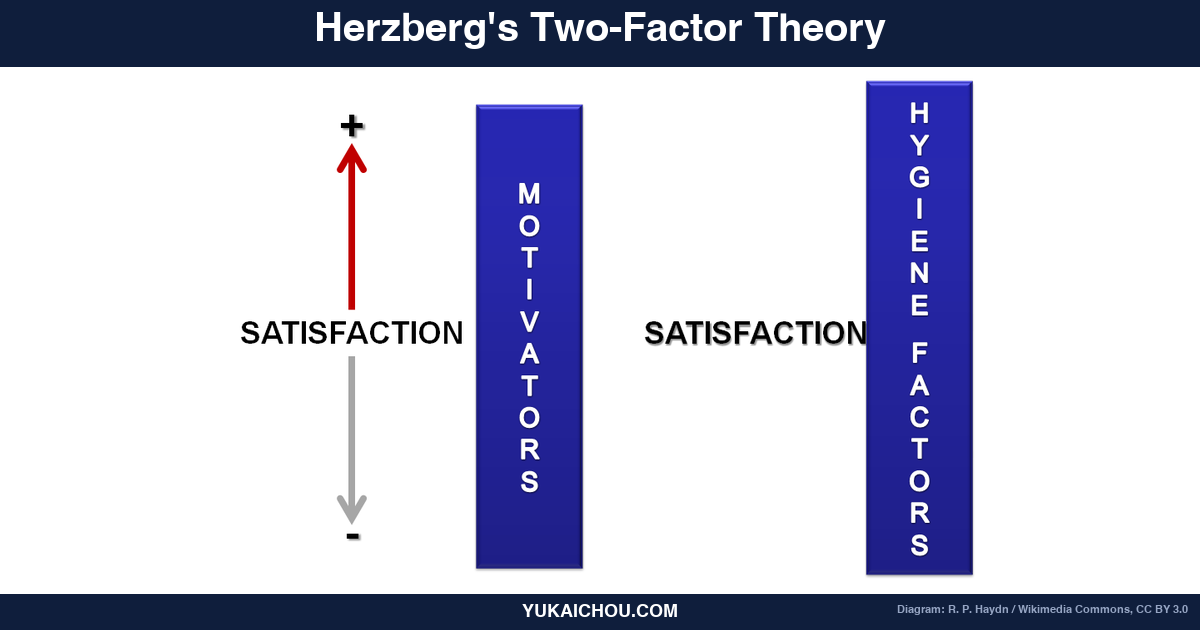

Short answer: Frederick Herzberg’s Two-Factor Theory (1959) says satisfaction and dissatisfaction at work are two separate scales, not opposite ends of one.
Motivators such as achievement, recognition, the work itself, responsibility, and growth create satisfaction. Hygiene factors such as policy, supervision, working conditions, and salary only prevent dissatisfaction.
Above a fair threshold, more pay mostly prevents resentment rather than creating engagement. To motivate, enrich the work itself instead of just adding more of it.
Pay a demotivated employee more and you do not get a motivated employee. You get a better-paid demotivated employee. Frederick Herzberg proved this in 1959 and most managers still refuse to believe it — which is why so much money gets spent on workplaces, products, and loyalty programs that fix the wrong half of the problem.
The Two-Factor Theory says satisfaction and dissatisfaction are not opposite ends of one ruler. They run on two separate rulers. One ruler — the hygiene ruler — measures whether you are annoyed. The other ruler — the motivator ruler — measures whether you are engaged. Fixing annoyance does not create engagement, and every UX designer, HR director, and gamification architect who has ever shipped a “the login page is slicker now, why did nobody celebrate” experience has collided with this exact fact.
This post is the S-Tier designer’s guide to the framework that turned that insight into a research program, a generation of HR policy, and — whether Herzberg intended it or not — the structural logic behind why the Octalysis Framework separates White-Hat Core Drives from Black-Hat Core Drives. By the end you will know what Herzberg got right, the three ways his 1959 study is fairly criticised, why the theory still keeps showing up in every serious engagement design, and exactly how I use it alongside Octalysis when advising teams at MrBeast, LEGO, Microsoft, Porsche, Coca-Cola, Tesla, and the governments of countries trying to motivate millions of citizens at once.
Speed Run Notes
- Satisfaction and dissatisfaction are on two separate rulers, not one. Herzberg’s 1959 Pittsburgh study of 203 accountants and engineers found the things people cited as sources of satisfaction (achievement, recognition, work itself, responsibility, advancement, growth) were almost never the same things they cited as sources of dissatisfaction (company policy, supervision, relationships, working conditions, salary, security). Fixing one does not move the other.
- Hygiene factors buy you the right to keep playing; motivators are what makes the game worth playing. Clean bathrooms, fair pay, and a competent boss get you to “not actively miserable.” Meaningful work, real responsibility, and visible growth are what get you to “engaged.” Mixing the two up is the single most common motivation-design mistake I see in the wild.
- The theory maps almost one-for-one onto the Octalysis White-Hat / Black-Hat split. Motivators behave like White-Hat Core Drives — Epic Meaning, Development, Creativity, Ownership. Hygiene factors behave like the Black-Hat floor — Scarcity, Unpredictability, Loss & Avoidance — where absence drives urgent action but presence produces only relief, not joy.
- Salary is a hygiene factor, not a motivator. This is the finding that still breaks executive brains. Pay raises prevent resentment; they rarely create engagement. The data has been replicated dozens of times since 1959 — see Rynes, Gerhart & Minette 2004 and the meta-analyses that followed — yet compensation consultants keep selling the opposite story because they have nothing else to sell.
- Herzberg’s method is fairly criticised for the critical-incident interview technique. Asking people “tell me about a time you felt great at work” invites self-serving attribution — successes get attributed to internal factors, failures to external ones. The two-factor split may be partly an artifact of how humans narrate themselves, not purely a property of motivation.
- The method-bound critique does not kill the prescription. Even if the clean split is softer than Herzberg claimed, the practical advice — “you cannot bribe your way out of a boring job, and you cannot make a fair wage feel meaningful by calling the break room a lounge” — has held up in 65+ years of workplace research and every piece of engagement data I have seen on the consulting side.
- Pure motivation design without hygiene foundation is a Jenga tower. Gamified recognition, badges, points, streaks — the White-Hat stack — only works on a foundation of hygiene. If the product is slow, the login fails, or the refund policy is hostile, no amount of celebratory confetti will hold a user. Ship hygiene first, then ship motivators.
- The practical rule of thumb: audit hygiene before you design motivation. If the basics are broken, motivation work will deliver a fraction of its potential. Once hygiene is good, motivation work is where almost all the ROI lives. This is why the best engagement consulting always starts with a friction audit, not a gamification brainstorm.
- Herzberg’s deepest contribution is the idea of “job enrichment.” Not “job enlargement” (more of the same tasks) but job enrichment — giving workers vertical loading: planning, deciding, evaluating their own work. Enrichment is the proto-autonomy concept that later flowered into Self-Determination Theory and the Autonomy-Mastery-Purpose stack every modern management book recycles.
- If you only remember one sentence: hygiene is “why people leave,” motivation is “why people stay.” Every engagement decision you make — in a product, in an HR program, in a loyalty arcade — should be tagged with which of the two problems it is actually solving. Mis-tagging a motivator as a hygiene fix (or vice versa) is how budgets disappear without moving the metric.
In This Article
- What Is the Two-Factor Theory
- The Core Findings of Herzberg’s 1959 Study
- What Herzberg Got Right
- Where Two-Factor Theory Falls Apart
- The Brain on Two-Factor Theory
- Two-Factor Theory vs Other Motivation Theories
- Two-Factor Theory in the Real World
- The Elephant in the Room
- How to Apply Two-Factor Theory with the Octalysis Framework
- Practical Steps to Apply Two-Factor Theory
- Frequently Asked Questions
Author Credibility: Yu-kai Chou

Yu-kai Chou created the Octalysis Framework after studying gamification since 2003 — years before the term entered mainstream vocabulary. As a Human-Systems Architect & Behavioral Designer, his framework has been applied by LEGO, Microsoft, Porsche, Coca-Cola, Salesforce, and MrBeast, impacting over 1.5 Billion Users.
Chou has taught the Octalysis methodology at Harvard, Stanford, Yale, Tesla, Google, BCG, and IDEO.
His work has been cited by Harvard, Stanford, MIT, Forbes, Wall Street Journal, Wired, US Department of Energy, NIST, NSF, NCBI, US Department of Education, ClinicalTrials.gov, and Google Scholar — with 3,700+ more academic publications. Explore his books here.

What Is the Two-Factor Theory
The Two-Factor Theory — also called the Motivation-Hygiene Theory — was introduced by American psychologist Frederick Herzberg in his 1959 book The Motivation to Work, co-authored with Bernard Mausner and Barbara Snyderman. Herzberg’s central claim is deceptively simple and still, in 2026, profoundly counter-intuitive to most managers: satisfaction and dissatisfaction are not opposite ends of the same continuum. They are two independent dimensions, each driven by a different set of factors.
Before Herzberg, the dominant assumption — implicit in Frederick Taylor’s scientific management and explicit in most HR practice of the 1950s — was that happiness at work ran along a single line from “very unhappy” through “neutral” to “very happy,” and that management’s job was to move people to the right along that line by any lever available: more money, better conditions, friendlier supervisors. Herzberg’s research found the line was not a line. It was a cross.
On one axis, he identified what he called motivators — factors that, when present, produced genuine satisfaction and engagement, and when absent, produced only a neutral “no satisfaction” state. These are achievement, recognition, the work itself, responsibility, advancement, and growth. On the other axis, he identified hygiene factors — factors that, when absent or inadequate, produced dissatisfaction, and when present at an acceptable level, produced only a neutral “no dissatisfaction” state. These are company policy, supervision, interpersonal relationships, working conditions, salary, status, and security.
The “hygiene” metaphor is the etymology most people get wrong. Herzberg chose it quite deliberately from medical hygiene: washing your hands does not make you healthy, but failing to wash your hands can make you sick. The job of hygiene in an organisation is not to produce motivation. It is to prevent demotivation. Fix the plumbing, pay people fairly, give them a supervisor who is not openly hostile, and you have earned the right to start designing for motivation. Skip hygiene and the most elegant motivator program you can invent will collapse under the weight of unresolved grievance.
Herzberg summarised his rule in a phrase that deserves to be carved over every HR-tech startup’s front door: “If you want people to do a good job, give them a good job to do.” Everything else in the theory — and arguably everything else in the modern engagement literature — is a footnote to that sentence.
The Core Findings of Herzberg’s 1959 Study
Herzberg’s method was the critical incident technique, borrowed from John Flanagan’s work on pilot performance during World War II. He interviewed 203 accountants and engineers from the Pittsburgh area and asked each one a pair of questions: describe a time you felt exceptionally good about your job, and describe a time you felt exceptionally bad about your job. He coded the stories into categories and counted which categories showed up in “good” stories versus “bad” stories.
The pattern in the data was stark. In the “good” stories, the top five themes were, in order, achievement (41% of positive incidents), recognition (33%), the work itself (26%), responsibility (23%), and advancement (20%). In the “bad” stories, the top five themes were company policy and administration (31%), supervision (20%), salary (17%), relationship with supervisor (15%), and working conditions (11%). The overlap between the two lists was small and, statistically, asymmetric — the “motivators” showed up in good stories roughly 5-10× more often than in bad stories, while the “hygiene” factors showed up in bad stories roughly 2-5× more often than in good stories.
Herzberg’s interpretation was that these two classes of factors operated on different psychological systems entirely. Motivators, he argued, addressed growth needs — the human drive to develop skill, take on meaningful challenges, and be recognised for real contribution. Hygiene factors addressed pain-avoidance needs — the animal drive to escape threat, discomfort, and unfairness. Because the two systems ran on different neural and motivational hardware, improving one could not substitute for failing on the other.
Three practical predictions fall out of this directly. First, improving hygiene beyond the “acceptable” threshold produces rapidly diminishing returns on satisfaction. A company that moves from terrible bathrooms to adequate bathrooms will see a large drop in complaints; a company that moves from adequate bathrooms to marble-floored bathrooms will see almost no change in engagement. Second, degrading a motivator matters far more than degrading a hygiene factor of equivalent “weight” — strip someone of their responsibility and they will be more devastated than if you cut their bonus by the same dollar amount. Third, the most efficient motivation design is a two-stage pipeline: fix hygiene to the acceptable threshold, then invest everything else in motivators. Spending motivator-budget before hygiene is fixed is like pouring water into a bucket with a hole in the bottom.
Herzberg replicated the study twelve more times across different occupations and countries over the following decade — hospital nurses, manufacturing supervisors, Finnish foremen, Hungarian engineers — and the pattern held. The content of the lists varied by culture and role, but the structure (two separate continua, with growth-oriented factors on one and environmental factors on the other) kept reappearing. That structural robustness, more than the original Pittsburgh numbers, is what earned the theory its place in every subsequent motivation textbook.
What Herzberg Got Right
Strip Herzberg of the 1959 prose and the clinical-sounding “hygiene” vocabulary, and what remains are three insights that every subsequent motivation theory has had to either accept or argue against. Each one is genuinely non-obvious, and each one has survived 65+ years of attempted refutation.
First, the two-dimensional structure itself. The most important contribution of the Two-Factor Theory is not the specific lists — it is the model of motivation as two orthogonal axes rather than a single continuum. Self-Determination Theory later formalised this as the intrinsic/extrinsic split. Deci and Ryan’s autonomy-competence-relatedness trio is recognisably Herzberg’s motivator list in new clothes. Daniel Pink’s Autonomy-Mastery-Purpose stack in Drive is the same idea sold as pop management. Even the Job Demands-Resources model — the dominant framework in occupational psychology since the 2000s — preserves the Herzberg structure by treating “demands” and “resources” as separate pathways to burnout vs engagement. The vocabulary has moved on, but the architecture has not.
Second, the insight that salary is a hygiene factor, not a motivator. This finding has been re-tested repeatedly, most notably by Rynes, Gerhart & Minette (2004) and the Tim Judge meta-analysis on pay satisfaction. The consistent result: compensation predicts pay satisfaction well, but pay satisfaction predicts job satisfaction only weakly, and job satisfaction predicts engagement and retention only partially through the pay path. Herzberg was not claiming pay doesn’t matter — he was claiming pay matters as a threshold, not as a scaling lever. Modern compensation data, especially the flatness of the pay-engagement curve above market rates, vindicates him.
Third, the prescription of “job enrichment.” Herzberg coined the term and distinguished it sharply from “job enlargement.” Enlargement means adding more of the same type of task horizontally — a data-entry clerk now also handles filing. Enrichment means adding vertical loading — the same clerk now owns the planning, execution, and evaluation of their own work. Enrichment is the ancestor of every serious autonomy-based design since: the Toyota Production System’s worker empowerment, Drucker’s knowledge-worker manifesto, Gore-Tex’s flat teams, agile self-organising teams, Valve’s flat org chart. Every time a modern company discovers that giving workers ownership of outcomes outperforms micromanagement, they are re-deriving what Herzberg wrote down in 1968 in the Harvard Business Review‘s most-reprinted article of all time: “One More Time: How Do You Motivate Employees?”
Where Two-Factor Theory Falls Apart
A framework that has survived six decades of scrutiny is not a framework with no fair criticisms — it is a framework with criticisms that practitioners and academics have learnt to file alongside the insights rather than against them. Three critiques are worth taking seriously.
1. The method-bound critique: critical-incident interviews invent the split
The most durable academic objection, first raised by Victor Vroom in Work and Motivation (1964) and formalised by House and Wigdor (1967), is that Herzberg’s two-factor pattern may be a property of the interview method, not a property of motivation itself. When you ask people to narrate a time they felt great, they reach for internal attributions — “I achieved something,” “I was recognised” — because taking credit feels good and is socially rewarded. When you ask them to narrate a time they felt terrible, they reach for external attributions — “the policy was unfair,” “my boss was awful” — because blaming the environment protects the self-concept. The clean split between intrinsic motivators and extrinsic hygiene factors may be less a fact about human motivation and more a fact about self-serving attribution bias in retrospective narrative.
This critique has real weight. Subsequent studies that used different elicitation methods — survey scales, experience sampling, behavioural measures — have usually found more overlap between the two factor lists than Herzberg reported. The pure two-factor split softens into something more like “these factors correlate strongly with satisfaction, these factors correlate strongly with dissatisfaction, but the categories are porous.” For a theoretical purist, this is damning. For a practitioner, it means the two-factor distinction is a useful heuristic rather than a hard law — treat it as a design aid, not a physics equation.
2. The generalisability critique: 203 Pittsburgh accountants and engineers are not the world
The original sample was 203 male, white-collar, professional workers in one American industrial city in the late 1950s. The specific lists of what counts as a motivator versus a hygiene factor reflect that sample’s economic and cultural context. For a subsistence-wage factory worker in 1960, “salary” may have been closer to an existential motivator than a hygiene factor. For a senior executive in 2026 whose base salary already exceeds any meaningful consumption threshold, bonuses may behave far more hygienically than Herzberg would have predicted — but so may “recognition,” because the executive already has a shelf of awards.
Cross-cultural replication studies — particularly the work of Hines in New Zealand (1973), the Machungwa and Schmitt study in Zambia (1983), and the more recent Lundberg, Gudmundson, and Andersson reviews — have shown that the structure (two rulers) tends to hold, but the contents shift. In high-context collectivist cultures, interpersonal relationships often behave more like motivators than hygiene factors. In highly hierarchical cultures, recognition from authority is more potent than peer recognition. The practical lesson: never copy Herzberg’s 1959 lists into a 2026 design brief without empirically re-checking which items belong on which ruler for your specific population.
3. The reification critique: “factors” are really bundles, not things
The third critique, made sharply by the critical management studies tradition, is that treating a category like “recognition” as a single “factor” hides the fact that recognition means radically different things in different contexts. Recognition that is specific, timely, and from a credible source behaves like a powerful motivator. Recognition that is generic, delayed, and delivered as a line item in a quarterly newsletter behaves like — at best — nothing, and at worst like condescension. The “factor” label makes it sound as if we can tune one knob; in reality every “factor” is a bundle of sub-factors, some motivator-like and some hygiene-like.
This critique is less about whether Herzberg was wrong and more about whether his vocabulary is granular enough for modern design work. Frameworks like Octalysis — which break motivation into 8 Core Drives and further into specific Game Techniques — are what you get when you accept the Two-Factor architecture and then push through the reification critique to get to actionable tactics. The motivator-hygiene split is the right top-level map. The Core Drives are the right second level. The Game Techniques are the right third level. Skip any level and you lose something real.
The Brain on Two-Factor Theory
Herzberg wrote decades before modern affective neuroscience had the tools to test his central claim directly, but the last twenty-five years of brain research have been unusually kind to the two-factor structure. The broad pattern: dissatisfaction and satisfaction recruit partly separate neural systems, with only modest overlap, and those systems have different timescales, different neurotransmitters, and different adaptation curves.
Dissatisfaction — the pathway Herzberg assigned to hygiene — is dominated by what Panksepp called the RAGE and FEAR affective systems, with correlates in the amygdala, the anterior insula, and the anterior cingulate cortex. These are the brain circuits that spike when a salary is less than a colleague’s for the same work, when the boss delivers a humiliating review, when the commute takes three hours because the company moved offices without consulting anyone. The emotional signature is aversive, present-tense, and demands action: remove the threat, restore fairness, escape the environment.
Satisfaction — the pathway Herzberg assigned to motivators — is dominated by the SEEKING system (ventral tegmental area, nucleus accumbens, mesolimbic dopamine) plus the pleasure circuits of the ventromedial prefrontal cortex and the orbitofrontal cortex. This is the brain circuitry that lights up when a goal is within reach, when mastery is growing, when work produces visible competence, when recognition comes from someone whose judgement you respect. The emotional signature is approach, anticipatory, future-tense, and intrinsically rewarding — you want more of the activity even without external prompting.
Two properties of these systems matter for design. Adaptation is asymmetric: the SEEKING-based satisfaction systems habituate relatively quickly to any specific reward (which is why salary raises feel great for a week and then normalise), while the aversive systems adapt much more slowly (which is why a hostile supervisor still feels hostile in year three). Overlap is not zero but it is partial: removing a source of dissatisfaction does produce a brief bump in the SEEKING system, but the bump is small and transient compared to the sustained activation you get from a genuine motivator. This is the neural substrate underneath Herzberg’s empirical finding that hygiene improvements produce only “no dissatisfaction,” not “satisfaction.”
The Octalysis language of White-Hat versus Black-Hat Core Drives is, at the brain level, a distinction between SEEKING-dominated motivation (White Hat: Epic Meaning, Development, Creativity, Ownership) and threat-and-loss-dominated motivation (Black Hat: Scarcity, Unpredictability, Loss & Avoidance). Herzberg was reading off the same underlying architecture with 1950s instruments. We now have the imaging data to show he was not hallucinating.
Two-Factor Theory vs Other Motivation Theories
Herzberg does not stand alone on the motivation shelf. His theory lives in a specific historical conversation with Maslow before him and Vroom, Deci & Ryan, Locke, Bandura, and McClelland around and after him. Knowing how the Two-Factor Theory relates to each of them tells you which tool to reach for when.
Two-Factor vs Maslow’s Hierarchy
Maslow’s hierarchy of needs is often taught as Herzberg’s predecessor — and Herzberg himself acknowledged the connection. The cleanest mapping: Maslow’s lower needs (physiological, safety, belonging at the workplace level) roughly correspond to Herzberg’s hygiene factors. Maslow’s higher needs (esteem, self-actualisation) roughly correspond to Herzberg’s motivators. The key difference is that Maslow assumed strict prepotency — you cannot pursue higher needs until lower ones are met — whereas Herzberg made the weaker, more defensible claim that hygiene factors are a floor, not a lockout. You can chase motivators without fully satisfying hygiene; it is just less effective.
Two-Factor vs Self-Determination Theory
Deci and Ryan’s Self-Determination Theory (SDT) is, in my view, the best modern successor to Herzberg. SDT’s three innate psychological needs — autonomy, competence, relatedness — are essentially a sharpened version of Herzberg’s motivator list, with tighter operational definitions and a much richer experimental literature. Where Herzberg said “responsibility and growth,” SDT says “autonomy and competence” and then gives you 40 years of controlled experiments to test the prescription. The Two-Factor Theory is still the easier framework to introduce to a new audience; SDT is the framework you graduate to when you need precision.
Two-Factor vs Expectancy Theory
Vroom’s Expectancy Theory attacks the motivation problem from a completely different angle — not “what kinds of things motivate people” but “what internal calculation predicts effort.” Motivation = Expectancy × Instrumentality × Valence. The two theories are not competitors; they complement each other. Herzberg tells you which factors to put on the Valence side of the equation (motivators, not hygiene factors); Vroom tells you that even high-valence motivators won’t produce effort if expectancy or instrumentality is broken.
Two-Factor vs Goal-Setting Theory
Locke and Latham’s Goal-Setting Theory says specific, difficult goals with commitment produce higher performance than “do your best.” It is fully compatible with Herzberg: SMART-style goals operate on the motivator axis (they give achievement, responsibility, growth a concrete target). Setting ambitious goals in a hygiene-broken environment, however, tends to produce resentment rather than performance — which is exactly the failure mode Herzberg predicted.
Two-Factor vs McClelland’s Needs Theory
McClelland’s three-needs framework — need for Achievement (nAch), Affiliation (nAff), and Power (nPow) — adds a dimension Herzberg essentially ignored: individual differences. Not every worker is equally motivated by the same “motivator.” High-nAch people respond disproportionately to challenge and feedback; high-nAff people respond to relationship quality; high-nPow people respond to influence and authority. Use Herzberg as the architectural map and McClelland as the personalisation layer on top.
Two-Factor Theory in the Real World
The Two-Factor Theory’s reach is broader than its 1959 workplace origins. Any system that depends on sustained human engagement — an HR program, a subscription product, a loyalty scheme, an education platform, a public-health campaign — runs into the hygiene/motivator distinction whether its designers know the vocabulary or not. Four domains where the framework still earns its keep:
Workplace and HR design
This is the home turf and still the cleanest application. The practical rule I give HR leaders: run an annual hygiene audit (fair pay, fair policy, competent management, humane conditions, safe interpersonal climate) before running any engagement initiative. Companies that run the motivator playbook — “we introduced peer recognition!” — before fixing hygiene produce a consistent pattern: the engagement scores spike for a quarter, then regress to baseline as employees realise the broken supervisor, unfair bonus structure, or hostile policy hasn’t changed. Companies that fix hygiene first and then invest in motivators — autonomy, meaningful work, visible growth paths — see compounding gains in retention and performance. The sequence is not optional.
Product and UX engagement
In digital products, the hygiene layer is everything that removes friction and frustration: page load speed, login flow correctness, accurate error messages, honest pricing pages, smooth cancellation, support response time. The motivator layer is everything that rewards continued use: visible mastery, meaningful progress, social recognition, creative expression, status, ownership. Gamification that stacks motivators on top of broken hygiene — confetti on a crashing app — is the textbook way to burn budget without moving retention. Gamification that treats hygiene as table stakes and concentrates on motivator design is where the Nike Run Clubs, Duolingos, and Salesforce Trailheads of the world come from.
Loyalty programs and customer engagement
The loyalty-program industry has relearned Herzberg painfully over the last two decades. Early programs were pure hygiene — “here is a discount, please come back” — and produced short-term retention gains that evaporated the moment a competitor offered the same discount. Modern engagement-tier programs (Starbucks Rewards, Sephora Beauty Insider, Nike Membership) succeed because they layer motivator mechanics — status, meaningful badges, personalised recognition, creative participation — on top of the hygiene baseline of a good discount and clean redemption. The Yu-kai Chou loyalty-program rankings repeatedly show that Level-4 (community) and Level-5 (meaning) programs outperform Level-1 and Level-2 (transactional) programs on every non-coupon retention metric.
Education and learning platforms
Education is the domain where the Two-Factor Theory is most visible and most ignored. Hygiene: working wifi, a non-hostile teacher, a curriculum that matches advertised outcomes, grading that isn’t arbitrary. Motivators: mastery-based progress, real project work, student autonomy in choice of problems, public recognition of genuine achievement. The learning platforms that scale — Khan Academy’s mastery structure, Duolingo’s streak and league system, freeCodeCamp’s project portfolio — run this playbook explicitly. The learning products that die in A/B tests are almost always the ones that tried to motivator-stack a hygiene-broken experience.
The Elephant in the Room
Here is the thing almost nobody writes about Herzberg: he was not writing for designers. He was writing for HR academics in 1959, in the prose style of 1959, for an audience that mostly worked in manufacturing and clerical office environments. Reading the original The Motivation to Work today is a slog — the case studies read like industrial relations arbitration, the statistical reporting is conservative, and the theoretical discussion borrows more from the Menninger Clinic’s psychiatric vocabulary than from anything a modern product manager would recognise.
This matters because there are two dominant misreadings of the theory. The first, usually made by airport-bookstore summarisers, is to turn the two-factor structure into a list of “do’s and don’ts” that reads like a poster in a break room — “motivators: give praise! hygiene: fix the coffee machine!” The original claim was far more radical: the entire architecture of motivation is on two separate rails, and treating them as one rail is a category error that guarantees you will spend budget on the wrong levers.
The second misreading, more common among academics, is to declare the theory “discredited” because the pure two-factor split softens when you change the measurement method. This is like declaring Newtonian mechanics “discredited” because general relativity produces different answers near a neutron star. The theory is an approximation that works superbly in the range of conditions most workplaces and products operate in, and fails gracefully at the edges. “Not literally true in all conditions” is not a synonym for “useless.”
The honest version, which is what I try to teach: the Two-Factor Theory is a design heuristic with an 80% hit rate and a deep structural insight behind it. Use it as your first pass when triaging an engagement problem. Use it as the high-level map when explaining engagement design to stakeholders. Then, when you need precision, drop down to a more granular framework — SDT for intrinsic motivation, Octalysis for the 8-drive structure, Expectancy Theory for effort allocation — and use Herzberg as the sanity check that you haven’t confused a hygiene problem for a motivator problem.
How to Apply Two-Factor Theory with the Octalysis Framework
The cleanest way to operationalise the Two-Factor Theory in 2026 is to read it through the Octalysis Framework. Herzberg gave you two rulers. Octalysis gives you eight Core Drives, each one a specific kind of motivator or a specific flavour of hygiene-adjacent pressure, and a set of Game Techniques for each drive that tell you exactly which design moves to make.

The mapping I use when I walk senior teams through this has four moves.
Move 1: Map Herzberg’s motivators to Octalysis White-Hat Core Drives
Herzberg’s motivator list (achievement, recognition, work itself, responsibility, advancement, growth) maps almost cleanly onto the top half of the Octalysis octagon — the White Hat. Core Drive 1: Epic Meaning & Calling is the vehicle for Herzberg’s “meaningful work.” Core Drive 2: Development & Accomplishment is Herzberg’s achievement, advancement, and growth. Core Drive 3: Empowerment of Creativity & Feedback is the work-itself and responsibility side — the part that says “the work has to let you exercise judgement and see its consequences.” Core Drive 4: Ownership & Possession is the psychological claim-of-territory that makes recognition feel real instead of generic. If your engagement program is stacking these four Core Drives, you are in the motivator quadrant Herzberg was pointing at, and you are building the satisfaction ruler, not the dissatisfaction ruler.
Move 2: Map Herzberg’s hygiene floor to the Octalysis Black-Hat floor
Herzberg’s hygiene list (policy, supervision, relationships, conditions, salary, security) maps to the Octalysis Black Hat — Core Drive 6: Scarcity & Impatience, Core Drive 7: Unpredictability & Curiosity, Core Drive 8: Loss & Avoidance — plus the lower-right social drive Core Drive 5: Social Influence & Relatedness in its hygiene form (peer resentment, boss hostility). Black-Hat drives will produce action, but the action is driven by aversion, not approach. If your engagement mechanics are dominantly Black Hat — pressure, loss framing, deadline anxiety, uncertainty spikes — you will hit short-term metrics and build long-term resentment. Herzberg’s data from 1959 says exactly this. Octalysis-level-1 audits in 2026 say exactly this. The brain-imaging data from the last decade says exactly this. It is the most replicated finding in motivational design.


Move 3: Sequence — hygiene first, then motivators
Herzberg’s sequence rule becomes the design rule: fix the Black-Hat floor before building the White-Hat ceiling. If your product has a broken login flow, a hostile refund policy, and surprise pricing, you are bleeding users through the Black-Hat floor faster than any White-Hat design can refill the bucket. Audit the hygiene layer — the Level-0 experience where the product simply has to work correctly, fairly, and predictably — and close those leaks first. Only then does the motivator stack (Epic Meaning narratives, Development progression, Creativity systems, Ownership mechanics) produce the compounding retention the theory predicts.
Move 4: Use Octalysis to operationalise Herzberg’s prescription
Herzberg told you what to do (build motivators, not hygiene) but not how to do it. The Game Techniques layer of Octalysis is the “how.” Want to build Recognition in a way that actually produces motivator effect, not hygiene-grade politeness? Pair Game Technique #2: Achievement Symbol with Game Technique #28: Glowing Choice — the recognition is anchored to a real challenge (CD2) and visually surfaced the moment it happens (CD7). Want to build Responsibility? Operationalise it via Game Technique #11: Meaningful Choice and Game Technique #12: Dynamic Feedback — users make consequential decisions and the system visibly honours them in real time (CD3 + CD4). Want to build Advancement? Stack Game Technique #4: Progress Bar with Game Technique #53: Last Mile Drive, sequenced against a mastery curve. Herzberg gives you the destination. Octalysis gives you the turn-by-turn directions.
Practical Steps to Apply Two-Factor Theory
Here is the step-by-step protocol I run when a team asks me to diagnose an engagement problem through the Herzberg lens. It is deliberately compact — you can work through it in an afternoon with a whiteboard and access to your actual user-feedback data.
Step 1: List every complaint in one column, every compliment in another
Pull your last 3-12 months of user feedback, exit interviews, NPS verbatim comments, app-store reviews, internal engagement-survey narratives. Separate everything into “things people said made them unhappy” and “things people said made them happy.” Resist the urge to merge into themes yet — you want the raw vocabulary. This is your 2026 version of Herzberg’s critical-incident interviews.
Step 2: Classify each item as hygiene or motivator
For each complaint, ask: if we fixed this perfectly, would users feel “actively delighted” or “not annoyed anymore”? “Not annoyed” = hygiene. For each compliment, ask: if we removed this, would users feel “mildly disappointed” or “fundamentally betrayed”? “Mildly disappointed” = motivator delivered at motivator level; “fundamentally betrayed” = motivator that has rotted into hygiene expectation (a known failure mode — more on this below).
Step 3: Triage the hygiene failures first
For every hygiene failure, write down the smallest possible fix that gets to “not annoying anymore.” You are not trying to make the bathroom into a spa. You are trying to stop the sink from leaking. Ship these fixes before you touch anything else. Budget rule: hygiene fixes are almost always cheap in absolute dollars because they are “make the thing work correctly” fixes, not “invent a new thing” investments.
Step 4: Design for the motivator gaps
Now look at the compliment column. Which motivators are under-represented? Your loyal users may be celebrating achievement but nobody is mentioning creativity or ownership. That tells you where to invest next. This is the step where Octalysis becomes the design vocabulary — each missing motivator maps to a Core Drive, and each Core Drive has a library of Game Techniques to choose from.
Step 5: Beware the hygiene-drift of aging motivators
A motivator that has been present for long enough stops being felt as a motivator and starts being felt as hygiene. The first time a company offered unlimited PTO it was a motivator. Today it is table stakes in tech, and its absence is a hygiene complaint. The first time a loyalty program offered free shipping it was a motivator. Today it is Amazon-level default and anything less is a hygiene gap. Schedule a hygiene-drift audit at least annually — today’s recognition programme is tomorrow’s “yeah, whatever” floor.
Closing Thoughts
Herzberg’s Two-Factor Theory has been on motivation-textbook syllabi for over sixty-five years not because the 1959 study was methodologically perfect — it was not — but because it drew a distinction that, once you see it, you cannot stop seeing. Every engagement problem splits cleanly into two questions: “are we failing at hygiene?” and “are we missing motivators?” Most engagement budgets get spent on the wrong side of that split. Most engagement wins come from getting the split right.
The version I teach at conferences and build into Octalysis is the 2026 edition of Herzberg: the structure is right, the specific lists need continuous refresh, the critiques are fair but not fatal, and the modern neuroscience has been unusually kind to the core claim. Use it as your first-pass map. Use Octalysis as the turn-by-turn navigator. Ship hygiene first, then motivators, and you will outperform 90% of the engagement programs you compete with — because most of them still think satisfaction and dissatisfaction live on one ruler, and they are spending accordingly.
If you want to go deeper, the Octalysis Framework is the most thorough operationalisation of the motivator side of Herzberg I know of, and my book Actionable Gamification is the step-by-step version of how to design through the two-factor lens for real products. Both are free to start and both begin, as this post does, with the same premise Herzberg planted in 1959: the boring work of fixing dissatisfaction is not the same as the creative work of building satisfaction, and doing the first does not give you the second.
If you want my team to run this operating system against a specific workplace, product, loyalty programme, or public-health campaign, that is what the Octalysis Group does. The engagements referenced at the top of this post — the ones spanning entertainment, consumer, enterprise, mobility, and national scale — are the kind of work we take in. The Two-Factor hygiene-audit-then-motivator-build sequence is Move 1 of every one of those projects.
Frequently Asked Questions
What is the Two-Factor Theory in simple terms?
Frederick Herzberg’s 1959 theory argues that workplace satisfaction and dissatisfaction are not opposite ends of one scale but two separate continua. Motivators — achievement, recognition, the work itself, responsibility, advancement, and growth — drive satisfaction when present and produce a neutral state when absent. Hygiene factors — company policy, supervision, working conditions, salary, security, and interpersonal relationships — drive dissatisfaction when absent and produce only a neutral state when present. Fixing one does not substitute for the other.
Why is salary considered a hygiene factor and not a motivator?
Herzberg’s Pittsburgh data showed that salary appeared in “bad story” narratives much more often than in “good story” narratives. Above a contextually fair threshold, additional pay mostly prevents resentment rather than creates engagement. Subsequent meta-analyses, most notably Rynes, Gerhart & Minette (2004), have replicated this finding: pay strongly predicts pay satisfaction, but pay satisfaction predicts overall engagement only weakly. Pay is a powerful lever for exit-prevention and a surprisingly weak lever for performance lift.
What is the difference between job enlargement and job enrichment?
Herzberg drew this distinction sharply in his 1968 Harvard Business Review article. Job enlargement means adding more tasks of the same type horizontally — a data-entry clerk now also does filing. Job enrichment means adding vertical loading — the same clerk now owns the planning, execution, and evaluation of their own work. Enlargement does nothing for motivation because it operates on the hygiene axis. Enrichment works because it activates the motivator axis through responsibility and autonomy.
How is the Two-Factor Theory related to Maslow’s hierarchy of needs?
Herzberg acknowledged the debt. Maslow’s lower needs (physiological, safety, belonging) roughly correspond to hygiene factors; Maslow’s higher needs (esteem, self-actualisation) roughly correspond to motivators. The key difference is that Maslow assumed strict prepotency — higher needs only activate after lower needs are satisfied. Herzberg made the weaker, more defensible claim that hygiene is a floor and not a lockout: you can pursue motivators without fully satisfying hygiene, it is just less effective.
What are the main criticisms of the Two-Factor Theory?
Three critiques have academic weight. First, the critical-incident interview method may create the two-factor split via self-serving attribution bias rather than revealing a real structural fact about motivation. Second, the 1959 sample was 203 male, white-collar, American professionals — a narrow base from which to generalise. Third, treating categories like “recognition” as single factors hides real heterogeneity within each factor. None of these critiques refutes the architecture; they modify how confidently the specific lists can be extrapolated.
Is the Two-Factor Theory still relevant in 2026?
Yes, with qualification. The specific content of the motivator and hygiene lists needs refreshing for each cultural and industry context — unlimited PTO is a motivator in 2015 and hygiene in 2026 — but the two-rulers structure has held up in six decades of replication and is consistent with modern neuroscience. The best way to use the theory today is as a high-level triage map, combined with a more granular framework (Self-Determination Theory, Octalysis, McClelland’s needs) for specific design work.
How does the Two-Factor Theory apply to product and UX design?
Map hygiene onto everything that removes friction and frustration — page speed, reliable flows, honest pricing, smooth support — and map motivators onto everything that rewards continued use — mastery, meaningful progress, recognition, ownership, creativity. Ship hygiene fixes before motivator investments; gamification stacked on a broken hygiene layer reliably fails. Companies like Duolingo, Nike, and Salesforce Trailhead win because they treat hygiene as table stakes and invest engineering creativity into motivator design.
What is the Two-Factor Theory’s relationship to the Octalysis Framework?
Octalysis is effectively a high-resolution 2026 version of the Two-Factor structure. The White-Hat Core Drives (Epic Meaning, Development, Creativity, Ownership) are the detailed operationalisation of Herzberg’s motivators. The Black-Hat Core Drives (Scarcity, Unpredictability, Loss & Avoidance) plus the hygiene-adjacent aspects of Core Drive 5 (Social Influence & Relatedness) are where Herzberg’s dissatisfaction sources show up in the octagon. Octalysis adds Game Techniques — specific design moves — which Herzberg never provided.
Can you motivate employees with money according to Herzberg?
Herzberg’s answer is nuanced. Money prevents the specific form of dissatisfaction that comes from perceived unfairness or inability to meet basic needs. It does not, by itself, produce sustained engagement. Pay people fairly and they will not leave because of pay; they will leave because their work is meaningless, their supervisor is hostile, or their growth path is blocked. The modern compensation data on the pay-engagement curve’s flatness above market rates is consistent with Herzberg’s original prediction from 1959.
Who was Frederick Herzberg and what else did he contribute?
Frederick Irving Herzberg (1923-2000) was an American psychologist who spent most of his career at Case Western Reserve University and the University of Utah. Beyond the Two-Factor Theory, his most cited contribution is the 1968 Harvard Business Review article “One More Time: How Do You Motivate Employees?” — the most reprinted article in HBR’s history — which introduced job enrichment as a practical management technique. He also pioneered the use of the critical-incident interview as a motivational-research method and wrote several books on the relationship between work design and mental health, including “Work and the Nature of Man” (1966) and “The Managerial Choice” (1976).
References
- Herzberg, F., Mausner, B., & Snyderman, B. (1959). The Motivation to Work (2nd ed.). New York: John Wiley & Sons.
- Herzberg, F. (1968). One more time: How do you motivate employees? Harvard Business Review, 46(1), 53–62.
- Herzberg, F. (1966). Work and the Nature of Man. Cleveland: World Publishing.
- Herzberg, F. (1976). The Managerial Choice: To be Efficient and to be Human. Homewood, IL: Dow Jones-Irwin.
- Vroom, V. H. (1964). Work and Motivation. New York: Wiley.
- House, R. J., & Wigdor, L. A. (1967). Herzberg’s dual-factor theory of job satisfaction and motivation: A review of the evidence and a criticism. Personnel Psychology, 20(4), 369–389.
- Hines, G. H. (1973). Cross-cultural differences in two-factor motivation theory. Journal of Applied Psychology, 58(3), 375–377.
- Machungwa, P. D., & Schmitt, N. (1983). Work motivation in a developing country. Journal of Applied Psychology, 68(1), 31–42.
- Deci, E. L., & Ryan, R. M. (2000). The “what” and “why” of goal pursuits: Human needs and the self-determination of behavior. Psychological Inquiry, 11(4), 227–268.
- Rynes, S. L., Gerhart, B., & Minette, K. A. (2004). The importance of pay in employee motivation: Discrepancies between what people say and what they do. Human Resource Management, 43(4), 381–394.
- Judge, T. A., Piccolo, R. F., Podsakoff, N. P., Shaw, J. C., & Rich, B. L. (2010). The relationship between pay and job satisfaction: A meta-analysis of the literature. Journal of Vocational Behavior, 77(2), 157–167.
- Bakker, A. B., & Demerouti, E. (2007). The Job Demands-Resources model: State of the art. Journal of Managerial Psychology, 22(3), 309–328.
- Locke, E. A., & Latham, G. P. (2002). Building a practically useful theory of goal setting and task motivation. American Psychologist, 57(9), 705–717.
- Panksepp, J. (1998). Affective Neuroscience: The Foundations of Human and Animal Emotions. Oxford University Press.
- Pink, D. H. (2009). Drive: The Surprising Truth About What Motivates Us. New York: Riverhead Books.
Related Reading
- Self-Determination Theory: The S-Tier Behavioral Designer’s Guide to Autonomy, Competence, Relatedness
- Maslow’s Hierarchy of Needs: A Designer’s Guide
- Expectancy Theory by Vroom: The Motivation Formula Every Designer Should Know
- Goal-Setting Theory (Locke & Latham): SMART Goals for Serious Designers
- The Octalysis Framework: Complete Gamification Framework