

I spent four hours of my Saturday losing a Mythic 9 dungeon with friends. Four hours. The same boss kept blowing us up. We wiped, we rezzed, we tried a different rotation, we wiped again. Around 1 AM we finally gave up and went to bed.
Driving home in my head from that session, something hit me about WoW endgame progression that I had not put words to before.
I was level 80. The game told me that over a year ago. The little XP bar at the bottom of the screen had been retired since the moment I crossed that threshold. By any tutorial measure, I had “finished” World of Warcraft. So why did losing a 5-person Mythic 9 dungeon feel like the most consequential failure I had experienced inside the game in months?
Because Blizzard had quietly swapped out the progression bar I thought I was playing for a different one, an item-level treadmill running underneath the headline level cap. And I had not noticed.
Speed Run Notes
- WoW’s real progression system is not character level. It is item level (ilvl), which begins exactly when the headline level cap ends.
- This two-ladder architecture is the single most-copied retention design in modern games, and almost no non-game product implements it correctly.
- Most apps build one ladder. Users hit the top of it, the screen goes blank, and they churn. The fix is to reveal Ladder 2 at the moment Ladder 1 caps.
- A working second ladder has three properties: visible status, dense steps, and asymptotic ceiling. Miss any one and it stops retaining.
- Blizzard’s execution leans heavily on Black Hat Core Drives (CD6 Scarcity, CD8 Loss). The good designer copies the architecture and replaces the burnout fuel with White Hat alternatives.
- The Lie WoW Tells Every New Player
- Why “Max Level” Is Actually the Onboarding Cliff
- The Two-Ladder Architecture (And the Hidden Third Ladder)
- Mapping the Endgame to the Octalysis Framework
- Why This Pattern Eats Non-Game Products Alive
- The Three Tests for a Working Second Progression System
- The Black Hat Cost Blizzard Pays (And You Should Not)
- A Build Pattern You Can Steal This Week
- The Question I Keep Asking About My Own Career
- Frequently Asked Questions
Why I’m the One Writing This
I created the Octalysis Framework to explain what makes some experiences chew up months of your life and others fall flat after a single session. I have spent over two decades advising LEGO, Microsoft, Porsche, MrBeast, and a few governments on engagement loops, and I have written two books about how those loops are wired (Actionable Gamification and 10,000 Hours of Play).
The other half of the credential set is that I actually play this game. My main is a rogue. Friday nights are Mythic+ keys with friends, and yes, I have lost real sleep to pet battles. The pattern I am about to describe is not theory I picked up from a YouTube essay. It is something I have watched eat my own evenings, and one I keep finding inside the products I help redesign.
The Lie WoW Tells Every New Player
When you start a new character in WoW, the game shows you a number. Level 1.
It tells you, with an XP bar and a leveling sound effect and a giant glowing reward screen, that the goal is to make that number bigger. You kill boars. You hand in quests. The little number ticks up: level 10, 20, 40, 60, 80. The game throws a small parade every time the number ticks up.
Then you hit the cap. The XP bar disappears.
And the game starts a different game without telling you it has done so.
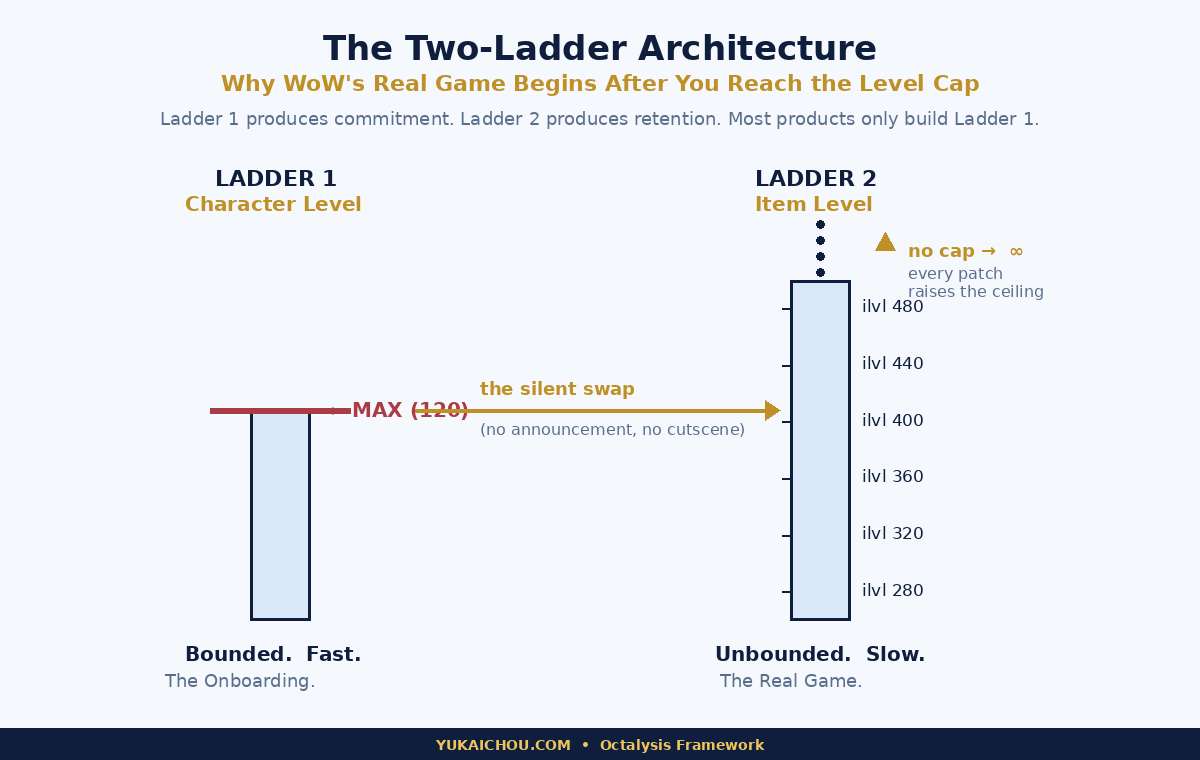
Item level (often shortened to “ilvl”) is the average power rating of the gear you have equipped. At level 60, your ilvl might be sitting around 480. At endgame, your ilvl might be 620. Or 645. Or 680 next patch. Item level has no cap, and the game now decides what content you can run, what groups you can join, and what loot will even drop for you based on this hidden second number.
The thing is, Blizzard does not announce this swap. There is no cutscene that says “congratulations, your character level no longer matters, please look at this other number now.” You just notice, slowly, that nobody on your friends list talks about being level 80. They talk about being ilvl 645. The game has changed. You either change with it or you log out for good.
Why “Max Level” Is Actually the Onboarding Cliff
This is the part most non-game designers miss, and it is the part I want you to sit with for a minute.
Levels 1 through 80 in WoW are not the game. They are the onboarding.
I know that sounds wild. Hundreds of hours of content, an entire continent of zones, dozens of dungeons, and I am calling it onboarding? Yes. Because the function of those levels, from a system design point of view, is to teach you the controls, get you invested in your character, and deliver enough small wins that you trust the game to keep rewarding you. That is what onboarding does.
The game proper begins at the cap.
If you understand this, the entire design of WoW makes sense. The world quests, the artifact power, the reputation grinds, the Mythic+ rating. None of it is bonus content tacked onto a finished game. It is the actual game, and the leveling experience was the foyer.
Now compare that to almost every non-game product you have ever used.
You finish the LinkedIn Learning course. The progress bar hits 100%. The screen says “Congratulations, you have completed the course.” And then? Nothing. There is no Ladder 2. The product treats the headline progression bar as the whole game, and the moment you finish it, you are off the cliff.
This is what I have started calling the onboarding cliff. It is the moment your most engaged users complete the visible progression and the product has nothing to hand them next. Watch any product retention chart and you will see the cliff as a sharp drop right around the moment users hit the visible end-state.
WoW does not have an onboarding cliff. WoW has an onboarding ramp that bends sideways into a second, taller ladder. That is the trick.
The Two-Ladder Architecture (And the Hidden Third Ladder)
Let me give you the structure as cleanly as I can.
Ladder 1 — Character Level (1 to cap). Bounded. Fast. Public. Highly satisfying. Designed to deliver the dopamine hits that get you hooked. Every ten levels you get a meaningful new ability or zone. The game floods you with rewards because the goal of Ladder 1 is to make sure you do not log out before Ladder 2 is offered.
Ladder 2 — Item Level. Unbounded. Slow. Public. Status-bearing. Each tier of content drops slightly better gear, and slightly better gear unlocks slightly harder content, and that content drops gear that is slightly better still. The gradient is finely tuned so each upgrade is small enough to feel earned and large enough to feel meaningful. Ladder 2 has no top.
Then there is the part most people miss.
Ladder 3 — Artifact power systems. In the Battle for Azeroth era, the Heart of Azeroth (a neckpiece) fueled azerite traits across three armor slots: head, shoulders, and chest. The currency was called Azerite Power. Newer expansions have rotated this mechanic through other shapes (covenant powers, then talent trees, then the current hero-spec system), but the move is always the same: a third progression layer riding on top of your second progression layer, which is riding on top of your first. It is ladders inside ladders.
And surrounding all three, you have orthogonal progressions:
Mount collection. Pet battle ratings. Mythic+ keystone score. Reputation with twenty different factions. Achievement points. Transmog wardrobe completion. Each one is its own small ladder, complete with visible numbers and public status, available at any time once you cross into endgame.
Take a breath and look at what Blizzard has built. There is no single moment a player can finish. There is always a denser, more specialized ladder one click below the one they are on. The architecture is fractal.
Mapping the Endgame to the Octalysis Framework
If you are not familiar with the framework, the short version is that there are eight Core Drives that motivate every meaningful human action, and a well-designed experience activates several of them at once. (For the full version, see The Ultimate Guide to Gamification.) WoW’s endgame is one of the cleanest case studies you will find of multi-Core-Drive engineering.
Watch how it stacks:
Core Drive 2: Development & Accomplishment. Both ladders activate this, but Ladder 2 keeps it active forever because there is always a higher item level to chase. The tutorial leveling is the warm-up. The endgame grind is the asymptote.
Core Drive 3: Empowerment of Creativity & Feedback. The three rogue specializations (Assassination, Outlaw, Subtlety) let you express how you want to play. Same character, three different fantasies, full feedback loops on each. This is horizontal expression layered into a vertical grind, and it keeps players from feeling locked in.
Core Drive 4: Ownership & Possession. Mount collections. Pet collections. Transmog wardrobes. The dragon you spent six months farming is yours, and the game shows it to everyone who looks at your character. Possession is amplified by the visible-to-others mechanic.
Core Drive 5: Social Influence & Relatedness. “LF2M Mythic+ ilvl 645+” is the most consequential sentence in WoW endgame culture. Your item level is the public stat that gates which groups you can join, and the social pressure to keep raising it is enormous. This is what turns Ladder 2 from a personal grind into a community-wide arms race.
Core Drive 6: Scarcity & Impatience. World quests reset on a daily timer. Mythic+ keys reset weekly. Vendor reputations rise slowly. Flying mounts are disabled in new territories until you grind a specific reputation. Scarcity is woven into every minute of endgame, and it is the single largest source of WoW’s retention numbers, and its burnout numbers.
Core Drive 7: Unpredictability & Curiosity. Loot tables are probabilistic. Mythic+ affixes rotate weekly. The boss that wiped your group last night might drop the trinket that completes your build tonight. Variable rewards are everywhere.
Core Drive 8: Loss & Avoidance. Each new expansion partially resets the gear you spent the last year acquiring. The dailies you skip stack as guilt. Players keep logging in partly because they do not want to fall behind their friends. This is the controversial Black Hat fuel that the next section will pick apart.
Notice that the leveling phase activates maybe three of these. The endgame activates seven, sometimes eight. That is not an accident. The product literally becomes a different product at the cap, and the new product is the one designed to retain you for years.
Why This Pattern Eats Non-Game Products Alive
I want to make this practical, because the WoW analysis is interesting but the lesson is what you are here for.
Almost every non-game product I have ever audited has exactly one progression ladder, and that ladder caps. Watch:
LinkedIn caps endorsements at 99+. After that, the number stops being satisfying because it stops moving. There is no Ladder 2 for the user who has hit the endorsement ceiling on their primary skill. The platform’s answer is to push you to other features, but those features are not progressions, they are activities. Different thing.
Duolingo’s primary metric is the streak. Streaks are addictive precisely because they cap nothing. They grow forever. But Duolingo has a hidden problem: a streak break is a total reset. There is no Ladder 2 to fall back on when Ladder 1 collapses. Lose a 400-day streak and you lose your entire emotional investment in the product. (They have started to mitigate this with Streak Freezes and league rankings, which is them slowly waking up to the second-ladder problem.)
Most fitness apps offer a 30-day program. Day 30 ends, the celebration screen plays, and the screen behind the celebration is blank. The app has not designed for what happens after “completion.” The user who finished the program is the user most likely to delete the app the next morning.
Course platforms are the worst offenders. The completion certificate is the entire game. Every metric they track (completion rate, time to certificate, number of certificates issued) points at the cap as the goal. So users hit the cap and leave, exactly as designed.
The WoW lesson, said plainly: your product is not finished when the user finishes it. Your design is finished when the user discovers the next progression at the moment they would have otherwise quit.
The Three Tests for a Working Second Progression System
Before you bolt a Ladder 2 onto your product, run it through three tests. I have watched teams skip these and ship a Ladder 2 that nobody touches.
Test 1: Is it visible? Item level is on every character’s portrait. It is on the group finder. It is in chat. The number is unavoidable. A Ladder 2 that lives buried in a profile settings page does not function as a status mechanism, and without status it does not create the social pressure that drives Ladder 2 engagement. If your power users cannot see each other’s Ladder 2 numbers, you do not have a Ladder 2 yet.
Test 2: Is it dense? Item level moves in tiny increments. 392, 393, 395, 397. Each upgrade is small enough that you can earn one in a single play session, which means every play session can produce a meaningful win. If your Ladder 2 only moves when the user does something monthly, the dopamine spacing is wrong. Daily and weekly cadences retain. Monthly cadences forget.
Test 3: Is it asymptotic? A Ladder 2 with a known top is just a longer Ladder 1. The retention magic only fires if the user can imagine the ladder going up forever. Each gear slot in WoW could theoretically always upgrade. The achievement count keeps climbing. The mount count grows with every patch. Asymptotic does not mean infinite. It means the perceived ceiling is high enough that users stop looking up. The moment a user can mentally calculate how long it would take to “finish” Ladder 2, the magic dies.
If your second progression flunks any of these three, it is decoration, not retention. Polish or kill it.
The Black Hat Cost Blizzard Pays (And You Should Not)
I am going to say something here that goes against the grain of most gamification writing: WoW’s endgame is partly built on Black Hat Core Drives, and that is exactly why so many ex-WoW players talk about the game like it was an abusive relationship.
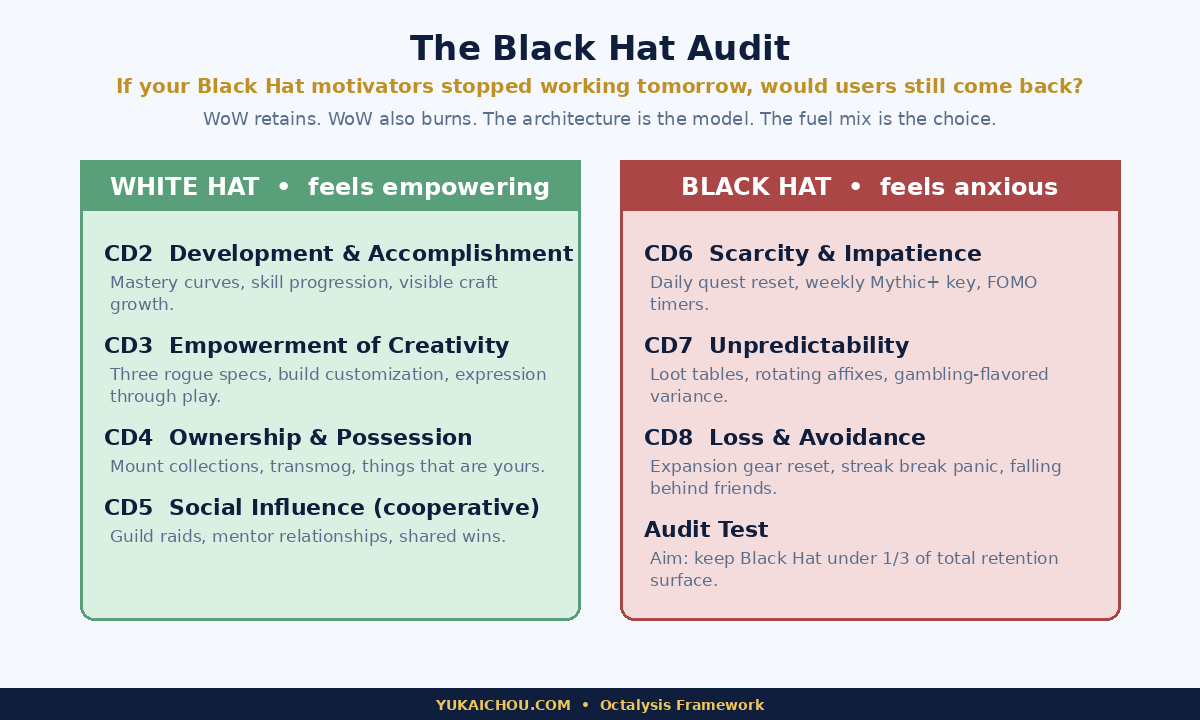
The framework distinguishes between White Hat motivators (CD2 Accomplishment, CD3 Creativity, CD4 Ownership, CD5 Social Influence) which feel empowering, and Black Hat motivators (CD6 Scarcity, CD7 Unpredictability, CD8 Loss) which feel anxious. Both retain. They retain through different mechanisms. (I broke this down further in Why Do the Best Game Buffs Always Hurt You? Short version: you cannot get pure White Hat retention at scale, but the ratio matters enormously.)
Look at WoW’s daily quest system. The quests refresh every day at server reset. Skip a day, and you fell behind your friends. The driver here is not joy, it is anxiety. CD6 (Scarcity) plus CD8 (Loss) running on a 24-hour clock. You log in not because you want to, but because you are afraid of what will happen to your character if you do not. That is a Black Hat appointment dynamic.
Look at the expansion gear reset. You spent eight months grinding your way to ilvl 645. The new expansion ships and the first quest reward in the new zone is ilvl 660. Your eight months of work is now a green item you sell to a vendor. CD8 (Loss) burning brightly.
WoW retains. WoW also burns its players out, drives subscription cancellations after expansions, and has spent twenty years cycling players through a relationship they keep saying they want to leave. The Black Hat is fuel, but it is fuel that consumes the engine.
The non-game lesson is simple: copy WoW’s ladder architecture, but replace as much of the Black Hat fuel as you can with White Hat alternatives. A daily streak driven by CD6/CD8 (lose your streak and you lose everything) burns out users. A daily streak that unlocks new self-expression options (CD3 Creativity) keeps them. Same mechanic, different engine.
The audit question I run every product through: if all my Black Hat motivators stopped working tomorrow, would users still come back? If the answer is no, you do not have engagement. You have a hostage situation.
A Build Pattern You Can Steal This Week
Here is the pattern, broken down into steps you can execute on a real product. I have used this exact sequence on consulting engagements with platforms ranging from fintech to fitness to learning, and the shape is consistent.
Step 1. Find your “max level” moment. Where in your product does a user finish the obvious thing? The course completion. A 30-day program ending. Their first 100 followers. The streak threshold that makes them feel “done.” Map it. This is your onboarding cliff.
Step 2. Identify the metric your power users already track. Power users almost always invent a Ladder 2 on their own, a metric they care about that the product is not tracking. For LinkedIn it is post engagement rate. In fitness apps it is one-rep-max progression. Language learners watch comprehensible-input minutes. Talk to your top 50 users and ask what number they actually watch. That is your Ladder 2, hiding in plain sight.
Step 3. Surface that metric at the moment Ladder 1 caps. The screen that currently says “Congratulations, you completed the program” should also say “and now your real number begins.” Reveal Ladder 2 at the cliff edge. Do not bury it in settings.
Step 4. Add two or three orthogonal mini-ladders. Collections, ratings, social proof, customization unlocks. These are the equivalent of WoW’s mounts and pet battles. They protect the user from over-investing in any single ladder, which means a temporary slowdown on the main ladder does not feel like total stagnation.
Step 5. Audit your Black Hat ratio. Count your daily-reset, lose-it-if-you-skip, can-only-get-this-now mechanics. Aim for replacing at least one third of them with White Hat equivalents. Unlock paths instead of daily resets, mastery curves instead of streak cliffs, social cooperation instead of social comparison. This is the difference between a product users love and a product users feel trapped by.
If you implement these five steps, you will have built a system that retains the user past the point where 80% of products lose them. That is the entire game.
The Question I Keep Asking About My Own Career
I want to close with something that might land sideways.
The WoW lesson is not really about WoW. It is about the structure of any long engagement. Once I saw it inside the game, I started seeing it everywhere. In companies, in marriages, in writing careers, in physical training.
Most people stop progressing because they hit what feels like a max level of their job, their craft, their relationship. The visible ladder caps. The screen goes blank. They start wondering if they are supposed to switch games entirely. Some do. Most just quietly disengage and call it “burnout.”
The question I keep asking myself, especially in the years where the obvious milestones are behind me: what is the item level of my own work?
Where is the second ladder, the one that gets denser as I climb, that has no visible top, that the people I respect most are quietly tracking even though nobody talks about it? Sometimes the answer is craft depth. Other days it is the joy of teaching someone less experienced. Often it is the quality of the questions I am asking, which is a metric nobody hands out trophies for but which separates people who keep growing for fifty years from people who plateau at thirty-five.
If you only have a Ladder 1 in your career, you will hit your cap and stop. If you can find your Ladder 2 (and protect it from being colonized by Black Hat fuel), you get something rarer, which is a game that keeps being worth playing.
That is what Blizzard understands. That is what most products do not. And that, on the long drive home from a 1 AM Mythic 9 wipe, is the lesson I keep coming back to.
Where to Go Next
If this struck a nerve, here is the order I would read in:
- The Ultimate Guide to Gamification for the full framework underneath this post.
- Why WoW is so engagement-dense for the longer teardown.
- The Core Drives × Difficulty Level map for matching motivators to player skill.
- Actionable Gamification for the applied playbook on building your own Ladder 2.
- 10,000 Hours of Play for the career-and-life version of this architecture.
Frequently Asked Questions
What does “item level” actually mean in World of Warcraft?
Item level (ilvl) is the average power rating of all the gear a character has equipped. Higher ilvl means stronger stats, better damage, more health, and access to harder content. Unlike character level, which caps at the current expansion’s ceiling, item level keeps climbing every patch as new gear gets introduced.
Why does WoW have two progression systems instead of one?
The character-level ladder produces commitment. It is fast, satisfying, and bounded, which gets new players invested. The item-level ladder produces retention. It is slow, asymptotic, and public, which keeps invested players coming back for years. One ladder cannot do both jobs without either feeling endless from the start or running out before the player is hooked.
How does this apply to non-game products like SaaS or apps?
Most non-game products only build the equivalent of WoW’s leveling phase. Users hit the visible end-state (course completed, program finished, profile filled out), and the product has nothing to hand them next. The fix is to design a second progression system that activates exactly at the moment the first one caps, ideally one that power users already informally track.
Is it ethical to use these retention techniques?
The architecture itself is neutral. The fuel matters. A second progression system powered by White Hat Core Drives (mastery, creativity, ownership) leaves users feeling more capable and is broadly defensible. A second progression system powered mostly by Black Hat Core Drives (loss aversion, scarcity, anxiety) retains users in the short term but tends to produce burnout and resentment. Audit your Black Hat ratio and aim to keep it under one third of your retention surface area.
What is the most common mistake when designing a second progression?
Hiding it. Many products build a second metric but bury it in a sub-menu or only surface it on a dashboard the user has to opt into. Item level works because it is unavoidable. Every other player can see yours. If your power users cannot see each other’s Ladder 2 numbers, the system loses the social-influence layer that makes Ladder 2 retain in the first place.