
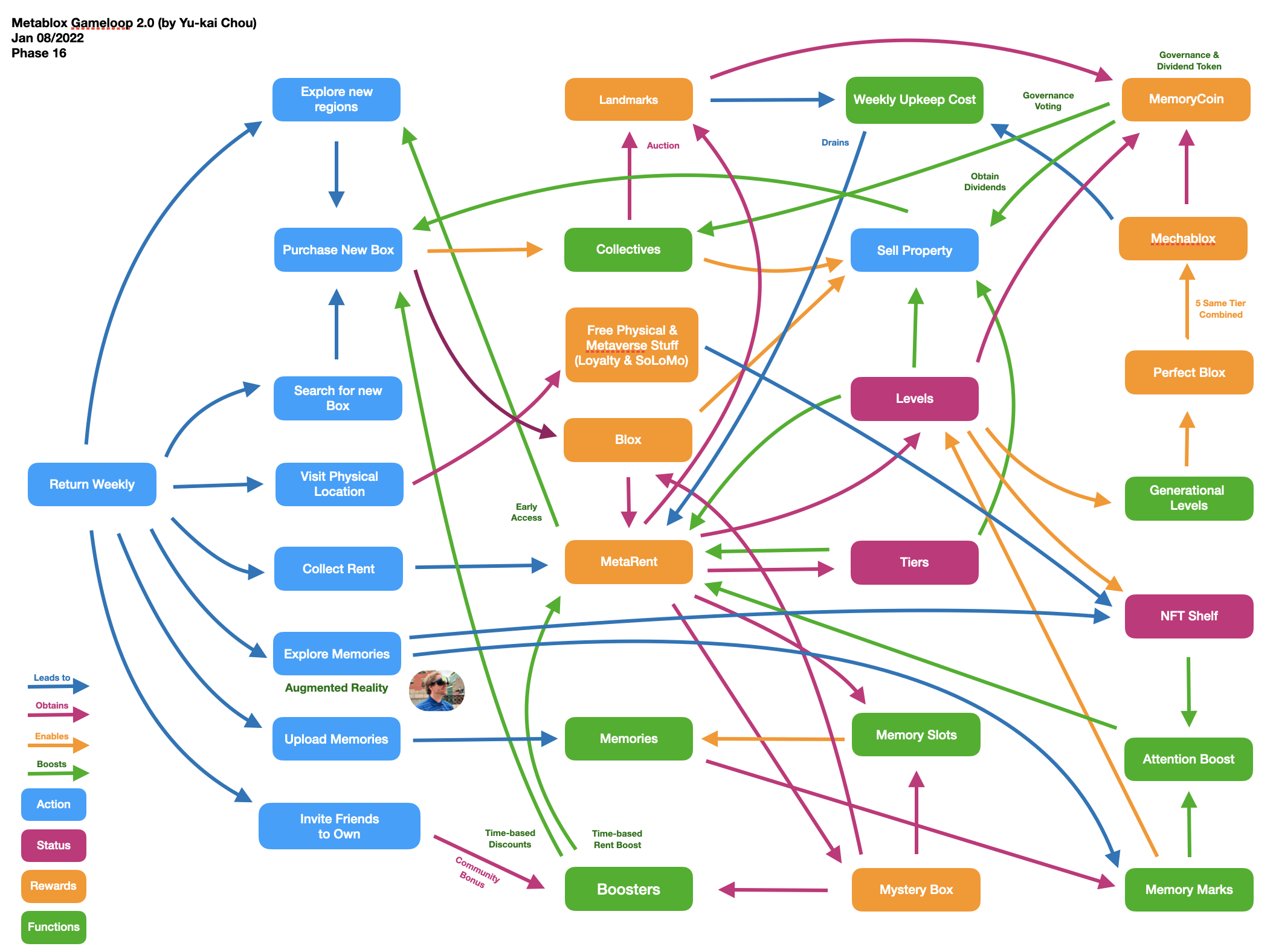

What happens when an NFT project’s investors walk away, but the creator and community refuse to quit? Yu-kai Chou, the behavioral designer behind the Octalysis Framework, self-funded the resurrection of Metablox.co and redesigned its game loop around memory, stewardship, and long-term meaning instead of short-term speculation.
This page is not a generic Web3 victory lap. It is a case study in what changes when a project stops chasing hype and starts designing for why people would care years later.
Most failed Web3 projects do not come back. The ones that do tend to come back with a sharper second thesis, not a softer market or a fresh round of capital. The story below is about that kind of return: the parts of the original idea that survived contact with the FTX collapse, the parts that had to be rebuilt, and the new product moves we only saw clearly once the noise died down.

⚡ Speed Run Notes
- Web3’s first era failed because it mistook ownership receipts for ownership meaning. An NFT without a story is just a spreadsheet row. Metablox’s resurgence is built on what the receipt is for, not the receipt itself.
- The right game loop for memory preservation is curatorial, not financial. Users are not minting to flip. They are minting to protect, organize, and eventually pass on meaningful places and memories.
- Core Drive 1: Epic Meaning and Core Drive 4: Ownership & Possession are the load-bearing drives. That is what makes this more durable than most speculation-heavy Web3 loops that depend mainly on scarcity and volatility.
- The deepest product move is making memories inheritable. Few mainstream products handle what happens to meaningful data when someone dies. A memory platform that does this well expands beyond collectors into families.
- A resurgence only matters if the second thesis is stronger than the first one. Metablox’s second era is not just a relaunch. It is a sharper claim about why memory, place, and stewardship belong together.
Table of Contents
Author Credibility: Yu-kai Chou

Yu-kai Chou created the Octalysis Framework after studying gamification since 2003 — years before the term entered mainstream vocabulary. As a Human-Systems Architect & Behavioral Designer, his framework has been applied by LEGO, Microsoft, Porsche, Coca-Cola, Salesforce, and MrBeast, impacting over 1.5 Billion Users.
Chou has taught the Octalysis methodology at Harvard, Stanford, Yale, Tesla, Google, BCG, and IDEO.
His work has been cited by Harvard, Stanford, MIT, Forbes, Wall Street Journal, Wired, US Department of Energy, NIST, NSF, NCBI, US Department of Education, ClinicalTrials.gov, and Google Scholar — with 3,700+ more academic publications. Explore his books here.

Slow Cook Period for Metablox.co
After the FTX collapse, a lot of NFT companies died because liquidity vanished and trust evaporated with it. The original Metablox investors wanted the company to pivot elsewhere, including toward projects like ConstantCloser.com.
But some Metablox team members, including me, plus many community users still believed in the original vision of preserving meaningful memories in meaningful places. Eventually a volunteer group purchased the rights and IP to form a new Metablox.co.
Because I was self-funding operations, progress was slower than a venture-backed launch. But that slower rebuild produced a better product thesis. Instead of pretending the market never changed, we used the quiet period to rethink the loop, improve the front end, and refocus the value proposition around permanence, identity, and memory stewardship.
The key belief is simple. Cute NFTs and shallow mini-games may not matter five years later. Important memories in important places still will. That gives this category a very different kind of time horizon.
I am comfortable with that patience because this is how I built my own career. I started in gamification in 2003, long before it became globally recognized, and I have seen many categories look strange before they look obvious.
That same patience shaped how I built the framework in the early years. The work had to be done before anyone wanted it. The first clients were not Microsoft or Tesla. They were small bets I made because the underlying problem was real, even when the market had not caught up. Memory preservation as a category sits in the same posture today. The technology is finally good enough, the user need is articulated clearly, and the long arc of behavior is on the right side of where I want to bet.
Core Drive 1: Epic Meaning & Calling is the load-bearing motivation here, not for me, but for the kind of user who shows up early. People who feel like they are part of preserving something larger than a single transaction are the people who keep contributing through quiet quarters. They were the early Wikipedia editors and the early Letterboxd reviewers. Those are the contributors a memory platform actually needs in its first thousand seats.
Memory Collections
Memory Collections allow people to chain memories together. That matters when a story spans multiple destinations, multiple years, or even a whole life arc.
This taps into Core Drive 4: Ownership & Possession. Once you start building a collection, you do not just post individual artifacts. You begin curating something that feels like part of your identity, which makes completion and stewardship far more motivating.
What separates Memory Collections from generic NFT galleries is the chain itself. Pokémon-style completionist mechanics reward you for filling slots in a checklist. Pinterest-style curation rewards you for assembling a mood. A memory graph rewards you for telling a true thing about your own life. These are different products, and they pull on different parts of the user. Memory Collections sit closest to the third one, which is the rarest in consumer software.
The other reason curation pulls harder than single-artifact ownership is the way collections behave over time. Owning one rare card is a moment. Owning a Pokémon binder built across years is a relationship. Once a person has a collection that took real effort to assemble, the cost of abandoning it climbs every week. That is the kind of switching cost that good products earn by being useful, rather than the kind extracted by manipulative platforms.
Collections also set up the inheritance angle quietly. A single rooted memory is hard to hand down as a meaningful artifact on its own. A curated collection of memories with a clear narrative shape is much easier to pass on. Future generations inherit an album, not a hash. The collection is the unit that turns a Web3 receipt into a cultural object, and that is the move most NFT loops never bothered to make.
Memories Anywhere + Global Blox Creation (Seeding)
At relaunch, we removed the old requirement that memories had to begin in one of the original Pillar Cities like San Francisco, New York, Singapore, Los Angeles, or Seattle.
Now a person can seed a meaningful memory anywhere in the world. After a short wait, the surrounding area can become a Blox, and the original contributor gets first access before the Blox becomes publicly available.
That change matters because it shifts the product from a constrained launch map to a true memory layer over the real world. If a place matters to you, the system should be able to recognize that without forcing you into an arbitrary city list.
There is a useful comparison to Foursquare-era place-based products, which got the geographic primitive right but never built a strong reason to come back to a place. The check-in itself was the loop, which is why mayorships got gamed and the social signal degraded over time. A memory rooted to a place behaves differently. It does not act as a flag claiming presence. The rooted memory is closer to small-scale cultural cartography that other people can read decades later, even if the person who placed it has long since moved on.
Underneath this is a healthy interaction between Core Drive 4: Ownership & Possession and Core Drive 6: Scarcity & Impatience. The first-access window after seeding is a clean expression of Core Drive 6 without becoming manipulative. Early seeders earn an honest priority for putting attention on a place before anyone else did, and the system still opens to the public after that window closes.
Rooting Memories onto the Blockchain with IPFS
Rooting memories onto the blockchain through IPFS was part of the original promise from the beginning, so bringing it back in usable form was essential.
Users can spend 1 Metablox Coin to root a memory, and every Memory Mark within that memory then counts as 5x points toward Blox leveling. Strategically, this is where the product starts to separate itself from generic NFT mechanics.
Rooting is not just a speculative action. It increases permanence, strengthens the emotional weight of a place, and creates a clear reason for people to care more deeply about what they have documented. That is a much healthier loop than chasing empty transaction volume.
The economy-design choices behind rooting are worth pulling apart. A single-action cost of 1 Metablox Coin paired with a 5x multiplier on Memory Marks is a cleaner economy hook than the gas-fee-per-mint pattern that dominated the first wave of Web3. Gas fees punish the user for showing up, which trains the wrong reflex from day one. A flat in-system cost punishes nothing and rewards intentional commitment.
IPFS is the other half of the rationale. The point of putting a memory on a distributed file system is permanence, not showmanship. Centralized image hosts disappear when companies pivot or die, and a long list of products that promised to keep your data safe have already proven that. Rooting is also where the user split between collectors and speculators becomes legible. Speculators do not pay to make something more permanent. Collectors do, because permanence is the actual product.
The Metablox.co Leaderboard
At the January 2026 relaunch stage, we also rolled out a leaderboard with weekly event rewards around adding new memories, collecting MetaRent, and acquiring new Blox.
The important design point was not the leaderboard itself. It was the way the rewards loop connected contribution, curation, and ownership. Blox Credit existed so people could earn progress without being forced to choose a property instantly, while Metablox Coin powered rooting, which in turn accelerated Blox leveling and future utility.
In the early relaunch phase, those rewards were intentionally generous because the goal was to seed activity and teach the system. That generosity should be read as a launch-stage mechanic, not as a permanent promise. The long-term question is how to keep the loop meaningful once the player base is much larger and the economy needs tighter balance.
Generosity at launch is also a form of honest signaling. A leaderboard that pays people well in the early phase tells contributors that the system values their time, without locking the economy into permanent inflation. That balance is closer to Core Drive 2: Development & Accomplishment done well: real progress feedback in the moment, while leaving room to tighten the rules as the population grows. The discipline most leaderboards lack is choosing what counts as a meaningful contribution. Mindless clicking is easy to measure and easy to game. Quality of memory rooted, depth of curation, and longevity of contribution are harder to measure, but those are the metrics worth designing around.
That is the more interesting lesson here. A leaderboard only works when it clarifies what the product wants more of. In this case, the target behavior was not mindless clicking. It was deeper contribution to the memory graph, stronger stewardship of rooted memories, and more thoughtful participation in the world-building layer.
Where the Product Can Still Go
The most exciting future for Metablox is not another short-term Web3 gimmick. It is the possibility of turning memories, places, inheritance, and community stewardship into one coherent long-term system.
Inheritance is the white-space thesis I keep coming back to. Almost no mainstream consumer product handles what happens to meaningful digital data when a person dies. Photos sit in cloud accounts that get locked behind unclaimed passwords. Social profiles become memorials with broken access controls. Family histories that used to live in shoeboxes and photo albums now live in apps that nobody else has the keys for. A platform that takes that problem seriously expands well beyond Web3 collectors. Families become the larger market once the product is genuinely useful for keeping memory alive across generations.
That direction also clarifies the relationship to the broader White Hat motivation thesis I have written about elsewhere. White Hat work is what holds up over years, because it builds identity, mastery, and meaning rather than extracting attention. A memory platform built around stewardship is one of the cleanest commercial expressions of White Hat that Web3 can offer. The product does not need a hype cycle to keep working. Scarcity tricks are not how it retains users. It needs to keep being a good place to keep what matters, year after year, long after the next speculative wave has burned itself out.
If the product keeps evolving in that direction, the upside is not just better NFT engagement. It is a more human use case for blockchain, one that aligns far better with White Hat motivation and durable identity-building than the category’s first wave ever did.
Check out the Discord channel if you want to follow the project and see where that experiment goes next.
Related Reading
- The Octalysis Framework
- What is Gamification
- Core Drive 1: Epic Meaning
- Core Drive 4: Ownership & Possession
- White Hat vs Black Hat Gamification
- Metablox Whitepaper 2.0 Part I
- How to Build Game Loops
- Books by Yu-kai Chou