
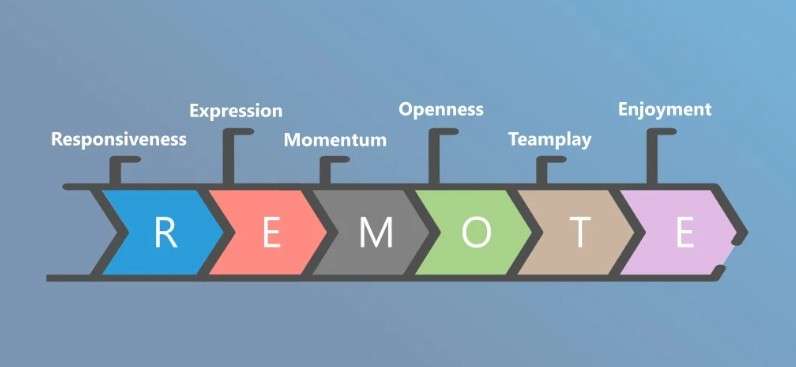

The REMOTE Work Cultural Framework is an original behavioral design framework created by Yu-kai Chou to address the unique motivational challenges of distributed and remote teams. Built on principles from the Octalysis Framework, REMOTE stands for Responsibility, Expression, Mastery, Ownership, Teamwork, and Engagement — each component targeting a specific human drive essential to sustaining culture at a distance.
Unlike surface-level productivity advice, the REMOTE framework applies gamification and behavioral design principles to ensure remote employees feel intrinsically motivated. Core drivers like Core Drive 5: Social Influence & Relatedness and Core Drive 1: Epic Meaning & Calling are woven into the framework to create belonging and purpose in remote work environments.
Managing Director Joris Beerda also posted a series explaining each component of the REMOTE framework in depth.
Check it out: The Ultimate Guide to REMOTE Work Series
⚡ Speed Run Notes
- Remote work culture fails when leaders try to replicate office rituals through screens. Zoom happy hours are worse versions of real happy hours. They produce fatigue without connection. Remote culture needs rituals designed for distance, not translated from proximity.
- The REMOTE framework works because it forces leaders to name the cultural goals before choosing the tools. Most remote culture initiatives start with a tool (“let's buy Slack huddles!”) and hope culture emerges. The framework inverts the sequence: name the value, then choose the tool. The inversion is the whole trick.
- CD5 (Social Influence) and CD1 (Epic Meaning) are the two drives remote work systematically underdelivers. Offices deliver both accidentally. Remote teams have to deliver them deliberately. Every remote ritual should be checked against whether it serves one of these two drives — otherwise it's filler.
- Asynchronous culture is stronger than synchronous culture when designed well. Async forces clarity. Sync rewards improvisation. Teams that invest in async-first rituals develop sharper communication and stronger documentation than any office team. The “remote penalty” is an assumption, not a law.
- The deepest insight: culture is the set of small rituals that survive without management attention. If you stop running the ritual and it dies, it wasn't culture — it was a meeting. Real culture self-perpetuates. The REMOTE framework is how you design rituals that outlive the manager who started them.
About the Creator of the Octalysis Framework

Yu-kai Chou created the Octalysis Framework after studying gamification since 2003 — years before the term entered mainstream vocabulary. As a Human-Systems Architect & Behavioral Designer, his framework has been applied by LEGO, Microsoft, Porsche, Coca-Cola, Salesforce, and MrBeast, impacting over 1.5 Billion Users.
Chou has taught the Octalysis methodology at Harvard, Stanford, Yale, Tesla, Google, BCG, and IDEO.
His work has been cited by Harvard, Stanford, MIT, Forbes, Wall Street Journal, Wired, US Department of Energy, NIST, NSF, NCBI, US Department of Education, ClinicalTrials.gov, and 3,700+ more academic publications. Explore his books here.
Related Reading
- The Octalysis Framework for Gamification & Behavioral Design
- Top 10 Enterprise Gamification Examples
- Books by Yu-kai Chou
- What is Gamification? Definition, Examples & Framework
- Core Drive 2: Development & Accomplishment