
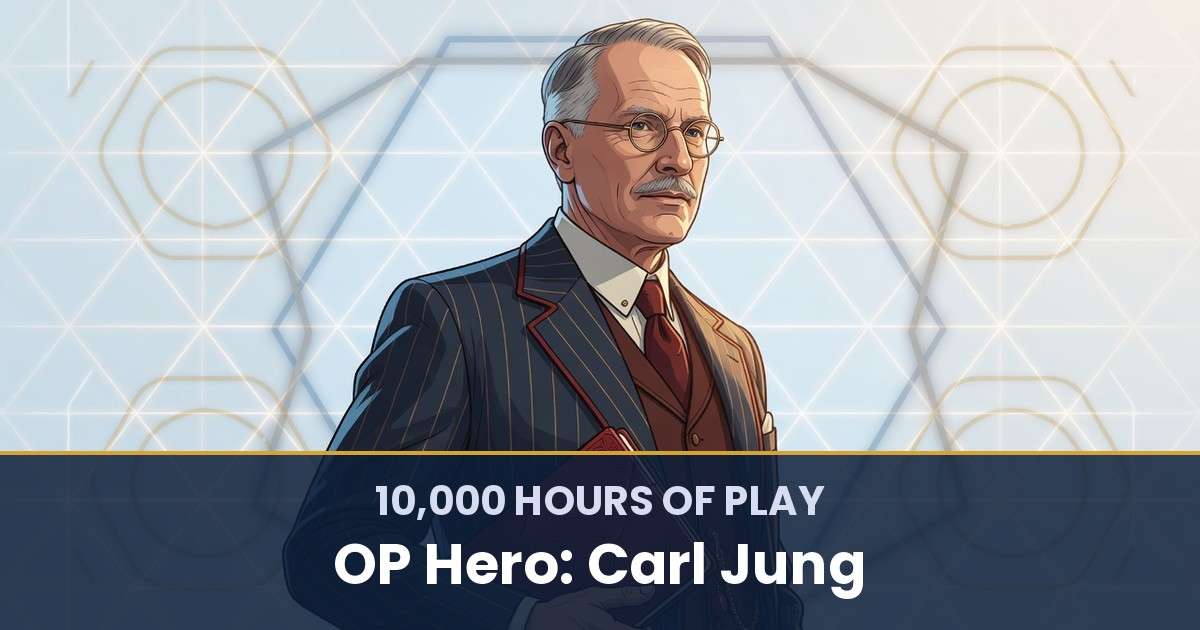


On March 3, 1907, a thirty-one-year-old Swiss psychiatrist arrived at Sigmund Freud’s apartment at Berggasse 19 in Vienna. By his own recollection, the two men talked for thirteen hours without interruption.
Six years later, Carl Jung walked away from that alliance and from the movement he had helped lead. Then he did something stranger: he began holding structured sessions with figures from his own imagination, and he wrote every session down.
Those private notebooks became The Red Book. The concepts he distilled from the whole adventure (introversion, extraversion, archetypes, the collective unconscious) still shape how we talk about personality more than a century later.
Run him through the 10,000 Hours of Play framework and Jung turns out to be one of the strangest, most instructive builds in this library: a data-driven Mage who won the game by treating his own unconscious as the dungeon, and himself as the first player to map it.
⚡ Speed Run Notes
- Jung’s Game was mapping the unconscious, and he played it with lab instruments: a stopwatch, word lists, and reaction-time data that turned invisible complexes into measurable events.
- His defining Quest was internal. After the 1913 break with Freud, he spent years in structured dialogue with his own visions, then decades converting that raw material into analytical psychology.
- Skills on display: Arcane Metrics (Mage), Courageous Heart (Paladin), Lich Grind (Warlock), Divine Shield (Paladin), Ley Line Infusion (Mage), and Vision of the Wild (Druid).
- Allies multiplied every chapter: Bleuler supplied the lab, Freud supplied the map to push against, Richard Wilhelm delivered the alchemy texts, and Aniela Jaffé helped him tell the story.
- The steal: instrument your inner life. Jung wrote down what almost everyone ignores, and the notes became the work.
Table of Contents
About Yu-kai Chou

Yu-kai Chou is the author of 10,000 Hours of Play — the book that treats your life as the most important game you’ll ever build a character in, and gives you the 6-Step framework (Game · Attributes · Role · Skills · Allies · Quests) to play it on purpose. He has spent two decades developing the system through which this post analyzes its OP Hero, and applies it to his own life and to the lives of the people he advises around the world.
Chou’s other framework, the Octalysis Framework, has been applied by LEGO, Microsoft, Porsche, Coca-Cola, Salesforce, and MrBeast, impacting over 1.5 Billion Users. He has taught the methodology at Harvard, Stanford, Yale, Tesla, Google, BCG, and IDEO, and has advised governments in eight nations including Ukraine, the United Kingdom, the Kingdom of Bahrain, Singapore, Taiwan, the Netherlands, Kazakhstan, and South Korea.
His work has been cited by Harvard, Stanford, MIT, Forbes, Wall Street Journal, Wired, US Department of Energy, NIST, NSF, NCBI, US Department of Education, ClinicalTrials.gov, and Google Scholar — with 3,700+ more academic publications. Explore his books here.
Jung’s build costs more than it looks. The sessions behind The Red Book frightened him, and he ran them anyway, for years, and told almost no one. That attribute, the tolerance to stay inside your own uncomfortable material without flinching away, is the one thing in his sheet I’d tell you to train first.
Step 1: The Game — What Carl Jung Was Actually Playing
Strip away the mystique and Jung’s Game is easy to name: map the structure of the unconscious mind, and build a workable path for ordinary people to integrate it.
He called that path individuation. It means growing into a whole personality that includes the parts the conscious mind would rather ignore.
The quest line locks in early and never wavers. His doctoral dissertation in 1902 examined unconscious material. The association experiments of his early career hunted it with a stopwatch.
The Red Book years engaged it face to face. The late alchemy volumes decoded centuries of its recorded symbolism.
In Memories, Dreams, Reflections, the autobiography he began with Aniela Jaffé in 1957, he frames his entire life as the attempt to give inner experience a scientific and symbolic form. One Game, played for six decades through wildly different terrain.
Every later choice Jung made, from which clinic to join to which fights to accept, reads as a move inside that single pursuit.
Step 2: Attributes — The Innate Stats
Attributes are the stats you’re born holding. Jung’s were visible before he turned ten.
Deep inwardness. In Memories, Dreams, Reflections he describes a childhood dominated by solitude and an inner world he treated as more real than school. He even distinguished two personalities within himself: a “No. 1” who handled daily life and a “No. 2” who lived in contact with something timeless.
Symbolic pattern recognition. Long before he had patients, the boy Jung puzzled over why religious images and rituals carried the weight they did. The adult Jung spotted recurring symbolic forms across dreams, myths, and cultures: the same stat, leveled up.
Psychic risk tolerance. His childhood dreams terrified him, and he faced them rather than looking away. That willingness to remain in frightening inner territory became load-bearing in 1913.
Independence from authority. He never made a comfortable conformist; his school years read as alienation punctuated by psychosomatic protest. The pattern repeats at every scale of his life, up to and including the 1913 break with Freud himself.
His edge sits exactly where the Talent Triangle Method tells you to look for one: at the intersection of talents, never in a single stat. Jung’s triangle crossed empirical rigor with symbolic imagination: the same man who timed word associations with a stopwatch spent his evenings painting visions.
Step 3: Role(s) — The Character Class Across Chapters
Roles are the character classes you equip for a chapter of life. Jung swapped his deliberately, and each swap compounded the previous one.
Apprentice Physician (1895–1900). A medical student at Basel who chose psychiatry after reading about pathological mental states, betting his career on the least fashionable specialty available to him.
Clinical Researcher (1900–1909). A staff psychiatrist at the Burghölzli clinic in Zurich under Eugen Bleuler, running experiments on patients and healthy subjects alike and publishing the results.
Psychoanalytic Champion (1907–1913). Freud’s leading Swiss ally, elected first president of the International Psychoanalytical Association in 1910.
Solitary Explorer (1913–1919). After the rupture, he kept a limited practice and poured his central energy into charting his own unconscious.
System Architect (1920s–1930s). The explorer returned with maps. Psychological types, archetypes, and the collective unconscious were organized into a school he called analytical psychology.
Elder Mentor and Lore-Keeper (1930s–1961). Seminars, supervision, cross-cultural symbol work, and finally the autobiographical project with Jaffé that codified the whole saga.
The arc bends from outer instruments toward inner authority, a Sage progression that rhymes with Laozi’s OP Hero build. The difference is that Jung kept publishing evidence the entire way.
Step 4: Skills — The Real-Life Game Skills Carl Jung Mastered
Skills are the learnable half of a build, and each of Jung’s breakthroughs traces to a specific one. The Skills Spectrum sorts players by how their training spreads, from dabblers sampling many games to specialists compounding into one. Jung sat at the specialist extreme: nearly every Skill he trained pointed at the same Game.
Arcane Metrics (Mage) — harnessing data to measure what others only feel. At the Burghölzli between 1904 and 1907, Jung ran word-association experiments with standardized stimulus lists and a stopwatch, publishing nine studies with collaborators including Franz Riklin. A response delayed beyond the subject’s own average betrayed a “complex,” an emotionally charged cluster interfering from below awareness.
He had converted the invisible into reaction-time data. The method fed his 1907 monograph The Psychology of Dementia Praecox, which carried experimental psychology into psychiatry.
Courageous Heart (Paladin) — charging into territory others avoid. After the break with Freud, Jung deliberately let fantasy material surface and engaged it directly, despite his own fear that he was approaching psychosis. Between late 1913 and April 1914 he recorded over thirty of these structured descents, the core material of The Red Book. He later named the method active imagination.
Lich Grind (Warlock) — intense, secluded work periods. The Red Book notebooks ran from 1913 to 1917 and were elaborated until around 1930, largely in disciplined solitude. In 1922 he bought land at Bollingen and began building a stone tower there the following year: a purpose-built seclusion environment for the deep work. Eliud Kipchoge’s OP Hero profile runs on the same Skill in a different arena: seclusion chosen on purpose, so the work has nowhere to hide. Jung built the psyche’s version in stone.
Divine Shield (Paladin): saying no, regardless of how persuasive the other party is. Holding his own theoretical ground against Freud, his mentor and the movement’s founder, cost Jung the alliance and his place at the center of the field. He paid it.
Ley Line Infusion (Mage): rapidly absorbing an entire body of knowledge. When Richard Wilhelm sent him a translation of the Chinese text The Secret of the Golden Flower around 1928, Jung recognized his individuation process inside a foreign symbolic system. He then spent years absorbing the Western alchemical corpus to decode it as psychology.
Vision of the Wild (Druid): seeing through multiple perspectives with empathy. Psychological Types (1921) formalized introversion and extraversion plus four functions of orientation. Jung built the typology partly to understand how Freud, Alfred Adler, and he could study the same patients and land on different theories. Disagreement itself became data.
Step 5: Allies — The People Who Multiplied Carl Jung
Nobody runs a sixty-year Game solo. Jung’s Allies arrived at the exact chapters that needed them.
Eugen Bleuler ran the Burghölzli and handed the young researcher a first-rate clinical laboratory. The association studies that made Jung’s reputation happened on Bleuler’s ward, with Bleuler’s patients.
Franz Riklin co-authored the 1904 association research, sharing the bench work behind complex theory.
Sigmund Freud multiplied Jung twice. The alliance years supplied a movement, a sparring partner of the highest order, and the IPA presidency in 1910.
The rupture supplied something stranger and more valuable: the pressure to build his own system. Even Psychological Types is partly an attempt to understand that disagreement.
Richard Wilhelm delivered the Golden Flower translation in 1928 and, with it, the bridge between individuation and centuries of alchemical symbolism. Jung credited the text with clarifying where his work was headed.
Aniela Jaffé sat with him from 1957 onward and turned recollection into Memories, Dreams, Reflections, the book that made his inner life legible to the public.
Step 6: Quests — The Milestones That Shaped the Saga
Quest 1: Make the unconscious measurable (1900–1907). Join the Burghölzli, master the ward, run the association experiments, publish the studies, cap it with the Dementia Praecox monograph: a full quest line cleared by 1907.
Quest 2: The psychoanalytic campaign (1907–1913). The thirteen-hour Vienna meeting, the leading-ally years, the first IPA presidency in 1910. Then came the boss fight nobody assigned him: defending his own ideas against his own mentor.
The setback. The rupture of 1913 cost him his movement and, for a stretch, his certainty about his own sanity. This is the failure chapter of the saga, and nearly everything canonical about Jung was built directly out of it.
Quest 3: The descent (1913–1930). Structured engagements with visionary material, recorded and painted into The Red Book. Jung kept the volume private for his whole life; it finally reached print in October 2009, decades after his death in 1961.
Quest 4: Publish the maps (1921). Psychological Types turned the private descent into public theory and gave everyday language two of its most-used personality words.
Quest 5: Decode the old masters (1928 onward). From The Secret of the Golden Flower to Psychology and Alchemy to Mysterium Coniunctionis, Jung read alchemy as a long historical record of individuation written in symbolic disguise.
Quest 6: The endgame integration (1944–1961). In early 1944 a broken foot and then a heart attack brought him to the edge of death, with intense visions. His verdict afterward: “a fruitful period of work began for me,” with a good many of his principal works written only then. He began Memories, Dreams, Reflections with Jaffé in 1957 and kept working on the record of his Game until 1961.
What You Can Steal From Carl Jung’s Build
You don’t need a psychiatric clinic to run Jung’s build; the moves transfer to ordinary life.
Instrument the invisible. Jung put a stopwatch on feelings. Track your own reactions somewhere: the delays, the flinches, the topics you keep avoiding. Once a pattern is visible, you can train against it.
Schedule the confrontation. Active imagination was a calendar commitment to material he feared. Whatever your version is (the difficult conversation, the honest financial review, the unsent letter), it goes on the calendar or it never happens.
Build your Bollingen. A dedicated environment for undistracted work multiplies every other Skill. Jung built his in stone. Yours might be a desk, a cabin weekend, or one protected morning a week.
Treat disagreement as typology. When a smart person reads the same evidence and lands somewhere else, ask what kind of mind produces that reading. The question builds empathy and better theory at the same time.
Keep a Red Book. Write the strange material down. Jung’s private notebooks, kept for years with no audience, turned out to hold the source code of his life’s work.
To see how other legendary builds run through the same six Steps, browse the rest of the OP Hero profiles.
Where this framework comes from

Want the full system this profile is built on?
Every OP Hero piece runs through the same 6-Step framework from 10,000 Hours of Play: Unlock Your Real-Life Legendary Success. The book covers the full system, walks through Yu-kai’s own life run as the first applied case study, and gives you the worksheets to audit your own build.
Related Reading
- OP Hero Profiles: 100+ Legendary Lives as RPG Builds
- Viktor Frankl: OP Hero Profile
- Friedrich Nietzsche: OP Hero Profile
- Immanuel Kant: OP Hero of 10,000 Hours of Play
- Gautama Buddha: OP Hero Profile
- Marcus Aurelius OP Hero: A 10,000 Hours of Play Build