
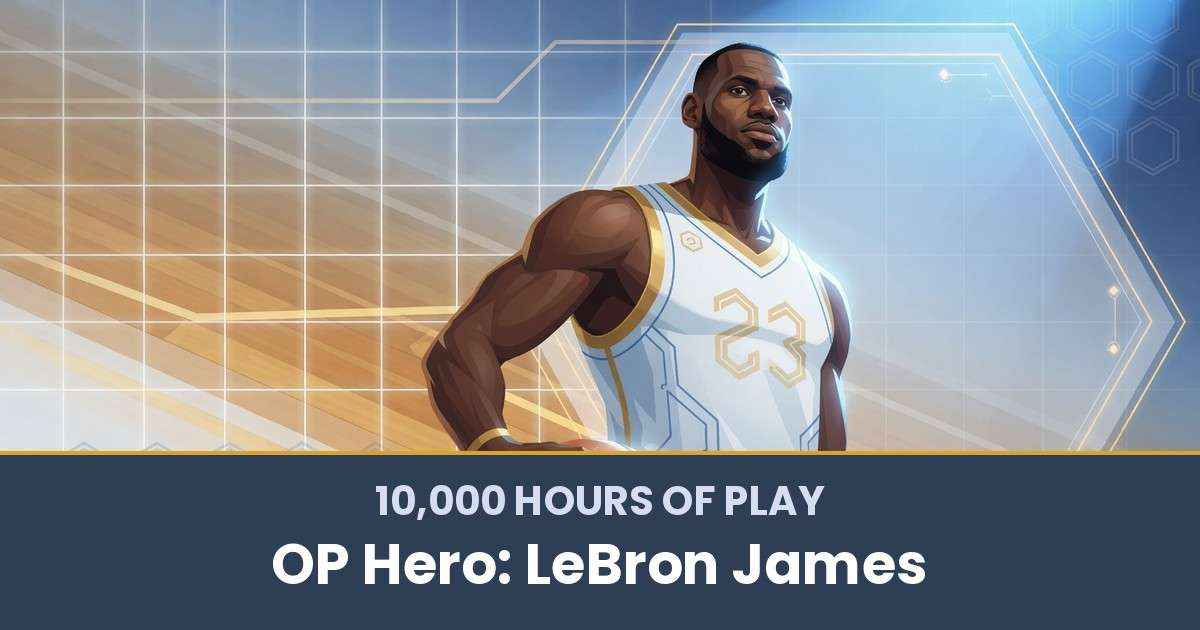


A kid from Akron with no NBA pedigree, no second parent in the house, and no certainty that next week’s apartment would even have heat decided at thirteen that he was going to be the most famous basketball player on Earth and a billionaire while he was still playing. Then he did it.
That sentence sounds like a marketing line. It is also the literal résumé. Four NBA championships, four Finals MVPs, the all-time scoring record, a self-funded public school in his hometown, a media company he controls, ownership stakes from Beats by Dre to Liverpool FC — all built by the same person who scored zero points in a summer league at twelve and decided that was unacceptable.
What’s interesting is not the highlights. It’s the build. LeBron Raymone James Sr. did not win the genetic lottery into a stable family or a top-tier prep program. He won the strategic lottery — over and over, on purpose, by stacking the right Attributes, picking the right Role at each chapter, and grinding canon Real-Life Game Skills that almost nobody in his bracket was even practicing.
Run his life through the 10,000 Hours of Play framework — Game, Attributes, Role, Skills, Allies, Quests — and a different story shows up under the trophies. The story of how a teenager built a character sheet good enough to survive a quarter-century of being the most-watched, most-doubted athlete in his sport, and still cash out as an owner.
⚡ Speed Run Notes
- LeBron’s “Game” was never just basketball. It was a stacked mission: longevity, hometown uplift, and business sovereignty — three quests that compound instead of competing.
- The court vision people praise as a Skill is actually an Attribute. He had it at thirteen. What he built on top of it — anticipation under fatigue — is the trainable layer.
- The Decision in 2010 looked like a PR disaster. It was also a deliberate move to test whether he could own his own narrative. The format failed; the strategic muscle stayed.
- 2016 Game 7 against the Warriors is the single cleanest case study of Phoenix Rebirth (Paladin) in modern sports — down 3-1, then a Finals where he led both teams in every major category.
- His real long-term play wasn’t winning more rings than Jordan. It was using basketball as a launchpad for SpringHill, Fenway equity, and the I PROMISE School — turning the game into capital and citizenship.
Table of Contents
- Step 1: The Game — What LeBron Was Actually Playing
- Step 2: Attributes — The Innate Stats
- Step 3: Role(s) — The Character Class Across Chapters
- Step 4: Skills — The Real-Life Game Skills LeBron Mastered
- Step 5: Allies — The People Who Multiplied LeBron
- Step 6: Quests — The Milestones That Shaped the Saga
- What You Can Steal From LeBron’s Build
- Where this framework comes from
- Related Reading
About Yu-kai Chou

Yu-kai Chou is the author of 10,000 Hours of Play — the book that treats your life as the most important game you’ll ever build a character in, and gives you the 6-Step framework (Game · Attributes · Role · Skills · Allies · Quests) to play it on purpose. He has spent two decades developing the system through which this post analyzes its OP Hero, and applies it to his own life and to the lives of the people he advises around the world.
Chou’s other framework, the Octalysis Framework, has been applied by LEGO, Microsoft, Porsche, Coca-Cola, Salesforce, and MrBeast, impacting over 1.5 Billion Users. He has taught the methodology at Harvard, Stanford, Yale, Tesla, Google, BCG, and IDEO, and has advised governments in eight nations including Ukraine, the United Kingdom, the Kingdom of Bahrain, Singapore, Taiwan, the Netherlands, Kazakhstan, and South Korea.
His work has been cited by Harvard, Stanford, MIT, Forbes, Wall Street Journal, Wired, US Department of Energy, NIST, NSF, NCBI, US Department of Education, ClinicalTrials.gov, and Google Scholar — with 3,700+ more academic publications. Explore his books here.
What I personally find instructive about LeBron’s build is the multi-quest stack. Most champion athletes pick one game and let everything else atrophy. LeBron treated his prime as a window to compound three games at once — the basketball game, the Akron game, and the equity game — and the one I’d lift for any reader is the discipline of refusing to let your peak years be a single-quest run. Your best decade should fund the next three.
Step 1: The Game — What LeBron Was Actually Playing
If you ask the casual fan what LeBron’s game is, the answer is “basketball.” If you ask LeBron, it’s never been one game. He’s been playing three quests on the same character at once since at least his early twenties, and the layering is what produced the LeBron we got instead of a more familiar one-dimensional superstar arc.
Quest one is basketball mastery and longevity. He has been explicit about chasing a complete résumé rather than a single record. The “chasing a ghost” line about Michael Jordan in 2016 was not modesty; it was a public commitment to compete against the most decorated career in the sport rather than the most decorated season. On February 7, 2023, he passed Kareem Abdul-Jabbar’s all-time scoring mark with 38,390 points, and he kept playing.
Quest two is hometown uplift. The LeBron James Family Foundation was formally established in 2004, the year after he entered the league. The I PROMISE School opened in Akron on July 30, 2018, as a public partnership with Akron Public Schools serving the kids most at risk of being where he was at thirteen. This was never a press-cycle charity. It was the build-out of a parallel mission.
Quest three is business sovereignty. From the 2005 founding of LRMR with Maverick Carter, Rich Paul, and Randy Mims, through SpringHill Entertainment in 2007, Uninterrupted in 2014, and their 2020 consolidation into The SpringHill Company — backed in successive rounds by Fenway Sports Group, Nike, Epic Games, and RedBird Capital — LeBron has methodically moved from being an endorsed athlete to being an equity-holding owner. The Beats by Dre stake that paid him roughly $30 million when Apple acquired the company in 2014 was the proof of concept; Liverpool FC through Fenway in 2011 was the upgrade.
Three quests, one character. That stack is the game. Pick this lens up the way 10,000 Hours of Play teaches and the headline trophies stop being the answer — they become the side quest funding the campaign.
Step 2: Attributes — The Innate Stats
Attributes in the 10K HP framework are the traits visible early — the ones you do not learn. LeBron’s were obvious to everyone who watched him at the Walker Williams Recreation Center in Akron before he was eligible to drive.
The first is anticipatory court vision. Local coaches at Walker Williams described a child who saw plays develop two passes ahead. By his sophomore year at St. Vincent–St. Mary High School in 2000-01 he averaged 25.2 points, 7.2 rebounds, 5.8 assists, and 3.8 steals — numbers no high-school sophomore puts up without an unusual perceptual stat. This is the Attribute behind every “how did he see that?” highlight twenty years later. You can run the same lens over your own profile with the Talent Triangle Method to find which of your innate stats is your real edge.
The second is the size-speed combo at a position no one had a manual for. He was an All-State wide receiver before he stopped playing high-school football in 2002. Football players who can also guard five basketball positions are not produced by any training program. That is base hardware.
The third is loyalty as a leadership channel. The “Fab Five” at SVSM — Sian Cotton, Dru Joyce III, Willie McGee, and later Romeo Travis — followed LeBron because LeBron refused to abandon them for a more prestigious program. He took less individual spotlight to keep the squad intact. Three state titles in 2000, 2001, and 2003 came out of that decision. So did the documentary More Than a Game in 2008, which is the case study of an Attribute paying out across a decade.
The fourth is media composure. The Sports Illustrated cover labeling him “The Chosen One” landed on February 18, 2002, while he was still in high school. Most teenagers handed that headline melt down inside a season. He kept averaging triple-doubles and signing autograph lines.
The fifth is resilience under instability. He and his mother Gloria moved repeatedly through his early childhood. The Walker family in Akron took him in for stretches. Most kids in that pattern do not become disciplined adults; they become survivors with a short time horizon. LeBron used the Walkers’ stability as a structural input and kept his planning window open.
Step 3: Role(s) — The Character Class Across Chapters
LeBron has played at least five distinguishable Roles, and the transitions between them are where you learn the most. Most superstars stay in one Role too long and bleed reputation. He swapped classes on purpose.
Role one was Prodigy Apprentice at SVSM from 1999 to 2003 — three state titles, Gatorade National Player of the Year in 2002, and a $90 million Nike endorsement signed in May 2003 before a single NBA game. The class here is hype-management as much as basketball. He had to perform under attention that would have collapsed a less composed teenager.
Role two was Anointed Heir in Cleveland from 2003 to 2010. First overall pick in the 2003 draft. Rookie of the Year in 2004 averaging 20.9 points and 5.5 rebounds. Carried a 17-65 franchise to the 2007 Finals. The role demanded that he be the entire offensive and emotional engine. He was. He also lost the 2007 Finals to the Spurs in a sweep, and that loss became the seed of Role three.
Role three was Strategic Free Agent in Miami from 2010 to 2014 — the consequential class change. “The Decision” television special on July 8, 2010 was the move’s botched delivery; the move itself was a Mastermind play to join Dwyane Wade and Chris Bosh and learn how to actually win at the championship level. The cost was years of being the most-booed player in basketball. The reward was the 2012 and 2013 titles, plus the championship habits he carried back to Cleveland.
Role four was Redemption King in Cleveland from 2014 to 2018, capped by the 2016 Finals — the only 3-1 Finals comeback in NBA history, in his hometown’s first championship in any major sport in 52 years. The role was about giving a city something it had been told it would never get.
Role five is Elder Statesman / Owner-Builder from 2018 onward — the Lakers tenure, the all-time scoring record, and the parallel rise of The SpringHill Company. The reason these chapters matter as Roles instead of just résumé lines is that each chapter required dropping the previous class’s coping behaviors. The Anointed Heir who tried to do everything had to learn to share the offense in Miami. The Redemption King who needed Cleveland’s love had to leave it again. Knowing when to leave a Role you have mastered is its own meta-skill, and very few champions ever learn it.
Step 4: Skills — The Real-Life Game Skills LeBron Mastered
Here is where the canon Real-Life Game Skills earn their keep. LeBron is one of the cleanest case studies in the catalog because so many of his moments are time-stamped and visible on film.
Vision Manifestation (Warlock) — the Skill of mentally rehearsing success so vividly that reality bends toward it. LeBron has talked openly about visualizing the final possession of championship games as a teenager. The “I want to be a billionaire athlete” goal he stated before he had a contract was not a press line; it was the public version of the mental movie he had already been running. Like the other Warlock skills in the canon, the power comes from the discipline of holding a specific image long enough for the body to start matching it.
Tactical Command (Ranger) — the Skill of making people of different talents work harmoniously. The SVSM Fab Five was the first proof. The 2010 Big Three in Miami was the master-class. He took Wade’s primary-scorer ego and Bosh’s role-flex, redesigned his own game to be the connector, and produced the franchise that won back-to-back titles in 2012 and 2013. Most superstars build teams that orbit them; he built one he could orbit and then bend.
Lich Grind (Warlock) — the Skill of intense, secluded work periods. His widely reported $1.5 million-per-year personal body program (hyperbaric chambers, cryotherapy, the dedicated chef, the masseuse on call) is the visible tip. The invisible part is the offseason film study — defensive coverages from teams he is not even sure he will face. The reason he is still effective at forty is not luck; it is decades of solitary maintenance.
Mastermind (Ranger) — the Skill of creating, adapting, and executing complex plans. The Miami move was a Mastermind play. The 2014 return to Cleveland — including the “I’m coming home” Sports Illustrated essay timed for maximum public-narrative reset — was a Mastermind play. The 2018 move to the Lakers, structured around his sons’ future opportunities and his Hollywood business stack, was a Mastermind play. Every major career hinge has been pre-modeled.
Bind Fate (Warlock) — the Skill of leveraging someone else’s brand to make yourself more powerful. The unprecedented $90 million Nike deal in May 2003 was the founding move; he bound his fate to Phil Knight’s empire and walked into the league with a swoosh before he had a jersey. The same Skill shows up in the Beats by Dre equity stake before the Apple acquisition, the early Blaze Pizza investment in 2012, and the Liverpool FC minority stake via Fenway in 2011. He is one of the few athletes whose endorsement deals are reliably more lucrative than his salary because he chose equity over fee. Compare it with how Phil Knight himself built Nike on the same Skill from the opposite end of the table.
Phoenix Rebirth (Paladin) — the Skill of recovering from devastating failure and coming back stronger. The 2007 Finals sweep by the Spurs forced the strategic rethink that produced Miami. The 2011 Finals loss to the Mavericks forced the post-up game he showed up with in 2012. The Decision PR disaster forced the public-narrative discipline he has used ever since. And the 2016 Finals — down 3-1 to a 73-9 Warriors team, then leading both teams in points, rebounds, assists, steals, and blocks across the seven games, capped by the chase-down block on Andre Iguodala in Game 7 — is the cleanest Phoenix Rebirth moment in modern sports.
Step 5: Allies — The People Who Multiplied LeBron
You do not become LeBron alone. He is one of the most networked superstars in the sport’s history, and the Allies he picked early have stayed with him for two decades.
Frankie Walker Sr. and the Walker family took him in during the unstable middle-school stretch and gave him the structure to attend practice every day. Without that input, the work product never compounds.
Dru Joyce II coached him through SVSM and was an Ally who refused to flatter the prodigy. Coach Joyce’s son, Dru Joyce III, was one of the Fab Five and is now in front-office work — the Allies were both peers and growth partners.
Maverick Carter is the Ally who built the business. They have been operating together since high school. Rich Paul, who started as a Cleveland luggage-store guy selling vintage jerseys, became the agent who founded Klutch Sports Group and rewrote the leverage map for NBA players. Randy Mims, the fourth member of the original LRMR squad, runs operations across the whole stack. The fact that these four are still the inner ring twenty years in is its own credibility test.
Savannah James is the long-term anchor — high-school relationship, married 2013, three kids, the home stability that lets the rest of the build keep running.
Phil Knight and Nike multiplied the financial side at the start. Fenway Sports Group multiplied the equity side after. Each Ally was picked for a specific Skill the user did not have, which is the model — pick Allies the way you pick raid party members, not the way you pick lunch companions. The life-as-game lens makes this calculation explicit.
Step 6: Quests — The Milestones That Shaped the Saga
The saga has at least six pivotal Quests. The wins are obvious; the losses are where the build was forged.
Quest one: the SVSM run from 1999 to 2003. Three state titles, two Gatorade National Player of the Year awards, the SI cover, and the $90 million Nike deal in May 2003. The Quest established the brand and proved he could perform under unprecedented teenage scrutiny.
Quest two: the 2007 Eastern Conference Finals against Detroit. Game 5 in Detroit, May 31, 2007 — 48 points, including 29 of the Cavaliers’ last 30, in a double-overtime road win that broke the Pistons and sent Cleveland to the Finals. This is the night the NBA accepted he was the heir. The Spurs swept him in the Finals two weeks later, which was the Quest’s necessary failure.
Quest three: the 2010 Decision and the Miami move. The PR was a disaster — he has said publicly he would do the announcement differently — but the championship habits learned alongside Wade and Bosh are how the rest of his career was possible. He won the 2011 Finals failure first, then the 2012 and 2013 titles.
Quest four: the 2016 Finals. Down 3-1 to a 73-win Warriors team that had been crowned the best regular-season squad in NBA history. Cleveland came back. LeBron led both teams in every major statistical category across the seven games. The chase-down block on Iguodala in Game 7 became the most replayed defensive play of the decade. He delivered Cleveland’s first major sports championship since 1964.
Quest five: the I PROMISE School opening on July 30, 2018. The school is a public partnership with Akron Public Schools serving at-risk kids in his hometown. It is not a charter, not a private vanity project; it is a Quest with a budget, an enrollment, a school board, and outcomes. This is the side quest he has talked about as the most important one.
Quest six: passing Kareem on February 7, 2023 and continuing to play. He scored 38 points against Oklahoma City to take the all-time mark with 38,390, then logged the next season anyway. The Quest was not the record. The Quest was proving that the longevity stack works.
Run those six together with the failures attached, and the shape becomes clear: every win was preceded by a public loss he metabolized in private. That is the pattern other OP Hero profiles show up with too, and it is the part that translates.
What You Can Steal From LeBron’s Build
The takeaway is not “be 6’9″ with a 250-pound frame and a perceptual gift.” You can’t be. The takeaway is structural.
Stack your quests. The single-quest career is the brittle one. LeBron has spent twenty years compounding three games at once, and each one has fed the others. Your career, your family, and your community work can run on the same character.
Pick equity over fee. The Beats stake, the Liverpool stake, the SpringHill consolidation — none of those were the highest-paying short-term deals on the table. They were the highest-leverage long-term ones. Whenever a deal offers a piece versus a paycheck and you can afford the piece, take the piece.
Build the Ally ring early and keep it. Maverick, Rich, Randy, Savannah, Coach Joyce, the Fab Five. He picked his inner ring before the money showed up, and that is why the ring still works after the money arrived. You cannot reverse-engineer that after you are famous.
Use your worst public moments as private rewriting prompts. The Decision in 2010, the 2011 Finals loss, the 2007 sweep — each one became the curriculum for the next chapter. The pattern is simple to describe and hard to do: refuse to let the public verdict be the final one. If you only run one experiment a year, run that one.
If those four moves land — and especially if the last one did — that is the entire system the book unpacks, with the worksheets to run it on your own character sheet.
Where this framework comes from

Want the full system this profile is built on?
Every OP Hero piece runs through the same 6-Step framework from 10,000 Hours of Play: Unlock Your Real-Life Legendary Success. The book covers the full system, walks through Yu-kai’s own life run as the first applied case study, and gives you the worksheets to audit your own build.
Related Reading
- All OP Hero Profiles — every hero on the site analyzed through the same 6-Step framework.
- OP Hero: Kobe Bryant — the other Lakers icon, built on a different attribute stack.
- OP Hero: Michael Jordan — the ghost LeBron has been chasing.
- OP Hero: Serena Williams — another generational athlete who built a parallel business empire.
- The Two-Quest Rule — how to stop researching and start running the actual quest.