
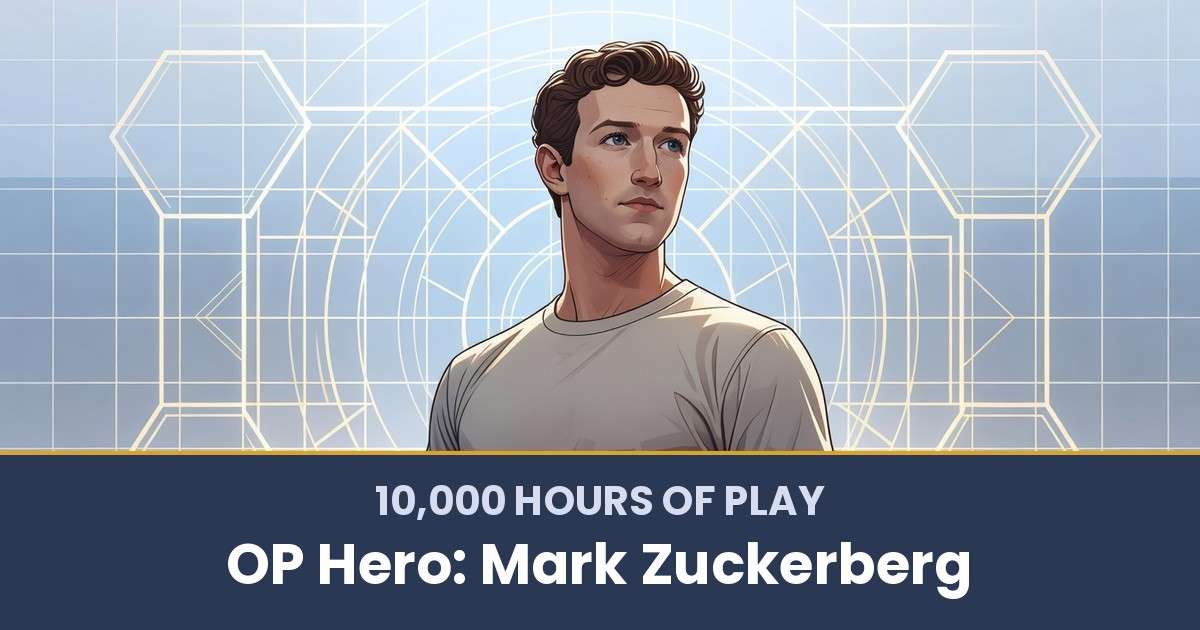


In February 2004, a 19-year-old Harvard sophomore launched a directory site for college students out of a dorm room in Kirkland House. Twenty-two years later, that same person stood in front of a Senate committee, ran the largest social platform in human history, owned the world’s most-used messaging app, had bet roughly $50 billion of his own company on a virtual world almost nobody had asked for, and was simultaneously rebuilding the entire org around open-source AI.
Mark Zuckerberg’s run is the most publicly observed founder build of the last twenty years. It is also the most consistently misread. The popular version is “lucky kid coded a website.” The actual version is a tight loop of one Game played in roughly six chapters, with the same handful of 10,000 Hours of Play Skills firing in different combinations each time the company nearly broke.
The interesting question is not “how did he build Facebook.” It is: how does the same operator survive the Facemash disciplinary hearing in 2003, the Beacon backlash in 2007, the IPO botch in 2012, Cambridge Analytica in 2018, the Meta share collapse in 2022, and still ship the strongest AI strategy in big tech by 2025? That is the build worth studying.
⚡ Speed Run Notes
- Zuckerberg’s Game was never “build a college directory” or even “build a social network.” It is one sentence: rewire how humans connect at planet scale, using whatever software substrate is current.
- The 2003 Facemash hearing is not a black mark on the build. It is the first visible firing of his core Attribute — comfort treating social conventions as engineering constraints to be tested, not laws to be obeyed.
- The $1B Instagram buy in 2012 and the $19B WhatsApp buy in 2014 are not separate deals. They are one Mastermind move: lock the mobile social graph before mobile finishes eating the desktop one.
- The 2018 Cambridge Analytica scandal cost the company about $5 billion in FTC fines and pulled Zuckerberg through seven Congressional appearances between 2018 and 2021. It is also the cleanest Phoenix Rebirth case study in the modern tech catalog.
- Reality Labs has burned nearly $60 billion since 2021 with no profit in sight. Read that as a Sacrificial Cycle bet, not a metaverse joke. The compounding upside is patient and the company-wide downside cap is what makes the bet legal at his shareholder structure.
- The lesson for your own life run: founders who survive twenty years are not the smartest in the room. They are the ones who can keep pointing at the same Game while everything underneath the Game keeps moving.
Table of Contents
- Step 1: The Game — What Mark Zuckerberg Was Actually Playing
- Step 2: Attributes — The Innate Stats
- Step 3: Role(s) — The Character Class Across Chapters
- Step 4: Skills — The Real-Life Game Skills Mark Zuckerberg Mastered
- Step 5: Allies — The People Who Multiplied Mark Zuckerberg
- Step 6: Quests — The Milestones That Shaped the Saga
- What You Can Steal From Mark Zuckerberg’s Build
- Where this framework comes from
- Related Reading
About Yu-kai Chou

Yu-kai Chou is the author of 10,000 Hours of Play — the book that treats your life as the most important game you’ll ever build a character in, and gives you the 6-Step framework (Game · Attributes · Role · Skills · Allies · Quests) to play it on purpose. He has spent two decades developing the system through which this post analyzes its OP Hero, and applies it to his own life and to the lives of the people he advises around the world.
Chou’s other framework, the Octalysis Framework, has been applied by LEGO, Microsoft, Porsche, Coca-Cola, Salesforce, and MrBeast, impacting over 1.5 Billion Users. He has taught the methodology at Harvard, Stanford, Yale, Tesla, Google, BCG, and IDEO, and has advised governments in eight nations including Ukraine, the United Kingdom, the Kingdom of Bahrain, Singapore, Taiwan, the Netherlands, Kazakhstan, and South Korea.
His work has been cited by Harvard, Stanford, MIT, Forbes, Wall Street Journal, Wired, US Department of Energy, NIST, NSF, NCBI, US Department of Education, ClinicalTrials.gov, and Google Scholar — with 3,700+ more academic publications. Explore his books here.
What I find instructive about Mark’s build is that his clearest competitive advantage is not his coding, it is his willingness to stay on a single sentence-long mission for two decades while the implementation around it gets rewritten four times. The lesson I would lift for your own run is at Step 1: the Game stays still while everything else changes. If your Game keeps drifting every two years, you do not actually have a Game. You have a series of jobs.
Step 1: The Game — What Mark Zuckerberg Was Actually Playing
One sentence: rewire how humans connect at planet scale, using whatever software substrate is current.
The same sentence covered Synapse, the MP3 player he built in high school in 2002 that learned which songs his friends liked. It covered CourseMatch and Facemash at Harvard in 2003, both of which were directories of human relationships in different shapes. It covered Thefacebook on February 4, 2004, opened up beyond Harvard later that year, and beyond universities in 2006. It covered the platform expansion in 2007. It covered the mobile pivot in 2012, the Instagram and WhatsApp acquisitions, the Meta rebrand in 2021, and the Llama open-source AI strategy from 2023 onward.
The substrate keeps changing. The Game does not. That is what most people miss when they call Zuckerberg “lucky.” Luck explains the first hit. It does not explain a twenty-year compounding loop where each new platform technology — web, mobile, VR, generative AI — gets folded back into the same one-sentence mission inside three years of its commercial arrival. The same pattern shows up in Jensen Huang’s run at NVIDIA: one Game (accelerated computing) held still while the use cases moved from graphics to crypto to AI.
The official Facebook mission statements track this. The 2012 S-1 read “make the world more open and connected.” The 2017 revision read “give people the power to build community and bring the world closer together.” The 2021 Meta rebrand framed it as helping people “feel present” with each other across digital space. Different words, same Game.
When you build your own life run, the test is whether your Game still makes sense after one of your platforms dies. Zuckerberg’s did when desktop died. It did when in-feed organic reach died. It will most likely survive the death of the smartphone too.
Step 2: Attributes — The Innate Stats
Five Attributes show up early in the record and have not gone offline since.
Comfort treating social conventions as engineering constraints. The Facemash incident in November 2003 is the cleanest early evidence. He scraped Harvard house photos without permission, built a “hot or not” ranking interface in a weekend, and pushed it live. The Administrative Board investigated him for breach of security and breach of privacy. He was not expelled. He was unfazed. The same Attribute reappears in the 2006 News Feed launch, the 2007 Beacon failure, and the 2014 changes to default privacy settings. He treats norms as variables, not constants.
Systems and abstraction thinking. Even at 18, the projects he picked were not toys; they were generalized engines. Synapse was a recommendation system, not a playlist. Facemash was a ranking algorithm, not a gallery. Thefacebook was the schema of a social graph before “social graph” was a phrase anyone outside MIT used. The Talent Triangle Method calls this the multiplier Attribute: the one that makes every Role you take downstream of it more valuable than it would have been alone. For Zuckerberg, systems-thinking is that multiplier.
Extreme focus over long horizons. Roommates Joe Green and Dustin Moskovitz have described him coding through nights at Kirkland House to the point of skipping classes for days. The mobile rewrite of Facebook from 2011 to 2014 was a roughly three-year company-wide push he led personally, refusing to ship feature work that did not pass the mobile test. The metaverse bet is now in year five and counting. The Attribute is not the length of any single push. It is the willingness to keep the same push going past the point where most operators rotate to something easier.
Risk tolerance disguised as engineer’s calm. Dropping out of Harvard in 2004 to move Facebook to Palo Alto when the site was still under 100,000 students. Turning down a $1 billion Yahoo acquisition offer in 2006. Spending $1 billion of company money on Instagram in 2012 when it had 13 employees and zero revenue. Spending $19 billion on WhatsApp in 2014. Renaming the entire company in 2021 to anchor a category that did not yet exist commercially. He does not present as a risk-seeker. He behaves like one.
Competitive scorekeeping mindset. Captain of the fencing team at Phillips Exeter, where he was rated by USA Fencing as a strong saber competitor. Fencing rewards individual ranking and tactical adaptation under time pressure, which is roughly what running a public company under quarterly earnings looks like as an Attribute test. He has framed almost every major moment publicly as “beating” something — beating MySpace, beating Google in time spent, beating TikTok with Reels, beating closed-source AI with Llama.
Step 3: Role(s) — The Character Class Across Chapters
Six Roles, none retired cleanly.
From roughly 2002 to 2005, he was the Hacker-Builder. Synapse Media Player in 2002 drew acquisition interest from Microsoft and AOL while he was still in high school; he released it free and went to Harvard anyway. CourseMatch and Facemash followed at Harvard. Thefacebook launched February 4, 2004 and crossed 1,000 Harvard users within 24 hours. The Role was: solo coder shipping product on weekly cycles.
From 2005 to about 2011, he was the Founder-CEO and Growth Commander. Moved to Palo Alto in the summer of 2004, dropped out of Harvard, took early angel money from Peter Thiel in September 2004, opened Facebook beyond colleges in September 2006, launched News Feed that same month, and launched the Facebook Platform at the first f8 conference on May 24, 2007 — the moment “social graph” entered the wider vocabulary as a programmable object.
From 2011 to 2015, he was the Mobile Rebuilder. Recognized in late 2011 that Facebook’s HTML5-based mobile app was failing against the iOS-native alternatives users were actually adopting. Personally drove a roughly three-year migration to native iOS and Android. Bought Instagram in April 2012 for ~$1 billion in cash and stock. Bought WhatsApp in February 2014 for ~$19 billion. Acquired Oculus VR in March 2014 for ~$2 billion. The Role was: catch the platform shift before it kills the company, and pay almost any price to do it.
From 2016 to 2020, he was the Crisis-Era Steward. Russian interference in the 2016 election, Cambridge Analytica in March 2018, two days of Congressional testimony in April 2018, a $5 billion FTC settlement in July 2019, the Christchurch livestream in March 2019, the Capitol siege moderation calls in January 2021. The Role was: stop denying that a platform of 2.5 billion users is a public utility, build the moderation, legal, and policy spine for it, and absorb the public-perception cost personally.
From October 2021 to roughly 2023, he was the Metaverse Architect. Renamed Facebook to Meta on October 28, 2021. Reorganized Reality Labs as a peer business unit. The stock dropped 64 percent in 2022 on combined ad-market weakness and the perceived Reality Labs drain. He kept the bet on. He took the public ridicule on the chin. This Role’s final ledger is not closed.
From roughly 2023 onward, he has been the Open-Source AI Counter-Strategist. Released Llama 2 with a permissive commercial license in July 2023 in a market where every major rival was going proprietary. Stood up the Meta AI assistant inside Facebook, Instagram, and WhatsApp at consumer scale by 2024. Re-anchored the company narrative on AI throughput while keeping Reality Labs running underneath. The Role borrows the body language from his early Hacker-Builder Role; the surface area is now company-scale instead of Kirkland House-scale.
Step 4: Skills — The Real-Life Game Skills Mark Zuckerberg Mastered
Six canon Real-Life Game Skills carry the build. Each one earns its place from a specific moment.
Vision Manifestation (Warlock). The same Skill family that includes the canonical Warlock examples in the 10K HP catalog. Zuckerberg’s clearest firing of this Skill is the social graph itself. At the May 2007 f8 keynote he stood in front of developers and described the social graph as a programmable platform layer that other apps would build on top of. The whole industry then proceeded to build out his mental model for the next decade. Vision Manifestation is rehearsing a future state so vividly that other people start agreeing to live inside your picture of it. He did that once with the social graph and is now in year five of doing it again with the metaverse, with the early results still unclear.
Lich Grind (Warlock). Intense, secluded work periods. The original Thefacebook codebase was largely written by him over a roughly two-week sprint in late January 2004, with the site shipping February 4. The same grind pattern reappears throughout the early Palo Alto years — Sean Parker and Dustin Moskovitz have both described him sitting in front of a screen for entire weekends. Lich Grind is not about hours logged; it is about the willingness to disappear from the social plane until the version-one ship is in production.
Mastermind (Ranger). Creating, adapting, and executing complex multi-step plans. The cleanest case is the mobile defense. By late 2011 he had identified that Facebook’s HTML5 mobile shell was going to lose to native apps, that mobile-native social was being captured by Instagram, that mobile-native messaging was being captured by WhatsApp, and that the next interface paradigm after mobile would most likely be spatial computing. Inside three years he had rewritten Facebook native, bought Instagram for $1 billion, bought WhatsApp for $19 billion, and bought Oculus for $2 billion. The same Skill drives the parallel sequence in Jeff Bezos’s early AWS sequencing: a long chain of moves where any single one taken alone would not have made sense.
Animate (Warlock). Automating human-labor processes to computing. News Feed in September 2006 was the first time a social product ranked content algorithmically at consumer scale, instead of presenting chronological lists. Users initially revolted; nearly 1 million joined a “Students Against Facebook News Feed” group inside a week. Zuckerberg held the launch, added privacy controls, and the algorithm became the default for every social platform that followed. The same Skill drives the ads-ranking auction, the People You May Know graph, and the Reels recommendation engine. Each one replaces what used to be a human curator with a system.
Phoenix Rebirth (Paladin). Recovering from devastating failure and coming back stronger. The Cambridge Analytica disclosure in March 2018 was a near-existential event. The company faced a $5 billion FTC fine in July 2019, two days of high-profile Congressional testimony in April 2018 followed by a multi-year cycle of follow-on Congressional appearances and private-litigation depositions, a multi-year overhaul of data sharing policy, and a deferred prosecution risk in several jurisdictions. The recovery shipped quietly: API restrictions, Privacy Checkup tooling, third-party audits, a $13 billion cumulative safety and security investment by 2022, and the eventual Reality Labs and AI pivots that re-anchored the company narrative away from “the trust scandal company.” It is the consumer-internet version of the same Skill that defines the Bill Gates antitrust recovery: take the punishment in public, do the unglamorous rebuilding in the years afterward.
Sacrificial Cycle (Warlock). Reinvesting all resources back into the project. Reality Labs has reportedly absorbed close to $60 billion in cumulative losses since 2021, with Meta’s own filings showing the segment running at $16 to $18 billion in annual operating losses through 2023 and 2024. He has refused to cut it. The cap-table structure built at the 2012 IPO, which left him with majority voting control, is what makes that refusal possible without an activist-investor revolt. Whether the bet pays off is an open question. The Skill is intact either way: he is reinvesting the cash flow from a mature ad business into a category that may or may not exist commercially in 2030.
Step 5: Allies — The People Who Multiplied Mark Zuckerberg
Sheryl Sandberg. Joined as COO in March 2008 from Google. Built the entire ads sales organization, the international expansion playbook, and the political-affairs spine that absorbed most of the public exposure during the 2016–2020 crisis cycle. Without Sandberg, Facebook is most likely a smaller, less monetized product and Zuckerberg himself has fewer protected cycles for product strategy. The COO-as-operational-twin pattern shows up in Tim Cook’s run alongside Steve Jobs at Apple a generation earlier.
Dustin Moskovitz. Roommate, co-founder, second engineer at Harvard, and the operational backbone of the early Palo Alto years. Wrote critical pieces of the original infrastructure. Left in 2008 to start Asana. The proof of his impact is in the period after he left: the company eventually had to hire entire teams to replicate the operational discipline he held in his head.
Sean Parker. Founding president of Facebook in 2004. Introduced Peter Thiel, negotiated the early term sheets, and shaped the founder-control voting structure that has since become the canonical model for founder-led tech companies. Forced out in 2005 over personal legal issues. The cap-table architecture he helped Zuckerberg lock in is the same structure that allowed the Reality Labs Sacrificial Cycle two decades later.
Peter Thiel. First outside investor at $500,000 for a 10.2 percent stake in September 2004 at a $4.9 million valuation. More importantly, the first board member who consistently advised Zuckerberg to bias toward long-horizon bets over quarterly optimization. Left the board in 2022 after 17 years. The advisory through-line shaped the bias toward platform moves that look insane on a one-year horizon.
Andrew “Boz” Bosworth. Joined in 2006 as one of the early engineering leads on News Feed. Now CTO of Meta and the operating lead on Reality Labs since 2017. The bench depth in the AR/VR build is largely his org. When historians look back at whether the metaverse bet shipped, his name will be on it next to Zuckerberg’s.
Priscilla Chan. Married Zuckerberg in May 2012. Co-founded the Chan Zuckerberg Initiative in December 2015, with a stated commitment of 99 percent of their Facebook shares to be given away during their lifetimes. The same pattern that shows up in other founder builds in this series: the home Ally is part of the infrastructure that makes a 20-year run survivable. The CZI work has also given Zuckerberg a parallel arena where the brand is not “the Facebook guy” but “the science funder,” which has bought back narrative range during the worst stretches of the company’s public reputation.
Step 6: Quests — The Milestones That Shaped the Saga
2002 — Synapse Media Player. High-school senior project that drew interest from Microsoft and AOL. Released free instead of sold. The first time he chose long-term optionality over a near-term liquidity event.
October 28, 2003 — Facemash launches and is shut down within 48 hours. Administrative Board investigation. No expulsion. The Comfort-with-norm-breaking Attribute is now on the public record.
February 4, 2004 — Thefacebook launches at Harvard. Crosses ~1,000 users in the first day.
Summer 2004 — moves to Palo Alto and drops out of Harvard. Sean Parker joins as founding president; Peter Thiel invests $500,000 in September. The Hacker-Builder Role hands off to the Founder-CEO Role.
2006 — turns down Yahoo’s $1 billion acquisition offer. The Risk-tolerance Attribute meets the Game-as-mission discipline for the first time at company-deciding scale.
September 5, 2006 — News Feed launches. Roughly 1 million users join a protest group within a week. Facebook holds the launch, adds privacy controls, and the algorithm becomes the default consumer-internet UX.
May 24, 2007 — f8 Platform launch. Introduces the social graph as a programmable layer. Beacon launches in November of the same year, draws an immediate user revolt over publishing purchase data, and is pulled. One Vision Manifestation hit, one Animate misfire, both in the same year.
May 18, 2012 — Facebook IPO at $38 per share. Botched first day on NASDAQ due to exchange technical issues. Stock falls roughly 50 percent within months. By August 2013 it is back above the IPO price; by 2015 it has tripled it.
April 9, 2012 — Instagram acquisition for ~$1 billion. 13 employees. No revenue. Mobile-native social graph locked.
February 19, 2014 — WhatsApp acquisition for ~$19 billion. Mobile-native messaging graph locked. The two acquisitions are the same Mastermind move executed 22 months apart.
March 25, 2014 — Oculus acquisition for ~$2 billion. Bet on the next post-mobile interface, made roughly seven years before the consumer market would be ready.
November 8, 2016 — US election outcome triggers misinformation backlash. The platform’s role in political information is the central public-perception question for the next four years.
March 17, 2018 — Cambridge Analytica disclosure. Stock drops ~7 percent on the day. The Phoenix Rebirth chapter begins. Two days of Congressional testimony on April 10–11, 2018. A $5 billion FTC settlement on July 24, 2019. Cumulative safety and security investment north of $13 billion by 2022.
October 28, 2021 — Meta rebrand. Reality Labs becomes a peer business unit. The Sacrificial Cycle chapter goes live at company scale.
2022 — Meta stock falls roughly 64 percent. Ad-market weakness plus Reality Labs perception combine into the worst single-year drawdown of any large-cap US tech name. Layoffs of 11,000 employees announced in November.
July 18, 2023 — Llama 2 released under a permissive commercial license. The Open-Source AI Counter-Strategist Role goes live. Meta stock more than doubles across 2023.
2024–2025 — Meta AI shipped at scale inside Facebook, Instagram, and WhatsApp. The same playbook from News Feed in 2006 applied to generative AI in the feed: ship at user scale before the rest of the industry has finished arguing about safety policy.
What You Can Steal From Mark Zuckerberg’s Build
Three transferable patterns.
First, the Game stays still while everything else changes. The substrate moved from desktop web to mobile native to spatial computing to generative AI in twenty years. Zuckerberg’s one-sentence mission did not move at all. If your Game shifts every two years, you do not have a Game; you have a sequence of jobs that look like a career from a distance. The fix is not to lock your job title. The fix is to write the one sentence above the title that survives all of them.
Second, Sacrificial Cycle (Warlock) at scale requires a governance moat to be legal. The Reality Labs bet is only continuable because the dual-class share structure set up in 2012 leaves Zuckerberg with majority voting control. If you want to take a long-horizon Sacrificial Cycle bet inside an organization you do not control, the prerequisite is to build the political and structural moat around it first. Otherwise the bet gets killed by the next earnings call, not by the bet itself failing.
Third, Phoenix Rebirth (Paladin) is not a comeback story; it is a years-long unglamorous rebuild. The Cambridge Analytica recovery did not happen in the two days of Congressional testimony. It happened in the four years of API restrictions, audit programs, and $13 billion of safety investment that nobody clipped for a documentary. The comeback that gets remembered is built on the part that does not photograph well. The fuller catalog of builds with this same pattern lives in the OP Hero profiles hub, where you can compare across founders.
Where this framework comes from

Want the full system this profile is built on?
Every OP Hero piece runs through the same 6-Step framework from 10,000 Hours of Play: Unlock Your Real-Life Legendary Success. The book covers the full system, walks through Yu-kai’s own life run as the first applied case study, and gives you the worksheets to audit your own build.
Related Reading
- All OP Hero Profiles — the full catalog of builds analyzed through the 6 Steps.
- Bill Gates (Microsoft) — OP Hero profile — the closest sibling build: another Harvard-dropout founder who absorbed an antitrust crisis and rebuilt the company around a new platform.
- Jeff Bezos (Amazon) — OP Hero profile — the parallel example for Mastermind (Ranger) used to chain multi-step bets across a decade.
- Jensen Huang (NVIDIA) — OP Hero profile — another founder-CEO who refused to sell during an existential trough and was eventually paid for the patience.
- The Talent Triangle Method — how to pick the Attribute / Skill / Role combinations your own Game is built on.
- The Skills Spectrum — Specialist, Dabbler, Master, Strategy. The taxonomy under every Skill mention in this profile.