
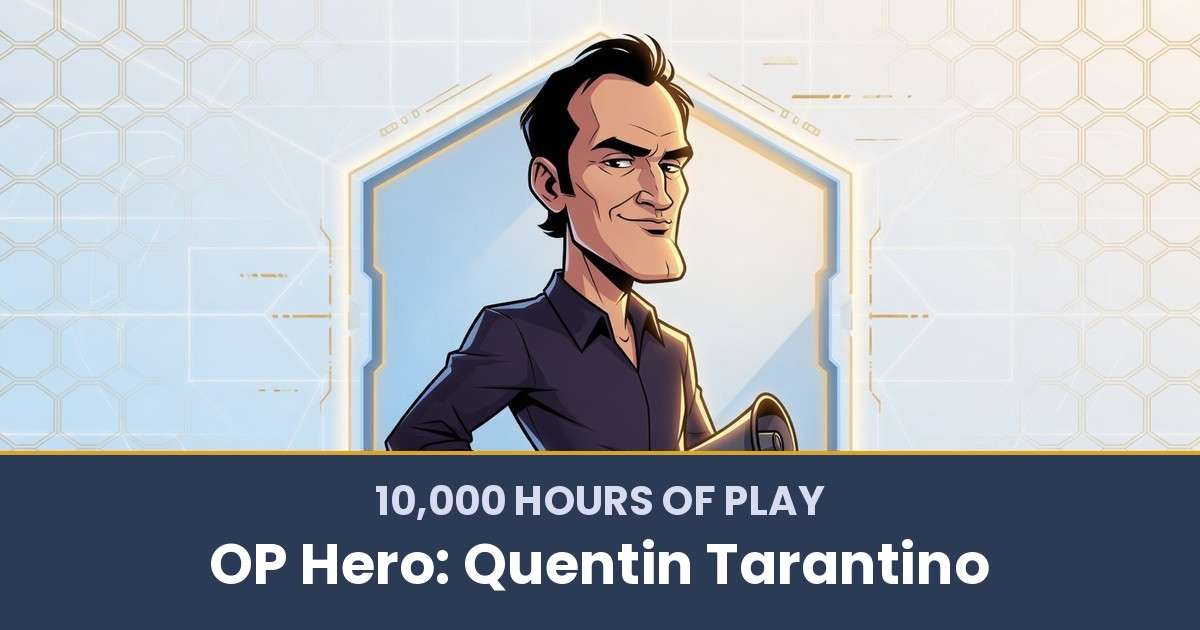


In the late 1980s, one of the best film educations in America was not happening at a film school. It was happening behind the counter of a video rental store in Manhattan Beach, California, and its most committed student was a high-school dropout who worked the counter there through his twenties.
Quentin Tarantino had no degree. He had left school at fifteen. He had no money, no industry connections, and no obvious way in. His first real attempt at a movie, shot on weekends over roughly three years, was never finished.
Then, in January 1992, a crime film called Reservoir Dogs premiered at the Sundance Film Festival. Two years later Pulp Fiction won the Palme d’Or at Cannes and an Academy Award. The clerk had become the most imitated filmmaker of his generation.
It is tempting to file that under raw talent or lucky timing. Run Tarantino through the 10,000 Hours of Play framework instead, and something more useful appears. You find a deliberate build, assembled piece by piece by someone who treated his obsession as training. Here is that build, step by step.
⚡ Speed Run Notes
- Tarantino’s real game was never just “direct movies.” It was to stay a fully independent writer-director with total authorship, and to leave behind a tight, finite body of work.
- His video-store years were not a detour before his career. They were the career’s training montage: thousands of hours of films watched, sorted, and argued about.
- His signature move is theft, by his own description. He absorbs everything cinema has ever done and recombines it into something that reads as new.
- His first film fell apart. Most of the footage was lost, and he started over. The setback became the foundation, not the end.
- When other hands rewrote one of his scripts and he hated the result, he turned that loss into a rule he never broke again: control the work or do not sell it.
- The move you can copy: pick one obsession and treat the hours you already spend on it as deliberate practice.
Table of Contents
- Step 1: The Game
- Step 2: Attributes
- Step 3: Role(s)
- Step 4: Skills
- Step 5: Allies
- Step 6: Quests
- What You Can Steal From His Build
- The 10K HP Frame in One Pass
- The Octalysis Core Drives He Activated
- Modern Echo: Who Plays This Game Today
- Frequently Asked Questions
- Where This Framework Comes From
- Related Reading
About Yu-kai Chou

Yu-kai Chou is the author of 10,000 Hours of Play — the book that treats your life as the most important game you’ll ever build a character in, and gives you the 6-Step framework (Game · Attributes · Role · Skills · Allies · Quests) to play it on purpose. He has spent two decades developing the system through which this post analyzes its OP Hero, and applies it to his own life and to the lives of the people he advises around the world.
Chou’s other framework, the Octalysis Framework, has been applied by LEGO, Microsoft, Porsche, Coca-Cola, Salesforce, and MrBeast, impacting over 1.5 Billion Users. He has taught the methodology at Harvard, Stanford, Yale, Tesla, Google, BCG, and IDEO, and has advised governments in eight nations including Ukraine, the United Kingdom, the Kingdom of Bahrain, Singapore, Taiwan, the Netherlands, Kazakhstan, and South Korea.
His work has been cited by Harvard, Stanford, MIT, Forbes, Wall Street Journal, Wired, US Department of Energy, NIST, NSF, NCBI, US Department of Education, ClinicalTrials.gov, and Google Scholar — with 3,700+ more academic publications. Explore his books here.
What I find instructive about Quentin Tarantino’s build is that he never waited for permission to start training. He could not get into film school, so he turned a video-store job into one. The lesson I would lift from his run is the one in Step 4 below: the obsession you already have is not a distraction from your real work. Treated deliberately, with enough hours and enough attention behind it, that obsession can become the most specific competitive advantage you will ever own.
Step 1: The Game — What Quentin Tarantino Was Actually Playing
Every OP Hero is playing one core game that sits under all the job titles. Tarantino’s game was never simply “be a film director.” Plenty of people direct films. His game was narrower and more stubborn. He wanted to be a fully independent writer-director, working in his own voice, with authorship of every frame, and to do it without being absorbed into the studio-for-hire system that swallows most directing talent.
He has been blunt about this for his whole career. In a 1994 interview he said he had not gotten into the business to be a director-for-hire; he wanted to write and direct his own material. The distinction matters. A director-for-hire executes someone else’s vision well. Tarantino wanted the vision itself to be the job.
There is a stranger rule inside his game, and it tells you how seriously he takes it. For years he has said he intends to stop directing after ten films. Not because he expects to run out of energy, but because he wants to leave behind a tight filmography rather than a long one that trails off at the end. Most ambitious people play for “more.” Tarantino designed his game for something closer to “enough, and excellent”: a deliberately small shelf of work he can stand behind completely.
That is exactly what Step 1 of the 10,000 Hours of Play system asks you to do first. Name the real game you are playing, not the role printed on your business card. Tarantino’s title has changed many times. The game under it has not moved an inch.
Step 2: Attributes — The Innate Stats
Attributes are the stats you show up with, the ones visible before anyone trains you. Tarantino rolled an unusual set.
Encyclopedic film memory. Long before he had any industry standing, the people around him noticed it. As a clerk he could recall actors, directors, scenes, and obscure titles on command, and chain them together: if you liked one movie, he could name three more that had the exact scene you loved. Co-workers described him as a walking film encyclopedia. That is pattern recognition aimed at a single domain, and it was running at full speed before anyone paid him for it.
A performer’s imagination. As a child he acted out movies and characters. As an adult he still does it. When he pitched Pulp Fiction, he reportedly performed the film in the room, moving between characters and voices. His dialogue reads the way it does because he hears it as performance first and text second.
High risk tolerance. He left high school at fifteen, betting that movies, not a diploma, would be his way through. Later he refused to soften the language and violence in his scripts even when that cost him comfort and approval. The willingness to be disliked for the work was there early.
Fan energy. Collaborators describe him as a fan first, someone whose open, almost boyish enthusiasm for cinema pulled other people into his orbit. That energy is not a learned sales technique. It is a temperament, and it did real work in getting his early films made.
If you want to find your own innate stats, Yu-kai built a tool for exactly that: the OP Talent Triangle Method, which locates the corner where your natural strengths overlap. Tarantino’s corner was obvious by his early twenties. He spent that decade walking straight toward it.
Step 3: Role(s) — The Character Class Across Chapters
A Role is the character class you play in a given chapter. Tarantino re-classed several times, and each class quietly equipped the next.
He began as an aspiring actor. After leaving school at fifteen he studied acting and picked up small parts, including a brief, now-famous turn as an Elvis impersonator on a 1988 episode of The Golden Girls. The acting career went nowhere. But the training in how performers build a character never left his writing.
Through the mid-1980s he played the role that defined everything: video-store clerk and self-directed film scholar. At Video Archives in Manhattan Beach he spent years watching films constantly, arguing about them with customers and co-workers, and drafting his own scripts on the side. This was the grinding-XP chapter, with no spotlight and no real income, just volume and attention.
From 1992 he re-classed to breakout indie writer-director with Reservoir Dogs, then Pulp Fiction. Small budgets, genre material, total creative control.
The late 1990s and 2000s brought the studio-scale auteur class. Jackie Brown, the two-volume Kill Bill, and Inglourious Basterds gave him bigger canvases and international casts, with the same authorship intact.
His current class, across the 2010s and beyond, is elder statesman and film historian. He programs a revival cinema, he published his first novel, and he talks about cinema’s past as carefully as he once recommended rentals.
No class was wasted. The actor taught him character, the clerk taught him cinema, the indie taught him control. Steven Spielberg ran the same logic, re-classing from amateur 8mm filmmaker to studio director to studio owner, each chapter funding the next. The early Role is always tuition for the later one.
Step 4: Skills — The Real-Life Game Skills Quentin Tarantino Mastered
Attributes are what you are born with. Skills are what you grind. In 10,000 Hours of Play, Skills are named like RPG abilities, each tied to a Class. Tarantino built a recognizable set.
Lich Grind (Warlock): long, secluded periods of intense work. This is the foundation Skill of his whole build. The Video Archives years were not a holding pattern before his real life started. They were the work: thousands of hours of films watched and dissected, plus scripts drafted with no audience and no paycheck for the effort. That kind of obsessive private grind, sustained for years, is the same Warlock discipline behind a Real-Life Game Skill like the Lich Pact: ordinary hours, compounded past the point most people are willing to go.
Siphoning (Warlock): extracting knowledge and technique rapidly from others. Tarantino has described his own method as theft. “I steal from every single movie ever made,” he said in a 1994 interview with Empire magazine, adding that he steals in order to make the result his own. He absorbed the grammar of Hong Kong action cinema, spaghetti westerns, exploitation films, and samurai pictures, then recombined them. Kill Bill is Siphoning made visible: a dozen genres drained for parts and welded into one revenge story.
Loremaster (Druid): weaving compelling, controlled stories. Tarantino’s craft is built on dialogue and structure. The opening of Inglourious Basterds is roughly twenty minutes of two men talking at a kitchen table, and it holds an audience by the throat the whole time because every line shifts the balance of power. That is Loremaster work: tension built from words, not explosions.
Mastermind (Ranger): designing and executing complex plans. Pulp Fiction was assembled from three separate story ideas, cut apart and reordered so the timeline loops back on itself. That is architecture, not instinct. The same planning Skill shows up in how he runs his career: the deliberate ten-film cap, and the deals he learned to structure so the work stays his.
Reflect Damage (Paladin): turning a setback into material for growth. Early on, a script of his was rewritten by other hands into a film he disowned (Step 6 has the story). Instead of stewing over it, he converted the experience into a rule he never broke again: protect control of the work.
Phoenix Rebirth (Paladin): recovering from a failure that could have ended the run. His first film collapsed before it was ever finished. He did not quit. He rebuilt, and the next attempt was Reservoir Dogs.
None of these are exotic powers. The Skills Spectrum makes the point well: mastery is usually a handful of ordinary Skills pushed to an unusual tier. Tarantino’s rarest move was not any single Skill. It was refusing to treat his fan-level obsession as a hobby, and grinding it like a craft instead.
Step 5: Allies — The People Who Multiplied Quentin Tarantino
No OP Hero levels up alone. Tarantino’s breakthrough ran on a small set of Allies, each one covering ground he could not cover himself.
Roger Avary was the first. The two met as co-workers at Video Archives, trading scripts, film recommendations, and story ideas. Avary shared in the creative DNA of the early work and won the Academy Award for Best Original Screenplay alongside Tarantino for Pulp Fiction. The video-store years were not a solo grind; they were a two-person workshop.
Lawrence Bender was the producer who turned scripts into films. He met Tarantino in the late 1980s, produced Reservoir Dogs, and went on to produce most of the films that followed. His job, again and again, was to find the money and protect the one non-negotiable point: that Tarantino direct his own scripts.
Sally Menke was his editor on every film from Reservoir Dogs through Inglourious Basterds. Tarantino has spoken of her as one of his closest collaborators, the person in the room who shaped the final rhythm of each movie. An auteur’s vision still needs a second pair of eyes to land, and for nearly two decades hers were his.
Miramax supplied the distribution muscle. After the studio picked up Reservoir Dogs, it gave Tarantino’s talky, violent, genre-soaked films a path to global audiences and awards rooms they might never have reached alone.
The pattern is worth copying. Tarantino did not build a vast network. He kept a few people with real standing: a co-writer, a producer, an editor, and a distributor who could carry the work outward. Stan Lee built Marvel the same way, pairing his own output with a tight circle of collaborators who turned ideas into a universe.
Step 6: Quests — The Milestones That Shaped the Saga
Quests are the concrete missions that move a saga forward. Tarantino’s headline Quests:
My Best Friend’s Birthday (mid-1980s). His first real film, shot on 16mm over roughly three years while he worked at the video store. It was never finished. Much of the footage was lost, and only a fragment survives today. This is the failed Quest every honest build contains, and it taught him how to make a movie before he had anything to lose.
Selling the scripts (early 1990s). Before he could direct, he wrote his way in. He sold the screenplays for True Romance and Natural Born Killers. The first became a Tony Scott film he was glad to have written. The second was reworked heavily by other hands into a movie he publicly disowned. Breaking in and getting burned happened almost in the same motion.
Reservoir Dogs (1992). Made for a reported budget of a little over a million dollars, his directorial debut premiered at the Sundance Film Festival in January 1992. It did not top the box office. It did something more useful: it announced, unmistakably, that a new voice had arrived.
Pulp Fiction (1994). The film that changed his standing entirely. It won the Palme d’Or at Cannes in 1994, earned Tarantino and Roger Avary the Academy Award for Best Original Screenplay, and grossed more than 200 million dollars worldwide, a figure almost unheard of for an independent film of its kind. The clerk was now the most copied filmmaker alive.
Buying the New Beverly Cinema (2007). A success Quest that looks backward. Tarantino bought the building housing a struggling Los Angeles revival cinema to keep it from closing. The most imitated director of his era spent his own money to protect a place that screens old movies on actual film.
Once Upon a Time in Hollywood (2019) and beyond. His 2019 film drew ten Academy Award nominations and won two, including Best Supporting Actor for Brad Pitt. In 2021 he published his first novel. With his self-imposed ten-film limit in view, every recent Quest is played with the ending deliberately in sight.
Read the full library of OP Hero profiles and the same shape keeps appearing: real builds always include at least one Quest the hero lost.
What You Can Steal From Quentin Tarantino’s Build
You are probably not going to direct films. That is not the point. The build logic is, and Tarantino, a man who has built a career on steal-and-recombine, would likely approve of you taking these three pieces.
First: treat your obsession as training. Tarantino never separated “watching movies for fun” from “becoming a filmmaker.” They were the same activity, run for enough years that they compounded. Most people quarantine their obsessions as hobbies and then wonder where their edge went. Whatever you already lose hours to, ask what it would look like to do it deliberately, with attention, and on the record.
Second: a closed door is not the end of the route. He could not get into the industry the normal way, so he built an irregular way in: a video-store education, two sold scripts, a tiny debut feature. When the front door is locked, the build does not stop. It re-routes.
Third: protect control of the work. The most expensive lesson of his early career was watching one of his scripts become a film he could not stand. He never let that happen again. If you make something you care about, decide early how much control you will trade away, because that decision is far harder to reverse than to get right the first time.
The quiet last lesson is in how it all started. Tarantino did not begin with access, money, or a plan anyone would have funded. He began with a fierce, specific love of one thing and the patience to spend ten thousand hours inside it. The filmography was what that obsession turned into once it was given enough time.
The 10K HP Frame — Quentin Tarantino Through the 6 Steps Lens
Run the whole story through the 10,000 Hours of Play framework in a single pass and Tarantino’s build reads as one of the cleanest in the entire OP Hero library.
The Game was defined early, and with unusual precision for a teenager: total authorship, and a finite shelf of work he could stand behind completely. Every decision afterward, from refusing director-for-hire money to capping the filmography at ten, executes that one definition.
The Attributes were loaded before anyone was watching. Encyclopedic film memory, a performer’s ear for dialogue, and a risk tolerance high enough to bet a diploma on a hunch.
The Roles stacked like tuition payments. The failed actor funded the writer, the video-store clerk funded the scholar, and the indie breakout funded the auteur.
Hours, stacked deliberately in a place nobody thought to look. That is the whole secret of the build.
The Skills chapter above names six abilities. Watching the arc again for this refresh, three more canon Skills from 10,000 Hours of Play earn their place on the character sheet.
True Sight (Ranger): observing keen details others miss. The clerk who could hear exactly which scene a customer loved and hand back three more films containing it grew into the director who saw a leading man inside John Travolta’s cold streak and a global star inside a then-unknown Christoph Waltz.
Batcave Crafting (Ranger): adapting and redesigning your environment to serve the mission. Tarantino has run this Skill twice at career scale. He converted a minimum-wage video store into a private film academy, and decades later he bought the New Beverly Cinema so a training ground like his would keep existing for whoever needs one next.
Divine Shield (Paladin): saying no, regardless of how persuasive the other side is. He said no to softening his scripts, no to a career of comfortable studio assignments, and no in 2024 to his own announced final project once it stopped clearing his bar.
The lineage deserves a line too. Akira Kurosawa ran a version of this same build decades earlier: an obsessive craftsman holding total control of the frame, whose genre inventions became raw material for every filmmaker after him, Tarantino very much included.
The Allies read like a deliberately balanced party. Roger Avary supplied a second creative brain at the video store, Lawrence Bender turned scripts into financed films, Sally Menke shaped the rhythm of every cut for two decades, and Miramax carried the finished work to the world.
Handing the Cliff Booth script to David Fincher in his sixties shows the Ally instinct still runs. When a Quest matters and the right specialist exists, an OP Hero recruits rather than hoards.
And the Quests hold the deepest lesson of the frame. The run opens with a failed mission, an unfinished first film shot over three years, and it aims to close on a designed ending, a tenth film held back until it can be worth the slot.
Most people let their careers end wherever momentum runs out. Tarantino wrote his ending into the quest log in advance.
Seen through the 6 Steps, the story loses its air of miracle and gains something better. It becomes a sequence you can study.
Which Octalysis Core Drives Quentin Tarantino’s Arc Activated
Yu-kai’s other framework, the Octalysis Framework, maps the eight Core Drives that power human motivation. Hold Tarantino’s arc against the octagon and four drives light up.
Core Drive 3: Empowerment of Creativity & Feedback. This is the engine of the whole filmography. “I steal from every single movie ever made” describes a creative loop: absorb the grammar of a hundred genres, recombine the parts, then test the result on a live audience.
The video store was CD3 running at maximum before any career existed. Every recommendation was a small creative act, and every customer reaction arrived as instant feedback.
Core Drive 4: Ownership & Possession. The most expensive lesson of his early career, watching other hands rework a script he loved, hardened into the rule that defines him: control the work or keep it.
Ownership also explains the purchases that puzzle outsiders, like buying the New Beverly so the projection booth his taste calls home would belong to him. Even the trademarks function this way. Chapter titles, trunk shots, and needle-drop soundtracks are possession markers, a signature declaring that this frame belongs to somebody specific.
Core Drive 6: Scarcity & Impatience. The ten-film cap is among the most disciplined pieces of scarcity design any artist has ever run on a career. The supply is capped, everyone knows it, and so each remaining film carries the weight of a closing window.
Most careers chase more. Tarantino designed his around enough, and the scarcity made every release an event.
Core Drive 7: Unpredictability & Curiosity. Nonlinear timelines, tonal whiplash, and genre switches between films mean audiences cannot model what he will do next, and that uncertainty is part of what they are buying a ticket for. Alfred Hitchcock built his own OP Hero run on the same drive from the other direction, engineering suspense inside the frame while Tarantino engineers it across an entire filmography.
CD7 turns out to govern his inner game as well. Explaining in 2025 why he handed his own script to another director, he said the material had stopped surprising him: “This last movie, I’ve got to not know what I’m doing again.”
The mix is worth pausing on. CD3 is a White Hat drive, CD6 sits on the Black Hat side of the octagon, and the fusion explains the durability of his pull: audiences feel creatively fed and time-pressured at once.
If you are designing your own run, each of these four drives converts into a practice.
CD3 says find a loop where your obsession produces something other people react to every week, the way the counter at Video Archives reacted to a recommendation. CD4 says decide early which parts of your work you will own outright, because that decision compounds harder than any salary.
CD6 says cap something. A finite commitment, publicly declared, turns ordinary output into events and forces quality into every remaining slot.
And CD7 says protect whatever part of your work still surprises you. The moment Tarantino stopped being surprised by a script, he handed it away rather than grind through it, and that instinct is a large part of why the first nine films hold up.
Modern Echo — Who’s Playing This Game Today
The specific door Tarantino walked through has closed. Video stores are gone, and the pattern they trained is alive everywhere.
Sean Baker spent two decades making fiercely independent films on his own terms, famously shooting Tangerine on iPhones and casting unknowns. Then Anora won the Palme d’Or at Cannes in 2024 and swept the Academy Awards in March 2025, where Baker personally collected four Oscars for one film (picture, director, original screenplay, and editing), a feat no individual had ever managed for a single movie.
The shape rhymes precisely. Pulp Fiction rode the same Palme-d’Or-to-Oscars arc three decades earlier, and Baker plays the same total-authorship Game all the way to the top table.
Danny and Michael Philippou never had a video store. They had YouTube. As RackaRacka, the Australian twins taught themselves filmmaking in public for years, unpaid and obsessive, before their debut feature Talk to Me grossed over 91 million dollars worldwide on a budget around 4 million and became one of A24’s biggest horror hits.
Their follow-up, Bring Her Back, reached theaters in May 2025. The clerk energy is identical. Only the counter has changed.
The video store closed. The training it offered did not.
Both echoes share the tell that separates a build from a lucky break: years of unpaid, self-directed reps in public before any gatekeeper said yes. That is the part you can copy, starting this week.
Since the Last Time We Told This Story
The tenth film remains unmade, and the story of why says everything about how seriously Tarantino plays his own rules. In April 2024 he canceled The Movie Critic, the project long announced as his finale, after concluding it walked ground he had already covered.
He then wrote The Adventures of Cliff Booth, with Brad Pitt returning as the stuntman from Once Upon a Time in Hollywood, and handed it to David Fincher to direct for Netflix. Writing a script this personal and giving the directing chair away is the ten-film cap enforced at real cost.
The scarcity design held. The final slot stays open, and the anticipation keeps compounding.
Frequently Asked Questions
Did Quentin Tarantino go to film school?
He did not. He left school at fifteen, studied acting, and then spent his twenties behind the counter at Video Archives, watching and dissecting thousands of films. His standard answer for three decades has been that he went to films.
Why is Quentin Tarantino only making 10 films?
He has said for years that he wants a tight filmography with no weak late entries, a body of work that ends on purpose. In Octalysis terms this is deliberate Scarcity design: capping the supply makes every remaining film an event.
What happened to The Movie Critic, Tarantino’s planned final film?
He canceled it in April 2024, deciding the material stayed too close to territory he had already explored in Once Upon a Time in Hollywood. The final-film slot went back on the shelf, unspent.
Is Quentin Tarantino directing The Adventures of Cliff Booth?
He wrote the script, and David Fincher directs it for Netflix with Brad Pitt in the title role. Because Tarantino stays off the director’s chair, the film leaves his ten-film count untouched.
Which Octalysis Core Drives does Quentin Tarantino’s career activate?
Four fire hardest: Core Drive 3 (Empowerment of Creativity & Feedback) through his steal-and-recombine method, Core Drive 4 (Ownership & Possession) through his control-the-work rule, Core Drive 6 (Scarcity & Impatience) through the ten-film cap, and Core Drive 7 (Unpredictability & Curiosity) through storytelling nobody can predict. The same analysis runs across the full library of OP Hero profiles.
Where this framework comes from

Want the full system this profile is built on?
Every OP Hero piece runs through the same 6-Step framework from 10,000 Hours of Play: Unlock Your Real-Life Legendary Success. The book covers the full system, walks through Yu-kai’s own life run as the first applied case study, and gives you the worksheets to audit your own build.
Related Reading
- The full library of OP Hero profiles. Every figure in this series, analyzed through the same six-step framework.
- 10,000 Hours of Play by OP Hero: Steven Spielberg. A director who re-classed from amateur to studio owner, chapter by chapter.
- 10,000 Hours of Play by OP Hero: Hayao Miyazaki. Another obsessive auteur who turned a single craft into a life’s work.
- 10,000 Hours of Play by OP Hero: George R. R. Martin. A storyteller whose voice took decades to build.
- 10,000 Hours of Play by OP Hero: J.K. Rowling. A writer who turned an early run of rejection into a comeback.
- The 10,000 Hours of Play framework. The full six-step system behind every OP Hero profile.