
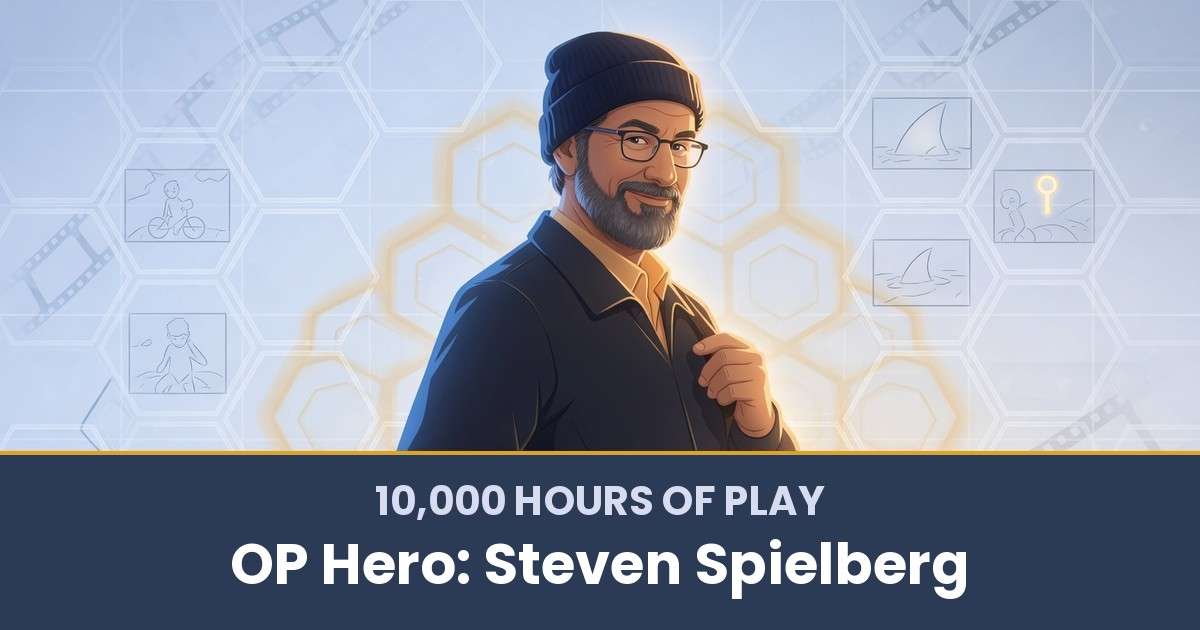


A sixteen-year-old kid in a borrowed suit walks past the Universal Studios guardhouse every morning for three months. No badge. No appointment. He just keeps showing up until the lot stops noticing him, finds an empty office, and starts answering the phone like he belongs there.
That kid did not have a film school degree. He did not have connections. What he had was a habit of pre-visualizing scenes since age twelve, a Boy Scout merit badge earned by directing his friends, and an instinct that the only way to break into a system is to act as if you already have. Within five years he had a seven-year director contract at the same studio. Within ten he had made Jaws, the picture that defined the modern summer blockbuster.
This is the build profile of Steven Spielberg through the 10,000 Hours of Play lens: a hero whose game was always the same, who collected the right roles in the right order, and whose biggest skill was stacking imagination on top of execution until the two were indistinguishable.
⚡ Speed Run Notes
- Spielberg’s life game was never “make movies.” It was “translate fear and wonder into rides the whole world will line up for,” which is why his career arcs cleanly from Jaws to Schindler’s List to the Shoah Foundation.
- His earliest innate Attributes were visual pre-visualization and a willingness to social-engineer his way onto sets. Both showed up before he was old enough to drive.
- The Role pivot that unlocked everything was moving from Teen Guerrilla Filmmaker to Universal TV Contract Director. Duel (1971) proved he could make a freeway-chase thriller out of a TV budget.
- Six canon Real-Life Game Skills carried him through six decades. Vision Manifestation and Phoenix Rebirth are the two most copy-able for anyone trying to build a creative career.
- His Allies are the masterclass. George Lucas, Kathleen Kennedy, John Williams, Sid Sheinberg, Tom Hanks. He picked collaborators young and kept them for forty-plus years.
- The 1979 flop of 1941 and the 1991 mauling of Hook were the two failure points where his Build either died or leveled up. Both times he chose the harder respawn.
Table of Contents
- Step 1: The Game — What Spielberg Was Actually Playing
- Step 2: Attributes — The Innate Stats
- Step 3: Role(s) — The Character Class Across Chapters
- Step 4: Skills — The Real-Life Game Skills Spielberg Mastered
- Step 5: Allies — The People Who Multiplied Spielberg
- Step 6: Quests — The Milestones That Shaped the Saga
- What You Can Steal From Spielberg’s Build
- Where this framework comes from
- Related Reading
About Yu-kai Chou

Yu-kai Chou is the author of 10,000 Hours of Play — the book that treats your life as the most important game you’ll ever build a character in, and gives you the 6-Step framework (Game · Attributes · Role · Skills · Allies · Quests) to play it on purpose. He has spent two decades developing the system through which this post analyzes its OP Hero, and applies it to his own life and to the lives of the people he advises around the world.
Chou’s other framework, the Octalysis Framework, has been applied by LEGO, Microsoft, Porsche, Coca-Cola, Salesforce, and MrBeast, impacting over 1.5 Billion Users. He has taught the methodology at Harvard, Stanford, Yale, Tesla, Google, BCG, and IDEO, and has advised governments in eight nations including Ukraine, the United Kingdom, the Kingdom of Bahrain, Singapore, Taiwan, the Netherlands, Kazakhstan, and South Korea.
His work has been cited by Harvard, Stanford, MIT, Forbes, Wall Street Journal, Wired, US Department of Energy, NIST, NSF, NCBI, US Department of Education, ClinicalTrials.gov, and Google Scholar — with 3,700+ more academic publications. Explore his books here.
I find Spielberg’s build instructive because he is the cleanest proof I know that imagination is a Skill, not a personality trait. The lesson I lift from him every time I revisit his run: pre-visualize so vividly that the actual production is a download from your head, not an invention on set. That is Vision Manifestation in its purest form, and it scales from a 8mm Boy Scout short to a $100M Universal picture without changing shape.
Step 1: The Game — What Spielberg Was Actually Playing
Most people think Spielberg’s game was making popular movies. That’s the score, not the game.
The actual game, traced across six decades, is more specific: use the most accessible medium on earth to convert private fear and historical memory into emotional experiences mass audiences can ride together. He has been chasing that one thing since he was twelve, when he shot an 8mm WWII rescue short called Fighter Squad in his Phoenix neighborhood with kids playing pilots.
You can see the consistency in how the slate evolves. Jaws (1975) is fear of the unseen. Close Encounters (1977) is wonder of the unseen. E.T. (1982) is what happens when a divorced kid’s loneliness collides with that wonder. Then Schindler’s List (1993) re-points the same engine at the worst chapter of the twentieth century, and the Survivors of the Shoah Visual History Foundation he founded in 1994 to record 50,000+ Holocaust survivor testimonies is the same engine again — translate memory into a form that lasts.
This is what “Step 1: Choose Your Game” means in the 10,000 Hours of Play system. Not a job title. A repeatable problem the hero keeps returning to from different angles, because solving it is what makes them feel alive. Spielberg’s game does not change between Raiders of the Lost Ark and Saving Private Ryan. Only the angle of attack changes.
Step 2: Attributes — The Innate Stats
Attributes are the traits you can see before training begins. With Spielberg they are unusually visible because he started filming at age twelve and the home movies still exist.
The first is obsessive visual imagination. As a child he drew elaborate storyboards of train crashes and war scenes, then staged his Lionel train wrecks to film them. The habit of pre-visualizing a moving image and then chasing the real-world execution of that image is the trait that later let him imagine the Jaws beach attack frame-by-frame before a single take. You cannot teach a child to do this. You can only notice when one already does.
The second is compulsion to organize groups. At twelve, for a Boy Scout Photography merit badge, he recruited troop members as cast and crew for a nine-minute Western called The Last Gunfight. Notice the verb — recruited. He was not just shooting. He was already producing.
The third is audacious access-seeking. The Universal-lot story is famous because it’s a tell: at sixteen he was sneaking onto the studio in a suit and briefcase, finding an empty office, and embedding himself on sets for three months before anyone challenged him. Risk-seeking in service of a goal is an early-life signature, not a learnable skill.
The fourth is outsider’s empathy. He was a Jewish kid in mostly non-Jewish suburbs in Phoenix and Saratoga and dealt with antisemitic bullying. He has cited that experience directly as the emotional root of Elliott in E.T. and the persecuted in Schindler’s List. The attribute is innate; the artistry is downstream.
If you are auditing your own Attributes against a hero like this, the OP Talent Triangle Method is the cleanest way to map which of your traits are signal and which are noise. Spielberg’s three signal traits — pre-visualization, organizing instinct, audacious access — are tight to one another. They compound.
Step 3: Role(s) — The Character Class Across Chapters
The Role pivots in Spielberg’s life are textbook because each one repurposes the same Attributes for a bigger arena.
Role one was Teen Guerrilla Filmmaker, late 1950s to 1965. The capstone was Firelight (1964), a feature-length 8mm UFO film he wrote, shot, and edited at seventeen, screened in a Phoenix theater on a Saturday night. It grossed about a dollar more than the $500–600 budget. The economics didn’t matter. The reps did.
Role two was Universal TV Contract Director, 1968 to 1974. After his Universal-lot infiltration converted into a real Sid Sheinberg deal, he directed for Night Gallery (the “Eyes” segment with Joan Crawford, 1969), then Marcus Welby, the pilot of Columbo (“Murder by the Book,” 1971), and the TV film Duel (1971). Duel is the proof point. A truck-chase thriller shot in fourteen days on a TV schedule, recut for European theatrical release. It told the industry he could direct under any constraint.
Role three was Blockbuster Auteur, 1975 to 1982. Jaws, Close Encounters, Raiders of the Lost Ark, E.T. in seven years. He invented the summer-tentpole release pattern Hollywood still runs on.
Role four, beginning in the 1980s and continuing now, is Studio Builder and Historical Witness. Amblin Entertainment (1981), then DreamWorks SKG with Jeffrey Katzenberg and David Geffen (1994), then the Shoah Foundation (1994), then Schindler’s List, Saving Private Ryan, Munich, Lincoln, The Post. The same hero. New class.
The right way to pick a Role is rarely “what am I qualified for” — it is “what arena gives my Attributes the best fight?” That is also why some heroes stall: they refuse to switch class even when their Attributes outgrow the current arena. Spielberg switched four times.
Step 4: Skills — The Real-Life Game Skills Spielberg Mastered
From the canon Real-Life Game Skills list in 10,000 Hours of Play, six show up across Spielberg’s life with citable receipts. If you want the broader theory of how learned Skills stack on top of innate Attributes, the Skills Spectrum piece is the reference frame.
Vision Manifestation (Warlock) — visualize success so vividly mental rehearsal shapes reality. Spielberg storyboards the entire film before shooting. The “shark attacks the beach” sequence in Jaws was cut frame-by-frame in his head before the malfunctioning mechanical shark forced him to shoot less of it and suggest more. The girl in the red coat in Schindler’s List, the only color in a black-and-white film, was a Vision Manifestation moment he held onto for years before the production existed.
Cognitive Lens (Mage) — zoom in on detail, zoom out for strategy. Spielberg can shot-list every blocking choice on a Tuesday and that same week make a release-window decision for a studio. He has never given up the micro to do the macro. Other directors like Shigeru Miyamoto built their careers on the same dual-altitude habit; both stay hands-on with single scenes while running global pipelines.
Mastermind (Ranger) — create, adapt, and execute complex plans. The Jaws shoot is the proof. The mechanical shark “Bruce” broke constantly in salt water at Martha’s Vineyard. The schedule blew from 55 days to 159. Most directors collapse there. Spielberg re-planned the picture to keep the shark hidden, which is why the film works at all. Same Skill later built DreamWorks from a press conference to a working studio with three founders, three checkbooks, and zero existing infrastructure.
Tactical Command (Ranger) — make people of different talents work harmoniously. A Spielberg crew is John Williams scoring, Janusz Kamiński or Allen Daviau shooting, Michael Kahn editing, Kathleen Kennedy producing, and hundreds of department heads in sync. He has kept many of those collaborators for twenty to fifty years. That is the visible artifact of strong Tactical Command. Builders who copy this — like Hayao Miyazaki at Studio Ghibli — get the same compounding effect.
Bind Fate (Warlock) — use someone else’s brand or resource to become powerful yourself. The Universal-lot infiltration is the cleanest Bind Fate move in Hollywood history. Spielberg did not buy a camera and start renting theaters. He picked the most powerful studio brand within reach and grafted onto it, which got him into Sid Sheinberg’s office and a seven-year directing contract at twenty-one. The same instinct later powered the George Lucas partnership on Indiana Jones — two brands, one franchise.
Phoenix Rebirth (Paladin) — recover from devastating failure and come back stronger. 1941 (1979) was a critical and commercial disaster after the run of Jaws and Close Encounters. He came back with Raiders in 1981 and E.T. in 1982 — arguably his most beloved year. Hook (1991) was savaged by critics. He came back two years later with Schindler’s List and won Best Picture and Best Director. The pattern is not luck. It is what happens when a hero treats the failure as field data instead of identity.
Step 5: Allies — The People Who Multiplied Spielberg
Spielberg’s Ally bench is the most-quoted in modern cinema because the same names keep showing up across forty years of credits.
Sid Sheinberg was the Universal executive who watched a short film called Amblin’ in 1968 and gave Spielberg a seven-year contract at twenty-one. Sheinberg also handed him Duel, which became the proof point that launched the theatrical career. Without that first believer, the Universal-lot infiltration is just a great story.
George Lucas co-created Indiana Jones with Spielberg over a beach conversation in Maui in 1977 and produced the franchise. Lucas also pulled Spielberg into the Skywalker Ranch screening culture, which is where many of Spielberg’s later picture-cutting habits came from.
John Williams has scored almost every Spielberg film since The Sugarland Express in 1974. Jaws is two notes, written by Williams over Spielberg’s initial skepticism. That collaboration is so dense it functions like a single creative mind across two bodies.
Kathleen Kennedy started as Spielberg’s assistant on Raiders in 1981, co-founded Amblin Entertainment, and produced or executive-produced more than thirty of his films before going on to run Lucasfilm. Spielberg picked a young Ally and the Ally rose to run an empire of her own.
Tom Hanks became Spielberg’s second-act onscreen partner starting with Saving Private Ryan (1998) and continuing through Catch Me If You Can, The Terminal, Bridge of Spies, The Post, and the Band of Brothers / The Pacific / Masters of the Air miniseries trilogy. He plays the moral center Spielberg keeps writing around.
The pattern is consistent. Spielberg picks Allies early in their arcs, gives them real creative authority, and renews the relationship so long the collaborators become co-architects rather than vendors. That is also how OP heroes like Bill Gates built their second-act philanthropic empires — long-tenure Allies who outgrow their original Role.
Step 6: Quests — The Milestones That Shaped the Saga
Six Quests carry the through-line.
Quest 1: Firelight (1964). A two-and-a-quarter-hour 8mm UFO movie made at seventeen, screened in a Phoenix theater. The point was not the gross. The point was the proof to himself that he could complete a feature.
Quest 2: Duel (1971). The TV movie that became a European theatrical release. Universal saw a 24-year-old who could direct a chase thriller under TV constraints and decided he was worth a real picture.
Quest 3: Jaws (1975). The shoot that almost ended his career. The mechanical shark broke constantly. The schedule tripled. He kept rewriting around what he could not shoot. The picture grossed $470 million on a $9 million budget and invented the summer blockbuster. Mastermind and Phoenix Rebirth both got their first big workout here.
Quest 4: 1941 (1979) — the failure. A bloated WWII comedy that flopped after the Jaws / Close Encounters momentum. He was twenty-eight. Most directors who get that ratio of hype to outcome retreat into smaller pictures. Spielberg took the data, kept the Mastermind muscle, and signed onto Raiders.
Quest 5: Schindler’s List (1993). Filmed in Poland, in black and white, on locations next to Auschwitz. He waited ten years before he felt ready to direct it, then made it in seventy-two days while finishing Jurassic Park in post on weekends. Won Best Picture and Best Director. The Shoah Foundation was founded the next year with the Schindler proceeds.
Quest 6: Saving Private Ryan (1998) and the long historical run. The Omaha Beach opening retired the prior generation’s WWII film grammar in one sequence. From there, the slate keeps returning to historical witness — Munich, Lincoln, Bridge of Spies, The Post, The Fabelmans. Step 1’s game, played at a new altitude.
If you want to study other Quests that share this structure, the full OP Hero hub has a couple dozen worked examples by now, and the patterns repeat in instructive ways across very different fields.
What You Can Steal From Spielberg’s Build
Three things, in order of how transferable they are.
First: pre-visualize before you produce. Spielberg’s Vision Manifestation habit started with crayon storyboards as a child. You do not need a film budget to copy it. Write the deck before the meeting. Sketch the user flow before the sprint. The reason this works is the same reason Spielberg’s set days are short — when you arrive with the picture already in your head, the team’s job is execution rather than discovery, which is roughly ten times faster.
Second: switch Roles when your Attributes outgrow the arena. He stopped being a teen filmmaker the year he could not get bigger results from a 16mm camera. He stopped being a TV director the moment Duel proved he could survive a feature schedule. Most builds get stuck because the hero refuses to graduate. Schedule the next class change on purpose.
Third: treat every failure as a respawn, not a verdict. The 1941-to-Raiders swing and the Hook-to-Schindler’s List swing are not unusual luck. They are what happens when Phoenix Rebirth is a habit, not a temperament. The cost of one failed Quest is one season. The cost of identifying as a failed hero is the entire run.
Pick a Game you’ll still want to play in forty years. Stack the Skills that compound. Keep the Allies who scale with you. The build is portable.
Where this framework comes from

Want the full system this profile is built on?
Every OP Hero piece runs through the same 6-Step framework from 10,000 Hours of Play: Unlock Your Real-Life Legendary Success. The book covers the full system, walks through Yu-kai’s own life run as the first applied case study, and gives you the worksheets to audit your own build.
Related Reading
- All OP Hero Profiles — the full 10K HP hub
- 10,000 Hours of Play by OP Hero: Shigeru Miyamoto
- 10,000 Hours of Play by OP Hero: Hayao Miyazaki
- 10,000 Hours of Play by OP Hero: Bill Gates
- 10,000 Hours of Play by OP Hero: Jensen Huang
- The OP Talent Triangle Method