
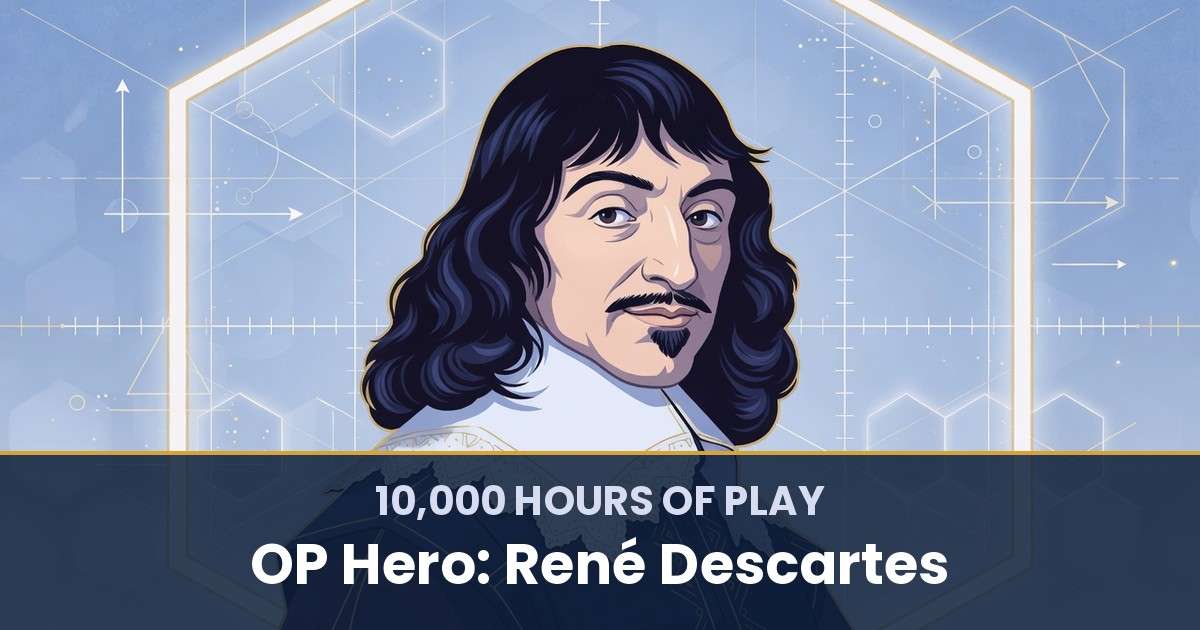


In 1633, René Descartes had a finished book on his desk and made himself put it away. Le Monde laid out a whole mechanical picture of the universe, sun-centered and moving, and he had spent years building it. Then word reached him that the Inquisition had condemned Galileo for saying almost exactly that.
So he shelved it. A completed work, buried on purpose, because the timing was wrong.
That decision looks like defeat. It was closer to a saving throw. Descartes was playing a longer game than any single book, and he knew a public fight with the Church would end the run before the real prize was won. Four years later he came back with a quieter, deadlier move: a slim French essay that reset how Europe decided what counts as true.
Here is the character sheet behind one of history’s most patient thinkers, read through the 6-Step framework this whole series runs on.
⚡ Speed Run Notes
- Descartes’ main quest was a single certainty engine: a method reliable enough to rebuild every science from the ground up, starting only from things he could not doubt.
- His signature move was subtraction. He doubted everything on purpose until one thing survived: “I think, therefore I am.” From that floor he rebuilt outward.
- Analytic geometry was born when he treated shapes as equations. Every graph with an x and y axis still runs on the Cartesian coordinate system he invented.
- He hid to work. Roughly twenty years in the Dutch Republic, moving houses often, guarding the solitude his system needed.
- His power came from a handful of allies: Beeckman lit the fuse, Mersenne ran his mail, Princess Elisabeth sharpened his weakest argument.
- The build’s lesson: pick one question worth a lifetime, then protect the conditions that let you actually answer it.
Table of Contents
About Yu-kai Chou

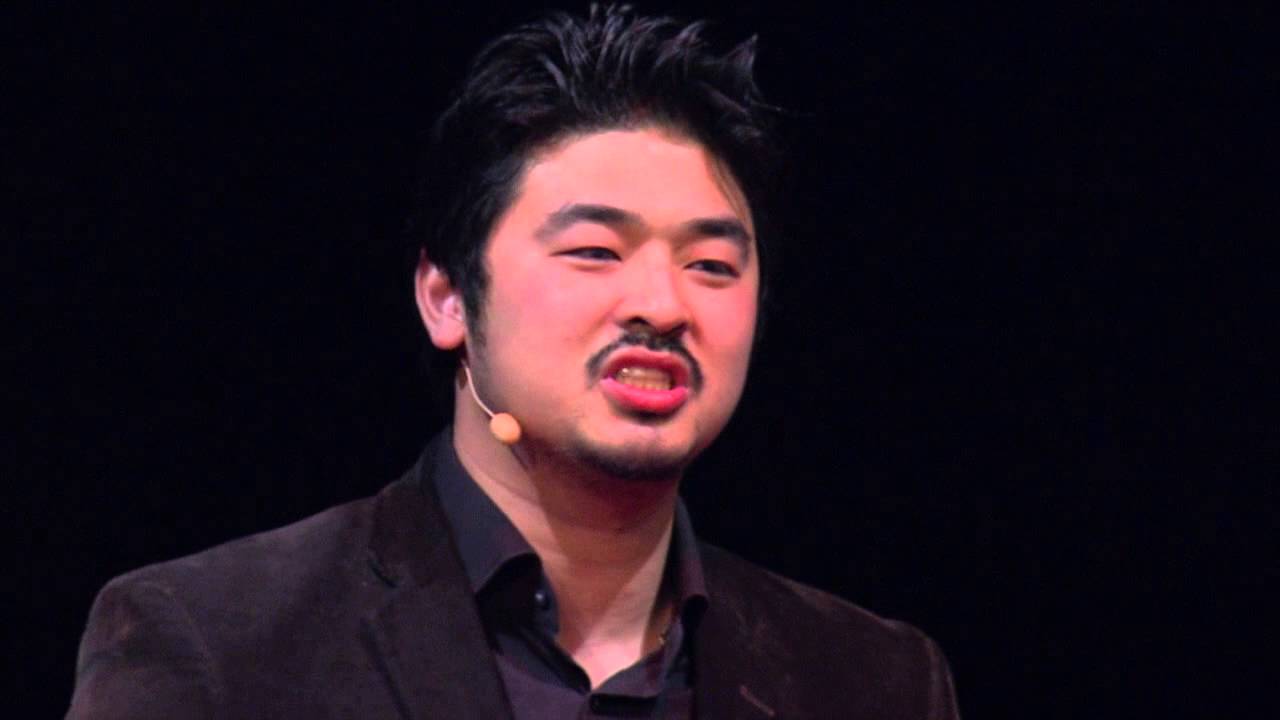
Yu-kai Chou is the author of 10,000 Hours of Play — the book that treats your life as the most important game you’ll ever build a character in, and gives you the 6-Step framework (Game · Attributes · Role · Skills · Allies · Quests) to play it on purpose. He has spent two decades developing the system through which this post analyzes its OP Hero, and applies it to his own life and to the lives of the people he advises around the world.
Chou’s other framework, the Octalysis Framework, has been applied by LEGO, Microsoft, Porsche, Coca-Cola, Salesforce, and MrBeast, impacting over 1.5 Billion Users. He has taught the methodology at Harvard, Stanford, Yale, Tesla, Google, BCG, and IDEO, and has advised governments in eight nations including Ukraine, the United Kingdom, the Kingdom of Bahrain, Singapore, Taiwan, the Netherlands, Kazakhstan, and South Korea.
His work has been cited by Harvard, Stanford, MIT, Forbes, Wall Street Journal, Wired, US Department of Energy, NIST, NSF, NCBI, US Department of Education, ClinicalTrials.gov, and Google Scholar — with 3,700+ more academic publications. Explore his books here.
What I keep coming back to with Descartes is his willingness to subtract before he built. Most ambitious people add: more inputs, more tactics, more open loops. He did the opposite, clearing the board down to one thing he could stand on, then constructing upward with discipline. If you lift one move from his build, make it that: find the single certainty at the center of your work, and let everything else be something you earn back rather than something you assume.
Step 1: The Game — What Descartes Was Actually Playing
Descartes was not chasing fame or a chair at a university. His game was certainty itself. He wanted to know whether a human being could arrive at knowledge so solid that no clever objection could ever knock it down, and then use that knowledge to rebuild philosophy and the sciences from scratch.
This is the same instinct behind the 6-Step framework: treat your life as a system you can examine, question, and redesign on purpose rather than one you inherit and never inspect. Descartes ran that examination on the whole of human knowledge.
The opponent in his game was the reigning worldview he had been handed. At the Jesuit college of La Flèche, he had absorbed the Aristotelian scholasticism that ruled European thought, and he came out unconvinced. Too much of it rested on authority and tradition instead of anything he could verify for himself. His mission became a demand that philosophy stand on reason alone.
Winning meant one thing: build a method so reliable that any careful person, following the steps, would reach the same true conclusions. He wanted a repeatable engine for separating truth from error, one that any careful person could run for themselves. That is the meta-quest he kept returning to for thirty years, across mathematics, physics, and the study of the mind.
Step 2: Attributes — The Innate Stats
Some of Descartes’ stats were visible long before he had any results to show for them.
The first was raw pattern recognition. He saw structure where others saw separate subjects, and that bent of mind is what let him later fuse algebra and geometry into one thing. It reads less like a trained skill and more like a native way of seeing the world as connected systems.
The second was appetite for epistemic risk. Choosing to suspend belief in everything he had been taught, including religion and the evidence of his own senses, is a nervy cognitive stance. He phrased it plainly: it is necessary, once in your life, to doubt as far as possible all things. Most people cannot tolerate that much uncertainty for an afternoon. He built his career on it.
The third was a deep orientation toward self-mastery. In his personal maxims he resolved to master himself rather than fortune, and to change his desires rather than the order of the world. That is an internal locus of control stated three centuries before psychologists named it, and it shows up in how he arranged his whole life around the work.
You can map these against your own sheet the same way Descartes’ contemporaries never could for themselves. The Talent Triangle Method exists to help you find where innate stats like these actually live in your build, so you can lean on them instead of fighting your own wiring.
Step 3: Role(s) — The Character Class Across Chapters
Descartes multiclassed, and the order of his roles matters as much as the roles themselves.
He opened as the Skeptical Scholar, a student steeped in the traditional system and quietly losing faith in it. In his early twenties he even took a law degree at Poitiers and then went soldiering across Europe, using the travel to observe how differently people reasoned in different places. That restlessness was deliberate fieldwork on the human mind.
Next came the Mathematician-Engineer. In this chapter he worked out analytic geometry, studied optics, and chased the physical laws behind light and weather. He was testing whether his emerging method could crack real problems in the physical world before he trusted it with bigger questions.
Then the System-Builder Philosopher, the role he is remembered for. Here he published his method openly and began laying out a full account of mind, matter, and God as a single connected structure. This is the class that produced Cartesian dualism, his claim that mind and body are two distinct kinds of substance.
His willingness to reason from the ground up rather than defer to inherited authority set the template for the philosophers who came after him, straight through to Immanuel Kant, whose entire project is a response to the questions Descartes forced open. Each role fed the next. The soldier’s-eye view of human disagreement drove the hunger for a universal method; the mathematician’s proofs gave him a model of what certainty could feel like; the philosopher spent both.
Step 4: Skills — The Real-Life Game Skills Descartes Mastered
Descartes is close to a pure Mage archetype in this framework, the class that analyzes and calculates, and his headline abilities all sit in that tree.
His foundational move was Nethermind (Mage) — intense, sustained focus on a single intellectual problem until it cracks. He turned method-of-doubt into a disciplined procedure, subtracting every belief that could possibly be false, and kept grinding it until one proposition refused to fall: “I think, therefore I am,” which appeared in the 1637 Discourse on the Method. That surviving certainty became the floor he rebuilt everything else on.
His most famous breakthrough came from Elemental Transposition (Mage) — reframing a problem in an entirely different domain so it becomes solvable. Geometry and algebra had lived in separate rooms for two thousand years. Descartes moved geometric curves into the language of algebraic equations and coordinates, and analytic geometry was born in his 1637 essay La Géométrie. Every x-and-y graph you have ever drawn runs on that transposition.
Underneath both sat Cognitive Lens (Mage) — zooming in on the smallest parts of a problem, then back out to reassemble them. His four-rule method in the Discourse is this skill written as procedure: divide every difficulty into as many parts as possible, solve from the simplest upward, then run a complete review to be sure nothing was skipped. It is the ancestor of how engineers still decompose hard problems today.
And the meta-skill under all of it was Self Mastery (Rogue) — the fast, ruthless self-awareness to know which of his own beliefs were merely comfortable rather than true. Descartes was a specialist who went deep on one method rather than dabbling across many; the Skills Spectrum shows why that kind of depth compounds into mastery instead of scattering into noise.
Step 5: Allies — The People Who Multiplied Descartes
A hermit who publishes nothing changes nothing. Descartes worked alone but was never truly isolated, and a few key allies turned his private grind into a public revolution.
Isaac Beeckman lit the fuse. When they met in the Dutch Republic around 1618, the older Beeckman rekindled Descartes’ interest in mathematical physics and pushed him toward mechanical explanations of nature. That spark set the direction for everything that followed.
Marin Mersenne was his signal-booster. A friar at the center of Europe’s scholarly correspondence, Mersenne acted as Descartes’ postmaster and switchboard, circulating his manuscripts, gathering formal objections to the Meditations from leading thinkers, and publishing the replies. Descartes could hide in the Netherlands and still argue with all of Europe, because Mersenne carried the letters.
Princess Elisabeth of Bohemia was his sharpest sparring partner. Beginning in 1643, she pressed him with the hardest question anyone put to his system: if mind and body are truly separate substances, how on earth do they interact? He never fully answered her, but the pressure pushed him to write The Passions of the Soul in 1649. A good ally does not just applaud; she finds the crack in your armor and makes you deal with it.
The last ally was also the fatal one. Queen Christina of Sweden summoned him to Stockholm in late 1649 to tutor her in philosophy. Prestige at the cost of everything that had kept him productive, which sets up the final chapter.
Step 6: Quests — The Milestones That Shaped the Saga
Descartes’ quest log runs from a private notebook to a deathbed in a foreign court.
The first quest was internal: around 1628 he drafted Rules for the Direction of the Mind, his early attempt to codify a method. He never published it in his lifetime, but it was the prototype for everything after.
The second was the failure that taught him strategy. He finished Le Monde, his sweeping mechanical cosmology, then withheld it after Galileo’s 1633 condemnation. Shelving a completed book is a brutal call, and it is exactly the kind of setback the framework wants you to study, because how a hero absorbs a blocked quest tells you more than any easy win.
The third quest was the comeback. In 1637 he published the Discourse on the Method with three scientific essays attached, including La Géométrie. It carried his revolution to the public in plain French rather than scholars’ Latin, which was its own quiet act of defiance.
The fourth was the cathedral: the Meditations on First Philosophy in 1641, followed by the Principles of Philosophy in 1644, where he tried to lay out his entire system as one connected whole.
The final quest went wrong. Queen Christina made him tutor her at five in the morning through a brutal Swedish winter, wrecking the late-rising routine he had guarded for decades. He caught pneumonia and died in Stockholm in February 1650. The man who spent a lifetime protecting his conditions lost them in the one chapter he let prestige override the build. You can trace how other thinkers handled that same tension between recognition and focus across the full OP Hero roster.
What You Can Steal From Descartes’ Build
You are not going to reinvent geometry. But three moves from Descartes’ sheet port directly into your own run.
Subtract before you build. Descartes’ whole method started by clearing away everything he could not verify, until he found the one thing he could stand on. When a project feels tangled, resist the urge to add more. Strip it down to the single claim you are certain of, and rebuild from there.
Protect the conditions your work needs. For twenty years Descartes arranged his entire life around solitude and a late-morning thinking routine, and his output was staggering. The moment he traded those conditions for royal prestige, the run ended. Guard the environment that lets your best work happen; it is more fragile and more valuable than any single opportunity.
Build one repeatable engine. Descartes wanted a method that would keep producing proofs for the rest of his life, so he poured his effort into the method itself. Ask what reusable system sits underneath your best results, then invest in that system so it keeps paying out. That is the difference between a lucky streak and a legendary build.
Where this framework comes from

Want the full system this profile is built on?
Every OP Hero piece runs through the same 6-Step framework from 10,000 Hours of Play: Unlock Your Real-Life Legendary Success. The book covers the full system, walks through Yu-kai’s own life run as the first applied case study, and gives you the worksheets to audit your own build.
Related Reading
- The full OP Hero profiles hub, where every legendary build is analyzed through the 6-Step framework.
- 10,000 Hours of Play by OP Hero: Immanuel Kant, the philosopher whose life’s work answered the questions Descartes forced open.
- 10,000 Hours of Play by OP Hero: Friedrich Nietzsche, another thinker who rebuilt his field by doubting its foundations.
- 10,000 Hours of Play by OP Hero: Plato, a founding architect of the questions Descartes inherited.
- The 10K HP Framework: 6 Steps to Gamify Your Life, the full system behind every OP Hero profile.
- The Skills Spectrum: Specialist, Dabbler, Master, on how deep focus on one skill compounds into mastery.