
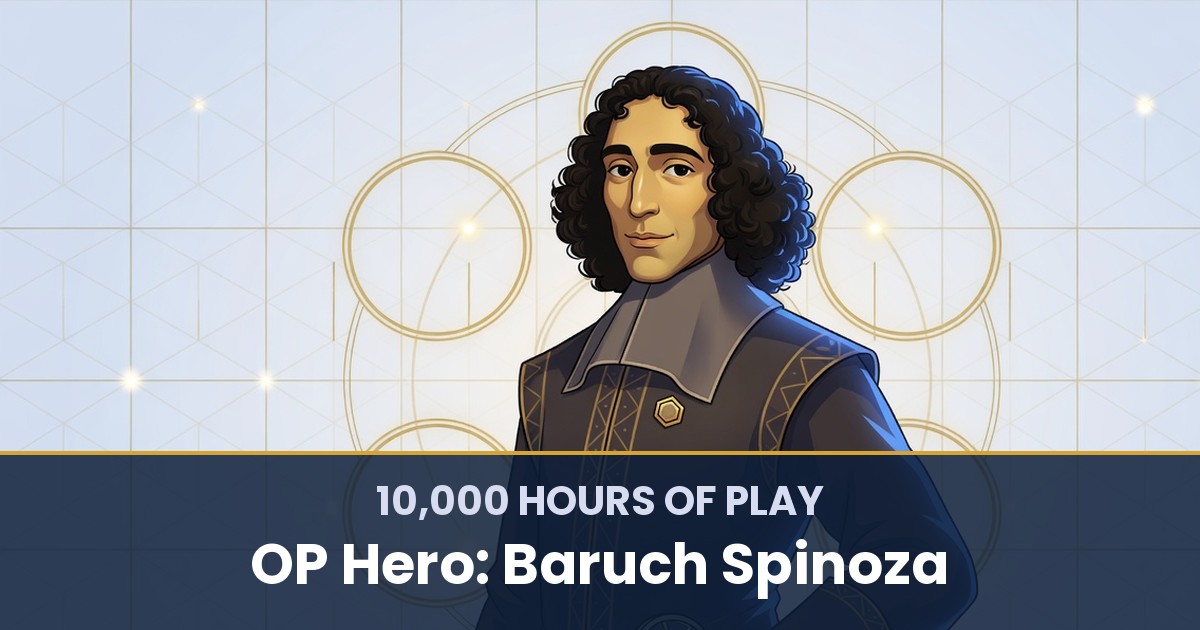


On 27 July 1656, the Portuguese-Jewish congregation of Amsterdam pronounced a ban against one of its own members, a 23-year-old named Baruch Spinoza.
The herem accused him of “horrible heresies” and “monstrous deeds.” It severed him from the community that had raised and educated him.
He never asked to be let back in. He learned to grind optical lenses, moved through rented rooms in small Dutch towns, and spent the rest of his life on philosophy, above all on one book, the Ethics.
He died in The Hague in February 1677, aged 44, with that book still unpublished.
⚡ Speed Run Notes
- Spinoza’s game: understand nature, God, and human emotion clearly enough that fear and inherited opinion lose their grip, and defend the freedom to do that thinking.
- Expelled from Amsterdam’s Portuguese-Jewish community at 23, he never recanted and rebuilt his life around independent work.
- He paid for his philosophy by grinding optical lenses, which kept him independent of any university or church post.
- In 1673 he turned down a philosophy chair at Heidelberg because he feared it would limit his freedom to philosophize.
- His signature Skill is Divine Shield (Paladin): saying no to attractive offers that would have cost him the one resource his game required.
Table of Contents
About Yu-kai Chou

Yu-kai Chou is the author of 10,000 Hours of Play — the book that treats your life as the most important game you’ll ever build a character in, and gives you the 6-Step framework (Game · Attributes · Role · Skills · Allies · Quests) to play it on purpose. He has spent two decades developing the system through which this post analyzes its OP Hero, and applies it to his own life and to the lives of the people he advises around the world.
Chou’s other framework, the Octalysis Framework, has been applied by LEGO, Microsoft, Porsche, Coca-Cola, Salesforce, and MrBeast, impacting over 1.5 Billion Users. He has taught the methodology at Harvard, Stanford, Yale, Tesla, Google, BCG, and IDEO, and has advised governments in eight nations including Ukraine, the United Kingdom, the Kingdom of Bahrain, Singapore, Taiwan, the Netherlands, Kazakhstan, and South Korea.
His work has been cited by Harvard, Stanford, MIT, Forbes, Wall Street Journal, Wired, US Department of Energy, NIST, NSF, NCBI, US Department of Education, ClinicalTrials.gov, and Google Scholar — with 3,700+ more academic publications. Explore his books here.
I keep returning to how small Spinoza’s economic footprint was. A lens bench, rented rooms, and a few loyal friends covered his costs, so no employer ever had a say in his conclusions. For anyone playing a long game, I’d copy that directly: keep your fixed costs low enough that the main quest never has to answer to a paycheck.
Step 1: The Game — What Baruch Spinoza Was Actually Playing
The first of the six steps is choosing your game, and Spinoza wrote his down in plain terms.
In the unfinished Treatise on the Emendation of the Intellect, probably begun in the late 1650s, he describes searching for “the true good,” something that could give him “continuous and supreme happiness.”
Then he audits the usual candidates. Wealth, honor, and sensual pleasure all fail when treated as final goals, because they are unstable and pull attention away from improving the mind.
So his game became understanding. He wanted to see nature, God, and human emotion clearly enough that fear, superstition, and inherited opinion stopped running his life.
The second half of the game was political. A game of understanding can’t be played for long if the state or the church can punish you for your conclusions.
His Theological-Political Treatise (1670) makes that case on its title page: freedom to philosophize can be granted “without injury to piety and the peace of the Republic.”
The end state he was playing toward shows up in the final proposition of the Ethics: “Blessedness is not the reward of virtue, but virtue itself.”
Step 2: Attributes — The Innate Stats
Attributes are what you bring before training. The labels below are interpretive, but each one shows up early in the record and keeps showing up.
High tolerance for isolation. At 23 he lost his community and did not retract his views. He kept working outside the structure his early life had depended on.
Pattern recognition at the largest scale. Spinoza kept looking for one explanation underneath things other people treated as separate: God and nature, mind and body, private emotions and public institutions.
His central claim in the Ethics is that there is only one substance, which he called God or Nature.
That is the kind of stat combination the OP Talent Triangle Method is designed to surface, and it pointed Spinoza toward long, solitary analysis and away from work that runs on status and approval.
Indifference to status. He described honor and wealth as unstable goals in his own writing.
Long-horizon patience. He worked on the Ethics for roughly fifteen years, from the early 1660s until his death, and set it aside when a more urgent project came up.
Detached emotional observation. Spinoza studied emotions as natural events with causes. In the preface to Part III of the Ethics he says he will treat human actions and appetites “just as if it were a question of lines, planes, and bodies.”
Step 3: Role(s) — The Character Class Across Chapters
Spinoza changed class several times across his 44 years.
Community son and student (1632–1656). Born in Amsterdam on 24 November 1632, he was educated inside the city’s Portuguese-Jewish community. The 1656 ban ended that role.
Lens grinder and independent philosopher (late 1650s onward). He supported himself by grinding and polishing optical lenses. In 1661 he moved to Rijnsburg, and in 1663 to Voorburg.
Cartesian expositor (1663). His Principles of Cartesian Philosophy worked through the first two parts of the philosophy of René Descartes. It was the only philosophical book Spinoza published under his own name during his lifetime.
Anonymous political theologian (late 1660s to 1670). He paused the Ethics to write the Theological-Political Treatise, which appeared without his name in 1670. That same year he moved to The Hague.
Correspondent in the Republic of Letters (1661–1677). His letters linked him to Henry Oldenburg in London, and later to Tschirnhaus, Schuller, and Leibniz.
Political philosopher (final years). His Political Treatise examines monarchy, aristocracy, and democracy. It breaks off in Chapter XI, partway through the discussion of democracy.
Step 4: Skills — The Real-Life Game Skills Baruch Spinoza Mastered
Five Skills show up clearly in his record.
Lich Grind (Warlock) — intense, secluded work periods. Spinoza’s adult life was one long Lich Grind: rented rooms in Rijnsburg, Voorburg, and The Hague, a lens-grinding bench for income, and around fifteen years of work on a single book.
On the Skills Spectrum, that puts him at the specialist end: a narrow set of Skills, run for two decades.
Elemental Transposition (Mage) — reframing every problem as a puzzle. The Ethics is built the way Euclid built geometry: definitions, then axioms, then propositions with demonstrations.
Spinoza took questions about God, the mind, and the emotions and recast them as problems to be worked step by step. A reader who accepted the definitions had to argue with the proofs.
Self Mastery (Rogue) — high self-awareness. Part III of the Ethics defines desire, joy, sadness, love, hatred, hope, and fear, then maps how they cause one another. His point was practical: the better you understand the causes of an emotion, the less it controls you.
Cloak (Rogue): executing without being noticed. The Theological-Political Treatise came out in 1670 with no author’s name and a false imprint naming Hamburg instead of Amsterdam.
That cover let him enter a dangerous public debate about Scripture and religious authority without handing his opponents an easy target.
Divine Shield (Paladin): saying no, however persuasive the offer. In 1673 the Elector Palatine offered him a chair of philosophy at Heidelberg, on the understanding that he would not disturb the established religion.
On 30 March 1673 Spinoza declined. He feared that the post, and that condition, would restrict his freedom to philosophize.
His early biographer Colerus reports an earlier version of the same move: Spinoza refused a gift of 2,000 guilders from his friend Simon de Vries.
Step 5: Allies — The People Who Multiplied Baruch Spinoza
Spinoza did his writing alone, but his output depended on a small circle of teachers, friends, and correspondents.
Franciscus van den Enden. His Latin teacher in the mid-1650s. Latin was the language of European scholarship, and every major book Spinoza wrote depended on it.
Henry Oldenburg. Secretary of the Royal Society in London. Their correspondence began in 1661, and Oldenburg relayed English scientific news to Spinoza while carrying Spinoza’s ideas into the Royal Society’s network.
Simon Joosten de Vries. A member of his Amsterdam circle. After Spinoza reportedly turned down the 2,000 guilders, de Vries left him a yearly pension of 250 guilders in his will.
Jarig Jelles and Lodewijk Meyer. Jelles was a close friend and financial supporter. Meyer wrote the preface to the 1663 Descartes book.
After Spinoza’s death, both men helped bring his unpublished work into print, and Jelles wrote the preface to the collected edition.
Jan Rieuwertsz. His Amsterdam publisher, who printed the Descartes book in 1663 and the posthumous collected works in 1677.
Gottfried Wilhelm Leibniz. Leibniz visited him in The Hague in November 1676, a few months before Spinoza died. They discussed metaphysics, necessity, and freedom.
Step 6: Quests — The Milestones That Shaped the Saga
Quest 1: Survive the ban (1656). The setback that started the saga. On 27 July 1656 the Talmud Torah congregation expelled him, and he answered by building a life that depended on no single community.
Quest 2: Publish under his own name (1663). Principles of Cartesian Philosophy appeared with an appendix, Metaphysical Thoughts, and a preface by Lodewijk Meyer. It would be the only philosophical book to carry his name while he was alive.
Quest 3: Defend the freedom to philosophize (1670). The Theological-Political Treatise argued that the Bible should be read historically, through its language, authorship, and context, and that a state can permit free thought and keep the civil peace.
In 1674 the States of Holland and West Friesland banned it, alongside other books they judged irreligious.
Quest 4: Keep his head in 1672. On 20 August 1672 a mob in The Hague murdered Johan and Cornelis de Witt. According to a later biographical tradition, Spinoza wrote a placard reading Ultimi barbarorum (“the ultimate barbarians”) and meant to post it at the scene, until his landlord, Hendrik van der Spijck, stopped him.
The story comes from later accounts, so treat it as reported. If it happened, the landlord who stopped him may have protected the whole run.
Quest 5: Publish the Ethics (1675). The second setback. He tried to publish the book in 1675 and withdrew it after word spread that theologians were preparing to accuse it of atheism. The manuscript stayed in his desk.
Quest 6: The posthumous release (1677). Spinoza died in The Hague on 21 February 1677, aged 44, of a lung illness. Later that year his friends published the Opera Posthuma, containing the Ethics, the Political Treatise, the Treatise on the Emendation of the Intellect, and his letters. A Dutch edition followed soon after.
What You Can Steal From Baruch Spinoza’s Build
Name the one resource your game can’t run without. For Spinoza it was freedom to think. The lens bench, the anonymous imprint, and the Heidelberg letter all protected it.
Price offers in quest currency. A professorship looks like a level-up. Spinoza asked what it would cost his main quest, and the answer was too much.
Use structure to carry hard ideas. The geometric format turned the Ethics into an argument readers had to work through line by line.
Recruit allies who can finish without you. Jelles, Meyer, and Rieuwertsz turned a desk full of manuscripts into the Opera Posthuma.
The last sentence of the Ethics reads: “All things excellent are as difficult as they are rare.”
Where this framework comes from

Want the full system this profile is built on?
Every OP Hero piece runs through the same 6-Step framework from 10,000 Hours of Play: Unlock Your Real-Life Legendary Success. The book covers the full system, walks through Yu-kai’s own life run as the first applied case study, and gives you the worksheets to audit your own build.
Related Reading
- All OP Hero Profiles: the complete library
- 10,000 Hours of Play by OP Hero: René Descartes
- 10,000 Hours of Play by OP Hero: Socrates
- 10,000 Hours of Play by OP Hero: Immanuel Kant
- 10,000 Hours of Play by OP Hero: Laozi
- What’s Your Main Stat? The 10,000 Hours of Play Attribute Test