
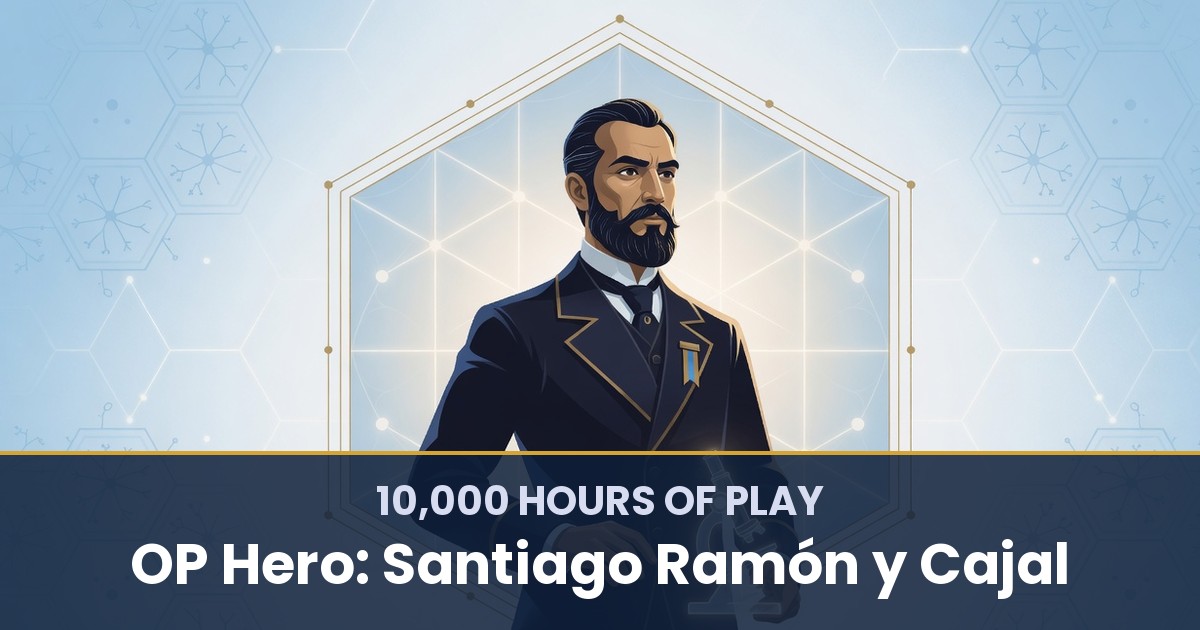


In 1889, a little-known Spanish professor packed his microscope and a stack of glass slides and traveled to a scientific congress in Berlin, reportedly paying his own way.
Nobody there was waiting for him. Spain barely registered on the map of European science, and the man himself had spent years publishing findings that the field’s establishment simply ignored.
So he set up his microscope on a table, laid out his preparations, and invited the giants of German anatomy to look. One of them, Rudolf Kölliker, looked. Then he kept looking.
What Santiago Ramón y Cajal had on those slides would rewrite how humanity understands its own brain. This is the story of how a defiant kid who was jailed at eleven for building a homemade cannon became the father of modern neuroscience, mapped through the 6-Step framework, Step by Step.
⚡ Speed Run Notes
- Cajal’s mission never changed across six decades: make the invisible nervous system visible. Drawing, photography, and microscopy were one weapon aimed at a single target.
- His decisive Attribute was pattern recognition. Where the entire field saw one continuous net of nerve tissue, he saw individual cells with boundaries.
- He did not invent the Golgi stain. He turned an unreliable staining method into a repeatable investigative platform, and that refinement won the argument.
- When the establishment ignored his papers, he traveled to the 1889 Berlin congress at his own expense and put the evidence under Kölliker’s microscope in person.
- Steal this: his Attributes pointed at art while his Role said doctor. Cajal fused the two instead of picking a lane, and the hybrid found the neuron.
Table of Contents
About Yu-kai Chou

Yu-kai Chou is the author of 10,000 Hours of Play — the book that treats your life as the most important game you’ll ever build a character in, and gives you the 6-Step framework (Game · Attributes · Role · Skills · Allies · Quests) to play it on purpose. He has spent two decades developing the system through which this post analyzes its OP Hero, and applies it to his own life and to the lives of the people he advises around the world.
Chou’s other framework, the Octalysis Framework, has been applied by LEGO, Microsoft, Porsche, Coca-Cola, Salesforce, and MrBeast, impacting over 1.5 Billion Users. He has taught the methodology at Harvard, Stanford, Yale, Tesla, Google, BCG, and IDEO, and has advised governments in eight nations including Ukraine, the United Kingdom, the Kingdom of Bahrain, Singapore, Taiwan, the Netherlands, Kazakhstan, and South Korea.
His work has been cited by Harvard, Stanford, MIT, Forbes, Wall Street Journal, Wired, US Department of Energy, NIST, NSF, NCBI, US Department of Education, ClinicalTrials.gov, and Google Scholar — with 3,700+ more academic publications. Explore his books here.
Cajal’s father ordered the drawing habit gone. Cajal instead fused it with medicine until the drawing hand became the discovery instrument itself. If one lesson transfers to your own character sheet, it’s his: the Attribute everyone tells you to drop may be the exact stat your future Role is waiting for.
Step 1: The Game — What Cajal Was Actually Playing
Step 1 of the framework is Choose Your Game: the mission a hero keeps chasing across decades, whether or not anyone is paying them to chase it.
Cajal’s game was to make the nervous system intelligible by direct observation. Turn the brain from an unknowable tangle into a mapped system of discrete cells and directional connections.
The game was never “become a famous scientist” or “win prizes for Spain.” Those things happened, but they were loot drops, never the quest objective.
The mission had linked stages that stayed coherent for sixty years. Image the invisible. Identify the elementary units of nerve tissue. Infer function from form, reading branching patterns and growth directions the way a strategist reads a map.
And then a final stage most players skip: build an independent research culture in Spain, so the game would keep being played after he logged off. He ran laboratories, trained younger investigators, and wrote methodological advice for researchers who hadn’t been born yet.
His autobiography, Recuerdos de mi vida, published in two parts in 1901 and 1917, reads like a player narrating his own campaign. The through-line never wavers: convert hidden anatomy into visible evidence, then make the evidence undeniable.
Step 2: Attributes — The Innate Stats
Step 2 is Know Your Attributes: the stats visible early in life, before any training montage. Cajal’s were visible in a village kid long before anyone called him a scientist, and you can audit your own the same way with the Talent Triangle Method.
Defiance of imposed authority. He resisted rote schooling, clashed with teachers, and treated every strict institution his father placed him in as a boss fight. At eleven, that defiance got him jailed for three days after he built a homemade cannon and destroyed a neighbor’s gate with it.
Visual imagination and artistic ability. Before he was a histologist he was a boy who compulsively drew. That stat later became his research instrument: his scientific illustrations were analytical reconstructions of microscopic structure, never decorative copies.
Mechanical curiosity. The cannon was not an isolated incident. He built devices, experimented with photography, and poked at physical phenomena, foreshadowing a career of solving biological problems through apparatus and technique.
Pattern recognition. His mature work depended on detecting recurring structural motifs across thousands of preparations: cell bodies, dendrites, axons, growth cones. This was a sustained capacity to extract general rules from irregular forms, the stat that let him see what everyone else’s eyes slid past.
Persistence under material constraints. Working in institutions he regarded as scientifically underdeveloped, with limited equipment, he improvised and kept publishing rather than waiting for ideal conditions.
Step 3: Role(s) — The Character Class Across Chapters
Step 3 is Select Your Role, and Cajal’s arc shows how a hero re-classes across chapters without abandoning the mission.
He opened as a rebellious autodidact: the kid sketching and building instead of reciting. His father, a physician-anatomist, redirected the class tree by training him in dissection, and Cajal studied medicine in Zaragoza, qualifying in 1873.
Then came a forced side-quest as a military physician. Sent to Cuba in 1874 during the Ten Years’ War, he contracted malaria, came home debilitated in 1875, and the soldier chapter closed.
Through the late 1870s and 1880s he played the provincial experimentalist, building microscopy and histology chops far from Europe’s centers of power. From 1883 he added professor and laboratory builder, holding chairs in Valencia, Barcelona, and Madrid.
The defining re-class came in 1887, when he encountered Golgi-stained tissue and became a neurohistologist: the mapmaker of the nervous system. From there the endgame roles stacked: theorist defending the neuron doctrine, Nobel laureate, and mentor to a generation.
Carl Jung ran the same re-class a generation later: enter through medicine, finish as a mapmaker of the mind. One case is a biography; two make it a pattern worth copying. The class you start in is rarely the class you finish in; the mission is what persists.
Step 4: Skills — The Real-Life Game Skills Cajal Mastered
Step 4 is Enhance Your Skills: the learned, trainable abilities layered on top of raw Attributes. In the 10K HP system these are the canon Real-Life Game Skills, and where your Attributes sit on the Skills Spectrum decides which ones deserve your grind hours. Cajal’s build ran five.
True Sight (Ranger) — observing keen details others miss. This was the skill of his life. Looking at the same stained tissue as every reticular theorist in Europe, he distinguished cellular boundaries from apparent continuity, axons from dendrites, terminal arborizations from fused networks. And the skill transfers across fields: Rosalind Franklin used it to read a diffraction photograph that other capable scientists handled without seeing.
Elemental Ensemble (Mage) — mentally visualizing complex compositions and executing them with precision. He treated every plate as an argument, selecting, simplifying, and what the microscope showed until the drawing itself carried the anatomical case. The Cajal Institute still holds roughly 2,800 of them.
Lich Grind (Warlock) — intense, secluded work periods. The Golgi stain was notoriously unreliable, so Cajal ground it into a repeatable platform, adjusting timing and handling through solitary repetition until complete dendritic trees and developing neurons emerged on demand. He also studied embryonic tissue, where growing cells are easier to read than mature tangles.
Courageous Heart (Paladin) — charging into uncomfortable, even hostile territory. The 1889 Berlin trip was this skill in armor: an ignored Spaniard walking into the heart of German anatomy, at his own expense, to demonstrate preparations to people predisposed to dismiss him.
Floral Blossom (Druid) — educating and mentoring others. His 1897 book Reglas y consejos sobre investigación científica, translated as Advice for a Young Investigator, turned his method into a teachable discipline, and his laboratories turned Spain into a school of neurohistology.
Step 5: Allies — The People Who Multiplied Cajal
Step 5 is Build Your Alliances. Cajal looks like a solo grinder from a distance, yet every breakthrough in his log has an ally’s fingerprints on it.
Justo Ramón y Cajal, his father, was the first: the physician-anatomist who took a defiant artist-kid and gave him a technical foundation in dissection and anatomical observation. The conflict between them over drawing was real, and so was the transfer of craft.
Luis Simarro Lacabra changed the entire campaign in a single session. In 1887 in Madrid, Simarro showed Cajal Golgi-stained nervous tissue, handing him the visual method that powered everything after. A single demonstration redirected his entire scientific life.
Camillo Golgi is the strangest entry on the roster: methodological predecessor, scientific opponent, and eventual co-laureate. His black reaction made neurons visible; his reticular interpretation of what it showed was the very thing Cajal spent years dismantling. Golgi multiplied Cajal by being wrong in a useful direction.
Rudolf Kölliker became the validator. When he examined Cajal’s preparations at the 1889 Berlin congress and accepted the interpretation, international recognition finally opened.
And the Spanish laboratory network he built (technicians, students, successors) multiplied his observations into a continuing research program that outlived him.
Step 6: Quests — The Milestones That Shaped the Saga
Step 6 is Achieve Your Quests: the concrete milestones, including the failed ones, that structure a hero’s saga. Six from Cajal’s log, in order.
The cannon incident (1863). Age eleven, three days in jail. A failed quest by any rubric, and simultaneously the first recorded evidence of the mechanical curiosity and defiance that powered everything later.
The Cuba deployment (1874–75). Another setback chapter: malaria, debilitation, a military medical career over almost before it began. The failure rerouted him toward academic histology.
The Golgi refinement (1887 onward). After Simarro’s demonstration, Cajal turned an inconsistent stain into a reliable engine, revealing complete neuronal profiles, cortical layers, and peripheral endings.
The Berlin demonstration (1889). The self-funded gambit that converted Kölliker and cracked open European recognition.
The neuron doctrine campaign (principally 1888–1891). The long argument that nerve tissue is made of discrete cells, fought with accumulated preparations and drawings against the reticular consensus, including his own future co-laureate.
The Nobel and the institution (1906, 1901–1920). The 1906 prize, shared with Golgi, came with dueling lectures: Golgi defended the reticulum, Cajal the neuron. By then Cajal was already directing the Laboratorio de Investigaciones Biológicas, and in 1920 the Instituto Cajal was established in Madrid with him as first director.
What You Can Steal From Cajal’s Build
First: when the gatekeepers won’t come to your evidence, carry the evidence to the gatekeepers. Publishing into silence for years could have ended the campaign. One self-funded trip to Berlin did what a decade of mailed papers couldn’t.
Second: refine someone else’s tool until it becomes your weapon. The stain came from Golgi; the repeatability came from Cajal, and it turned pictures into proof.
Third: treat setbacks as chapters rather than verdicts. Jail at eleven and malaria in his early twenties rerouted the build without touching the mission, and the years of being ignored did the same.
And last: play for the guild, not just the character. The drawings, the advice book, the institute: Cajal designed his endgame so that thousands of investigators inherited his map.
Where this framework comes from

Want the full system this profile is built on?
Every OP Hero piece runs through the same 6-Step framework from 10,000 Hours of Play: Unlock Your Real-Life Legendary Success. The book covers the full system, walks through Yu-kai’s own life run as the first applied case study, and gives you the worksheets to audit your own build.
Related Reading
- All OP Hero Profiles: the full 10,000 Hours of Play hub
- 10,000 Hours of Play by OP Hero: Rosalind Franklin
- 10,000 Hours of Play by OP Hero: James Clerk Maxwell
- 10,000 Hours of Play by OP Hero: Carl Jung
- The OP Talent Triangle Method: find your three core talents
- The Skills Spectrum: Specialist, Dabbler, or Master