
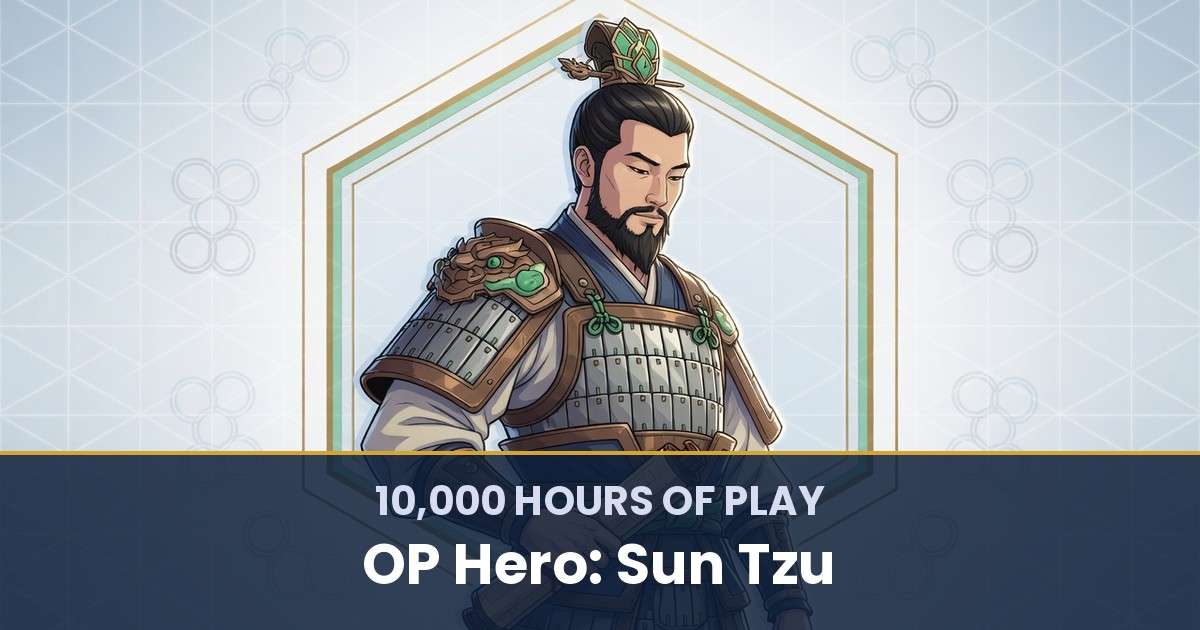


Twenty-five centuries after it was written, The Art of War still gets quoted in boardrooms, locker rooms, and courtrooms by people who will never command a single soldier. The stranger part: we are not even certain the man whose name is on the cover existed as one person.
What survives without dispute is the book. Thirteen tight chapters that treat conflict as something you can measure, model, and settle before the first blow lands. Scholars still argue whether “Sun Tzu” was a single general in the service of the state of Wu or a school of strategists whose work got bundled under one name. Either way, the mind behind that text played a very particular game, and played it at a level almost no one has matched since.
Run that mind through the 10,000 Hours of Play framework and something clicks into place. Sun Tzu treated war the way a master player treats a hard game: study the board, know your pieces, refuse the fights you can’t win, and set up the ones you can so completely that winning looks inevitable. Here is his character sheet.
⚡ Speed Run Notes
- Sun Tzu’s real game was winning before the fighting started: measure both sides across five factors, then commit only when the math already favors you.
- His signature move was deception. The Art of War treats shaping the enemy’s perception (look weak when strong, far when near) as the heart of strategy.
- The most famous story about him, the palace drill in Sima Qian’s history, is a lesson in discipline: rules mean nothing until there is a real cost for breaking them.
- He barely appears in the historical record. His ideas survived because a state adopted them and commentators like Cao Cao carried them forward for centuries.
- The transferable skill has nothing to do with war: treat any hard situation as a solvable game rather than a test of how much you can grind.
Table of Contents
About Yu-kai Chou

Yu-kai Chou is the author of 10,000 Hours of Play — the book that treats your life as the most important game you’ll ever build a character in, and gives you the 6-Step framework (Game · Attributes · Role · Skills · Allies · Quests) to play it on purpose. He has spent two decades developing the system through which this post analyzes its OP Hero, and applies it to his own life and to the lives of the people he advises around the world.
Chou’s other framework, the Octalysis Framework, has been applied by LEGO, Microsoft, Porsche, Coca-Cola, Salesforce, and MrBeast, impacting over 1.5 Billion Users. He has taught the methodology at Harvard, Stanford, Yale, Tesla, Google, BCG, and IDEO, and has advised governments in eight nations including Ukraine, the United Kingdom, the Kingdom of Bahrain, Singapore, Taiwan, the Netherlands, Kazakhstan, and South Korea.
His work has been cited by Harvard, Stanford, MIT, Forbes, Wall Street Journal, Wired, US Department of Energy, NIST, NSF, NCBI, US Department of Education, ClinicalTrials.gov, and Google Scholar — with 3,700+ more academic publications. Explore his books here.
What I keep coming back to with Sun Tzu is how much of his edge lived before the fight ever began. The move I would lift for my own life is his opening habit: assess honestly across a few clear factors, and let that assessment tell you whether to commit at all. Willpower gets all the attention. His real lever was clarity, and clarity is the more useful attribute to build.
Step 1: The Game — What Sun Tzu Was Actually Playing
Every OP Hero is playing a specific game, whether they name it or not. Sun Tzu named his with unusual precision. The Art of War opens not with tactics but with accounting. Before you move, it says, weigh both sides across five constant factors: the Dao or moral influence that binds people to their leader, Heaven (timing and weather), Earth (terrain and distance), the Commander, and Method: the discipline and logistics that hold an army together.
Notice what that list does. It turns war, the messiest thing humans do, into a set of comparable variables. Score both sides honestly and the likely winner is visible before anyone draws a sword.
That was the game: win the contest on paper first, then let the battlefield confirm it. The treatise returns again and again to speed, information, and the avoidance of long, ruinous campaigns. The prize was never a glorious fight. It was the political outcome (territory, security, a rival deterred) bought at the smallest possible price.
Nearly all strategy since has been a footnote to that reframe. If you can measure a situation clearly enough, you can often see the result before you commit, and the highest-scoring move is frequently the fight you decline. Twenty-five centuries later, that is still the hardest lesson in the book to actually practice.
Step 2: Attributes — The Innate Stats
Attributes are the stats a hero seems born with. With Sun Tzu we have to read them backward from the text, because no contemporary account of his childhood survives. What the writing reveals is a distinctive mind.
The first stat is a relentlessly analytical temperament. The Art of War reduces chaos to checklists, rankings, and decision rules with a consistency that suggests someone who could not help but systematize the world.
The second is a low tolerance for waste. The book is almost allergic to prolonged war, counting the cost of every extra day an army spends in the field. That instinct for efficiency runs through every chapter.
The third is psychological acuity: an unusual read on how fear, morale, and overconfidence move large groups. The fourth is patience, a willingness to wait for conditions to ripen instead of forcing action. The fifth is comfort with ambiguity, treating uncertainty as the normal weather of any contest rather than a problem to complain about.
You cannot train your way into most of these. They sit closer to the raw talents each of us is dealt, the same mix the Talent Triangle Method is built to help you find in yourself. Sun Tzu’s genius was recognizing his own hand early and building a life’s work squarely on top of it.
Step 3: Role(s) — The Character Class Across Chapters
A Role is the character class you play in a given chapter of life. The tradition around Sun Tzu hands him several, stacked on top of one another.
His base class was strategist: the theorist who formulated the principles, the mind that caught patterns in conflict others missed. In the 10,000 Hours of Play taxonomy that reads as a Ranger build, the class that observes and innovates before it acts. If you want to see how different core temperaments map to leadership styles, Yu-kai’s seven leadership personas cover that ground.
On top of the strategist sat the advisor. According to Sima Qian’s Records of the Grand Historian (written centuries after the events, and treated by historians as tradition rather than eyewitness record), Sun Tzu served King Helü of the state of Wu, translating theory into counsel a ruler could act on.
Then came the hardest class to fake: commander. It is one thing to write about discipline and another to stand in front of troops and enforce it. The tradition insists he could do both.
He was also, in the end, an author, and that is the role that outlived every other. There is a useful parallel in Marcus Aurelius, another leader who kept writing philosophy in the gaps between military campaigns, and whose book ended up mattering far more than any single battle he fought.
Step 4: Skills — The Real-Life Game Skills Sun Tzu Mastered
Attributes are potential. Skills are what a hero actually trains. Reading Sun Tzu’s playbook against the 10,000 Hours of Play skill list, five stand out.
Foresight (Ranger) — the ability to project outcomes and risks before committing. The five-factor assessment that opens the book is Foresight formalized: score the board, and the winner is often visible in advance.
Mastermind (Ranger) — creating, adapting, and executing complex plans. Thirteen interlocking chapters on terrain, timing, supply, and morale add up to one of history’s first complete planning systems.
Decoy (Rogue) — misleading an opponent while you execute the real plan. The book’s most quoted idea is that deception sits at the center of strategy: appear unable when able, appear far when near, and let the enemy defeat himself through bad information.
Fulcrum Strike (Rogue) — the single decisive move that turns everything, the strategic cousin of the 80/20 rule. Sun Tzu’s version is concentrating force where the enemy is unprepared, hitting the one point that collapses the whole position instead of pushing everywhere at once.
Cognitive Lens (Mage) — zooming into the smallest detail of terrain and zooming out to grand strategy in the same breath. The treatise moves fluidly between the shape of a specific hillside and the shape of an entire war.
Skills like these are why the book never became obsolete. They describe how a strong player thinks, and thinking transfers across games. Moving any one of them from beginner to mastery is its own long climb, which is exactly what the Skills Spectrum maps: the road from dabbler to specialist to master.
Step 5: Allies — The People Who Multiplied Sun Tzu
No hero levels up alone, and the strange thing about Sun Tzu is how much of his power came from allies he never met.
The first was King Helü of Wu. In the traditional account, a ruler willing to test and then trust an outsider’s methods gave Sun Tzu something no theory can supply on its own: a real army, a real war, and permission to run the experiment. Ideas need a patron with skin in the game, and Helü was his.
The second ally was the institution itself. A strategist’s playbook only carries force if a court and a command structure actually adopt its discipline. Sun Tzu’s authority came less from lone genius than from a state that operationalized what he wrote. The same pattern shows up in Lee Kuan Yew, whose strategic playbook mattered because an entire government executed it.
The third set of allies arrived long after any plausible lifetime: the commentators. Generals and scholars across the centuries, including the warlord Cao Cao and the Tang-era writer Tu Mu, annotated and preserved The Art of War, arguing with it and sharpening it for each new age. They are the reason a Spring and Autumn period manuscript survived to reach you. A hero whose closest teammates are strangers born a thousand years later is a rare build, and it is the clearest proof that the strongest thing you can create is work good enough that other people carry it for you.
Step 6: Quests — The Milestones That Shaped the Saga
Quests are the concrete milestones that define a run. Sun Tzu’s are unusual because the biggest one is a book, not a battle.
The founding quest was the treatise itself: thirteen chapters that compressed everything into a system portable enough to outlast its author. Whether one hand wrote it or many, assembling that structure was the achievement that mattered.
The second quest was getting a state to adopt it. Moving strategy out of the study and into the machinery of Wu turned private theory into public power.
The third is the most famous story anyone tells about him, and it doubles as his signature setback. Sima Qian records that King Helü tested Sun Tzu by handing him the palace women and daring him to drill them into soldiers. They laughed and ignored the first order. Sun Tzu’s response, in the tradition, was ruthless: he held the appointed officers accountable, enforced the penalty over the king’s protests, and only then did the ranks move as one. The story cuts both ways. It shows a commander who could impose order on chaos, and it shows the ugly cost of proving authority. The king got his demonstration and lost the smile on his face.
The quiet final quest happened after death: transmission. The long argument over whether Sun Tzu was one man or a whole tradition is itself a milestone, the sign of a work so influential that its authorship became a puzzle worth fighting about. Stack that run beside the other OP Heroes and a pattern appears: the ones who echo longest often win their biggest quest without being in the room for it.
What You Can Steal From Sun Tzu’s Build
You are not going to command an army. The build still transfers, because Sun Tzu’s real subject was decision-making under pressure, and that shows up in every hard thing you do.
Steal the assessment habit first. Before your next big move (a negotiation, a launch, a career jump), score it the way he scored a battlefield. What is the terrain? Who holds the stronger position? Where is your leverage point? Most people skip straight to effort. Sun Tzu would tell you the game is often decided before effort begins.
Steal the discipline about waste, too. He measured the cost of every extra day at war. You can measure the cost of every project that drags and every fight you pick out of ego instead of advantage.
And steal the deepest move of all: treat the hard thing as a solvable game rather than a referendum on how much you can grind. That reframe is the whole spine of the 10,000 Hours of Play system, and Sun Tzu is its oldest proof. Twenty-five centuries later, the character sheet still plays.
Where this framework comes from

Want the full system this profile is built on?
Every OP Hero piece runs through the same 6-Step framework from 10,000 Hours of Play: Unlock Your Real-Life Legendary Success. The book covers the full system, walks through Yu-kai’s own life run as the first applied case study, and gives you the worksheets to audit your own build.
Related Reading
- The full OP Hero library: every profile run through the same 6-Step framework.
- 10,000 Hours of Play by OP Hero: Laozi: a very different mind from the same turbulent stretch of ancient Chinese history.
- 10,000 Hours of Play by OP Hero: Marcus Aurelius: the other great strategist-philosopher who wrote between campaigns.
- 10,000 Hours of Play by OP Hero: Lee Kuan Yew: modern proof of what happens when a whole state adopts one strategist’s playbook.
- The 10,000 Hours of Play framework: the six steps behind every profile, in one place.