
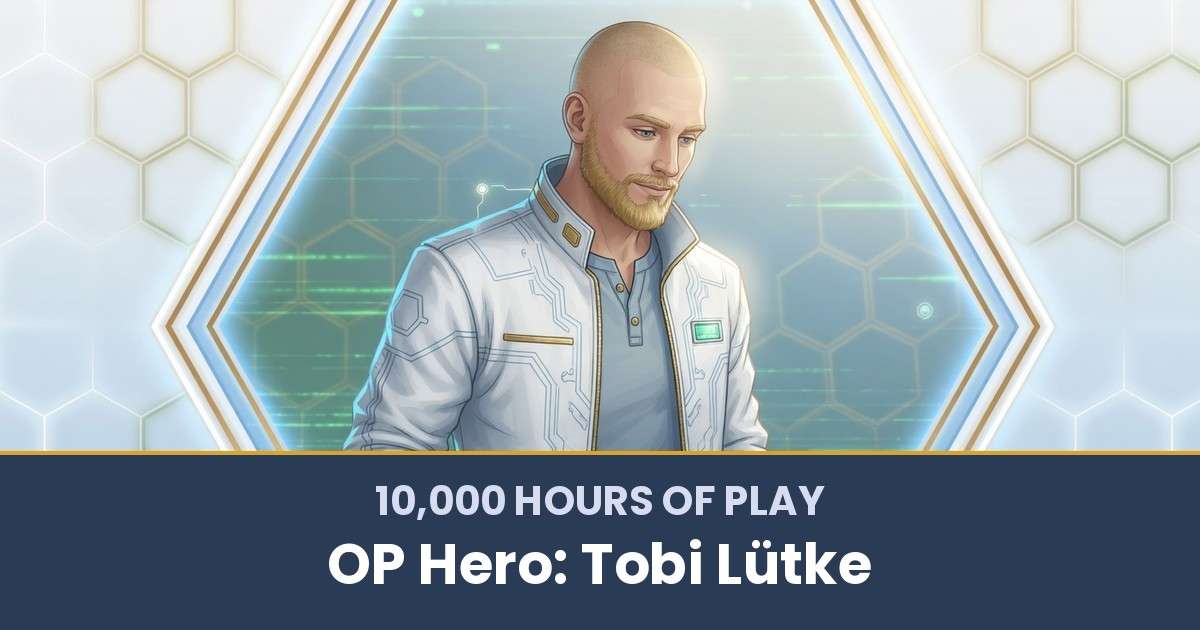


In 2004, a German programmer living in Ottawa wanted to sell snowboards online. He looked at the e-commerce software on the market, decided all of it was bad, and did the thing almost nobody does. He didn’t pick the least-bad option. He wrote his own.
The programmer was Tobi Lütke. The shop was called Snowdevil. It sold snowboards for a couple of years and then quietly faded. The software running underneath it did not fade. It became Shopify, the platform that now carries millions of merchants and has handled hundreds of billions of dollars in sales.
Here is the part worth your attention. Lütke did not set out to build a company. He set out to build a tool he wanted to use, and the company was a side effect. That sounds like luck. Read his life closely and it stops looking like luck.
Run Tobi Lütke through the 10,000 Hours of Play framework and a clear build emerges: a coder who treated every bad tool as a puzzle, kept his hands on the keyboard long after the org chart told him to stop, and made one very public, very expensive mistake he refused to hide. Here is that build, step by step.
⚡ Speed Run Notes
- Tobi Lütke never set out to build Shopify. He wanted to sell snowboards online, hated every e-commerce tool he tried, and wrote his own. The shop faded; the software became a company.
- His real game was never “run a store.” It was “build the tool I wish existed,” then notice that everyone else wished it existed too.
- He stayed a programmer after becoming CEO. The rarest move in his whole build is refusing to stop being technical when the org chart said he should.
- In 2020 he made Shopify digital by default, turning a pandemic constraint into a permanent redesign of how the entire company worked.
- The honest scar: in 2022 he bet the online-shopping surge was permanent, was wrong, cut about 10% of staff, and wrote “I got this wrong” under his own name.
- The move you can copy: when every tool in front of you is bad, that is not a dead end. It is a precise brief for what to build next.
Table of Contents
About Yu-kai Chou

Yu-kai Chou is the author of 10,000 Hours of Play — the book that treats your life as the most important game you’ll ever build a character in, and gives you the 6-Step framework (Game · Attributes · Role · Skills · Allies · Quests) to play it on purpose. He has spent two decades developing the system through which this post analyzes its OP Hero, and applies it to his own life and to the lives of the people he advises around the world.
Chou’s other framework, the Octalysis Framework, has been applied by LEGO, Microsoft, Porsche, Coca-Cola, Salesforce, and MrBeast, impacting over 1.5 Billion Users. He has taught the methodology at Harvard, Stanford, Yale, Tesla, Google, BCG, and IDEO, and has advised governments in eight nations including Ukraine, the United Kingdom, the Kingdom of Bahrain, Singapore, Taiwan, the Netherlands, Kazakhstan, and South Korea.
His work has been cited by Harvard, Stanford, MIT, Forbes, Wall Street Journal, Wired, US Department of Energy, NIST, NSF, NCBI, US Department of Education, ClinicalTrials.gov, and Google Scholar — with 3,700+ more academic publications. Explore his books here.
What I find instructive about Tobi Lütke’s build is how long he refused to stop being a builder. Most founders treat the CEO title as a graduation out of the actual work. Lütke treated it as a constraint to fight. The lesson I would lift from his run is the one in Step 4 below: when the tools in front of you are all bad, that is not a reason to settle. It is the clearest brief you will ever get for what to make next. Lütke heard that brief in a snowboard shop and spent the next twenty years answering it.
Step 1: The Game — What Tobi Lütke Was Actually Playing
Every OP Hero is playing one core game that runs underneath all the job titles. Tobi Lütke’s game was not “run an online store.” It was not even “run a company.” His game was simpler and stranger than that: build the tool I wish existed, then notice that other people wish it existed too.
Look at the origin and the pattern is right there. He wanted to sell snowboards, and selling snowboards was the surface activity. The thing he could not stop doing was building the system underneath the snowboards. When the available e-commerce software annoyed him, he did not treat that as a roadblock. He treated it as the real assignment.
Lütke has described what Shopify is for in a consistent way for two decades: arming the rebels. Small merchants against large incumbents. Independent builders against the platforms that would rather own them. He has talked about building weapons for the rebels, and he has stayed loyal to that framing through every stage of the company.
There is a second, quieter rule inside his game. He has refused to stop being a programmer. Becoming CEO did not end his identity as a builder of tools; he kept committing code and kept pushing for better developer tools long after most founders would have moved fully into management.
This is exactly what Step 1 of the 10,000 Hours of Play system asks you to do first: name the real game, not the role you happen to be paid for. Lütke’s business card has said many things. The game underneath it never changed.
Step 2: Attributes — The Innate Stats
Attributes are the stats you show up with, the ones visible before anyone teaches you anything. Lütke rolled an unusual set.
Systems pattern-recognition. As a kid he did not just use computers, he took them apart. He learned to program by modifying games and systems rather than by following a curriculum, which means his earliest instinct was to see the machine underneath the thing. By his teens he was customizing his school’s computer systems and writing his own software tools. The reflex to look past the surface and into the structure was there from the start.
Deep focus, low need for an audience. Lütke describes himself as an introvert who is happiest programming alone for long stretches. This matters more than it sounds. A lot of founder energy is social energy. His was the opposite kind: the capacity to sit with a hard problem in a quiet room until it gave way.
A self-taught engine. He left the conventional academic track early and never collected a university degree. Instead he completed a vocational apprenticeship as a programmer in Germany and did the rest of his learning himself, treating learning as the steady building of mental models rather than the passing of exams.
Calm risk tolerance. He moved from Germany to Canada in 2002 with no tech-career plan, mostly to be with his girlfriend and, in his own telling, to snowboard. He later turned a small snowboard store into a software company at a moment when no one knew e-commerce platforms would become a category. None of this reads as thrill-seeking. It reads as quiet conviction.
If you want to map your own innate stats, Yu-kai built a tool for exactly that: the OP Talent Triangle Method, which finds the corner where your natural strengths overlap. Lütke’s strengths pointed at one corner early: systems. He spent his twenties walking toward it.
Step 3: Role(s) — The Character Class Across Chapters
A Role is the character class you play in a given chapter. Lütke re-classed several times, and each class quietly equipped the next.
He started as a hacker and toolmaker apprentice in Germany in the 1990s, growing up around Koblenz. This was the backline-engineer class: no spotlight, no business, just code and games and the slow accumulation of craft. He formalized it with a German vocational apprenticeship as a software developer rather than a university degree.
In 2002 he re-classed to immigrant coder and snowboarder. He moved to Canada to be with Fiona McKean, later his wife, and by his own account he was not chasing a company at all. He wanted to write code and ride a snowboard. It was a low-equipment character starting fresh in a new country.
Around 2004 came the merchant-founder class. With Scott Lake he started Snowdevil, an online snowboard shop, and to run it he built the store software himself. For the first time he was playing two classes at once: shopkeeper on the surface, engine-builder underneath.
In 2006 the engine became the product, and Snowdevil became Shopify. When co-founder Scott Lake stepped away in 2008, Lütke took the CEO role and re-classed again, into a product-first founder-CEO: still coding, but now responsible for hiring, capital, and a growing team.
His current class, roughly from the 2015 IPO onward, is systems architect and public technology leader. He spends less time in the codebase and more time designing the organization itself: how it works, where it works, and what tools it must adopt.
The lesson of this Step is that no class is wasted. The apprentice made the founder possible. Reed Hastings ran the same pattern at Netflix, teaching himself the CEO job chapter by chapter rather than arriving with it finished. The early Role is always the tuition for the later one.
Step 4: Skills — The Real-Life Game Skills Tobi Lütke Mastered
Attributes are what you are born with. Skills are what you grind. In 10,000 Hours of Play, Skills are named like RPG abilities, each tied to a Class. Lütke built five of them to a high tier.
Elemental Transposition (Mage): reframing every problem as a puzzle instead of a complaint. This is the founding Skill of the whole build. In 2004 the e-commerce software Lütke needed for Snowdevil did not exist in a form he respected. The ordinary move is to settle for the best of a bad set of options. His move was to treat the gap as a solvable puzzle and write his own store software on Ruby on Rails, then a brand-new framework. That reframe is the entire difference between a snowboard shop and Shopify.
Bat Signaling (Ranger): building a reputation over time until it does work for you. While building Shopify, Lütke joined the core team of Ruby on Rails and authored widely used open-source libraries, including the Liquid templating language and the ActiveMerchant payments library. That public craft became a signal. It marked Shopify as a serious engineering shop, pulled in strong developers, and laid the groundwork for the third-party ecosystem the platform later ran on.
Batcave Crafting (Ranger): redesigning the environment your team works in. In May 2020, with the pandemic forcing the question, Lütke did not treat remote work as a temporary patch. He announced that Shopify was becoming digital by default and said that office centricity was over. He took a constraint everyone else was merely enduring and turned it into a deliberate, permanent redesign of how the company operated.
Reflect Damage (Paladin): using a setback as material for growth instead of hiding it. When his biggest bet failed in 2022 (Step 6 has the full story), Lütke wrote a memo to the entire company that included the line that placing the bet was his call to make and he got it wrong. He signed his name to the error in public. Most leaders bury that sentence. He led with it.
Animate (Warlock): pushing human-labor processes toward automation. By 2025 Lütke had made AI use an explicit expectation at Shopify rather than an optional tool, telling staff to reach for AI by reflex and setting a rule that new headcount would not be approved unless a team could show that AI could not do the job.
None of these are exotic powers. The Skills Spectrum makes the point well: mastery is usually ordinary Skills pushed to an unusual tier. The rarest thing in Lütke’s set is not any single Skill. It is that he kept the engineer’s Skills sharp while playing the CEO’s game, the same refusal to stop being technical that defines Jensen Huang‘s long run at Nvidia.
Step 5: Allies — The People Who Multiplied Tobi Lütke
No OP Hero levels up alone. Lütke’s build ran on a small set of Allies, each one covering ground he could not cover himself.
Scott Lake was the first. He co-founded the original company, first called Jaded Pixel, with Lütke and served as the early CEO while Lütke built the product. When Lake stepped away in 2008, the CEO seat passed to Lütke, and the company’s center of gravity shifted permanently toward product and engineering.
Daniel Weinand, a co-founder, owned design. As Shopify’s Chief Design Officer, and later Chief Creative Officer, he made sure the platform’s craft lived not only in the code but in how Shopify looked and felt to the merchants using it every day.
Harley Finkelstein is the clearest proof of Lütke’s eye for Allies. Finkelstein started as a Shopify merchant in 2006, while still in law school, then joined the company full-time in 2010 to run business development. He rose to Chief Operating Officer in 2016 and to President in 2020: a merchant who became the company’s outward-facing operator.
John Phillips supplied early belief and early capital. Through his firm Klister Credit Corporation he became Shopify’s first outside investor in 2007 and chaired its board, giving a young Ottawa company financial ballast before the wider market had any reason to take it seriously.
Fiona McKean belongs in any honest account of this build. She is the reason Lütke moved to Canada in 2002, which is to say she is the reason Snowdevil and Shopify happened in Ottawa at all. The two later co-founded a philanthropic organization together in 2019.
The pattern is worth copying. Lütke did not assemble a giant network. He found a few people who covered operations, design, and capital, and he gave them real standing. Brian Chesky built Airbnb on the same principle: a founder obsessed with the product still needs Allies to carry everything the product is not.
Step 6: Quests — The Milestones That Shaped the Saga
Quests are the concrete missions that move a saga forward. Lütke’s headline Quests:
Snowdevil (2004). The online snowboard shop that started everything. It mattered less as a store than as the reason the store software ever got written.
Shopify launches (2006). The store software was generalized into a product other merchants could use, and the company stopped being a snowboard shop. The side effect had become the main quest.
Taking the CEO seat (2008). When Scott Lake departed, Lütke became CEO and then did the hard, unglamorous work of teaching himself the job, building the management skills the role demanded as Shopify grew.
The IPO (2015). Shopify filed to go public in April 2015 and listed that year. A small Ottawa company was now a public one, with public capital and public scrutiny behind every decision.
The pandemic surge (2020). When lockdowns pushed retail online, Shopify’s 2020 revenue grew 86% over the prior year, and the volume of sales across the platform nearly doubled. From inside that surge, it looked like the future had simply arrived early.
The bet that failed (2022). This is the setback the highlight reels skip. Lütke had concluded the pandemic shift was permanent. The share of shopping done online, he believed, had leapt five or even ten years ahead for good, and he scaled Shopify for that world. It was wrong. As shopping patterns reverted, Shopify’s stock fell roughly 80% across 2022, and in July the company cut about 10% of its staff. Lütke’s memo did not spread the blame; it said the call was his and he got it wrong.
The AI mandate (2025). Recovered and refocused, Lütke moved early again, making fluent AI use a baseline expectation across Shopify rather than a perk for the curious.
Read the full library of OP Hero profiles and the same shape keeps appearing: real builds always include at least one quest the hero lost.
What You Can Steal From Tobi Lütke’s Build
You are probably not going to build a commerce platform. That is not the point. The build logic is, and three pieces of it transfer to almost anyone.
First: a bad tool is a brief. When Lütke could not find e-commerce software he respected, he did not read that as bad luck. He read it as a precise description of what to build. The next time the tools in front of you are all frustrating, resist the urge to just pick one. The frustration is telling you exactly where the open space is.
Second: do not graduate out of the work. The standard founder story treats becoming CEO as the moment you stop building and start managing. Lütke fought that. He kept his hands technical because the technical view kept making him a sharper decision-maker. Whatever your version of the real work is, think hard before you promote yourself away from it.
Third: own the bet out loud. Lütke’s 2022 misread was expensive and public, and the most useful thing he did was refuse to hide it. “I got this wrong” is a stronger sentence than any spin, because it keeps a team’s trust intact for the next bet. A build that never records a loss is not an honest one, and people can always tell.
The quiet last lesson is in how the whole thing started. Lütke did not set out to be a CEO or to be wealthy. He set out to build one good tool, carefully, for a use he personally cared about. The empire was the side effect. Often the most durable games are the ones you start playing for their own sake, before you have any idea how large the board will turn out to be.
Where this framework comes from

Want the full system this profile is built on?
Every OP Hero piece runs through the same 6-Step framework from 10,000 Hours of Play: Unlock Your Real-Life Legendary Success. The book covers the full system, walks through Yu-kai’s own life run as the first applied case study, and gives you the worksheets to audit your own build.
Related Reading
- The full library of OP Hero profiles. Every figure in this series, analyzed through the same six-step framework.
- 10,000 Hours of Play by OP Hero: Reed Hastings. Another founder who taught himself the CEO job one chapter at a time.
- 10,000 Hours of Play by OP Hero: Jensen Huang. An engineer-founder who never stopped being technical.
- 10,000 Hours of Play by OP Hero: Brian Chesky. A personal need turned into a platform millions of people use.
- 10,000 Hours of Play by OP Hero: Phil Knight. A builder who turned one niche passion into a global company.
- The 10,000 Hours of Play framework. The full six-step system behind every OP Hero profile.