
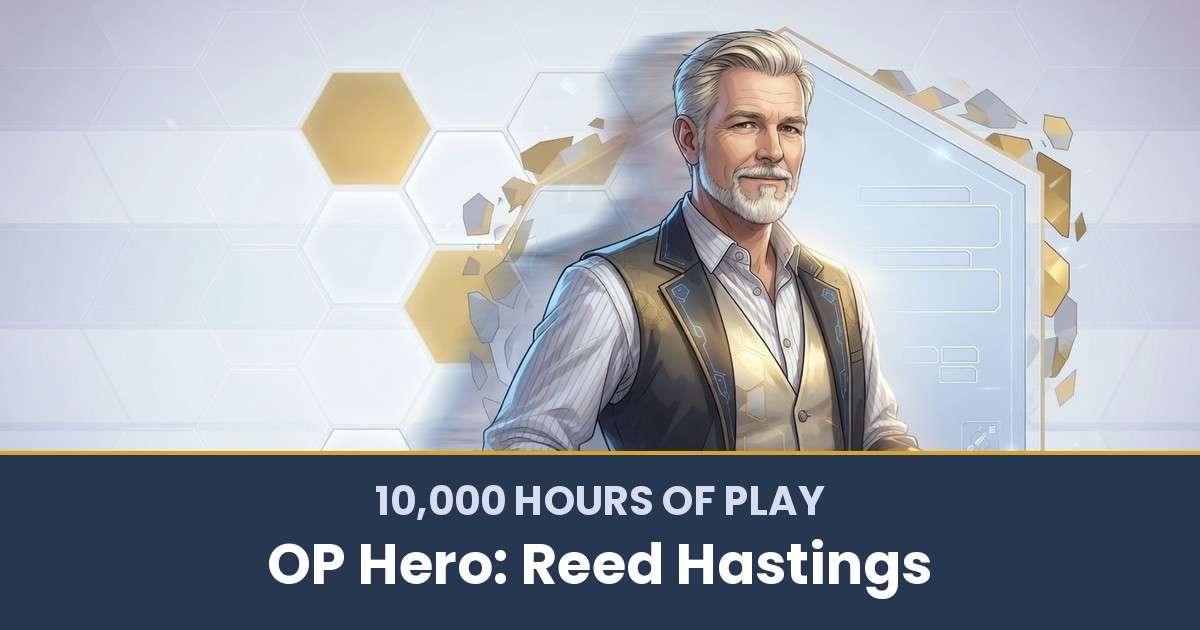


In September 2011, Reed Hastings did something almost no founder does on purpose. He split his own company in two, and watched the stock fall roughly 77% from about $300 a share to near $60. Netflix shed around 800,000 subscribers in a single quarter. The business press started drafting the obituary.
Twelve years later he stepped down as CEO of a company with more than 220 million members and a content library the old studios were openly afraid of. Same man. Same decade. The distance between those two facts is the most useful thing about him.
Run Hastings through the 10,000 Hours of Play framework and the 2011 disaster stops looking like a fluke. It starts looking like a feature. The exact Attributes that nearly sank Netflix are the ones that built it, and you only see why once you look at the whole character sheet.
⚡ Speed Run Notes
- Hastings never changed his Game: use software and culture to widen what ordinary people are free to choose. Netflix and his education work are the same bet at two scales.
- His Attributes showed up before the companies did — extreme risk tolerance (Peace Corps in rural Swaziland), systems thinking that always abstracts up a level, and a near-total comfort with conflict.
- The 2011 Qwikster split was the worst self-inflicted wound of his career: a 60% price hike, about 800,000 subscribers lost, the stock down roughly 77%. He reversed it in 22 days.
- The recovery was not luck. It was Phoenix Rebirth and Guardian Restraint: he published the apology, signed his own name to it, and undid his own decision in public.
- The streaming pivot meant deliberately killing the DVD business that paid the bills. That is Mastermind play — building the thing designed to destroy your current cash cow.
- The build is copyable. Pick a Game tight enough to survive your worst quarter, then design a culture that can run it when you are not in the room.
Table of Contents
- Step 1: The Game — What Reed Hastings Was Actually Playing
- Step 2: Attributes — The Innate Stats
- Step 3: Role(s) — The Character Class Across Chapters
- Step 4: Skills — The Real-Life Game Skills Reed Hastings Mastered
- Step 5: Allies — The People Who Multiplied Reed Hastings
- Step 6: Quests — The Milestones That Shaped the Saga
- What You Can Steal From Reed Hastings’s Build
- Where this framework comes from
- Related Reading
About Yu-kai Chou

Yu-kai Chou is the author of 10,000 Hours of Play — the book that treats your life as the most important game you’ll ever build a character in, and gives you the 6-Step framework (Game · Attributes · Role · Skills · Allies · Quests) to play it on purpose. He has spent two decades developing the system through which this post analyzes its OP Hero, and applies it to his own life and to the lives of the people he advises around the world.
Chou’s other framework, the Octalysis Framework, has been applied by LEGO, Microsoft, Porsche, Coca-Cola, Salesforce, and MrBeast, impacting over 1.5 Billion Users. He has taught the methodology at Harvard, Stanford, Yale, Tesla, Google, BCG, and IDEO, and has advised governments in eight nations including Ukraine, the United Kingdom, the Kingdom of Bahrain, Singapore, Taiwan, the Netherlands, Kazakhstan, and South Korea.
His work has been cited by Harvard, Stanford, MIT, Forbes, Wall Street Journal, Wired, US Department of Energy, NIST, NSF, NCBI, US Department of Education, ClinicalTrials.gov, and Google Scholar — with 3,700+ more academic publications. Explore his books here.
What makes Hastings worth studying through this framework is that his sharpest skill is also his least glamorous one: he is unusually good at being publicly wrong. The Qwikster reversal is a clean example of Guardian Restraint, the ego-check move of undoing your own decision on the record. The lesson I would lift for your own build: the founders who last are not the ones who avoid the bad call. They are the ones who can survive making it in front of everyone.
Step 1: The Game — What Reed Hastings Was Actually Playing
Strip away the red logo and Hastings spent his whole career playing one Game: use software and culture to widen what ordinary people are allowed to choose. The product kept changing. The bet underneath it never did.
Netflix said this out loud. The company’s 2002 S-1 filing stated the goal plainly, to build the world’s largest and most influential movie distribution company. Not the best-reviewed. Not the most prestigious. The one that put the most choice in the most living rooms, on the viewer’s schedule instead of the network’s.
The same instinct shows up far from Hollywood. Between Bowdoin College and Stanford, Hastings spent 1983 to 1985 teaching high school math in Swaziland with the Peace Corps. After he stepped back from running Netflix, he poured himself into education: President of the California State Board of Education, board seats at KIPP and the Charter School Growth Fund, a $120 million gift to historically Black colleges in 2020. Different arena, identical Game. Hand more people more control over what they get to learn and watch.
This matters for the rest of the build because the Game was strict enough to force painful choices. Linear television made money by deciding for you, both what was on and when. Hastings decided early that the future belonged to the opposite arrangement. Once that was the Game, killing late fees, killing the schedule, and eventually killing his own DVD business stopped being radical. They were the Game being honest with itself.
Step 2: Attributes — The Innate Stats
The Attributes Hastings ran on were visible long before Netflix, and most of them are not the ones a business school would put on a slide. Map him on the Talent Triangle Method and three stats sit far above the line.
Risk tolerance most people would call reckless. A new graduate with a math degree had safe options in the early 1980s. Hastings joined the Peace Corps and moved to rural Swaziland, an experience he later credited with building his comfort around ambiguity and bad odds. The pattern held into business. Netflix’s 2002 S-1 disclosed that he had personally guaranteed bank loans for the early DVD operation. He was not playing with house money. He was playing with his own.
Systems thinking that always abstracts up a level. Pure Software, his first company, did not build an app for end users. It built debugging tools for engineers, a meta-product that improves other products. At Netflix the same habit kept firing. He pushed past “online DVD store” to a recurring subscription, then past subscription to a data-driven personalization platform, then past that to streaming. Each move climbed one rung up the ladder of abstraction.
Comfort with conflict that registers as cold. Hastings built and defended the “keeper test”: if you would not fight to keep an employee, you owe them a generous exit and a replacement, even if they are perfectly competent. He ran live feedback sessions where the criticism pointed at him too. Most leaders find this kind of candor physically uncomfortable. He treated it as a tool he happened to enjoy using.
Step 3: Role(s) — The Character Class Across Chapters
Hastings cycled through four Roles across five decades, but the Class underneath them barely moved. He was a Ranger the whole way: strategic, opportunity-focused, the kind of player who reads the board two moves ahead and commits before the rest of the table sees it. The costumes changed. The way he saw the game did not.
He started as the idealistic adventurer. He dropped out of Marine Corps officer training, then chose the Peace Corps instead, teaching math in Swaziland from 1983 to 1985. This chapter was not a detour from the entrepreneur. It was where the entrepreneur’s appetite for hard, uncertain terrain got its first real workout.
Next came the first-time founder. Hastings launched Pure Software in 1991, took it public in August 1995, and saw it through a 1997 merger with Rational Software valued at roughly $700 to $750 million. The software-founder Role is one Bill Gates made famous, but Hastings ran it twice. Pure also taught him a lesson by negative example. It grew into a process-obsessed company he did not enjoy running, and he built Netflix as the deliberate opposite.
Then the Role that history remembers: Netflix co-founder and CEO, from 1997 until January 2023. Twenty-five years in one seat, through the 2002 IPO, the 2007 streaming launch, the 2013 move into original content, and global expansion past 220 million members.
His current Role is Executive Chairman and education philanthropist. He handed day-to-day control to co-CEOs in 2023 and turned his attention back to the learning arena he started in.
Step 4: Skills — The Real-Life Game Skills Reed Hastings Mastered
Read his life through the canon skill set and six moves keep surfacing. They are not generic “leadership skills.” They map cleanly onto the same Real-Life Game Skills the Skills Spectrum uses to grade every OP Hero on this site.
Foresight (Ranger). He named a DVD-by-mail company “Netflix” in 1997, when streaming a movie over consumer broadband was barely possible. In a 2002 New York Times profile he told the paper he expected the DVD business to peak around 2010 and that the real future was online delivery. He was projecting the end of his own core product while it was still growing.
Elemental Transposition (Mage). This is the skill of reframing every problem as a puzzle. In 1997, instead of arguing about whether DVDs would survive the postal system, Hastings and Marc Randolph mailed a disc to Hastings’s house and checked whether it arrived intact. Netflix’s product discovery ran on cheap experiments like that for years, turning open debates into tests with answers.
Batcave Crafting (Ranger). Hastings did not just set strategy. He redesigned the environment that would execute it. The Netflix Culture Deck, posted publicly around 2009, codified “talent density” and high freedom into a system, and he later expanded it into the book No Rules Rules. He engineered the organization on purpose, the way an engineer designs a machine.
Mastermind (Ranger). The Netflix arc was a staged plan: DVD-by-mail, then subscription, then streaming in 2007, then original content in 2013 with a roughly $100 million up-front commitment to two seasons of House of Cards. The hard part was that streaming was built to destroy the DVD business funding it. Jeff Bezos ran the same move when the Kindle was designed to cannibalize Amazon’s physical book sales. Eat your own cash cow before a competitor does.
Phoenix Rebirth (Paladin). This is recovery from a devastating failure, and the 2011 Qwikster collapse qualifies. The stock fell roughly 77%, subscribers walked, and the company looked broken. Two years later Hastings was running the most-watched streaming service on Earth. The failure is covered in Step 6; what matters here is that he treated the wreckage as a starting position, not an ending.
Guardian Restraint (Paladin). The ego-check skill. On September 18, 2011 he published a blog post opening with “I messed up.” On October 10, 2011 he reversed the Qwikster split entirely and kept Netflix as one site. Undoing your own publicly announced decision is a specific kind of discipline. It costs pride to buy back trust.
Step 5: Allies — The People Who Multiplied Reed Hastings
Netflix carries Hastings’s name in the public memory, but the build leaned on a small Alliance whose moves became hard to separate from his own.
Marc Randolph was the co-founder and Netflix’s first CEO. He ran the early company day-to-day, drove the experiment-heavy product culture, and was in the room for the founding experiments. His memoir, That Will Never Work, is the primary first-hand account of how the company actually started.
Patty McCord spent roughly fourteen years as Netflix’s chief talent officer and co-authored the Culture Deck with Hastings. She is the reason his raw instinct for candor became a documented, teachable system instead of a personality quirk that only worked when he was in the room.
Ted Sarandos ran content and drove the bet on Netflix originals, the strategy that turned a distribution pipe into a studio the legacy players feared. He became co-CEO in 2023, which is the cleanest possible proof that Hastings trusted the Alliance to carry the Game forward.
Erin Meyer, an INSEAD professor, co-wrote No Rules Rules with Hastings in 2020. Her role was to stress-test the Netflix culture from the outside, including the places where its candor and the keeper test create real friction. An Ally who only agrees with you is not multiplying you.
Step 6: Quests — The Milestones That Shaped the Saga
Six Quests bracket the run. Listed in order, the throughline is clear: every setback fed the next breakthrough.
2000 — the Blockbuster rejection. Early in 2000, Hastings, Marc Randolph, and CFO Barry McCarthy flew to Blockbuster’s Dallas headquarters and offered to sell Netflix for $50 million, proposing to run Blockbuster’s online arm. CEO John Antioco declined. Blockbuster filed for bankruptcy a decade later. The rejection forced Netflix to build the business itself.
2002 — Netflix goes public. The IPO gave the DVD subscription model the capital and the credibility it needed to scale nationally.
2007 — streaming launches. “Watch Now” arrived on January 16, 2007, with roughly 1,000 titles, Windows-only, and viewing hours tied to your DVD plan. The product was thin on purpose. The point was to start learning before the market flipped.
2011 — the Qwikster fiasco. On July 12, 2011, Netflix announced a price restructure that worked out to a 60% increase for many members. On September 18, it announced it would spin DVDs into a separate service called Qwikster, with its own site and its own bill. Customers revolted. The company lost about 800,000 subscribers that quarter and the stock cratered roughly 77%. On October 10, Hastings killed Qwikster. Brian Chesky hit a similar cliff when COVID erased most of Airbnb’s bookings in 2020. The survivable version of these moments always involves naming the damage out loud.
2013 — original content. House of Cards premiered on February 1, 2013, and became the first online-only series to earn major Emmy recognition. Netflix was no longer a pipe for other people’s films. It was a studio.
2023 — the handoff. In January 2023, after 25 years as CEO, Hastings moved to Executive Chairman and handed operations to co-CEOs. A founder who can leave on his own terms has finished building the system, not just the company.
What You Can Steal From Reed Hastings’s Build
The lazy lesson from a Hastings profile is “pivot.” Everyone says pivot. It explains nothing, because most pivots fail and the word does not tell you why his worked.
The real lesson is structural. Build a Game tight enough to survive your worst quarter. Hastings’s Game — widen what people can choose — did not wobble when the stock fell 77%, because the Game was never “sell DVDs” or even “win at streaming.” It was a level above the product, so a product disaster could not invalidate it. If your mission would be erased by one bad quarter, it is not a mission. It is a business line.
Then there is the skill almost nobody trains: being publicly wrong well. Hastings put his name on the Qwikster apology, reversed his own decision in 22 days, and let the reversal be visible. He spent pride to buy back trust, and trust compounds. Howard Schultz did a version of the same thing when he returned to Starbucks and publicly walked back the company’s drift. The move is not glamorous, and it is rare precisely because it costs ego in the moment.
Audit your own build against his. Is your Game one level above your product? Could your culture run the Game without you in the room? And when you make the inevitable bad call, can you make it in public and keep going? The OP Hero profiles are full of people who failed loudly and recovered. Not one of them tried to pretend the failure never happened.
Where this framework comes from

Want the full system this profile is built on?
Every OP Hero piece runs through the same 6-Step framework from 10,000 Hours of Play: Unlock Your Real-Life Legendary Success. The book covers the full system, walks through Yu-kai’s own life run as the first applied case study, and gives you the worksheets to audit your own build.
Related Reading
- All OP Hero Profiles — the full catalog of life-as-RPG breakdowns, organized by Class and Skill.
- 10,000 Hours of Play by OP Hero: Jeff Bezos — the other long-game builder who cannibalized his own cash cow on purpose.
- 10,000 Hours of Play by OP Hero: Brian Chesky — a founder who reinvented his company through a near-fatal crisis.
- 10,000 Hours of Play by OP Hero: Bill Gates — the software-founder Role run to its maximum scale.
- 10,000 Hours of Play by OP Hero: Jensen Huang — another decades-long Ranger build in technology.
- The 10,000 Hours of Play framework — the hub for the full system.