
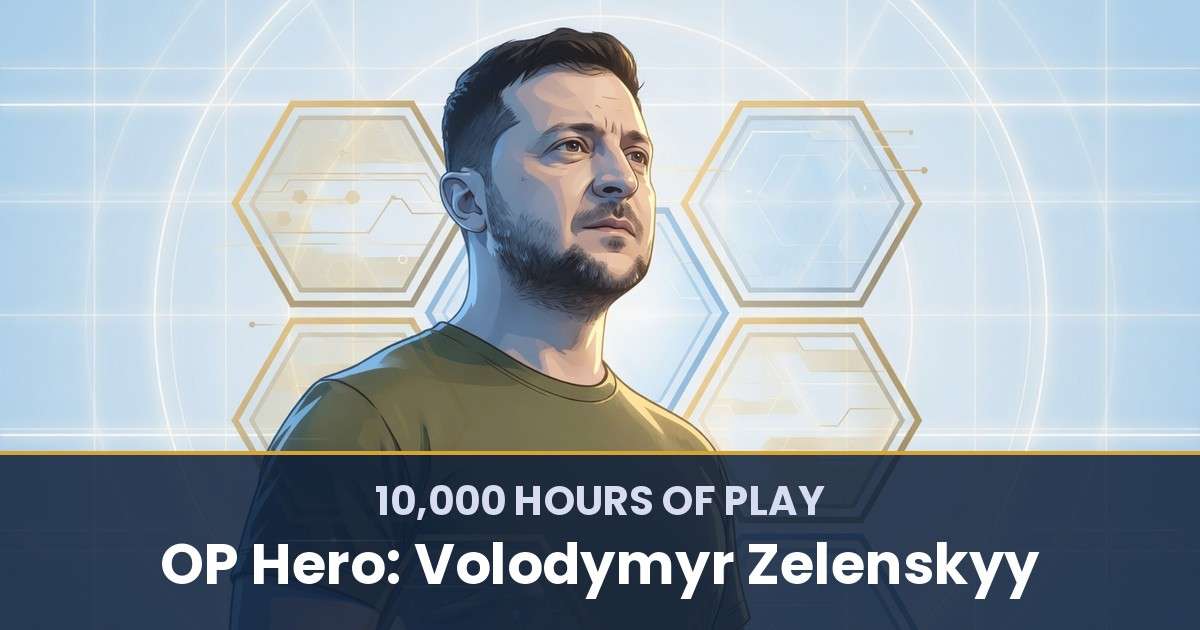


Just after midnight on February 25, 2022, Volodymyr Zelenskyy stepped onto Bankova Street in central Kyiv, faced a phone camera, and recorded a thirty-something-second selfie video with four of his top aides. Russian armored columns were closing on the capital. American intelligence had offered him an evacuation route. He chose a different play.
“Prime Minister is here. Head of the Office of the President is here. President is here. We are all here.” That was the whole script. A former television comedian, less than three years into his first political job, with the largest land army in Europe driving toward his front door, refused to leave the building.
The reason that short clip rerouted the war is the same reason a kid from Kryvyi Rih could win 73.22% of Ukraine’s presidential vote without ever holding office, and the same reason his 2015 sitcom on 1+1 created a political party that elected him in 2019. Zelenskyy didn’t stumble into the role. He grinded into it for thirty years on a build most political analysts thought was disqualifying.
Here is what his run actually looks like through the 6-Step framework of 10,000 Hours of Play.
⚡ Speed Run Notes
- Zelenskyy spent two decades as a comedian and TV producer first. By the time he ran for president in 2019, Studio Kvartal 95 (founded 2003) was already one of Ukraine’s largest entertainment houses.
- Servant of the People wasn’t a sitcom that “led to politics.” It was the political brand. The party that won 2019 was literally named after the show.
- The April 21, 2019 runoff was a 73.22% to 24.45% landslide against an incumbent. That gap is not normal. It is what happens when a fictional character earns voter trust before the real candidate ever asks for it.
- His decision to stay in Kyiv on the night of February 24-25, 2022 was not improvisation. It was thirty years of stage presence applied to a war.
- The build to study is not “comedian becomes president.” It is one consistent narrative skill that survived a class change from Performer to Wartime Leader without losing voice.
Table of Contents
About Yu-kai Chou

Yu-kai Chou is the author of 10,000 Hours of Play — the book that treats your life as the most important game you’ll ever build a character in, and gives you the 6-Step framework (Game · Attributes · Role · Skills · Allies · Quests) to play it on purpose. He has spent two decades developing the system through which this post analyzes its OP Hero, and applies it to his own life and to the lives of the people he advises around the world.
Chou’s other framework, the Octalysis Framework, has been applied by LEGO, Microsoft, Porsche, Coca-Cola, Salesforce, and MrBeast, impacting over 1.5 Billion Users. He has taught the methodology at Harvard, Stanford, Yale, Tesla, Google, BCG, and IDEO, and has advised governments in eight nations including Ukraine, the United Kingdom, the Kingdom of Bahrain, Singapore, Taiwan, the Netherlands, Kazakhstan, and South Korea.
His work has been cited by Harvard, Stanford, MIT, Forbes, Wall Street Journal, Wired, US Department of Energy, NIST, NSF, NCBI, US Department of Education, ClinicalTrials.gov, and Google Scholar — with 3,700+ more academic publications. Explore his books here.
Why Zelenskyy’s build stays with me: I have advised one of the governments listed in my bio above, and the lesson I keep returning to from Zelenskyy’s run is not “comedy is good training for politics.” It is that a coherent character carries you between roles. The same voice that won an audience on Kvartal 95’s stage in the late 1990s won 73% of a national vote in 2019 and held a wartime alliance together in 2022. The attribute to lift from his build is not charisma. It is the discipline to keep being the same person across class changes that should have broken him.
Step 1: The Game — What Zelenskyy Was Actually Playing
Every OP Hero plays one long game underneath all the smaller ones. Zelenskyy’s looks like a career-pivot story from the outside, but the through-line is older than any of his roles.
From his first KVN sketches in the mid-1990s, through the Kvartal 95 stand-up era, through Servant of the People, and into wartime: the game he keeps playing is turning ordinary Ukrainians from spectators into protagonists of their own state. The medium changes. The audience changes. The job description changes. The game does not.
In the 1990s the format is satire that names corrupt elites out loud while the elites are still in power. In 2015 the format is a fictional history teacher who reads a viral anti-corruption rant and accidentally becomes president. In 2019 the format is a real campaign on the same line. In 2022 it is a man in an olive shirt addressing his country every night because the country has been told it would be erased by Friday and is still there on Monday.
If you map this through the 10K HP framework, Zelenskyy’s main quest is not “become president.” Presidents are a Role he picked up. The actual quest is closer to: make the ordinary Ukrainian the protagonist of the story being told about Ukraine. The reason that game is so legible from outside is that he has been playing exactly one version of it since he was 18.
Step 2: Attributes — The Innate Stats
Attributes are the stuff you can see before the training begins. Zelenskyy’s were visible by the time he was in his teens.
Performer instinct. Long before professionalization, he was the front of the room. He joined local theater in Kryvyi Rih, then a KVN comedy team in school, and within years was the face of a top-league post-Soviet KVN troupe broadcasting nationally. That kind of stage placement is not learnable; teammates put the highest-charisma person in the front, and they keep doing it.
Comic timing and vocal range. The Kvartal 95 act relied on impersonation and quick character switches. The same vocal instrument carried Paddington Bear in the Ukrainian dub of Paddington (2014) and Paddington 2 (2017), a role that needs warmth more than technique. Voice acting children’s films and headlining adult political satire with the same toolkit is unusual.
Risk tolerance. He enrolled in law at the Kyiv National Economic University and walked away from a stable legal path to chase comedy in 1990s Ukraine, which was not a safe career market. Two decades later, he wound down a thriving entertainment career to run for president with no prior office. Different decades, same shape.
Empathy with the unfamous. His comedy archetypes were teachers, conscripts, lower-middle-class fathers, not elites. His wartime speeches still default to the individual story (a soldier, a child, a civilian) before policy. That isn’t a learned message discipline. It’s an instinct visible in his earliest sketches.
Yu-kai’s Talent Triangle Method is the diagnostic for this layer of the build: where the genuinely innate stuff lives, what to grow around it, and which trainings actually compound on top. Zelenskyy’s triangle has charisma and risk tolerance at two of its corners, with mimicry filling out the third. Everything else is what he built on top.
Step 3: Role(s) — The Character Class Across Chapters
Most OP Heroes change Role once or twice. Zelenskyy has changed it five times without changing voice.
Law Student / Apprentice (late 1990s). Faculty of International Economics and Law at the Kyiv National Economic University. He never practiced. The chapter mattered for institutional literacy, not credentials.
KVN Performer and Team Lead (mid-1990s to early 2000s). Front of the Kvartal 95 team, named after his Kryvyi Rih neighborhood. The KVN league was the cultural training ground for a generation of post-Soviet comedians. He was a Charismatic Bard archetype: improvise under pressure, hold a troupe together on the road, keep the audience laughing while the politics underneath the joke gets sharper each season.
Studio Founder and Producer (from 2003). Studio Kvartal 95 incorporates as a TV production company. Zelenskyy moves from performer to operator: budgets, network deals (notably with 1+1), writers’ rooms, IP. This is the class change most narrators of his story skip. Without the Producer chapter he is a stage comedian. With it, he has a production engine, a TV channel relationship, and a national distribution arm long before he needs one.
TV Star and Brand-Builder (2015–2018). Servant of the People debuts October 16, 2015 on 1+1. Vasyl Holoborodko, history teacher turned president, becomes household-name fiction. Two seasons later, the character’s reformist voice is more recognizable in Ukraine than most actual politicians. The character isn’t a separate persona from Zelenskyy. The character is a prototype.
Candidate and President (December 2018 to February 2022). Candidacy announced December 31, 2018 on the New Year’s Eve broadcast. Runoff April 21, 2019: 73.22% to Petro Poroshenko’s 24.45%. Inaugurated May 20, 2019. The peacetime presidency is dominated by anti-corruption promises, Donbas ceasefire attempts, and the July 25, 2019 phone call with Donald Trump that triggered the first US impeachment proceedings.
Wartime Leader (February 24, 2022 to now). The chapter the world watches. Daily addresses, allied diplomacy, frontline visits, and a global communication operation that has very little precedent at its scale. The class change is the largest one any of his peers in his cohort have done. Winston Churchill’s Wartime Leader chapter is the closest historical comparison, and Churchill had decades of cabinet roles to draw on first. Zelenskyy did not.
Step 4: Skills — The Real-Life Game Skills Zelenskyy Mastered
Of the canon Real-Life Game Skills in the 10K HP system, six show up repeatedly in Zelenskyy’s record. (For context on what canonical Skill writeups look like, see Yu-kai’s Lich Pact writeup as an example of the format.)
Charm (Druid) is the ability to make a person or group affectionate toward you. Zelenskyy’s Kvartal 95 years are the textbook training arc for this Skill. KVN audiences in the post-Soviet space were notoriously fickle, and the team that ends up at the top of the league has, by definition, won over rooms in dozens of cities. By the early 2000s he was being booked because the audience laugh started before the punchline. That is a measurable Charm stat.
Bind Fate (Warlock) is the move of using someone else’s brand or resource to become powerful yourself. Zelenskyy’s masterstroke between 2015 and 2019 was binding his real identity to the fictional brand of Vasyl Holoborodko. The new political party was literally named Servant of the People after the show. Voters were not asked to evaluate an unknown comedian. They were asked to elect a character they already trusted, and the actor came with the character.
Wildfire Spark (Ranger) is the mastery of viral marketing. The December 31, 2018 candidacy announcement is the canonical example. He used a pre-recorded video on 1+1 in a prime New Year’s Eve slot, displacing the incumbent president’s traditional address on the same channel. That single move turned campaign launch into national event. The Bankova Street video on February 25, 2022 is the same Skill, repurposed: one phone, one minute, global distribution by morning.
If you want to see this Skill’s range against very different personalities, Malala Yousafzai built a global advocacy career on the same compounding effect, starting from a single BBC blog and one survived attack.
Loremaster (Druid) is the art of weaving compelling, inspiring stories. The Servant of the People scripts, the campaign messaging, and the March 16, 2022 virtual address to the US Congress are all the same Skill at three difficulty levels. The Congress speech invoked Pearl Harbor and 9/11, anchoring Ukrainian suffering to American historical memory. That kind of cross-context analogy is the Loremaster move: take a story the audience already knows and make your story rhyme with it.
Behind every one of these Skills is the same general layer of training: a sense of where a given audience sits on the Skills Spectrum, and what kind of language each audience will actually hear. KVN trained him on Ukrainian and Russian-speaking civilians. 1+1 trained him on the national mainstream. The Congress speech trained him on a chamber full of legislators raised on Reagan and 9/11. Same Skill, different language packs.
Courageous Heart (Paladin) is the willingness to charge into uncomfortable zones, uncharted territory, and hostile environments. The night of February 24-25, 2022 is the cleanest example in modern politics. He had a US-offered evacuation option, intelligence that decapitation teams were inside the capital, and a family in the residence. He recorded the Bankova video instead. The widely quoted “ammunition, not a ride” line rests on second-hand accounts rather than a verbatim public record, but the actual decision (stay in Kyiv, address the country live) is documented and the harder data point.
Thunder Clap (Paladin) is public speaking that charges up and inspires people. Daily wartime video addresses. The December 21, 2022 joint session of the US Congress, where he presented a Ukrainian flag signed by frontline troops in Bakhmut. The September 2023 in-person UN General Assembly address. The Skill is not “be eloquent.” It is to walk into a room and leave it with the audience committed to something they were merely sympathetic to when they sat down.
Step 5: Allies — The People Who Multiplied Zelenskyy
OP Heroes are almost never solo. Zelenskyy’s roster shows up across both halves of his life, which is unusual.
Olena Zelenska (wife, First Lady since May 20, 2019). She has built her own public role around humanitarian campaigns, mental health initiatives, and cultural diplomacy that complements the wartime political track. The First Lady job in a country at war is not ceremonial; she has been one of the most effective vectors for Ukrainian soft power in the West.
Andriy Yermak (Head of the Office of the President since February 2020). The political fixer who runs back-channel diplomacy, controls access to Zelenskyy, and coordinates everything from prisoner exchanges to ally negotiations. Indispensable, and the source of most of the public criticism the inner circle takes; that is the trade you make for that role.
Serhiy and Borys Shefir (Kvartal 95 co-founders). Serhiy became First Assistant to the President and survived an assassination attempt in September 2021. The Shefir brothers built the studio with Zelenskyy in 2003 and translated that team into the presidential administration in 2019. When commentators say Zelenskyy “brought his comedy crew into government,” this is the technically accurate version of the claim, and most of those crew members are still there.
Valeriy Zaluzhnyi (Commander-in-Chief, July 27, 2021 to February 8, 2024). The military spine of the early war. The Kyiv defense, the Kharkiv counteroffensive, and the early Kherson operation all carried his fingerprints. His February 2024 dismissal and replacement with Oleksandr Syrskyi was one of the riskiest internal moves Zelenskyy has made; the relationship had become politically sensitive, and the decision still attracts argument.
Dmytro Kuleba (Foreign Minister, March 4, 2020 to 2024). The diplomatic architect of the wartime alliance: sanctions coordination, the Ramstein meetings, weapons asks, and the strategic isolation of Russia at the UN. Without Kuleba’s chamber-by-chamber lobbying, the speeches have nowhere to land.
Step 6: Quests — The Milestones That Shaped the Saga
The shape of any 10K HP run is best read in the specific Quests the hero either completed or failed.
2003: Studio Kvartal 95 incorporates. The class change from performer to operator. Without this Quest, the rest of the run is impossible: no production engine, no 1+1 relationship, no national reach when the candidacy lands.
October 16, 2015: Servant of the People premieres on 1+1. Holoborodko’s anti-corruption rant goes viral inside the show, and the show itself goes viral outside it. The fictional character builds the political brand before the party exists.
December 31, 2018: candidacy announced. The video drops on 1+1 during prime New Year’s Eve airtime, partly displacing the sitting president’s traditional address on the same channel. The launch is the message.
April 21, 2019: runoff victory. 73.22% to Poroshenko’s 24.45% per Ukraine’s Central Election Commission. Turnout around 61%, support broadly distributed including in the south and east. The cleanest mandate any post-independence Ukrainian president had received.
July 25, 2019: the Trump phone call. The Quest that did not go well. A White House memorandum of the call became central to the first impeachment of a sitting US president. Zelenskyy spent his first months on the world stage trapped inside someone else’s political crisis, with critical US security assistance temporarily withheld. The lesson he took out of it shows up later: never let the global narrative around Ukraine be written by anyone else.
February 24-25, 2022: the invasion night. Decision to stay in Kyiv. Bankova video. The “we are all here” line becomes the rallying anchor of the first months of the war and shifts allied expectations of how long Ukraine will hold from days to indefinite.
If you want to see how this Quest pattern threads across other OP-Hero profiles in the 10K HP system, the OP Hero Profiles hub collects the full library.
What You Can Steal From Zelenskyy’s Build
Three lessons hold up across his entire run.
One: the Producer chapter matters more than the Performer chapter. The version of Zelenskyy most people pattern-match on is the stage comedian. The version that won 2019 and survived 2022 is the operator who spent fifteen years building a production company first. If your current Role is performer-shaped, the highest-leverage upgrade is the layer below the performance: the engine that makes the performance ship at scale.
Two: a coherent character carries you between Roles. KVN, Kvartal 95, Holoborodko, candidate Zelenskyy, President Zelenskyy, Wartime Zelenskyy. The job title changes; the voice does not. That is how a 30-year build feels in the wild. If every chapter looks like a different person, you do not have a build; you have a sequence of jobs.
Three: when the script calls for you to leave, sometimes the entire game is the decision to stay. Zelenskyy’s most lasting Skill is not Charm and not Loremaster. It is Courageous Heart applied at the one moment when leaving was the rational play. Most of us will never be in a Bankova Street moment. We will all be in scaled-down versions of it, where the rational play is to ship the smaller idea instead of the harder one, take the safer Role instead of the truer one, or send the message that does not commit. The build that pays off is the one that says no to that.
That is the OP Hero pattern in one sentence. The Game is the same as it was on day one. The Roles change. The Skills compound. The Allies multiply you. The Quests are the proof. And the part of the build no one can copy from you is the discipline to stay in character when the stakes finally arrive.
Where this framework comes from

Want the full system this profile is built on?
Every OP Hero piece runs through the same 6-Step framework from 10,000 Hours of Play: Unlock Your Real-Life Legendary Success. The book covers the full system, walks through Yu-kai’s own life run as the first applied case study, and gives you the worksheets to audit your own build.
Related Reading
- All OP Hero Profiles — the full library of 10K HP profiles, sorted by build pattern.
- The 10,000 Hours of Play Framework — the 6 Steps system this profile is built on.
- 10,000 Hours of Play by OP Hero: Winston Churchill — the closest historical comparison for the Wartime Leader class change.
- 10,000 Hours of Play by OP Hero: Malala Yousafzai — another Loremaster build that scaled from a single platform to global voice.
- 10,000 Hours of Play by OP Hero: Jacinda Ardern — a sibling Wartime-adjacent Communicator build for comparison.
- The OP Talent Triangle Method — the diagnostic for the Attributes layer of your own build.