

When life punches you in the face, how do you know if you should get back up immediately or take a moment to cry about it?
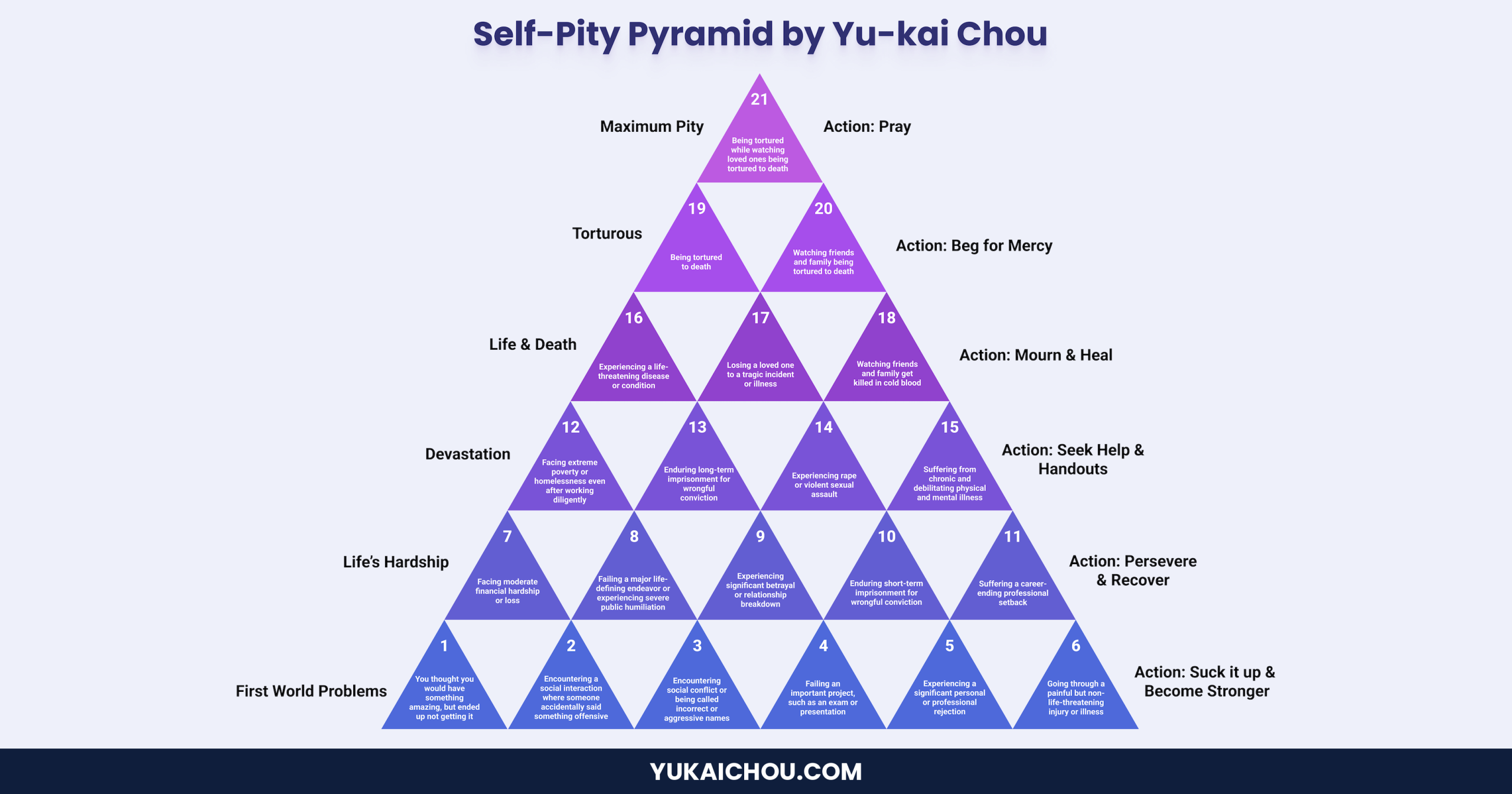
I created the Self-Pity Pyramid — a 21-tier behavioral model that ranks life struggles from “your coffee order was wrong” to the most unimaginable suffering a human can endure. It connects directly to Core Drive 8: Loss & Avoidance in my Octalysis Framework — the drive that makes us dwell on what we’ve lost rather than what we’ve gained.
What started as a tongue-in-cheek thought experiment became one of the most personally useful models I’ve ever built.

⚡ Speed Run Notes
- Self-pity is not the enemy — mis-located self-pity is. Everyone feels bad about something. The damage is done when a tier-3 problem is felt with tier-18 intensity. The Pyramid is a calibration tool: it tells you where your pain honestly sits in the distribution of human pain, without denying that it is pain at all.
- The Pyramid is a CD1 (Epic Meaning) intervention, not a shame intervention. It is tempting to read the model as “other people have it worse, shut up.” That is the wrong reading. The correct reading is “you are part of a large human story, and here is where your chapter currently sits.” The frame is perspective, not judgment.
- 21 tiers is deliberately too many — and that is the feature. A 3-tier model forces everyone into crude buckets. A 21-tier model forces the reader to read carefully, find their exact rung, and discover rungs they didn't know existed. The act of reading all 21 is the intervention. A shorter model would produce less insight, not more.
- The highest tiers are not described as hopeless — they are described as dignified. A model that treats the worst human suffering as a black hole of despair is not useful to anyone living there. The Pyramid's highest tiers honor the dignity of people carrying enormous loads. That respect is what lets lower-tier readers recalibrate without feeling lectured.
- The deepest use of the Pyramid is not self-diagnosis — it is compassion for others. Once you know the model, you stop dismissing other people's pain for being “small” and stop worshipping other people's pain for being “big.” You see everyone on the same map, each carrying their own tier honestly. That social effect is worth more than the personal one.
Table of Contents
- What Is Self-Pity?
- Self-Pity at its Finest
- The Self-Pity Pyramid
- Self-Pity Layer 1: First World Problems (Tiers 1-6)
- Self-Pity Layer 2: Life’s Hardships (Tiers 7-11)
- Self-Pity Layer 3: Devastation (Tiers 12-15)
- Self-Pity Layer 4: Life & Death (Tiers 16-18)
- Self-Pity Layer 5: Torturous (Tiers 19-20)
- Self-Pity Layer 6: Maximum Pity (Tier 21)
- Empower Yourself with the Self-Pity Pyramid
- Warning: Only Use Specific Tiers on People You Don’t Like
Author Credibility: Yu-kai Chou

Yu-kai Chou created the Octalysis Framework after studying gamification since 2003 — years before the term entered mainstream vocabulary. As a Human-Systems Architect & Behavioral Designer, his framework has been applied by LEGO, Microsoft, Porsche, Coca-Cola, Salesforce, and MrBeast, impacting over 1.5 Billion Users.
Chou has taught the Octalysis methodology at Harvard, Stanford, Yale, Tesla, Google, BCG, and IDEO.
His work has been cited by Harvard, Stanford, MIT, Forbes, Wall Street Journal, Wired, US Department of Energy, NIST, NSF, NCBI, US Department of Education, ClinicalTrials.gov, and Google Scholar — with 3,700+ more academic publications. Explore his books here.

What Is Self-Pity?
Self-pity is the feeling of being sorry for yourself — a self-focused response to hardship where you dwell on your own suffering, feel uniquely unlucky, and stop looking for solutions. Psychologists treat it as a form of rumination: the pain loops instead of processing, which keeps you stuck longer than the problem itself.
But here’s what most articles about self-pity miss: not every struggle deserves the same amount of it. That’s why I built the Self-Pity Pyramid, a 21-tier map of life’s hardships that tells you when to cry it out and when to get back up.
Self-Pity at its Finest
This is the latest model I’ve created for fun, which surprisingly ended up becoming valuable for me: The Self-Pity Pyramid.
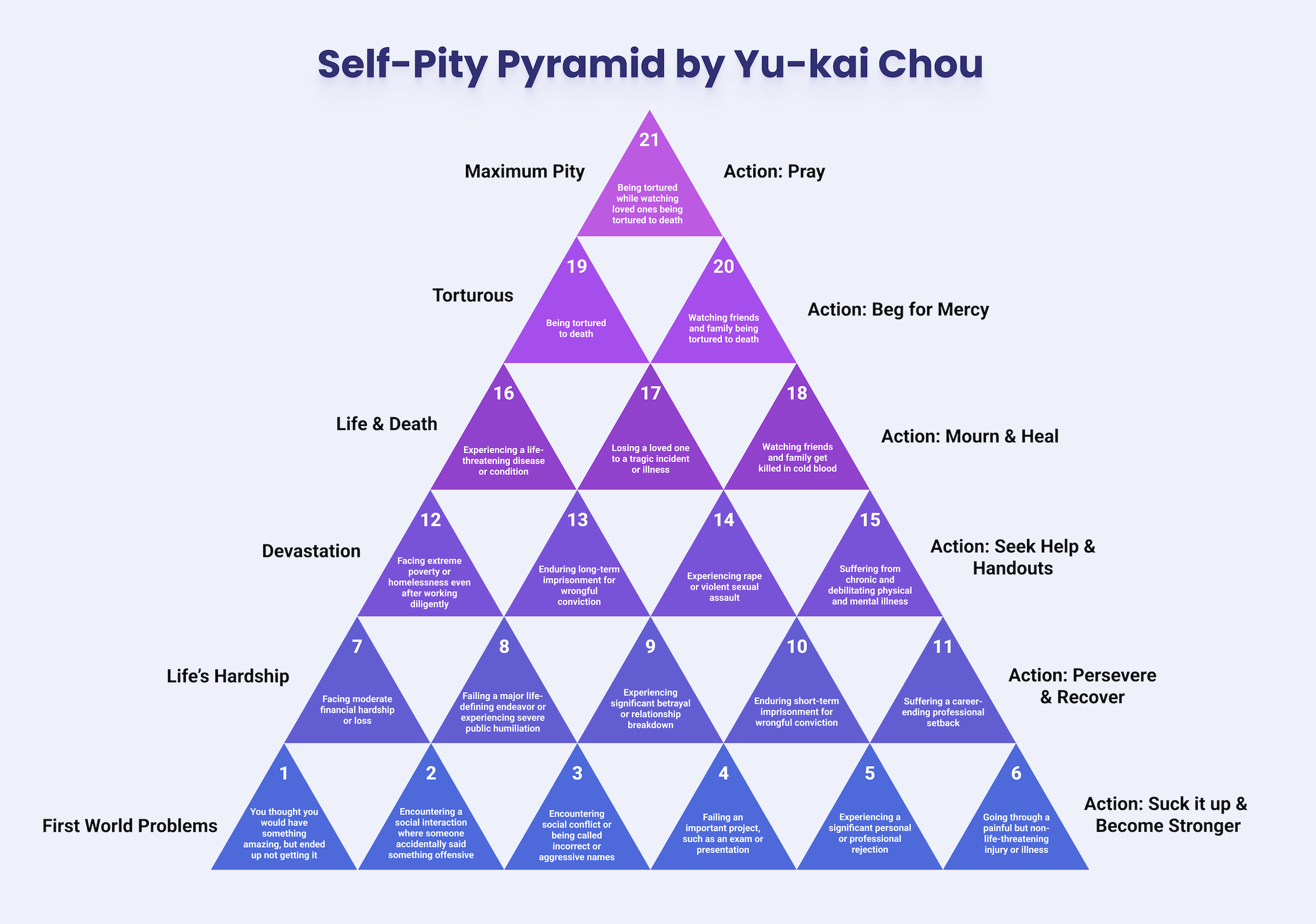
The Self-Pity Pyramid categorizes life events into 21 tiers, ranging from the least deserving to the most deserving of self-pity. It offers a slightly more objective way to determine how much self-pity you should bestow yourself in various situations.
While a little tongue-in-cheek, I’ve already surprisingly obtained value and utility from it in my life. When life throws challenges my way and I start to feel overwhelmed, this model helps me put my struggles into perspective by determining how much self-pity I deserve.
Earlier this year, some unfortunate things happened to me, and I started having all these negative thoughts about how my life was falling apart.
Then I remembered to go look at the Self-Pity Pyramid and discovered I was only experiencing Tier 3 out of 21.
This realization made me feel more grounded and helped me see that I shouldn’t waste time feeling sorry for myself.
Instead, I picked myself up and gained strength as well as perspective from this mental exercise.
Of course, the actual tiers can be customized to align with your values. Anyone can rearrange the tiers based on their personal beliefs about which experiences are more painful. As long as you actually prefer to go through a lower tier over a higher one, this model remains valid. (So don’t argue with me if you think one tier should be above another; it’s up to you how you want to scale your self-pity!)
Additionally, each Self-Pity Layer has an Action Plan that gives you a personal suggestion on what you should do if you experience that life event.
Similarly, you can customize the Action Plans to what you think is more appropriate for each layer too.
This model connects to several concepts from gamification and behavioral design. The tiered structure leverages Core Drive 2: Development & Accomplishment — giving you a sense of progress as you realize your situation isn’t as bad as it could be. And the Action Plans tap into Core Drive 3: Empowerment of Creativity & Feedback — empowering you to take meaningful action at each level.
The Self-Pity Pyramid
Self-Pity Layer 1: First World Problems (Tiers 1-6)
These are issues that we face on a regular basis but will only realistically affect us for a few hours to a few weeks.
We can reliably recover and grow from these challenges. Those who let these issues affect them negatively for months or years can likely improve their lives by enhancing their resilience and moving on to greater futures.
Action Plan: Endure and Emerge Stronger
Tier 1: You thought you would have something amazing, but ended up not getting it
- Minor disappointments, while momentarily upsetting, are part of everyday life and typically easy to overcome.
Tier 2: Encountering a social interaction where someone accidentally said something offensive
- Minor social misunderstandings, though uncomfortable, are often resolvable and less impactful in the long run.
Tier 3: Encountering social conflict or being called incorrect or aggressive names
- Social conflicts and verbal aggressions can affect one’s emotional state and social interactions.
Tier 4: Failing an important exam or project
- Failure in academic or professional endeavors can lead to feelings of inadequacy and the need for redirection.
Tier 5: Experiencing a significant personal or professional rejection
- Rejections can be disheartening, impacting one’s self-confidence and future outlook.
Tier 6: Going through a painful but non-life-threatening injury or illness
- Injuries or illnesses that cause pain and require recovery time but are not life-threatening still impact daily life and well-being.
Self-Pity Layer 2: Life’s Hardships (Tiers 7-11)
These are events that are difficult to endure, but the average person would probably experience these a few times in their lives.
Despite the pain and difficulty, pushing through with support from loved ones can help you grow beyond these challenges and return to a productive life.
Action Plan: Persevere & Connect with Friends
Tier 7: Facing moderate financial hardship or loss
- Financial difficulties, while not catastrophic, require considerable adjustment and can cause stress and anxiety.
Tier 8: Failing a major life-defining endeavor or experiencing severe public humiliation
- Major failures or public humiliation can challenge one’s self-esteem and standing in the world. I’ve been through this with my failed startup RewardMe — it was devastating, but I came back stronger.
Tier 9: Experiencing significant betrayal or relationship breakdown
- Major betrayals or the collapse of important relationships can lead to emotional distress and feelings of isolation.
Tier 10: Enduring short-term imprisonment for wrongful conviction
- Short-term wrongful imprisonment subjects individuals to injustice and personal challenges.
Tier 11: Suffering a career-ending professional setback
- The abrupt end of a career due to unforeseen circumstances can shatter one’s professional identity and future aspirations.
Self-Pity Layer 3: Devastation (Tiers 12-15)
These are devastating events in life that could cause life-long suffering if unresolved.
Those who go through this should seek plenty of help wherever that could be obtained, including governmental aid.
Action Plan: Seek Help & Handouts
Tier 12: Facing inescapable extreme poverty or homelessness even after working diligently
- Persistent poverty and homelessness, despite diligent effort, can lead to a sense of hopelessness and social alienation.
Tier 13: Enduring long-term imprisonment for wrongful conviction
- Wrongful imprisonment robs individuals of their freedom and subjects them to prolonged injustice and hardship.
Tier 14: Experiencing rape or violent sexual assault
- Violent sexual assault is a strongly traumatic experience that impacts a person’s sense of safety, trust, and self-worth.
Tier 15: Suffering from chronic and debilitating physical and mental illness
- Chronic illnesses can diminish quality of life, requiring ongoing adaptation and resilience.
Self-Pity Layer 4: Life & Death (Tiers 16-18)
These are issues involving the permanent loss of loved ones or facing one’s own mortality.
Often, there is little you can do, and it is insensitive to even suggest staying strong. During these times, you fully deserve to mourn for as long as you need, hoping that time will slowly heal you, physically or emotionally.
Action Plan: Mourn & Heal
Tier 16: Experiencing a life-threatening disease or condition
- Facing a severe health crisis challenges one’s physical and mental fortitude, often reshaping life priorities and capabilities.
Tier 17: Losing a loved one to a tragic incident or illness
- The unexpected loss of a close family member or friend is heart-wrenching and can alter one’s life.
Tier 18: Watching friends and family get killed in cold blood
- The trauma of witnessing loved ones murdered in cold blood leaves lasting emotional scars and a deep sense of loss.
Self-Pity Layer 5: Torturous (Tiers 19-20)
This layer is worse than death, typically experienced only by those enduring wartime horrors (like my grandfather, who was captured by the Chinese Communist Party as a soldier) or victims of severe psychopaths.
Physically, you must find any way possible to cease the abuse. Emotionally, there is little you can do besides hoping your tormentor will let you go.
You deserve nothing but pity.
Action Plan: Beg for Mercy
Tier 19: Being tortured to death
- Enduring prolonged physical and psychological pain leading to death is an ultimate form of suffering.
Tier 20: Watching friends and family being tortured to death
- Witnessing the extreme suffering and demise of loved ones is devastating and affects one’s mental state.
Self-Pity Layer 6: Maximum Pity (Tier 21)
This is the epitome of suffering. Even thinking about it makes most people cringe with discomfort and disgust.
Such horrors occur only during wartime or in states of lawlessness where the tormentor is also a severe psychopath.
Unfortunately, some people do endure this level of suffering, and all they can do is put this life behind them and hope for spiritual salvation in the afterlife. They deserve maximum pity that the world can offer.
Action Plan: Pray
Tier 21: Being tortured while watching loved ones being tortured to death
- This represents the pinnacle of human suffering, where the individual endures unimaginable physical and emotional agony.
Empower Yourself with the Self-Pity Pyramid
Navigating life’s challenges can be overwhelming, but the Self-Pity Pyramid offers a perspective that empowers you to manage and overcome adversity.
By categorizing life events into 21 tiers, this model helps you understand and validate your feelings while encouraging resilience and strength.
Share this with friends and family to help them gain a fresh outlook on their struggles. The Self-Pity Pyramid is not just a way to measure your hardships — it’s a guide to transforming self-pity into personal growth.
Whether you’re facing minor disappointments or profound losses, this model can provide the clarity and motivation needed to keep moving forward. It’s a practical application of White Hat motivation — using positive psychological framing to drive action instead of dwelling in negativity.
Warning: Only Use Specific Tiers on People You Don’t Like
While sharing the whole Self-Pity Pyramid to people is fine and could even cause a few chuckles (while actually being a useful tool later when difficulty comes), DO NOT tell your friends who are moping, “Hey look, you are only going through Tier 4, so stop moping.” You will not be liked by your friends.
However, if you are interacting with people you don’t like online who are demonstrating an immense amount of self-pity that you feel is undeserved, then you can share the model and inform them that they are only Tier 2 out of 21 so they can take a chill pill.
If you have interesting interactions with “Self-Pity Warriors,” please share them in the comments so I can understand how people respond to new perspectives of the difficulties they are going through.
At least now you have a tool to communicate how victimized a person should feel, which is ludicrously essential in today’s social picture.
Good luck on your journeys. I’ll be praying even when I’m not in Self-Pity Layer 6.
Related Reading
- The Octalysis Framework for Gamification & Behavioral Design
- Core Drive 8: Loss & Avoidance
- White Hat vs Black Hat Gamification
- Anti Core Drives: The Hidden Forces Killing Your User Engagement
- 4 Steps to Master Lifestyle Gamification
- Books by Yu-kai Chou