

We chase happiness like it’s a trophy we misplaced. We buy things, hit milestones, check boxes, and then feel… empty. The weird part? We know exactly what makes us happy. Creative work. Time with people we love. Learning something hard. Growing. But we almost never do those things.
Instead, we doom-scroll for an hour. We panic about a deadline that’s suddenly tomorrow. We buy another gadget we don’t need. And we feel alive doing it, but only for a moment.
There’s a reason for this disconnect. And it’s not willpower. It’s not discipline. It’s not that you’re broken.
It’s a design problem.
⚡ Speed Run Notes
- Happiness often breaks when expectations rise faster than reality. The same outcome can feel joyful or crushing depending on the story you expected to live.
- White Hat drives are better at fulfillment than urgency. Meaning, creativity, growth, and connection usually feel good, but they rarely chase you.
- Black Hat drives can make you productive and miserable at the same time. Fear, scarcity, and pressure are powerful, but they are terrible places to live full time.
- Money solves pain first, then mostly amplifies comparison. Once your basics are covered, more income often shifts from security into status and expectation management.
- The practical fix is design, not guilt. Put more structure around meaningful work, relationships, and creative progress instead of waiting to feel naturally pulled toward them.
Table of Contents
Author Credibility: Yu-kai Chou

Yu-kai Chou created the Octalysis Framework after studying gamification since 2003 — years before the term entered mainstream vocabulary. As a Human-Systems Architect & Behavioral Designer, his framework has been applied by LEGO, Microsoft, Porsche, Coca-Cola, Salesforce, and MrBeast, impacting over 1.5 Billion Users.
Chou has taught the Octalysis methodology at Harvard, Stanford, Yale, Tesla, Google, BCG, and IDEO.
His work has been cited by Harvard, Stanford, MIT, Forbes, Wall Street Journal, Wired, US Department of Energy, NIST, NSF, NCBI, US Department of Education, ClinicalTrials.gov, and Google Scholar — with 3,700+ more academic publications. Explore his books here.

The White Hat Paradox
I built the Octalysis Framework by mapping what drives human behavior: eight Core Drives that push us toward action. Four are Black Hat (negative): Scarcity, Unpredictability, Avoidance, and Urgency. These create addiction and compulsion. Four are White Hat (positive): Meaning, Empowerment, Social Influence, and Ownership. These create fulfillment.
Here’s what breaks people: the activities that activate White Hat drives, the ones that actually make us happy, are terrible at compelling action. Creating something meaningful? No urgency. Spending time on a relationship? No scarcity. Learning a skill for growth? No deadline.
Meanwhile, Black Hat drives are urgency machines. Your phone buzzes. Dopamine hits. You check. A deadline appears, and suddenly you’re grinding for sixteen hours straight, powered by pure panic. You feel productive. Alive. Needed.
Then it ends. The dopamine crashes. You feel hollow.
We optimize for what compels us, not what fulfills us. So most people end up living in Black Hat mode: stressed, addicted, successful by external metrics, and quietly miserable.
| White Hat (CD1, CD2, CD3, CD5) | Black Hat (CD6, CD7, CD8) | |
|---|---|---|
| Feeling | Fulfilling, meaningful, lasting | Urgent, addictive, hollow afterward |
| Examples | Creative work, deep relationships, learning a skill, contribution | Deadlines, doom-scrolling, fear of missing out, panic-buying |
| Time horizon | Marathon. Pays off over years. | Sprint. Pays off in minutes. |
| Best use | The destination. What life is for. | The launcher. Gets you started, then hand off to White Hat. |
The Happiness Formula: Reality − Expectations
A high school student scored 89.46% on an exam. Just 0.04% away from an A. He should have been devastated. Instead, he celebrated wildly.
Why? His expectation was a C. Reality exceeded expectations by nearly 40 percentage points. Pure joy.
When I was in school and brought home a B, my parents went berserk on me. Same reality (B grade). Opposite emotion (shame). My expectation was an A.
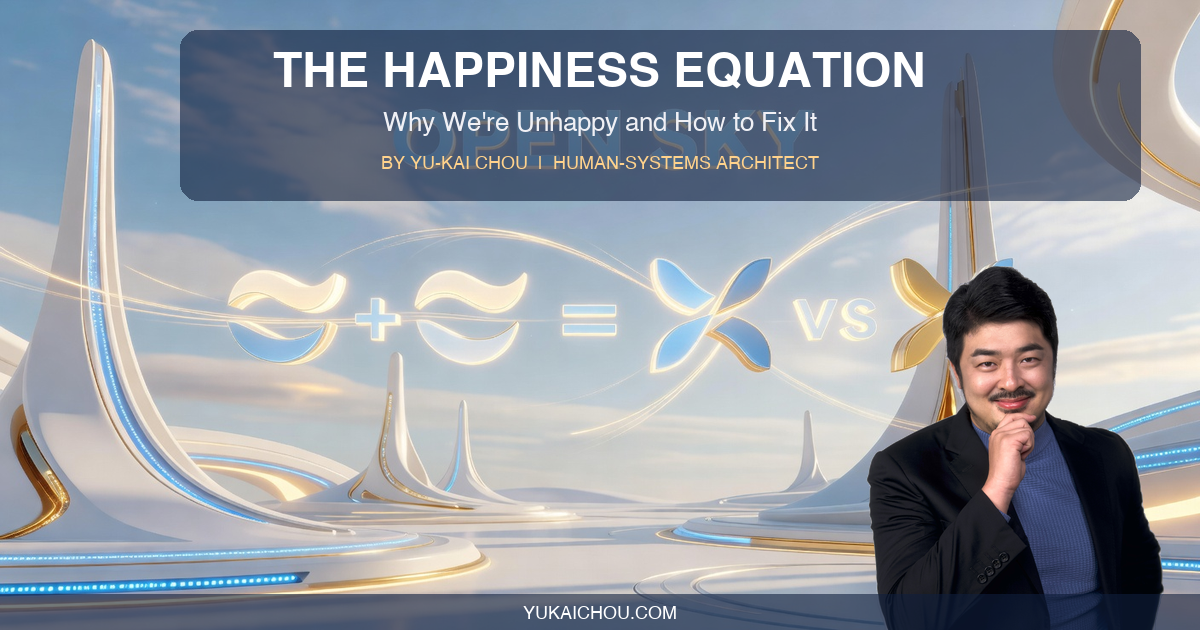
The formula is simple: Happiness = Reality − Expectations.
Same reality. The emotional outcome depends entirely on the gap. I’ve met people who moved to America from Africa. They lived in houses smaller than what they came from, earned less money, had less family nearby. By Western metrics, their reality declined. But they talked about being happier than ever. Why? Their expectations shifted. In their previous context, they expected struggle and scarcity. Now they expected those things less.
This formula explains so much of what we call the “hedonic treadmill” or “hedonic adaptation.” It’s not that nice things stop making us happy. It’s that our expectations adjust to match our new reality, and then we need the next nice thing to feel the same spike.
Most advice ignores this completely. We’re told to work harder, earn more, achieve bigger goals. But if expectations scale with reality, you’re on a treadmill running nowhere.
Aim High, Expect Low
This is my life motto: Aim high, expect low.
It sounds contradictory until you understand what I mean. Aim high means you commit fully. You design your best effort. You bring intention to the work. You’re trying to win.
Expect low means your identity doesn’t live in the outcome. You’re okay with dying on the first attempt. The goal is the goal, but it’s not who you are.
Think about playing a new video game. You haven’t read guides. You don’t know the mechanics. Your aim is to win, to progress, to beat the boss. But you have zero expectation of doing it on your first try. When you die, you think “Hey, let me try again.” There’s no shame. There’s no identity attached to it. You’re enjoying the learning process.
That’s the gap between suffering and flow.
When I apply this to work — to creating something, to building a business, to having a conversation — the stakes feel lower but my effort stays the same. I’m still aiming high. I’m still committed. But I’m not hostage to the outcome. The outcome is just information for the next attempt.
This reframe deletes so much suffering. The person who aims high and expects high is crushed by any shortfall. Someone who aims high and expects low enjoys the entire journey because the outcome isn’t where their identity lives.
The Denmark Paradox
Denmark usually ranks near the top of global happiness surveys. Strong social systems, healthcare, and community support should make that story feel simple. It isn’t.
How does this happen?
My working theory is that when your environment keeps telling you that you should be happy, and you’re not, the blame has nowhere left to go except inward. You conclude you’re the problem.
In places with more visible hardship, struggle often feels external. In places that are supposed to be enviable, unhappiness can start feeling like a personal defect. You’re supposed to be thriving in this system. If you aren’t, it starts sounding like a verdict on you.
That is where shame gets dangerous. Once people stop seeing their pain as something happening to them and start seeing it as proof of who they are, the whole emotional equation changes.
I’m not claiming Denmark explains suicide with one neat theory. I’m saying this pattern shows up often enough in human motivation that I pay attention to it: when people feel they have run out of external explanations, self-judgment gets much harsher.
The most dangerous moment is not always the obvious crisis. Sometimes it is the quieter moment afterward, when someone decides this is just who they are and stops imagining a different future.

This is why the happiness formula matters so much in wealthy environments. When circumstances look favorable from the outside, the expectation gap can become internal, tied to identity, self-judgment, and the story you tell yourself about what you deserve.
Why Money Stops Working After a Comfort Threshold
A common finding in happiness research is that money strongly improves life when it removes instability, and then becomes much less powerful once your basics are covered. Daniel Kahneman and Angus Deaton’s 2010 paper at Princeton put a U.S. number on it; Matthew Killingsworth, Kahneman, and Barbara Mellers later reconciled the picture in 2023, showing that for most people more income keeps adding to well-being but with sharply diminishing returns once survival pressure is gone. The exact number varies by country, cost of living, and methodology. The pattern is what matters.
Understanding why reveals how Octalysis works in your pocket.
Below that comfort threshold, money removes pain. It pays for shelter, food, healthcare, and security. These are Core Drive 8 (Loss & Avoidance) problems. You’re escaping threat. Money directly solves this.
Once you are above that threshold, more money often shifts toward Core Drive 4 (Ownership & Possession). That usually happens after your basics are covered. A bigger house. A nicer car. Fancier clothes. That can feel good for a while, but ownership adapts quickly. Yesterday’s luxury becomes today’s baseline.
You do not need a lab to see this. Buy something expensive that you wanted badly. For a short window it feels like arrival. Then it becomes normal. Then your expectations reset. The object did not fail. Your psychology updated.
Meanwhile, using money to support Core Drive 1 (Epic Meaning & Calling), Core Drive 3 (Empowerment of Creativity & Feedback), and Core Drive 5 (Social Influence & Relatedness) usually lands differently. Generosity, meaningful contribution, and relationships tend to keep paying emotional dividends longer than another possession does.
I learned this tangibly when I hired a housekeeper. My first instinct was to optimize: “I’m spending money on something that doesn’t feel like an investment.” But then I realized what was actually happening. I was spending money to remove friction that had degraded my relationship with my family. The cleanup work was stealing time and energy from the people I cared about. Removing that friction was spending money to protect Core Drive 5 (Social Influence & Relatedness).
Same money. Different Core Drive. Opposite emotional outcome.
Building Connection With the REMOTE Framework
After years of studying what keeps people connected and fulfilled, I codified six practices into what I call the REMOTE framework. These are the activation barriers for White Hat drives.
Responsiveness. Call instead of text. Show up in person instead of sending an email. Your nervous system recognizes presence. When someone takes time out of their schedule to be responsive to you, not delayed, not filtered through digital intermediaries, you feel valued. This activates Core Drive 5.
Expression. Be your true self. Stop performing the version of yourself you think is acceptable. The most fulfilling relationships are the ones where you don’t have to edit. Where your authentic thoughts, fears, weird jokes, and strange opinions are met with recognition, not judgment. This is terrifying and essential.
Momentum. Design your environment to make fulfilling activities the path of least resistance. If you want to exercise, put your gym clothes where you’ll see them. If you want to read, have a book open on your bed. Momentum is about removing the activation energy for what matters.
Openness. This is vulnerability. My friend Chris Tomaso taught me something: “The depth of connection is determined by the depth of vulnerability you’re willing to risk.” When you share something true about yourself, something that costs you to admit, you give other people permission to do the same. Connection deepens in that space.
Team Play. This is why board games create such strong bonds. They activate empowerment, social influence, and even a bit of Core Drive 4 when you’re winning. You’re collaborating, competing, laughing at the absurdity, and experiencing shared meaning. Replace some of your social screen time with games where you have to be present.
Enjoyment. Gamify the activities that actually fulfill you. If you want to read more, track it like a game: pages per week, genres conquered, books completed. If you want to exercise, find the game-like element (splits, PRs, streaks). This isn’t manipulating yourself. It’s lowering the activation barrier for what you already want by feeding it the compulsion structure it needs.
Here’s the underlying mechanic on all six of these. White Hat drives feel good but have no urgency, which is why people procrastinate on the things that actually fulfill them. Black Hat drives have urgency but leave you hollow. The trick isn’t to pick one. It’s to use Black Hat as a launcher and let White Hat be the destination. A gym trainer calling you out (Core Drive 8: Loss & Avoidance) gets you to the gym, but the satisfaction of a hard workout (Core Drive 2 + 3) is what keeps you coming back. A streak counter (Core Drive 6: Scarcity) gets you to open the book; getting lost in the story is Core Drive 7: Curiosity, which is intrinsic. Black Hat starts the engine. White Hat is where the car actually wants to go.
These six practices are design tools. They’re not mystical. They’re mechanical. Apply them, and your White Hat activation barrier drops meaningfully.
The Emotional Utility Framework
Not all emotions are problems to fix. Some emotions are useful. Others are not.
Anger is useful. It tells you that a boundary has been crossed. It mobilizes you to protect something. Without anger, you’d accept mistreatment.
Sadness is useful. It bonds you to others who understand loss. The movie Inside Out got this right: sadness allows you to connect with people who’ve experienced the same thing. It’s the admission of vulnerability that deepens relationships.
Bitterness is useful. It’s the refusal to accept a bad story about your life. It’s the defiance of a fate you didn’t choose. Without bitterness, you’d accept injustice.
But insecurity? Insecurity is never useful. It’s pure paralysis. It’s reckless compensation. It’s the voice that tells you to prove yourself by buying something you can’t afford or performing for people who don’t care. Insecurity creates no useful action. It only creates shame.
Jealousy is never useful either. But here’s the key: jealousy isn’t the root emotion. It’s downstream of insecurity. You’re not jealous of someone’s success because their success is bad. You’re jealous because you’ve decided their success proves your inadequacy. That’s insecurity talking. Fix the insecurity, and jealousy evaporates.
This is worth saying out loud: Insecurity is useless.
The practice is simple. When you feel an emotion, ask: Is this emotion moving me toward something I actually value? Is it giving me useful information? Or is it just paralyzing me?
Anger that protects your time? Useful. Anger that makes you lash out? Track it back to insecurity.
Sadness that connects you to others? Useful. Sadness that isolates you? Usually insecurity underneath.
Once you identify insecurity as the root, you can address it directly instead of managing the symptoms.
Two moves I actually use. First, when I notice the feeling, I say it out loud: “Insecurity is useless.” That sentence forces my attention from how I feel to what’s useful, and the frame shift is most of the fix. Second, if the feeling won’t move, I give it a deadline. I once lost a business and a lot of investor money, and I gave myself a full month to mope. Two and a half weeks in, I got bored of being sad. The thing I started building next eventually became the Octalysis Framework.
Bounded moping works because it gives the emotion a container. You’re not pretending it isn’t there. You’re not pushing it away. You’re telling yourself: this feeling is allowed, but it has an end date. The container makes the emotion finite. Insecurity hates that.

The Bottom Line
- The Happiness Equation: Sustained happiness comes from White Hat Core Drives (Epic Meaning, Accomplishment, Empowerment) not Black Hat drives (Scarcity, Loss Avoidance). Chasing urgency creates anxiety disguised as productivity.
- The White Hat Paradox: White Hat motivation feels good but creates no urgency, so people procrastinate on meaningful work while urgently completing Black Hat tasks that don’t matter.
- Hedonic Adaptation: This makes achievement-based happiness temporary. The promotion or raise feels good for weeks, then resets to baseline. Sustainable happiness requires process-oriented drives like Core Drive 3 (Empowerment of Creativity & Feedback) instead of solely relying on outcome-oriented drives like Core Drive 2 (Development & Accomplishment).
- Successful but Unhappy: The Octalysis Framework reveals why this happens: these individuals have optimized for achievement and ownership while neglecting meaning and genuine connection.
- The Antidote: Deliberately design your life for White Hat core drives. Choose work that activates Epic Meaning and Empowerment. Build relationships that activate Social Influence. Use Accomplishment as a milestone marker, not a life strategy.
FAQ
Can gamification actually make people happier?
When designed with White Hat Core Drives, yes. Systems that give people meaning, visible progress, and creative autonomy improve wellbeing. Systems that rely on anxiety, scarcity, and loss avoidance create engagement at the cost of happiness.
Why do I feel productive but unhappy?
You’re likely running on Black Hat drives: urgency, deadlines, fear of falling behind. These create intense activity but no fulfillment. The fix is shifting your most important work to White Hat motivation structures where the work itself feels meaningful.
How do I apply this to my daily life?
Audit your daily activities through the Octalysis lens. Which Core Drives dominate? If Core Drive 6 (Scarcity & Impatience) and Core Drive 8 (Loss & Avoidance) drive most of your day, you’re optimizing for anxiety. Deliberately schedule more Core Drive 1 (Epic Meaning & Calling), Core Drive 3 (Empowerment of Creativity & Feedback), and Core Drive 5 (Social Influence & Relatedness) into your week.
Isn’t some Black Hat motivation necessary?
Yes, for short-term tasks that need urgency. Deadlines, scarcity, and loss avoidance are effective tools. The problem is when they dominate your entire motivational architecture. Use Black Hat for sprints; use White Hat for the marathon.
Can organizations use this to improve employee happiness?
Absolutely. Most workplace gamification relies on Black Hat drives like quotas, rankings, and fear of underperformance. Shifting toward White Hat systems like meaningful mission framing, creative autonomy, and genuine peer recognition improves both happiness and performance.
Ready to Design Your Happiness?
Happiness is not a trait you’re born with. It’s a system you design. If you’ve ever felt productive but empty, the Octalysis Framework is the design language behind why. And the fix.
→ Read next: The Octalysis Framework: the eight Core Drives that move humans.
Or go deeper with Yu-kai’s books for the full behavioral-design toolkit.
Related Reading
- Black Hat vs. White Hat: The Two Engines of Motivation
- Oxytocin vs Serotonin: Design Belonging, Not Dominance
- The Irrational Power of Scarcity: Why Price Amplifies Desire
- Books by Yu-kai Chou