

Have you ever received a gift you couldn’t open yet?
Maybe it was a Christmas present placed under the tree two weeks early. You could hold it. Shake it. Stare at it during breakfast. It was yours — your name was literally written on it — but you couldn’t use it until Christmas morning.
That feeling — “I have this, but I can’t use it yet”, is one of the most powerful motivational states a designer can create. And most designers completely miss it.
In my Octalysis Framework, I call this technique the Grown Up Lock (Game Technique #122). It sits at the intersection of Core Drive 4: Ownership & Possession and Core Drive 6: Scarcity & Impatience, and it creates a specific kind of emotional tension that no other mechanic can replicate.
Speed Run Notes
- The Grown Up Lock (GT #122) creates engagement by giving users an item they own but can’t use yet, the ownership-usage gap drives action more powerfully than future promises or milestone unlocks.
- Three conditions required: the user must already own the item, they cannot use it yet, and clear desired actions lead to unlocking.
- It sits at the intersection of Core Drive 4 (Ownership & Possession) and Core Drive 6 (Scarcity & Impatience), creating what I call “disturbing emotional tension.”
- The Sacred Contract: whatever users grind to unlock must be valuable in their new context. Mediocre payoff after heavy investment doesn’t just disappoint, it destroys trust and engagement permanently.
- Real-world applications: stock option vesting, egg-hatching mechanics (Pokemon GO), SaaS greyed-out features, children’s Christmas presents.
- Companion techniques: Bootleg Quests (GT #107) add failure risk to the progression, and Revival Potions (GT #119) provide compassionate safety nets for broken streaks.
- The strongest Grown Up Locks use action gates (complete tasks) over time gates (just wait), they channel the ownership tension into productive behaviors.
If you want to explore the full spectrum of behavioral design techniques, check out my books Actionable Gamification and 10,000 Hours of Play, or study the complete Octalysis Framework.

Table of Contents
- Speed Run Notes
- About Yu-kai Chou
- What Is the Grown Up Lock?
- The Pocket Legends Story That Changed How I Think About Ownership
- Why This Is Different From Every Other Unlock Mechanic
- The Three Conditions That Make It Work
- Real-World Applications (Beyond Games)
- The Sacred Contract: Why Delivery Must Match the Promise
- Companion Techniques: Bootleg Quests and Revival Potions
- How to Design Your Own Grown Up Lock
- Frequently Asked Questions
About the Creator of the Octalysis Framework

Yu-kai Chou created the Octalysis Framework after studying gamification since 2003, years before the term entered mainstream vocabulary. As a Human-Systems Architect & Behavioral Designer, his framework has been applied by LEGO, Microsoft, Porsche, Coca-Cola, Salesforce, and MrBeast, impacting over 1.5 Billion Users.
Chou has taught the Octalysis methodology at Harvard, Stanford, Yale, Tesla, Google, BCG, and IDEO.
His work has been cited by Harvard, Stanford, MIT, Forbes, Wall Street Journal, Wired, US Department of Energy, NIST, NSF, NCBI, US Department of Education, ClinicalTrials.gov, and 3,700+ more academic publications. Explore his books here.
What Is the Grown Up Lock?
The name comes from an experience every kid understands. You’re eight years old and your older cousin has this incredible toy, maybe a remote control car or a complex LEGO set. Your parents tell you, “When you’re grown up, you can have one too.” The toy exists. You’ve seen it. You’ve probably touched it. But you can’t use it because you haven’t met the condition yet.
That’s the Grown Up Lock. And when designed correctly, it drives more sustained engagement than almost any reward system I’ve encountered.
The Pocket Legends Story That Changed How I Think About Ownership
Let me tell you about the time a mobile game broke my heart, and taught me one of the most important lessons in behavioral design.
Years ago, I was playing a game called Pocket Legends. It was one of the first real MMORPGs on mobile, and I was hooked.
At level 12, I randomly obtained a level-30 sword. The stats were insane, +110 damage, freeze effect, burn effect, life leech. It was sitting right there in my inventory, glowing with promise. I could see it. I could read every stat. I could imagine how powerful I’d be wielding it.
But I couldn’t equip it. The requirement was clear: Level 30.
So I ground. For weeks. Every spare moment went into leveling up, not because the game’s daily quests were particularly exciting, but because that sword was mine and I needed to use it. The ownership-usage gap was eating me alive.
Then I hit level 30. I equipped the sword with the kind of anticipation you feel opening a birthday present. And you know what happened?
The sword was average. Mediocre, even. By level 30, every other player had weapons with comparable or better stats. My weeks of grinding had earned me… the baseline.
I quit the game that day.
Not gradually. Not “I’ll play less.” I closed the app and never opened it again. The betrayal wasn’t just disappointment, it was a violation of something deeper. The game had promised me that this sword was special. My inventory told me it was special. My weeks of effort confirmed it was special. And then the game revealed it was all a lie.
This experience crystallized something I now teach to every designer I work with: the Grown Up Lock carries a sacred contract. Whatever users grind to unlock must deliver on what the ownership phase promised. Break that contract, and you don’t just lose engagement, you create active resentment.
Why This Is Different From Every Other Unlock Mechanic
Most designers lump all “unlock” mechanics together. They’re not the same. Not even close.
Think about the difference between these three experiences:
Experience A: The Future Promise. “If you reach level 30, you’ll receive a powerful sword.” Your reaction? “Cool, maybe. If I even get there.” There’s no ownership. The sword is hypothetical. You might dismiss it entirely, “I’ll never reach level 30”, and feel nothing.
Experience B: The Milestone Unlock. “Complete 10 quests to unlock the Flame Sword.” Your reaction? “Okay, I’m working toward something.” There’s a goal, but the sword doesn’t feel like yours yet. You’re earning access, not recovering something you already possess.
Experience C: The Grown Up Lock. “You found a Level-30 Flame Sword! (Requires Level 30 to equip)” Your reaction? “This is MINE. I need to get to level 30 NOW.” The sword is in your inventory. You can see it, admire its stats, compare it to your current gear. It’s yours. You just can’t use it yet.
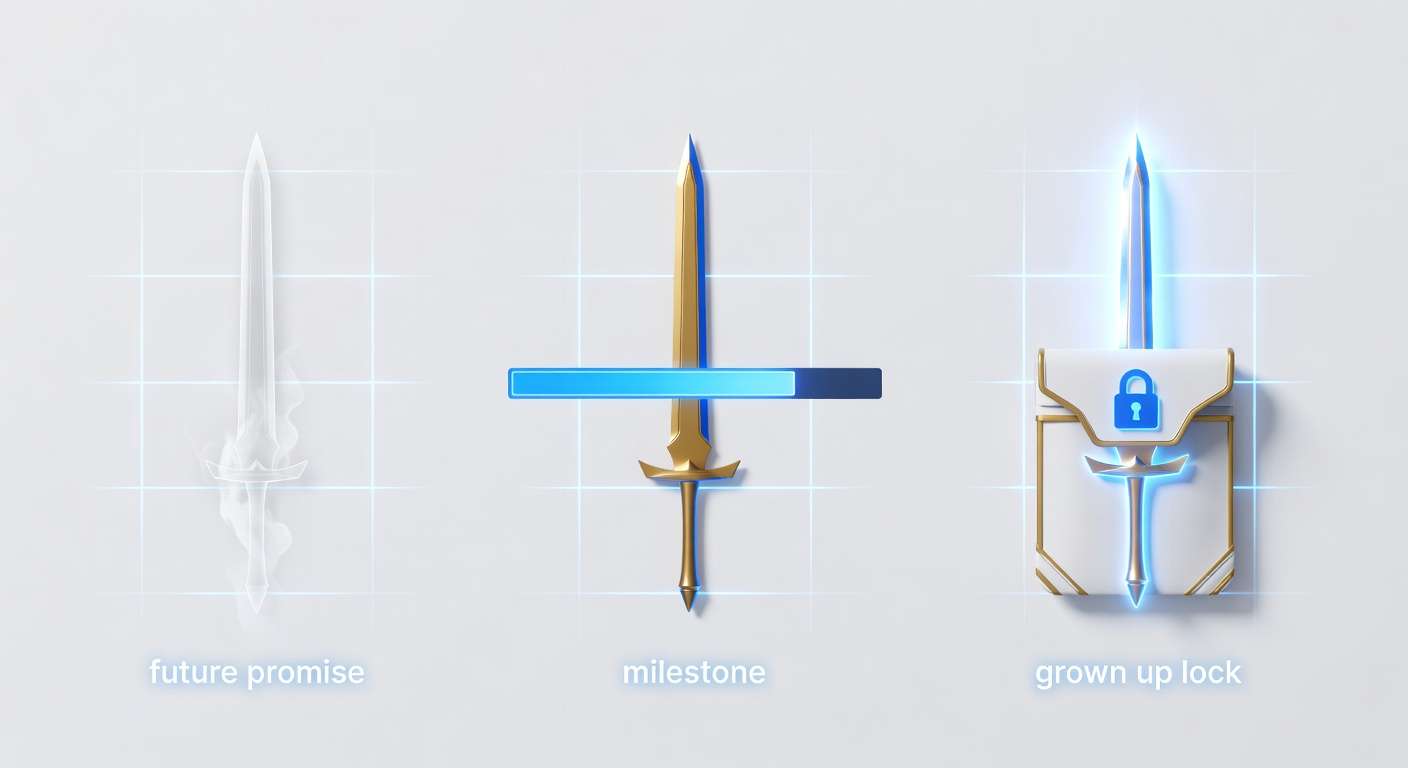
The motivational gap between these three experiences is enormous, and it comes down to one psychological principle: we are far more motivated to close a gap between what we have and what we can use than we are to pursue something we don’t have at all.
In Octalysis terms, Experience A activates a weak form of Core Drive 6: Scarcity & Impatience, “I want but can’t have.” Experience B activates Core Drive 2: Development & Accomplishment, “I’m progressing toward a goal.”
But Experience C? That’s where the magic happens. It activates CD4 and CD6 simultaneously, creating what I call a “disturbing emotional tension.” You own something. You can see its value. And every moment you can’t use it feels like waste. That tension is what drives compulsive action, not toward some abstract future reward, but toward closing the gap between what you already have and what you could be doing with it.
The Three Conditions That Make It Work
Not every “locked item” qualifies as a Grown Up Lock. Over the years, I’ve identified three conditions that must all be present for the technique to generate its full motivational power.
Condition 1: The User Already Owns the Item
This is non-negotiable. The item must be in their inventory, their account, their hands. It can’t be on a shop shelf or in a “coming soon” preview. The ownership feeling has to be real.
When a player finds a rare weapon drop, it goes into their inventory. When an employee receives stock options, the shares appear in their brokerage account. When a child receives a wrapped present, it has their name on it. Possession must precede restriction.
Condition 2: The User Cannot Use or Benefit From the Item
The value must be locked behind clear conditions, level requirements, time gates, completion milestones, behavioral thresholds. The user can see the potential. They can calculate what they’re missing. But they can’t access it. Not yet.
This is where Core Drive 6 kicks in. The item isn’t scarce in the traditional sense, you literally have it. But the usage is scarce. And that creates a unique psychological state: “I possess something valuable that I’m not allowed to benefit from.” It’s maddening, in the best possible way.
Condition 3: Clear Desired Actions Lead to Unlocking
The path from “have” to “use” must involve the behaviors you want the user to perform. This is where the Grown Up Lock becomes a design tool rather than just a frustration mechanism.
Pure time gates, “wait 30 days and it unlocks automatically”, are the weakest version. They activate CD6 but give the user nothing productive to do with that energy. The user just waits, and waiting without agency breeds resentment.
Parents accidentally invent the world’s worst Grown Up Lock all the time, the “when you grow up, you’ll understand” line. Think about why it fails. There’s no desired action. There’s no metric. The unlock condition is “wait ten or twenty years.” So the kid disengages, the lock fades from memory, and the supposed reward (understanding) never feels earned. Compare that to “you’ll understand when you become team captain.” Same kind of statement, but now there’s a clear path, a visible milestone, and the tension actually drives behavior.
The principle generalizes. If your Grown Up Lock collapses into “just wait,” you don’t have a Grown Up Lock — you have a parking lot.
Action gates are far more powerful. “Reach level 30” means playing the game. “Complete your certification” means learning the platform. “Stay at the company for four years” means performing well at work. The Grown Up Lock channels the ownership-usage tension into exactly the behaviors the designer wants.
When all three conditions are met, you get something remarkable: users who are grinding not because you’re dangling a carrot, but because they’re trying to access something that’s already theirs. The motivation feels internal even though the design is external. That’s the art of it.
Real-World Applications (Beyond Games)
The Grown Up Lock isn’t just a game mechanic. Once you understand the principle, ownership without usage creates more motivation than aspiration without ownership, you start seeing it everywhere. And more importantly, you start designing with it.
Stock Option Vesting: The Most Powerful Grown Up Lock in Business
Think about what happens when a startup offers an employee 40,000 stock options with a four-year vesting schedule.
From day one, those shares are “theirs.” The employee can see the number in their equity dashboard. They track the company’s valuation. They calculate their paper wealth during boring meetings. The ownership feeling is real and immediate.
But they can’t touch the shares. Not for four years. And if they leave early, they lose the unvested portion, they lose something that’s already “theirs.” That last sentence is doing all the heavy lifting, because it’s pure Core Drive 8: Loss & Avoidance stacked on top of the CD4 ownership feeling. The employee isn’t just choosing whether to take a future bonus, they’re choosing whether to forfeit something that’s already in their name. CD8 is one of the strongest motivational forces in the Octalysis toolkit, and the Grown Up Lock is one of the few techniques that can stack it cleanly on top of CD4 and CD6 in a way that still feels white-hat for the user.

Now compare that to a year-end bonus promise: “Perform well and you might get a $50,000 bonus in December.” There’s no ownership feeling. The bonus is hypothetical. If the employee gets a better offer in August, the December bonus is easy to walk away from because it was never theirs to begin with.
The vesting schedule, on the other hand, creates four years of Grown Up Lock tension. Every quarter, a few more shares unlock. Every day the employee stays, they’re closer to “using” what they already “have.” The behavioral design is elegant: the desired action (continued employment and performance) is the unlock condition for something the employee already perceives as their property.
This is one reason stock option vesting so often becomes a powerful retention tool. It’s not just about the money, it’s about the ownership-usage gap.
Egg-Hatching Mechanics: Ownership Plus Mystery
Pokémon GO, still going strong in 2026 under Scopely’s ownership, understood something profound when it shipped egg hatching. You possess an egg. It sits in your inventory, waiting. You can’t access what’s inside until you walk a certain distance — 2km, 5km, 7km, or 10km depending on the egg.
What makes this a double-layered Grown Up Lock is the addition of Core Drive 7: Unpredictability & Curiosity. You own the egg but you don’t know what’s inside. The ownership-usage gap drives walking (desired action), while the mystery of the contents adds an extra layer of anticipation. Two Core Drives pulling in the same direction.
Designers who simply show locked items with known rewards are leaving CD7 on the table. Adding unpredictability to a Grown Up Lock compounds the motivational effect, and techniques like the Mystery Box reward pattern show how powerful that uncertainty can become when it is handled deliberately.
SaaS Platform Design: The Greyed-Out Feature
Here’s where most SaaS companies get it wrong. They hide premium features behind a paywall on a separate pricing page. The user never sees what they’re missing because it’s not in their interface.
A Grown Up Lock approach is different. Show the premium features right in the user’s dashboard, greyed out but visible. “Analytics Dashboard. Unlocked at Level 15” or “Advanced Reporting. Available after completing your certification.” The features are in their interface, part of their workspace. They just can’t click on them yet.
In practice, the difference in conversion is often meaningful. A paywall says “pay us for something you don’t have.” A Grown Up Lock says “you already have this, you just need to unlock it.” One is a purchase decision. The other is closing a gap. And people are often far more motivated to close gaps than to make purchases.
Children and Christmas Presents: Nature’s Grown Up Lock
Every parent who has placed a wrapped gift under the tree two weeks before Christmas has deployed a Grown Up Lock. The child holds the gift. It has their name on it. It’s theirs.
But they can’t open it. Not until Christmas morning.
Now add a behavioral condition, “If you behave well, you can open it on Christmas morning”, and you’ve created a complete Grown Up Lock system. The desired actions (good behavior) become the unlock conditions for something the child already perceives as their property.
Watch a child in December. They’ll shake the present, hold it up to the light, ask increasingly creative questions about what’s inside. The ownership-usage gap is visible in their behavior. They can’t stop thinking about it. That’s CD4 and CD6 working together, and it’s the same emotional state that keeps employees at companies and players grinding in games.
The Sacred Contract: Why Delivery Must Match the Promise
My Pocket Legends story isn’t just a funny anecdote. It reveals the most dangerous failure mode in Grown Up Lock design.
When you create a Grown Up Lock, you’re making an implicit promise to the user: “This thing is as valuable as it looks. Your effort to unlock it will be rewarded.” The user trusts that promise. They invest time, energy, and emotional capital based on it.
If the unlocked item turns out to be mediocre relative to their new context, if the level-30 sword is average at level 30, if the vested stock options are underwater, if the “premium feature” is underwhelming, the betrayal hits harder than if you’d never given them the item at all.
Here’s why: you didn’t just disappoint them. You made them complicit in their own disappointment. They chose to grind. They chose to stay. They chose to invest. And the whole time, you knew (or should have known) that the payoff wouldn’t match the buildup.
In Octalysis terms, this is a catastrophic failure of Core Drive 2: Development & Accomplishment. The user expected the unlocking moment to feel like an achievement. Instead, it felt like a con. And once trust in CD2 is broken, it’s nearly impossible to rebuild.
The design lesson is absolute: if you’re going to create a Grown Up Lock, the locked item must be valuable at the moment of unlocking. Not “valuable compared to what they had before”, valuable compared to their new context. The level-30 sword needs to be impressive at level 30. The vested shares need to represent real wealth. The premium feature needs to actually transform their workflow.
Promise must equal delivery. Anything less, and you’ve weaponized ownership against your own users.
Companion Techniques: Bootleg Quests and Revival Potions
The Grown Up Lock doesn’t exist in isolation. Two companion techniques extend its design principles in ways worth understanding.
The Bootleg Quest (Game Technique #107): Risk That Locks Into Reward
The Bootleg Quest shares the Grown Up Lock’s core pattern, black-hat tension that transforms into white-hat satisfaction, but adds a failure risk that makes the journey itself dramatic.
Here’s how Bootleg Quests work in games like Heroes of the Storm. You might be tasked to hit enemy heroes with a specific skill shot a set number of times to accumulate a permanent damage bonus. But if you die, the progress resets to zero. You keep building, keep risking, keep sweating through every teamfight. Then, when you hit the required number of successful strikes, something magical happens: the bonus locks in permanently. A huge power spike. Your capability visibly transforms.
The 2026 version of this same pattern lives in roguelikes like Hades II and Balatro. Within a single run you stack relics, boons, jokers, building toward a god-tier loadout. Death wipes the run. But pull off a clean clear and the meta-progression unlocks something you keep forever. Same psychology. Same Sacred Contract. Different decade, different genre, identical Core-Drive cocktail.
The metaphor I use in my teachings is smuggling goods across the ocean. Every moment of the journey is precarious, pirates, storms, inspections. But once you deliver the cargo to port? You’re set for life. That “once it locks in, it’s permanent” transition is what makes the Bootleg Quest so satisfying.
The connection to the Grown Up Lock is structural. Both techniques create a period of anxious investment (CD6 and Core Drive 8: Loss & Avoidance) followed by a permanent reward (CD2 and CD4). The difference is that the Grown Up Lock’s anxiety comes from “I have it but can’t use it,” while the Bootleg Quest’s anxiety comes from “I’m building something that could vanish at any moment.”
Revival Potions (Game Technique #119): The Compassionate Safety Net
What happens when a streak breaks? When the Bootleg Quest resets? When the Grown Up Lock journey hits a wall and the user loses progress?
Without a safety net, users burn out and quit. The emotional crash from losing accumulated progress is severe, Core Drive 8 in its most destructive form.
Revival Potions solve this by turning failure into a recovery quest. I’ve identified five ways to implement them, and the design differences matter enormously:
The best approach: Earn Revival Potions through consistent engagement. Play 30 consecutive days and you bank one potion. This rewards commitment and creates a “savings account” feeling, another layer of CD4 ownership.
Earned through in-game currency: Spend the currency you’ve accumulated to recover your streak. Better than real money because the currency itself was earned through desired actions.
Earned through urgent optimism: Lost your streak? Come back for 10 consecutive days and we’ll restore it. This turns the failure moment into a new mini-quest, converting CD8 despair into a fresh CD2 challenge.
Anchor juxtaposition: Show both options side by side, “Pay $4.99 to restore your streak OR complete 10 more consecutive days.” The comparison makes the free path feel exciting rather than punishing.
The worst approach: Make Revival Potions real-money-only, like Duolingo does with its streak freezes. I’ve always questioned this design. When a user pays real money to preserve an artificial streak, they’re paying to lie to themselves. It feels exploitative rather than empowering. And exploitative design erodes trust in the system.
The critical principle: Revival Potions should reward continued engagement, not punish failure with a cash register. They should make users feel like the system wants them to succeed, not like it’s profiting from their mistakes.
How to Design Your Own Grown Up Lock
If you’re a product designer, game designer, or anyone building systems that need sustained engagement, here’s how to implement the Grown Up Lock effectively.
Step 1: Identify your highest-value item or feature. What do your users want most? What would make them say “wow” if they suddenly had access to it? That’s your Grown Up Lock candidate. It has to be desirable, a mediocre item behind a lock is just an annoyance.
Step 2: Give it to them early. Put it in their inventory, their dashboard, their account. Make ownership unmistakable. They should be able to see it, read about it, maybe even preview what it does. The key is creating the ownership feeling before the usage gap.
Step 3: Define the unlock conditions as your desired actions. What behaviors do you want from your users? Leveling up? Completing courses? Staying subscribed? Making purchases? Using features? The unlock path must align with the actions that matter to your business or platform.
Step 4: Make the lock visible and progress trackable. The user should always know exactly how far they are from unlocking. A progress bar, a level counter, a checklist, whatever fits your context. Hidden progress creates frustration. Visible progress creates momentum.
Step 5: Honor the sacred contract. When the item unlocks, it must deliver. Test it against the user’s new context, not their old one. If a feature unlocks after the user has invested 40 hours, it better be worth 40 hours of investment. If it’s not, redesign the item or shorten the lock.
Step 6: Add a safety net. Not everyone will complete the unlock journey in a straight line. Build in Revival Potions, ways for users who stumble to recover without starting over. The most engaged users are often the ones who fell and got back up, not the ones who had a smooth ride.
Frequently Asked Questions
How is the Grown Up Lock different from a paywall?
A paywall gates access to something you don’t have, “pay us and you’ll get this feature.” A Grown Up Lock gates usage of something you already possess, “you have this feature, complete these actions to activate it.” The psychological difference is significant. Paywalls create a purchase decision. Grown Up Locks create an ownership-gap tension that drives action. Users who encounter a paywall think “do I want to buy this?” Users who encounter a Grown Up Lock think “I need to unlock what’s already mine.”
Can a Grown Up Lock backfire?
In two ways. First, if the unlock conditions are too long or too difficult, the tension becomes frustration. The user gives up because the gap between “have” and “use” feels insurmountable. Second (and worse), if the unlocked item disappoints, the betrayal of trust can drive users away permanently. My Pocket Legends experience is the cautionary tale every designer should study.
What’s the ideal length for a Grown Up Lock?
It depends on the value of what’s being locked. A minor cosmetic item might justify a few days of effort. A transformative feature or rare weapon might justify weeks. The principle is proportionality: the perceived value of the item should roughly match the investment required to unlock it. When the lock is too long relative to the reward, users feel cheated. When it’s too short, the unlock feels anticlimactic.
Does this work outside of games?
The Grown Up Lock is one of the most versatile techniques in the Octalysis toolkit. Stock option vesting, SaaS feature unlocking, educational credentialing, loyalty programs, subscription tiers, anywhere you can create an ownership feeling before granting full access, the Grown Up Lock applies. The principle is universal: people are far more motivated to close a gap than to pursue a distant reward.
Where to Take This Next
If the Grown Up Lock landed for you, the next step is to study how it interacts with the rest of the Octalysis toolkit. Start with Core Drive 4: Ownership & Possession, the foundation everything in this post is built on. Pair it with Core Drive 6: Scarcity & Impatience to see why the ownership-usage gap creates such intense tension. Then explore the complete Octalysis Framework to see where GT #122 fits among the other 175+ Game Techniques.
If you want to apply this professionally (to your product, your team, your own retention design), pick up Actionable Gamification and 10,000 Hours of Play, the two books that turn these techniques into a working design system you can use tomorrow.