
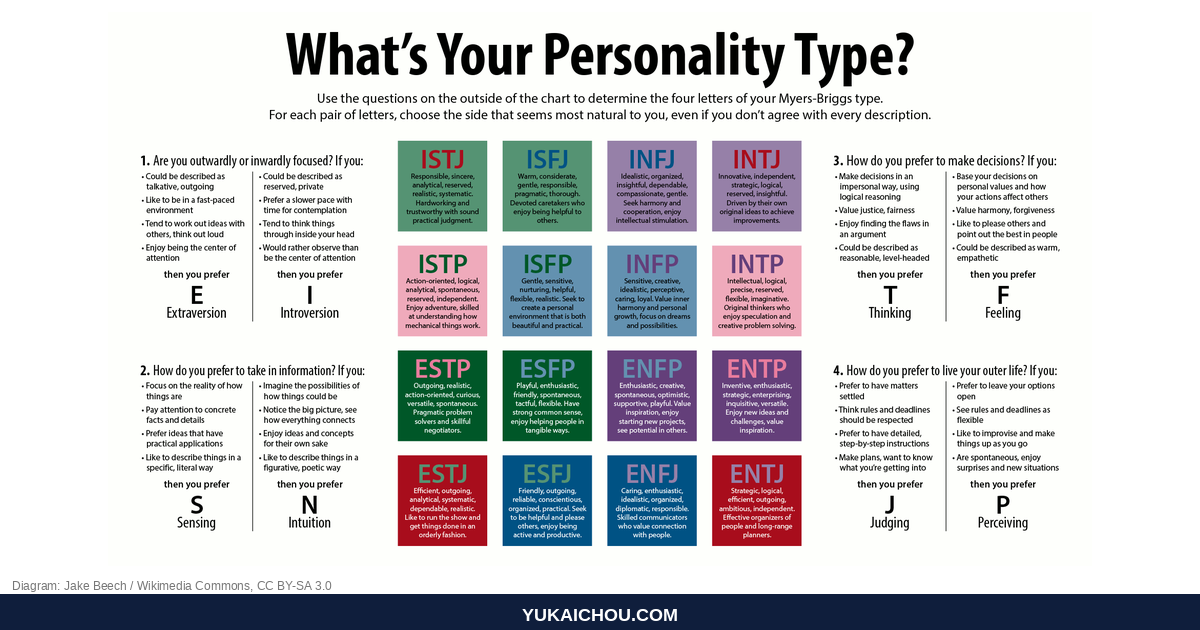

Every Sunday on LinkedIn, somebody announces their personality type the way other people announce a promotion. ENTJ. INFP. ENFP-A-T. The Myers-Briggs Type Indicator is the most-searched personality framework on earth — roughly 201,000 people typing “MBTI” into Google every single month — and it anchors a multi-billion-dollar personality-testing industry, a cottage trade in dating-app bios, and entire HR departments that type their engineers before assigning them to a team.
It is also, quietly, one of the least scientifically defensible instruments still in widespread professional use.
I have spent the better part of two decades mapping the behavioral-science literature that actually predicts human motivation — the literature underneath my Octalysis Framework. MBTI keeps coming back around in client conversations because of how viral and socially sticky it is, so I cannot ignore it the way I ignore horoscopes and Enneagram numerology. I also cannot endorse it. What follows is my best attempt at a fair, expert-level designer’s guide to what MBTI is, what Isabel Myers and Katharine Briggs got right, the three places it falls apart under replication, and how a behavior-based system like Octalysis gives you most of the social utility with far less of the measurement cost.
Speed Run Notes
- MBTI sorts people into 16 personality types across four dichotomies — Extraversion/Introversion, Sensing/Intuition, Thinking/Feeling, Judging/Perceiving — derived by Isabel Briggs Myers and her mother Katharine Cook Briggs from a loose reading o…
- The most persistent replication finding against MBTI: roughly 50 percent of people who retake the test within five weeks land in a different type.
- Every dichotomy MBTI treats as categorical (“you are an E or an I”) is, in real data, a normal bell curve.
- MBTI consistently fails to predict job performance, team outcomes, relationship satisfaction, or career success in peer-reviewed meta-analyses.
- What Myers and Briggs did get right: the social intuition that people differ on how they gather information, what they prioritize when deciding, and where they direct attention.
- The enduring appeal of MBTI isn’t psychometric — it’s narrative.
In This Article
- What Is the Myers-Briggs Type Indicator?
- The Core Findings: Four Dichotomies, Sixteen Types
- What Myers and Briggs Got Right
- Where MBTI Falls Apart
- The Brain on MBTI: Why the Test Feels So Accurate
- MBTI vs. Big Five, Enneagram, and Bartle’s Player Types
- MBTI in the Real World
- The Elephant in the Room
- How to Apply MBTI with the Octalysis Framework
- Practical Steps for Designers, Managers, and Curious Readers
- Frequently Asked Questions
I’m Yu-kai Chou, the creator of the Octalysis Framework — the behavioral-design system now applied to products and experiences reaching more than a billion users. I’ve advised MrBeast, LEGO, Microsoft, Porsche, Coca-Cola, Tesla, and governments including Ukraine on how to use the science of motivation without crossing into manipulation.
On the topic of personality typing specifically, my standing is slightly different from my standing on the frameworks I have fully endorsed on this site. I have never used MBTI in a client engagement, in a team-design recommendation, or in an Octalysis-based segmentation. I have been asked about it thousands of times, and every time I have had to give roughly the same answer: the intuitions underneath MBTI are correct; the instrument that formalizes them is not; there is a better way. This article is the long-form version of that answer, written so that the next designer, HR leader, or curious reader who asks me about it can read it once instead of asking me in the hallway.
My reading of the replication literature draws on Pittenger’s reviews of MBTI validity (1993, 2005), the CAPT and CPP technical reports, the cognitive-dissonance work underneath why people resist retyping after an inconsistent retest, and the Big Five / OCEAN literature Paul Costa and Robert McCrae spent forty years building. My design view on what to use instead comes from every Octalysis engagement I have run since 2013.
About the Author

Yu-kai Chou is an S-Tier Behavioral Designer and the creator of the Octalysis Framework, the gamification design system now applied to products and experiences reaching over 1.5 billion users. His book Actionable Gamification is one of the most-cited works in the field, and he has been ranked the #1 Gamification Guru in the World.
He has advised MrBeast, LEGO, Microsoft, Porsche, Tesla, Stanford, Harvard, and governments including Ukraine on turning behavioral psychology into product mechanics that actually change user behavior.
Verify: Wikipedia · Google Scholar · Wikidata · LinkedIn
What Is the Myers-Briggs Type Indicator?
The Myers-Briggs Type Indicator is a self-report questionnaire that assigns a respondent to one of sixteen personality types. The types are labelled with four letters — INTJ, ESFP, ENFP, ISTP, and so on — each letter drawn from one end of a paired preference. The four dichotomies are Extraversion versus Introversion, Sensing versus Intuition, Thinking versus Feeling, and Judging versus Perceiving.
The instrument was developed between 1943 and the mid-1960s by Isabel Briggs Myers and her mother Katharine Cook Briggs. Neither had formal training in psychometrics or clinical psychology. Their stated goal was to make Carl Jung’s theory of psychological types — published in German in 1921 and in English in 1923 — usable for women entering the wartime workforce, so employers and employees could “sort” themselves toward work that fit their nature. The earliest versions circulated through the Educational Testing Service; Consulting Psychologists Press (later The Myers-Briggs Company) took over publication in 1975, which is when the instrument began its long slow march into corporate training rooms.
Today the instrument is taken by around 1.5 to 2 million people each year through official CPP channels, and by hundreds of millions more through unlicensed look-alikes — most famously 16Personalities, which uses the same four-letter scheme on a Big Five substrate and doesn’t disclose the substitution clearly on its landing page. Between the official test and its many imitators, MBTI or its lookalikes appear in roughly 89 of the Fortune 100’s training catalogs, in a large fraction of government agency team-building offsites, and in the small-talk of Gen Z dating in the way sun signs were weaponized twenty years ago.
That usage is culturally enormous and scientifically odd. Almost no published peer-reviewed research in the last two decades uses MBTI as a personality measure. Almost no modern personality-psychology textbook recommends it. The instrument sits in a strange cultural niche — everybody has heard of it, corporate America is built on it, and the academic field that studies personality has quietly moved on to other tools.
The Core Findings: Four Dichotomies, Sixteen Types
To understand what MBTI claims to measure, it helps to walk through the four axes it tests and what each pole is supposed to indicate.
Extraversion (E) vs. Introversion (I) — Where Energy Comes From
In Jung’s original framing, extraversion and introversion were about the direction of attention. The extravert’s energy flows outward toward objects, people, and action. The introvert’s energy flows inward toward thought, reflection, and internal imagery. Myers and Briggs preserved that direction-of-attention frame but added the pop-psychology wrinkle most people know today: extraverts are energized by being around people and drained by solitude; introverts are energized by solitude and drained by crowds. That second framing is the one that survives in office small-talk, even though it’s a substantive departure from Jung.
Sensing (S) vs. Intuition (N) — How Information Is Taken In
Sensors are said to prefer concrete, sequential, fact-based information — what their five senses report, what has been measured, what has been done before. Intuitives are said to prefer patterns, meanings, possibilities, and implications — what could be, what the data hints at, what the future shape of a problem might look like. The letter N is used for Intuition because I was already taken by Introvert; this is the kind of pragmatic ad-hoc decision that recurs throughout the instrument’s history.
Thinking (T) vs. Feeling (F) — How Decisions Get Made
Thinkers are said to weigh decisions on principles, logic, consistency, and cause-effect. Feelers are said to weigh decisions on values, harmony, impact on specific people, and relational context. Myers was careful, correctly, to note that this axis isn’t about whether a person has emotions or uses logic — everyone does both — but about which criterion takes priority when the two conflict. In practice, most popular descriptions collapse the distinction into “head versus heart,” which is exactly the oversimplification Myers tried to avoid.
Judging (J) vs. Perceiving (P) — How the Outer World Is Approached
This axis is the one Myers and Briggs added on top of Jung; it’s not present in the 1921 original. Judgers are said to prefer structure, closure, plans, deadlines, and settled decisions. Perceivers are said to prefer openness, flexibility, options-kept-open, and adaptive response to whatever comes up. Again the popular description — “organized versus spontaneous” — is a caricature of what Myers intended, which was something closer to whether a person’s outward-facing orientation tends toward control or exploration.
Cross-multiply the four dichotomies and you get sixteen types: INTJ, INTP, ENTJ, ENTP, INFJ, INFP, ENFJ, ENFP, ISTJ, ISFJ, ESTJ, ESFJ, ISTP, ISFP, ESTP, ESFP. Each type comes with a nickname (Architect, Logician, Commander, Debater, Advocate, Mediator, Protagonist, Campaigner, and so on), a list of famous people said to share it, and an increasingly elaborate backstory assembled over decades of MBTI marketing.
If you only remember one structural fact about MBTI, remember this: the instrument forces each respondent onto one side of each dichotomy. There is no “moderate extravert” in MBTI. You are an E or an I. That forced categorization is the single architectural choice that drives most of the downstream problems the replication literature has uncovered.
What Myers and Briggs Got Right
It would be unfair and inaccurate to dismiss MBTI as a junk framework top to bottom. The intuitions underneath it are real. Where Myers and Briggs went astray was in the operationalization, not in the underlying observation. Let me name the three things they got right.
People do differ reliably on where they direct attention
The extraversion-introversion distinction is the single axis of MBTI that survives modern psychometric scrutiny almost unchanged, because it maps cleanly onto the Big Five’s Extraversion factor, which in turn maps onto measurable dopaminergic reward sensitivity in the brain. Extraverts really do show larger dopamine responses to novel social stimuli. Introverts really do show faster cortical habituation. That finding is forty years old, it has replicated across cultures, and MBTI’s insistence on making it one of its headline axes was correct. The only thing Myers and Briggs did wrong was force people to pick one side.
People do differ reliably on what they prioritize when deciding
The Thinking-Feeling axis, despite the popular caricature, points at a real individual-difference dimension: when two decision criteria conflict — logical consistency versus interpersonal harmony, let’s say — which one does a given person typically privilege? That question has been operationalized far better by later tools (the Hogan Personality Inventory’s Interpersonal Sensitivity scale, for example, or the Big Five’s Agreeableness), but Myers and Briggs were early in noticing the signal.
The language of types is socially useful even when scientifically loose
Giving people a four-letter code does something the more scientifically defensible continuous-trait instruments don’t: it gives them a handle to talk about themselves. “I’m an INFJ” communicates faster, socially, than “I’m at the 67th percentile of Agreeableness and the 71st percentile of Openness.” The type labels are scientifically lossy, but they’re conversationally efficient. That efficiency is a genuine social good; it’s just one that a personality instrument shouldn’t be optimizing for.
Set those three observations aside and the rest of MBTI has had a much rougher ride in the replication literature. That’s where we go next.
Where MBTI Falls Apart
This is the section most MBTI write-ups gloss over in four sentences. Treat what follows as the long form. If you are a manager, HR leader, or product designer considering using MBTI in a real decision, this is the section you owe your team to read carefully.
1. Test-retest reliability falls off a cliff — about half of people change type within five weeks
The gold standard question for any categorical classification instrument is simple: if I take the test today and again in five weeks, do I land in the same category? For MBTI, the answer is roughly a coin flip. Pittenger’s widely-cited 1993 Journal of Career Planning & Employment review, the Kaplan and Saccuzzo psychometrics textbook, and the CPP’s own technical manual all report that only around 50 percent of respondents receive the same four-letter type on a five-week retest. Even expanding the window to nine months, the reclassification rate remains uncomfortably high.
If personality is a trait — a stable, enduring characteristic of a person — an instrument claiming to measure it should not reclassify half its respondents within weeks. The Big Five, by comparison, shows test-retest correlations above 0.80 across the same timescales; which means the order of people on each continuous dimension remains stable even if individual scores drift a little. MBTI, because it forces each trait through a threshold, amplifies measurement noise into category flips. A respondent who scores 51’st percentile on Extraversion this week and 49’th percentile in five weeks comes out E the first time and I the second — an apparent “personality change” that’s an artifact of where Myers and Briggs drew the line.
This single finding is the one that should end the conversation for any high-stakes use. You wouldn’t hire an engineer on the basis of a blood-pressure reading that was randomly different every time you measured it. You shouldn’t staff a team on the basis of a personality label that flips with the wind.
2. The dichotomies aren’t actually bimodal — MBTI forces a bell curve through a knife
Myers and Briggs’s theory predicts that, on each dichotomy, the population should cluster at the two extremes and thin out in the middle. Call this the bimodality prediction. If the theory is right — if E and I are qualitatively different orientations rather than two ends of one continuum — we should see a distribution with two humps. If the theory is wrong, we should see a single bell curve centered near the middle.
Every empirical test that has looked at the distributions has found a single bell curve. People are normally distributed on each of MBTI’s four axes, with the largest mass of respondents sitting near the middle. Pittenger, Stricker and Ross, Howes and Carskadon, and independent re-analyses of the CPP’s own raw data all converge on the same finding. There is no empirical bimodality on any of the four axes.
Why does that matter? Because when you take a bell curve and force it through a midpoint threshold, you maximally scramble the categorization of people near the middle. Two respondents who are functionally identical on Extraversion — one at the 51’st percentile, one at the 49’th — get opposite letters. Two respondents who are wildly different on Extraversion — one at the 51’st percentile, one at the 99’th — get the same letter. The letter labels obscure the signal instead of revealing it.
3. MBTI doesn’t predict the outcomes it’s used to justify
The implicit argument for using MBTI in hiring, team-building, or relationship-matching is that the four-letter code predicts something downstream: job performance, team cohesion, marital satisfaction, career fit. If the instrument predicted those outcomes well, even a scientifically loose instrument would have utility.
It doesn’t. The Society for Industrial and Organizational Psychology’s position statement on MBTI, the Committee on Techniques for the Enhancement of Human Performance at the U.S. National Research Council, and every peer-reviewed meta-analysis on personality-based hiring concludes the same thing: MBTI has not been shown to predict job performance, team outcomes, leadership effectiveness, or career satisfaction in any validated way. The Big Five, by contrast, reliably predicts job performance through the Conscientiousness factor and leadership emergence through Extraversion; it does so with effect sizes that are modest but real.
This is the deepest problem with MBTI’s corporate adoption: the instrument’s main professional use is a use it is not empirically equipped to support. Using MBTI to inform a hiring decision, a team composition, or a promotion is, on current evidence, closer to using astrology than using science.
The Brain on MBTI: Why the Test Feels So Accurate
If MBTI is as psychometrically wobbly as the previous section describes, why do so many intelligent adults read their four-letter report and come away feeling it nailed them? The answer is a cluster of well-documented cognitive biases that operate on every pseudoscientific self-description, not just MBTI. A designer who intends to use any typing system responsibly needs to understand what’s actually going on when the reader says “wow, that’s so me.”
The first mechanism is the Barnum effect (sometimes called the Forer effect after Bertram Forer’s 1948 classroom demonstration). Forer gave a class of students what they thought were individualized personality readings; in fact, every student received the same text, assembled from horoscope fragments. Students rated the accuracy of their “personal” reading at 4.26 out of 5. MBTI descriptions rely heavily on statements that are vague enough to apply to almost anyone (“You have a great need for other people to like and admire you”) and are interpreted as specifically true of the reader.
The second mechanism is confirmation bias. Once a reader is handed the label INFJ, they selectively remember evidence consistent with the label and selectively forget evidence inconsistent with it. An INFJ who was socially outgoing at a party later tells themselves it was an exhausting stretch, even if they enjoyed it in the moment. The label reshapes the memory.
The third mechanism is identity investment. This is where my cognitive-dissonance work becomes directly relevant. When a person publicly declares their MBTI type — on LinkedIn, to a friend, on a dating profile — they create a behavioral commitment. Taking the test a second time and getting a different answer now threatens that commitment. The brain resolves the dissonance by either retaking the test until the “right” answer comes back or by dismissing the second result as a testing anomaly. This is how a personality label ossifies into an identity even when the underlying measurement is unstable.
The fourth mechanism is community belonging. INFJ Reddit, INTJ Twitter, and the ENFP-Reddit subculture are real communities. Declaring a type grants membership. Changing type costs membership. This is Core Drive 5 (Social Influence & Relatedness) running in the background and is, in my view, the single largest reason MBTI has outlived its psychometric obituary by three decades.
MBTI vs. Big Five, Enneagram, and Bartle’s Player Types
MBTI is not the only personality map on the market, and a fair review has to situate it against its peers. The four most common points of comparison are the Big Five / OCEAN model, the Enneagram, the HEXACO extension of the Big Five, and (for gamification designers specifically) Bartle’s Player Types.
Big Five / OCEAN (Costa & McCrae)
The Big Five — Openness, Conscientiousness, Extraversion, Agreeableness, Neuroticism — is what modern personality psychology converged on after forty years of lexical-hypothesis and factor-analytic work. Its five dimensions are continuous (no forcing through thresholds), empirically bimodal nowhere (which is correct — that’s how human populations actually distribute), cross-culturally stable, and reliably predictive of real-world outcomes like job performance (through Conscientiousness), leadership emergence (through Extraversion), and academic achievement (through Conscientiousness and Openness). If you need one personality instrument to use seriously, the Big Five is the correct answer. I cover the Big Five in more depth across the Behavioral Analysis library.
Enneagram
The Enneagram divides people into nine types based on core motivations. It has even less empirical support than MBTI — the nine-type structure has never been validated by independent factor analysis, and the test-retest reliability is similarly poor. It survives because its descriptions are rich and narrative, which makes it socially sticky. If MBTI is astrology with better PR, Enneagram is astrology with better storytelling.
HEXACO (Lee & Ashton)
HEXACO adds a sixth factor — Honesty-Humility — on top of the Big Five. It is the best instrument we currently have for detecting Machiavellian, narcissistic, and psychopathic tendencies, which the Big Five underweights. For dark-side personality work, HEXACO is the instrument of choice. For everyday personality typing, it offers no advantage over the Big Five.
Bartle’s Player Types (Achievers, Explorers, Socializers, Killers)
In game design, Richard Bartle’s four player types were the ancestral MBTI of the gaming industry. Achievers want to complete challenges; Explorers want to discover systems; Socializers want to interact with others; Killers want to compete against others. The typology is a useful heuristic and a terrible diagnostic — because, like MBTI, it treats individual variation as categorical when it is in fact continuous. Most real players score on multiple types, not one. The right update is to map Bartle’s intuitions onto the eight Octalysis Core Drives, which are continuous intensities rather than categorical labels — and that’s the move I’ve been advocating since 2013.
MBTI in the Real World
MBTI’s footprint in real institutional life is larger than its scientific footprint. A fair review has to describe that footprint honestly — both the places where the instrument has attached itself and the places where its use should be reconsidered.
Workplace: Hiring, Team-Building, and the $2B Training Industry
MBTI generates tens of millions of dollars a year through the official Myers-Briggs Company, plus a long tail of licensed-practitioner workshops, official-test licensing fees, and adjacent training spend that pushes the broader MBTI footprint into the hundreds of millions annually. About 89 of the Fortune 100 have used it in some form — mainly in team-building retreats, manager-development workshops, and onboarding sessions. The instrument’s corporate appeal is easy to explain: it’s fun, it’s non-confrontational (no type is labeled “bad”), and it gives groups a shared vocabulary for talking about difference without having to talk about competence.
The problem is when MBTI graduates from conversation piece to decision instrument. Using it to screen candidates, assign roles, or reorganize teams rests on an empirical foundation the instrument cannot bear. Some HR practices built on MBTI have been quietly retired over the last decade as legal and evidentiary pressure has grown. The U.S. Equal Employment Opportunity Commission has repeatedly cautioned against personality tests that lack validation evidence for the specific job — which is exactly the situation MBTI is in for most roles.
Education: Career Counseling and Student Self-Knowledge
The original target audience for MBTI was workforce entrants, and education has been the instrument’s second-largest market. Thousands of high-school and college counseling offices still administer MBTI to students as part of career exploration. The honest use case here is modest: an MBTI session gives a student vocabulary for thinking about their own preferences and how those preferences might interact with different working environments. The dishonest use case is telling the student which careers are “right” for their type, which is a claim the evidence doesn’t support.
Dating and Relationships: The Four Letters on the Bumble Profile
The cultural rise of MBTI on dating apps is newer, mostly post-2018, and mostly Gen Z. It’s a phenomenon I find fascinating and concerning in roughly equal parts. Fascinating because it reflects a real cultural hunger for compressed self-description — people want a fast handle on a potential match, the way astrology provides one. Concerning because the research on MBTI in relationship-compatibility prediction is, predictably, non-existent. If you are two INTJs on a great first date, it’s because you’re two people with a real connection, not because the letters matched.
Marketing & Product Design: Persona Development Gone Wrong
Some product teams use MBTI types as the basis for user personas — “our primary persona is an ENTJ early adopter,” and so on. This is a near-twin failure mode of the hiring use case. Personas exist to ground design decisions in a mental model of the user; MBTI’s unreliable type labels create the illusion of precision without the substance. I’ve seen product teams reorganize roadmap priorities on the basis of assumed MBTI distributions of their users. That’s a rounding error promoted to a strategy.
The Elephant in the Room
The elephant: MBTI is enormously culturally popular, survives every scientific critique, and will almost certainly still be in use in corporate America long after this article’s author has retired from writing about it. Why?
Because it does three things well that scientifically better instruments don’t. First, it gives people a narrative identity — a short code that feels personal and specific. Second, it gives them a community — other people with the same code who recognize them instantly. Third, it gives them permission to be themselves — a framing that says your way of being is one of 16 valid ways, rather than a deviation from a universal standard.
Those three payoffs map cleanly, if somewhat uncomfortably, onto my own Octalysis framework:
- Core Drive 1 (Epic Meaning & Calling) — “my type is part of what makes me uniquely me, and fits me into a larger pattern of human types.”
- Core Drive 4 (Ownership & Possession) — “this type is mine — I own my INFJ-ness the way I own my name.”
- Core Drive 5 (Social Influence & Relatedness) — “other INFJs get me in a way non-INFJs don’t.”
The uncomfortable implication is that MBTI’s cultural durability is Octalysis working as designed. The instrument is psychometrically weak but motivationally strong. If you take it away without replacing the motivational payoff, people will just adopt the next pseudoscientific alternative. The answer isn’t to mock MBTI; it’s to give people a scientifically defensible instrument that offers the same three payoffs. That’s the gap I want to close in the next section.
How to Apply MBTI with the Octalysis Framework

Here’s the design move. Instead of typing users by their self-reported MBTI, type them by the Octalysis Core Drives they actually respond to inside your system. You already have the data: every click, every return visit, every feature they ignore or lean into is a signal about which Core Drives are carrying their engagement.
Concretely, here is how I’d turn each of MBTI’s four axes into a behavior-based signal inside an Octalysis-informed design:
E/I → CD5 (Social Influence & Relatedness) intensity
Instead of asking users to report whether they are extraverts or introverts, observe how they use the social surfaces of your product. Do they open chat? Join guilds? Post on the forum? Share content? React to others? The intensity of their CD5 engagement is a live measurement of the same underlying disposition MBTI is trying to catch with E/I — except your measurement updates every day, and is based on observed behavior rather than self-report.
S/N → MASK00025 intensity
Sensing and Intuition map roughly onto how much a user wants ordered concrete detail versus how much a user wants open-ended creative space. In your product, this shows up as whether they prefer structured wizards and step-by-step flows or freeform sandbox modes. A user who gravitates toward the sandbox is showing you high CD3 pull. A user who gravitates toward the checklist is showing you low CD3 pull and probably high CD2 (Accomplishment) pull.
T/F → CD2 (Development & Accomplishment) vs CD5 (Relatedness) weighting
Does the user respond more strongly to individual progress signals (badges, leaderboards, completion bars) or to relational signals (helpful nudges from a buddy, a team challenge, a mentor connection)? That behavioral split captures the same distinction MBTI’s T/F is trying to capture — but it tells you what actually drives this user’s engagement with your product, not what they said about themselves last summer.
J/P → CD4 (Ownership) vs MASK00028 weighting
Users who lean Judging in MBTI’s sense tend to show up in Octalysis as high CD4 (they want to see their collection, their progress, their plan, their build-out complete) with low CD7 (they dislike surprises that destabilize their plan). Users who lean Perceiving show up as higher CD7 and lower CD4 — they like variable schedules, lucky drops, surprise events. Design your surface to let both modes coexist rather than forcing a single experience on all users.
The deeper point is this. MBTI is the Level-1 version of what Octalysis does at Level-3 and Level-4. Level-1 Octalysis (the hero image above) gives you the eight Core Drives. Level-3 Octalysis gives you player-type variations on how those Core Drives are weighted across Bartle-style segments. Level-4 Octalysis gives you longitudinal shifts in those weightings as the player ages, changes life stage, and moves through the 4 Experience Phases. Every one of those layers is continuous, behavior-based, and self-updating. MBTI’s 16 discrete types are a static snapshot. Octalysis is a live map.
If you’ve been running MBTI in your workplace or product, you don’t have to throw away what you’ve learned. Keep the conversations, the shared vocabulary, and the reminder that people differ. Just stop letting the four-letter code make decisions that matter.
Practical Steps for Designers, Managers, and Curious Readers
If you’re a product designer
Don’t segment users by self-reported MBTI. Segment by observed behavior. Identify the three Core Drives that best predict retention and monetization in your product, then design feature variants that over-serve each segment’s dominant drive without starving the other two. Re-segment users monthly, because real behavior drifts and your typing should drift with it.
If you’re a manager
Don’t hire on MBTI, don’t promote on MBTI, don’t reorg on MBTI. If your team has been using MBTI as conversation scaffolding in team retros, that’s fine — just name it as such. For anything consequential, use validated instruments: Hogan for derailment risk, the Big Five for general personality structure, structured behavioral interviews for job fit. The evidentiary gap between those instruments and MBTI is roughly the gap between a thermometer and a mood ring.
If you’re an HR leader
Audit where MBTI results are being stored in your systems and who has access. Treat the type labels as unvalidated data that should not be used for any decision with legal or economic consequence. If you contract an MBTI workshop vendor, make clear in writing that the workshop is a team-development conversation starter, not a psychometric assessment.
If you’re a curious reader
Take the test, enjoy the conversation, hold the result loosely. Your four-letter code is a fun social artifact, not a blueprint of who you are. The evidence that you’d get a different code on a different day is overwhelming. Treat the test the way you’d treat a horoscope you read and enjoyed — an opportunity to reflect, not a diagnosis.
Closing Thoughts
I’ve been told, more than once, that writing critically about MBTI is an “unpopular” position. It isn’t, inside academic personality psychology — it’s the mainstream position. It’s unpopular only in the corporate world that grew up on MBTI workshops and the social world that grew up on INFJ Reddit. And even there, my point isn’t that the instrument is worthless. It’s that the instrument is doing a social job that’s being confused for a measurement job.
Once you separate those two jobs, the path forward is clear. Keep the social payoff — the identity, the vocabulary, the community — and deliver it through a framework that doesn’t pretend to be measuring something it cannot measure. Octalysis at Levels 2, 3, and 4 is my best attempt at that framework. The Big Five is the best academic attempt. Either one — or both in combination — is a better foundation than the sixteen four-letter codes we’ve all been repeating at each other for fifty years.
That’s the bar I want designers, managers, and readers to hold themselves to. When a framework survives less on its measurement properties than on its social function, the mature move is to replace it with something that earns its keep on both counts. MBTI earns its keep on one. We can do better.
Where to Go Next
- Replace types with traits. If you want the validated alternative MBTI keeps gesturing at, start with the Octalysis Framework — the eight-Core-Drive map that ditches the four-letter code in favor of continuous, observed-behavior weightings.
- See the cognitive-dissonance engine running underneath identity investment. Read Cognitive Dissonance — the mechanism that makes people defend an MBTI letter long after the second-retest disagreed.
- Translate Bartle’s player types the same way. The Bartle taxonomy has the same categorical-vs-continuous problem MBTI does; map Bartle onto the Octalysis Core Drives for a continuous segmentation that actually predicts behavior.
- Build the segmentation in your own product. Actionable Gamification walks through Octalysis at Levels 1-4 with the case-study evidence MBTI’s corporate adoption never produced; Octalysis Prime is the implementation membership for designers ready to ship the segmentation.
Frequently Asked Questions
Is MBTI scientifically valid?
As a diagnostic or predictive instrument, no. MBTI fails the test-retest reliability standard (roughly half of people change type on a five-week retest), shows no evidence of the bimodal type distributions its theory predicts, and doesn’t reliably predict the downstream outcomes — job performance, team success, relationship satisfaction — that it’s used to justify. As a vocabulary for talking about differences in preference, it captures some real intuitions, but those intuitions are better captured by the Big Five.
Why does my MBTI result feel so accurate?
The Barnum effect, confirmation bias, identity investment, and community belonging combine to make any reasonably well-written personality description feel personal. Bertram Forer showed in 1948 that students rated an identical pseudo-personalized reading at over 4 out of 5 for accuracy. Feeling accurate is not the same thing as being accurate.
Is 16Personalities the same as MBTI?
16Personalities uses the same four-letter type scheme as MBTI but is built on a Big Five-style continuous substrate under the hood. It’s closer to a simplified Big Five with MBTI-flavored labels than it is to the official MBTI instrument. Both share the same core problem of forcing continuous scores through thresholds to produce discrete types.
What should I use instead of MBTI for serious decisions?
For hiring or selection, use validated job-specific assessments combined with structured behavioral interviews and work-sample tests. For general personality description, use the Big Five / OCEAN. For dark-side risk assessment, use HEXACO or the Hogan Development Survey. For product segmentation, use behavioral data analyzed through the Octalysis Core Drives rather than self-reported types.
Can I change my MBTI type?
Empirically, yes — about half of people do, simply by retaking the test. That ease of change is itself the problem: a stable personality trait shouldn’t reclassify so easily. What actually changes between tests is usually mood, context, and how the respondent interprets ambiguous items, not the underlying person.
Did Carl Jung endorse MBTI?
No. Jung developed the theoretical typology of psychological types in 1921 but never endorsed an instrument derived from it. Isabel Briggs Myers and Katharine Cook Briggs built the MBTI independently, starting in the 1940s, adapting and extending Jung’s framework in ways Jung did not oversee. The Judging/Perceiving axis in particular is an addition not present in Jung’s original text.
Why is MBTI still so popular in corporate training?
Because it’s fun, non-confrontational, and non-threatening. No type is labeled “bad.” Managers can run a team session without any one person feeling exposed. The instrument’s corporate longevity reflects social utility, not psychometric quality. Scientifically better alternatives exist but are less immediately friendly for a two-hour team offsite, which is why they’ve had a harder time displacing MBTI.
Is there any harm in taking MBTI for fun?
Not on its own, no. The harm shows up when MBTI results start making decisions they’re not equipped to make — hiring, team composition, relationship compatibility, career steering for young people who over-update on a result that may flip in five weeks. Use it socially, hold it loosely, and don’t let the letters narrow your options for things that matter.
What’s the difference between MBTI and the Big Five?
Both ask about preferences and self-perception; both map roughly similar dimensions. The key difference is that the Big Five keeps each dimension continuous (you score at some percentile along Extraversion rather than being pushed to one side), which preserves individual variation and doesn’t create the artificial type-flipping MBTI does near the midpoint of each axis. The Big Five also has far stronger evidence linking its dimensions to real-world outcomes.
How does MBTI relate to Octalysis?
MBTI is a trait-based typing system (you are assigned a type). Octalysis is a behavior-based motivation framework (we observe which of the eight Core Drives your engagement reflects). MBTI’s four axes map loosely onto Octalysis Core Drive weightings (E/I onto CD5 intensity, S/N onto CD3 pull, T/F onto CD2 vs CD5 prioritization, J/P onto CD4 vs CD7 balance), but the Octalysis mapping has the huge advantage of being continuous, observed rather than self-reported, and auto-updating as behavior changes.
References
- Jung, C. G. (1921). Psychologische Typen. Rascher Verlag. [English translation: Psychological Types, 1923, Pantheon Books.]
- Myers, I. B., & Briggs, K. C. (1944). The Briggs Myers Type Indicator manual. Educational Testing Service.
- Myers, I. B. (1962). The Myers-Briggs Type Indicator. Consulting Psychologists Press.
- Pittenger, D. J. (1993). “Measuring the MBTI… and coming up short.” Journal of Career Planning & Employment, 54(1), 48–52.
- Pittenger, D. J. (2005). “Cautionary comments regarding the Myers-Briggs Type Indicator.” Consulting Psychology Journal: Practice and Research, 57(3), 210–221.
- Stricker, L. J., & Ross, J. (1964). “An assessment of some structural properties of the Jungian personality typology.” Journal of Abnormal and Social Psychology, 68(1), 62–71.
- Howes, R. J., & Carskadon, T. G. (1979). “Test-retest reliabilities of the Myers-Briggs Type Indicator as a function of mood changes.” Research in Psychological Type, 2(1), 67–72.
- Hunsley, J., Lee, C. M., & Wood, J. M. (2003). “Controversial and questionable assessment techniques.” In S. O. Lilienfeld, S. J. Lynn, & J. M. Lohr (Eds.), Science and pseudoscience in clinical psychology (pp. 39–76). Guilford Press.
- McCrae, R. R., & Costa, P. T. (1989). “Reinterpreting the Myers-Briggs Type Indicator from the perspective of the five-factor model of personality.” Journal of Personality, 57(1), 17–40.
- Costa, P. T., & McCrae, R. R. (1992). Revised NEO Personality Inventory (NEO-PI-R) and NEO Five-Factor Inventory (NEO-FFI): Professional manual. Psychological Assessment Resources.
- Barbuto, J. E. (1997). “A critique of the Myers-Briggs Type Indicator and its operationalization of Carl Jung’s psychological types.” Psychological Reports, 80(2), 611–625.
- Druckman, D., & Bjork, R. A. (Eds.). (1991). In the mind’s eye: Enhancing human performance. Committee on Techniques for the Enhancement of Human Performance, National Academy Press. [Chapter on personality assessment reviewing MBTI limitations.]
- Forer, B. R. (1949). “The fallacy of personal validation: A classroom demonstration of gullibility.” Journal of Abnormal and Social Psychology, 44(1), 118–123.
- Lee, K., & Ashton, M. C. (2004). “Psychometric properties of the HEXACO Personality Inventory.” Multivariate Behavioral Research, 39(2), 329–358.
- Grant, A. M. (2013). “Goodbye to MBTI, the fad that won’t die.” Psychology Today / LinkedIn Pulse.
- Chou, Y. (2015). Actionable Gamification: Beyond Points, Badges, and Leaderboards. Octalysis Media.
Related Reading
- Bartle’s Player Types — and how Octalysis Core Drives map onto them
- Reiss’s 16 Basic Desires — a wider-resolution alternative to MBTI
- Cognitive Dissonance — why people resist retyping after an inconsistent MBTI retest
- Emotional Intelligence — the behavior-based counterpart to trait-based personality typing
- The Octalysis Framework — the continuous, behavior-based alternative to static personality types
Personality typing is a story your users tell about themselves. Octalysis is the system that explains the story. Stop sorting users into sixteen letters and start watching which of the eight Core Drives actually carries their engagement — that’s the move from a personality label that flips every five weeks to a behavioral map that updates with every click. Octalysis Prime is where the implementation work happens.