

A founder I’d just met pulled out his phone and showed me his “MVP.” The login screen worked. The signup flow worked. The dashboard had a placeholder chart and a button that didn’t do anything yet. He told me, with real pride, that he’d shipped it in eight weeks and was now collecting signups.
I asked him one question: “What hypothesis is this MVP testing?”
He stared at me for a few seconds. Then he said, “What do you mean? It’s the minimum thing. That’s what an MVP is.”
That conversation has happened to me, in some form, at least fifty times over the last decade. Different founders. Different industries. Same misunderstanding. They’ve absorbed the phrase “minimum viable product” as a license to ship something half-built and call the result a strategy, when in reality they’ve spent two months learning nothing about whether their actual idea works. The MVP is supposed to be the cheapest possible answer to a yes-or-no question your business is betting its life on. If your MVP doesn’t answer that question, it isn’t an MVP. It’s just a crappy product with a fashionable name.
Speed Run Notes
- An MVP is not the crappiest product you can ship. It is the simplest possible experiment that proves or disproves the one hypothesis your whole business depends on.
- Most “MVPs” test the wrong hypothesis. They test “can we build this?” when the question that actually matters is “will anyone care if we build this?”
- Sort your hypotheses into Core, Feature, and Polish. If your Core hypothesis fails, the whole product fails. Test that one first. Everything else is optimization.
- Zappos, Dropbox, and Airbnb each launched MVPs that didn’t fully exist as products yet. They existed just enough to answer the one question that mattered.
- “Minimum” is a subtraction word and that’s why founders get it wrong. The right frame is additive: what is the smallest thing that creates real engagement and produces a real signal?
- If your MVP launch can’t change your mind about the business, it’s not an MVP. It’s busywork in disguise.
In This Article
- The MVP Misunderstanding That’s Costing Founders Years
- What an MVP Actually Is
- The Two-Year Trap
- The Hypothesis Hierarchy: Core, Feature, Polish
- What Real MVPs Look Like (Zappos, Dropbox, Airbnb)
- How I Used This for Octalysis Prime
- The Octalysis Lens on MVPs
- Why Community Makes Your MVP Stronger
- The Four Ways MVPs Quietly Fail
- The One Question to Ask Before You Build Anything
- Frequently Asked Questions
About Yu-kai Chou

Yu-kai Chou is an S-Tier Behavioral Designer and the creator of the Octalysis Framework, the gamification design system now applied to products and experiences reaching over 1.5 billion users. His book Actionable Gamification is one of the most-cited works in the field, and he has been ranked the #1 Gamification Guru in the World.
He has advised MrBeast, LEGO, Microsoft, Porsche, Tesla, Stanford, Harvard, and governments including Ukraine on turning behavioral psychology into product mechanics that actually change user behavior.
Verify: Wikipedia · Google Scholar · Wikidata · LinkedIn
I’m writing this post specifically because I’ve watched too many talented founders burn six to eighteen months on what they called an MVP and what was actually a fully-built product nobody asked for. I made that exact mistake on Octalysis Prime, my own gamified learning platform, before correcting it. The behavioral framing in this post is not theoretical. It’s the same set of questions I now make my advisory clients answer before they write a single line of code, and it’s saved teams I work with millions of dollars in wasted engineering time.
The MVP Misunderstanding That’s Costing Founders Years
Eric Ries popularized the term “minimum viable product” in The Lean Startup, and he was explicit about what it meant: a version of a product that allows a team to collect the maximum amount of validated learning about customers with the least effort. That’s the whole definition. Maximum learning. Least effort.
Notice what’s missing from that sentence. The word “crappy.” The word “shipped.” The word “launched.” None of it. The MVP is defined entirely by what it teaches you, not by what it looks like or whether it’s live in the App Store.
But somewhere between Ries’s book and most founders’ Notion docs, the definition got mangled. “Minimum viable product” got compressed into “minimum product.” And “minimum product” got translated into “ship the cheapest, ugliest, most stripped-down version of the full thing you eventually want to build, then iterate.” That sounds reasonable. It’s also wrong, and it’s wrong in a way that can quietly kill a startup.
Here’s why. If you build a stripped-down version of your full product, you’ve made a giant assumption before you started: that the full product is the right product. You’ve already decided what to build. You’ve just decided to build less of it for now. The MVP, in that framing, isn’t testing whether your product should exist. It’s testing whether you can ship.
That is not a hypothesis worth testing. You already know you can ship. Anyone can ship. The expensive question is not “can we build it” — it’s “should we build it.” And almost every “MVP” I see in the wild is silently dodging that question.
What an MVP Actually Is

Let me give you the version I’ve taught for years and that has held up across every product I’ve advised on, from physical retail to Web3 games to government engagement platforms.
An MVP is the simplest possible artifact that proves or disproves the single hypothesis your whole business depends on.
The artifact may not even be a product in the conventional sense. It might be a video, a landing page, a Slack community, or you, manually doing the work behind a fake automated front end. What makes it an MVP is not its form. What makes it an MVP is the question it answers.
Three filters tell you whether something is a real MVP.
Filter one: it is tied to a falsifiable hypothesis. “People will love our app” is not falsifiable. It’s vibes. “At least 5% of people who land on this page will pre-order at $49 within seven days” is falsifiable. You will know if you were right or wrong, and you will know it fast.
Filter two: the hypothesis is core, not cosmetic. If the answer is yes, you have a real reason to keep going. If the answer is no, you have a real reason to pivot or stop. Anything where both yes and no leave you in the same place is not testing a real hypothesis.
Filter three: it costs less to run the test than to be wrong. If your MVP costs more to ship than the cost of being wrong about the underlying belief, you’ve inverted the economics. The whole point is to spend small to learn big. If you find yourself proposing a six-month engineering project just to “validate” something, you are no longer running an MVP. You are building the product and calling it an experiment.
The Two-Year Trap
Picture two founders. Same idea, same market, same starting capital, same talent.
Founder A spends two years quietly building what she believes will be the perfect product. She doesn’t show anyone outside her team because she wants the launch to be a moment. Two years in, she launches, and within three weeks of real user contact, she discovers that her customers don’t have the problem she was solving. She thought they had mice in the kitchen. They actually have termites in the foundation. The mouse traps she spent two years engineering are not just useless. They’re embarrassing.
Founder B spends six months shipping a deliberately small artifact whose only job is to discover whether her customers have mice or termites. Five months in, she has her answer. It’s termites. She has eighteen months left to build something for the actual problem, and she enters that build with real signal: she knows what she’s targeting, what users will pay for, what demos resonate, what objections come up.
Both founders end the second year with a product. One of them ends with the right one.
This is the asymmetry that makes the MVP discipline so unreasonably valuable, and it’s also why “ship a crappy version of what we already plan to build” misses the point so completely. The crappy version doesn’t help you discover that you’re solving the wrong problem. It just makes the wrong product cheaper to build. You’re still building it.
The Hypothesis Hierarchy: Core, Feature, Polish
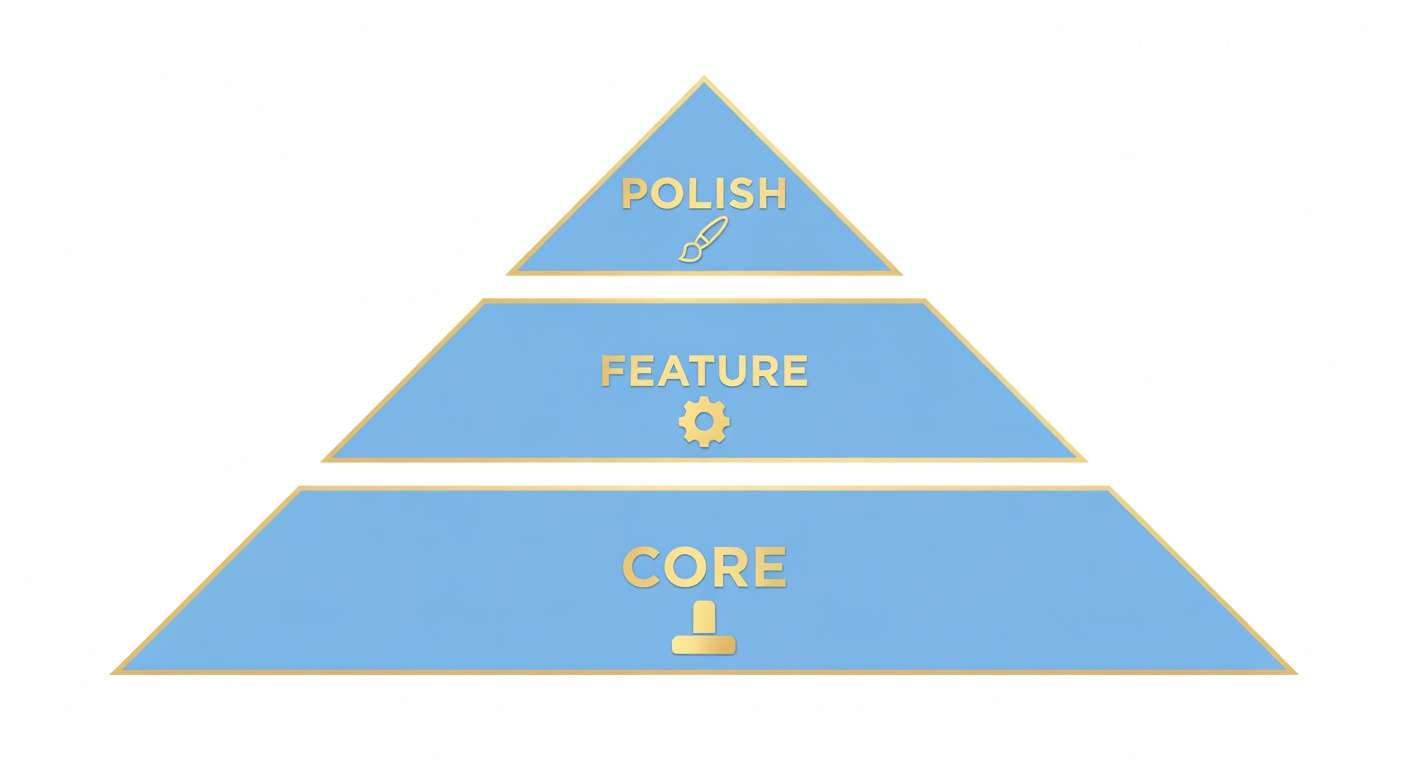
Inside any product, there are dozens of hypotheses you could test. The skill is knowing which to test first. Here’s the sorting frame I use.
Core hypotheses are the ones where the answer being “no” means the whole business doesn’t exist. “People want gamified learning more than they want passive video courses.” “Restaurants will pay for a delivery integration.” “Users will trust an AI to write production code.” These are the ones you must validate before everything else, because nothing downstream matters if these are wrong.
Feature hypotheses sit one layer down. “Adding leaderboards will increase engagement.” “Letting users customize avatars will improve retention.” If these turn out to be wrong, you remove or replace the feature. The product still exists. The business still exists. You’ve just learned which lever doesn’t work.
Polish hypotheses are the ones at the bottom of the stack. “This animation feels better than that animation.” “Users prefer this color palette.” Wrong here means a slightly worse product, not a dead one. You delay polish testing until you have something worth polishing.
The mistake almost every founder makes is testing in reverse. They polish before they validate the feature, they validate the feature before they validate the core, and by the time they realize the core hypothesis was wrong, they’ve spent eighteen months on something nobody wants. Test top-down. Cheapest test first, biggest assumption first, most dangerous belief first.
If you want to see this hierarchy in action across an entire startup arc, the Startup Revenue Equation walks through how to sequence these decisions from zero to a million dollars in revenue.
What Real MVPs Look Like (Zappos, Dropbox, Airbnb)
The cleanest examples of MVPs done right almost never look like products at all. They look like experiments dressed up in product clothing, just enough to be believable to a real customer.
Zappos. When Nick Swinmurn started Zappos in 1999, he didn’t have inventory, a warehouse, or a logistics chain. He had one hypothesis: would people buy shoes online without trying them on first? In an era where that was not obvious. So he walked into local shoe stores in San Francisco, took photos of their inventory, posted those photos on a barebones site, and when someone ordered, he walked back to the store, bought the pair at retail, and shipped it. He lost money on every order. That didn’t bother him. He was paying tuition on the only question that mattered. Once the answer was clearly yes, he raised real money to build real infrastructure. He didn’t waste a year building a warehouse for a hypothesis he hadn’t tested.
Dropbox. Drew Houston’s Dropbox MVP was a three-minute video. That’s it. He hadn’t built the syncing engine yet, because the engineering was nontrivial and he wanted to know whether anyone would actually want this before doing the work. He posted the video to Hacker News showing what the product would do, with a signup link for the beta waitlist. Overnight the waitlist went from 5,000 to 75,000. The hypothesis was proven before a single line of the actual product had been written for the public.
Airbnb. Brian Chesky and Joe Gebbia tested whether anyone would pay to sleep on a stranger’s air mattress before they built a marketplace. They put their own apartment online during a design conference, and three people paid eighty dollars each to crash on their floor. That was the entire MVP. It told them the unthinkable thing was actually thinkable: strangers would pay for this. The marketplace came later, after the core hypothesis had survived its first contact with reality.
Notice what’s common across all three. None of them built the eventual product first. None of them shipped a crappy version of the eventual product. They each built the absolute smallest thing that could answer the one yes-or-no question their entire business was secretly betting on. That’s the move.
The same pattern is alive and well in 2026. The first version of Cursor was a fork of VS Code with a basic chat panel bolted on. v0 launched as a single text box that returned a React component. ChatGPT’s earliest internal demos were a stripped chat UI on top of a model OpenAI already had. In every case, the product team built just enough to answer one question. Would developers pay to chat with their codebase? Could designers trust AI-generated UI? Were normal humans willing to hold a conversation with a language model? Then they let the answer drive what came next.
How I Used This for Octalysis Prime
I want to be honest about how I learned this lesson, because I learned the hard way.
When I first conceived Octalysis Prime, my dream was an entire 3D island where learners would explore zones, level up against eight Core Drives, unlock terrain, fight conceptual bosses, and treat education like a real role-playing game. That was the vision. And early on, I was about to spend a year and a half building all of it before launch.
Then I caught myself. I asked the question I’m now asking you to ask. What is the one hypothesis this whole project is betting on? It wasn’t “can we render an island in 3D.” Of course we could. It was something deeper: would learners actually prefer non-linear, exploratory, core-drive-based learning over the traditional linear video courses they’d been buying for years?
If the answer was no, the island didn’t matter. The terrain didn’t matter. Boss fights didn’t matter. The whole thing was a beautiful waste.
So I changed the launch plan. The MVP for Octalysis Prime was just the videos people had already paid for, organized non-linearly around the eight Core Drives, with a Slack community attached. No island, no 3D rendering, no GeoMods. Just enough structure for me to see whether the non-linear core-drive framing actually changed how people engaged with the material.
It worked. The early Kickstarter backers loved the non-linear framing, and their feedback shaped which zones I built first when I did finally invest in the island technology. By the time the full island launched eight months later, the riskiest hypothesis had been answered. The remaining work was execution risk, not concept risk. Those are different categories entirely, and confusing them is one of the most expensive mistakes a founder can make.
The Octalysis Lens on MVPs
Here’s where the behavioral design angle gets interesting, and where most lean-startup writing goes thin. The Lean Startup methodology treats users like instruments — they exist to give you signal. But users are humans. Humans engage based on motivation, and a half-built product that fails to motivate them tells you nothing useful, because you can’t tell whether they’re disengaged because the idea is wrong or because the experience is too dead to react to.
This is where the Octalysis Framework changes how you scope an MVP. Even at the most stripped-down level, your MVP needs to activate at least one or two of the eight Core Drives strongly enough that users have a real reaction. Otherwise the silence you get back from users isn’t a hypothesis result. It’s just silence.
The two Core Drives that matter most for almost any MVP are these.
Core Drive 2 (CD2): Development & Accomplishment. Your MVP needs to give the user a clear sense that they accomplished something during the test. If your MVP is a landing page, the accomplishment is committing to a pre-order. For a Zappos-style concierge MVP, the accomplishment is receiving the actual product. When users go through your MVP and feel like they accomplished nothing, you can’t distinguish “this idea is bad” from “this experience was too thin to engage with.”
Core Drive 7 (CD7): Unpredictability & Curiosity. Your MVP needs to leave users curious about what comes next. If they finish the experience and don’t wonder what the full thing would feel like, you have no signal that the idea has any pull. A good MVP often deliberately ends on a small cliffhanger that hints at “if this worked, here’s what comes next,” because that curiosity gap is itself a hypothesis test.
The Core Drive most often missing from bad MVPs is Core Drive 1 (CD1): Epic Meaning & Calling. Founders strip out the why because it feels like marketing fluff. But for early adopters, who are the only people you’ll get to test your MVP at all, the meaning is often the entire reason they showed up. Strip out the mission and you’ve stripped out the magnet that made the test possible.
If you want to go deeper on how to evaluate which Core Drives your product is activating versus which it’s missing, the Mouse-to-Horse game loop principle is a useful companion lens.
Why Community Makes Your MVP Stronger
One of the moves I now recommend to almost every founder I work with: don’t launch your MVP to the open market. Launch it to a small, passionate, self-selecting community first.
The reasons are behavioral, not just practical. Early-stage communities forgive things the open market never will. They tolerate bugs. They forgive missing features. Ugly UI doesn’t scare them off. What they want, more than polish, is to feel ownership over something being built. They want to know their feedback shaped what comes next. That maps directly onto Core Drive 4 (CD4): Ownership & Possession, and it’s why Kickstarter backers will defend a half-built thing that random Product Hunt users would savage.
It also produces dramatically better signal. A user from a passionate community telling you “this didn’t work for me” is giving you usable feedback, because they want the product to succeed. A random user from a paid ad campaign saying the same thing is giving you data soup. You can’t tell whether they didn’t like the idea, didn’t get the idea, or never wanted the idea.
For Octalysis Prime, my early community was the Kickstarter backers. They knew the platform was unfinished. They were there to support a mission, not to consume a polished product. Their feedback flagged what was confusing, told me which zones felt empty, and shaped how I prioritized what to build next. That community signal was worth more than any A/B test on a landing page would have been.
One small caveat I’ll add, because I’ve watched founders over-rotate on this: an early community is not a substitute for the open market. It’s a faster, cheaper, kinder first contact. Eventually you have to validate against people who don’t already love you. But starting with people who do gives you the best shot at iterating to something that the people who don’t will eventually love too.
The Four Ways MVPs Quietly Fail
I’ve seen the same four failure modes destroy more MVPs than any technical issue.
One: too minimal. The “MVP” is a login page and a coming-soon banner. It tests nothing. The hypothesis it could possibly answer is “do people enter their email if we ask them to,” which is a wildly weak proxy for “do people want our product.”
Two: testing the wrong hypothesis. You ship the product, look at engagement metrics, and use those to “validate.” But your engagement metrics are a feature-level test, not a core test. Users may engage politely with something they don’t actually need. Engagement without purchase intent is one of the most common false positives in startup history.
Three: no real learning loop. The MVP ships, data trickles in, and the team has no formal process for asking “did the hypothesis confirm or fail.” So they default to interpreting whatever happened as confirmation, because the alternative is admitting they need to pivot. This is where ego quietly devours data.
Four: emotional attachment to features. The hypothesis fails. The data is clear. But the team has spent six months building a particular feature and refuses to cut it. So they rationalize, “the messaging was wrong” or “we need more traffic,” and they keep iterating on a corpse. This is the single most expensive failure mode I’ve ever watched, and the only protection against it is to commit to your falsification criteria before you ship, in writing, where you can’t argue with yourself later.
If you want a deeper read on how Lean Startup’s pivot culture can quietly damage founders psychologically, separate from the MVP misunderstanding I’m describing here, I wrote about that in How the Lean Startup Could Kill Your Company. It pairs well with this post.
The One Question to Ask Before You Build Anything
If I could give a founder one question to put on their wall before they raise a round, hire a team, or write a single line of code, it would be this:
What is the smallest experiment I could run, this month, that would change my mind about this business?
If you can’t answer that question, you’re not ready to build. Not because you lack a good idea. Because you don’t yet know which part of your idea is the real bet. And until you know which part is the real bet, anything you build is going to test the wrong thing.
If you can answer it, if you can name the specific assumption, the specific test, and the specific result that would make you change direction, then you have an MVP plan. The form of the MVP barely matters at that point. Video, landing page, concierge service, prototype, manual back end pretending to be automated. Pick whatever shape makes the test cheapest to run. The shape is just the wrapper. The hypothesis is the whole thing.
Elon Musk has a line I think about a lot, where he argues that the most useful thing to learn is physics, because physics gives you the underlying laws you can rely on no matter what specific problem you face. Behavioral science plays the same role for product builders. You may have never built a marketplace, a SaaS tool, a game, or an AI agent before. But if you understand what motivates humans to engage, what makes them feel ownership, and what makes them stay (the eight Core Drives of Octalysis), you can dramatically improve your odds even on a product domain you’ve never touched. The MVP is where that physics gets tested, fast and cheap, before you commit your scarce time to building the wrong thing well.
Build the smallest experiment. Run it. Let it change your mind. That’s not a shortcut. That’s the work.
Frequently Asked Questions
What is an MVP, really?
A Minimum Viable Product is the simplest possible artifact that proves or disproves the single most dangerous assumption your business depends on. The official definition from Eric Ries is “a version of a product that allows a team to collect the maximum amount of validated learning about customers with the least effort.” It is defined by what it teaches you, not by how stripped-down or basic the product looks.
What is the difference between an MVP and a crappy product?
A crappy product is a low-quality version of what you eventually want to build. An MVP is an experiment designed to answer one specific yes-or-no question your business is betting on. A crappy product tests whether you can ship. An MVP tests whether you should. The two often look similar from the outside, but they answer completely different questions, and only one of them is worth the time you spent building it.
What hypothesis should an MVP test?
Always test your core hypothesis first. The core hypothesis is the one where the answer being “no” means the entire business does not exist. Examples include “people will pay for this,” “users will trust an AI to do this critical task,” or “this experience is engaging enough to retain users.” Feature and polish hypotheses come later, only after the core has survived contact with real users.
What are good examples of MVPs?
Three classics. Zappos started with photos of shoes from local stores and Nick Swinmurn manually buying inventory after each order — testing whether anyone would buy shoes online without trying them on. Dropbox launched with a three-minute explainer video that drove 75,000 waitlist signups before the product was built. Airbnb tested with three air mattresses in their own apartment during a design conference. Each one proved its core hypothesis before the team built the actual product.
How long should building an MVP take?
Long enough to test the hypothesis, no longer. If your “MVP” is taking more than 8 to 12 weeks to ship, you are likely no longer building an MVP — you are building the product and calling it an experiment. Concierge MVPs, video MVPs, and landing page MVPs can often be live in days, not months. The goal is the speed of learning, not the volume of code.
Related Reading
- The Octalysis Framework: 8 Core Drives of Gamification — the behavioral physics underneath every MVP.
- How the Lean Startup Could Kill Your Company — the behavioral cost of pivoting too fast.
- The Startup Revenue Equation: How to Go from $0 to $1M — sequencing core, feature, and polish bets across a startup’s arc.
- Stop Building Horses: The Mouse-to-Horse Game Loop Design Principle — the iteration discipline that follows MVP validation.
- Actionable Gamification — the full book on the eight Core Drives and how to design experiences around them.