

Short answer: WOOP stands for Wish, Outcome, Obstacle, Plan. It is a four-step self-regulation protocol from Gabriele Oettingen (NYU and Hamburg) that combines Mental Contrasting with Implementation Intentions in a five-to-ten-minute exercise, published in her 2014 book Rethinking Positive Thinking.
WOOP is Mental Contrasting plus a fourth Plan step. Mental Contrasting alone is the Wish-Outcome-Obstacle sequence; the if-then Plan converts it from a goal-commitment tool into a goal-commitment-plus-execution tool.
Why not just visualize success? Oettingen and Mayer’s 2002 paper found four populations in which more vivid positive fantasies were associated with worse real-world outcomes. The fantasy delivers some of the affective payoff the achievement was supposed to deliver, which drains the motivation to pursue it.
If you ask a stadium full of people whether visualizing success makes success more likely, almost everyone raises a hand. The self-help shelves have been telling them this since the 1950s. The corporate keynote circuit has been telling them this since the 1990s. The wellness app on their phone tells them this every morning, and none of them have heard of WOOP (Wish, Outcome, Obstacle, Plan) or mental contrasting. There is a reason it sticks: the picture in the head feels productive, the picture in the head feels motivating, and a chemical drip of pleasant feeling reliably follows the picture in the head.
The picture in the head is also, on its own, a near-perfect predictor of failing the goal it depicts.
Gabriele Oettingen and her collaborators have been replicating that result for over twenty years across weight-loss patients, multiple sclerosis (MS) patients, hip-replacement patients, college job-seekers, romantic partners, third-graders studying English vocabulary, and people trying to drink less alcohol. The more vividly someone fantasizes about the desired outcome before pursuing it, the less weight they actually lose, the less progress they actually report, the lower their final salary, and the smaller the relationship advance. The pleasant feeling that arrives with the fantasy is doing the work the actual pursuit was supposed to do.
Mental Contrasting is the procedure Oettingen built to fix this, a structured way of pulling the future into productive contact with the present so that wishes either convert into commitment or get released cleanly instead of squatting in the calendar as zombie goals. WOOP is the four-letter mnemonic she and her team turned the procedure into so a college student or a coronary heart disease patient can actually run it in under five minutes. This guide is about both: the laboratory mechanism and the field protocol. If you design products, set goals, lead teams, or talk to your own brain about what you want next year, the result is the same. The picture in the head is not enough. The picture has to be put in contact with the wall.
Zombie goals show up in every product I audit, so WOOP is far from the only diagnostic I keep loaded. I file all of them in my Behavioral Framework Library: the Self-Concordance Model for testing whether a wish was ever really yours, Expectancy Theory for the math behind whether you believe you can pull it off, and a couple hundred more I reach for when a design stalls. Browse it after this guide if you want the wider shelf. For now, back to Oettingen.
Speed Run Notes
- Positive fantasies alone predict worse outcomes. Oettingen & Mayer 2002 found vivid pre-pursuit fantasy was tied to less weight lost, slower recovery, and lower starting salaries across four samples.
- Mental Contrasting is the corrective. Imagine the wish, then the inner obstacle, in that order. The contrast forces an expectancy check that converts feasible wishes into commitment and releases infeasible ones cleanly.
- WOOP is contrasting plus implementation intentions. After Wish/Outcome/Obstacle you add a Plan. Gollwitzer & Sheeran 2006 meta (k=94) put if-then plans at d ≈ 0.65 on goal attainment.
- The Octalysis Framework mapping is unusually clean. Wish/Outcome activate Core Drive 1 (CD1): Epic Meaning & Calling and Core Drive 2 (CD2): Development & Accomplishment; Obstacle deploys Core Drive 8 (CD8): Loss & Avoidance in the diagnostic position; Plan converts intent into ownership of the trigger surface, Core Drive 4 (CD4): Ownership & Possession.
- The diagnostic upside is asymmetric. A high-expectancy wish becomes commitment; a low-expectancy wish becomes clean release. Both beat the modal outcome of half-believed wishes squatting in the calendar.
- Effect sizes are real but modest. Cross-domain meta-analyses put mental contrasting around d ≈ 0.20-0.35. Reliability across domains, not magnitude in any one. Precision tool, not silver bullet.
Table of Contents
Jump to a section
- What Is WOOP / Mental Contrasting?
- The Four Steps: Wish, Outcome, Obstacle, Plan
- Mental Contrasting vs Indulging vs Dwelling
- What Oettingen Got Right
- Where WOOP Falls Apart
- What’s Really Happening Inside the Brain
- WOOP vs Other Goal-Pursuit Models
- WOOP in the Real World
- The Elephant in the Room: When Obstacles Are Not Inside You
- How to Apply WOOP with the Octalysis Framework
- Practical Steps: Designing for Mental Contrasting
About Yu-kai Chou

Yu-kai Chou is an S-Tier Behavioral Designer and the creator of the Octalysis Framework, the gamification design system now applied to products and experiences reaching over 1.5 billion users. His book Actionable Gamification is one of the most-cited works in the field, and he has been ranked the #1 Gamification Guru in the World.
He has advised MrBeast, LEGO, Microsoft, Porsche, Tesla, Stanford, Harvard, and governments including Ukraine on turning behavioral psychology into product mechanics that actually change user behavior.
Verify: Wikipedia · Google Scholar · Wikidata · LinkedIn
I have spent over two decades sitting across the table from product teams whose user-engagement curves told the same story: the onboarding worked, the early sessions worked, and then the curve fell off a ledge nobody could quite explain. Half the time, the explanation lived inside Mental Contrasting territory. Users had been allowed to enter the product on a vivid wish and a sketched outcome, and the obstacle layer was not anywhere in the experience. The product was running on positive fantasy, and Oettingen’s twenty-five-year program of replications had already told us how that ends. WOOP belongs in this library because it is one of the few applied behavioral protocols I have seen survive translation from a controlled laboratory study to a working onboarding screen, and because the design discipline it imposes, confront the obstacle before committing energy to the wish, closes the exact gap most engagement architectures leak through.
What Is WOOP / Mental Contrasting?
WOOP is a four-step self-regulation protocol developed by Gabriele Oettingen, professor of psychology at NYU and the University of Hamburg, that combines two distinct research streams: Mental Contrasting (her own program of work, beginning with her 1996 paper on positive fantasies and motivation in Cognition & Emotion) and Implementation Intentions (Peter Gollwitzer’s program, with the foundational 1999 American Psychologist review). The integrated WOOP protocol (Wish, Outcome, Obstacle, Plan) was named and packaged for general use in Oettingen’s 2014 book Rethinking Positive Thinking, after roughly two decades of laboratory work establishing each component separately.
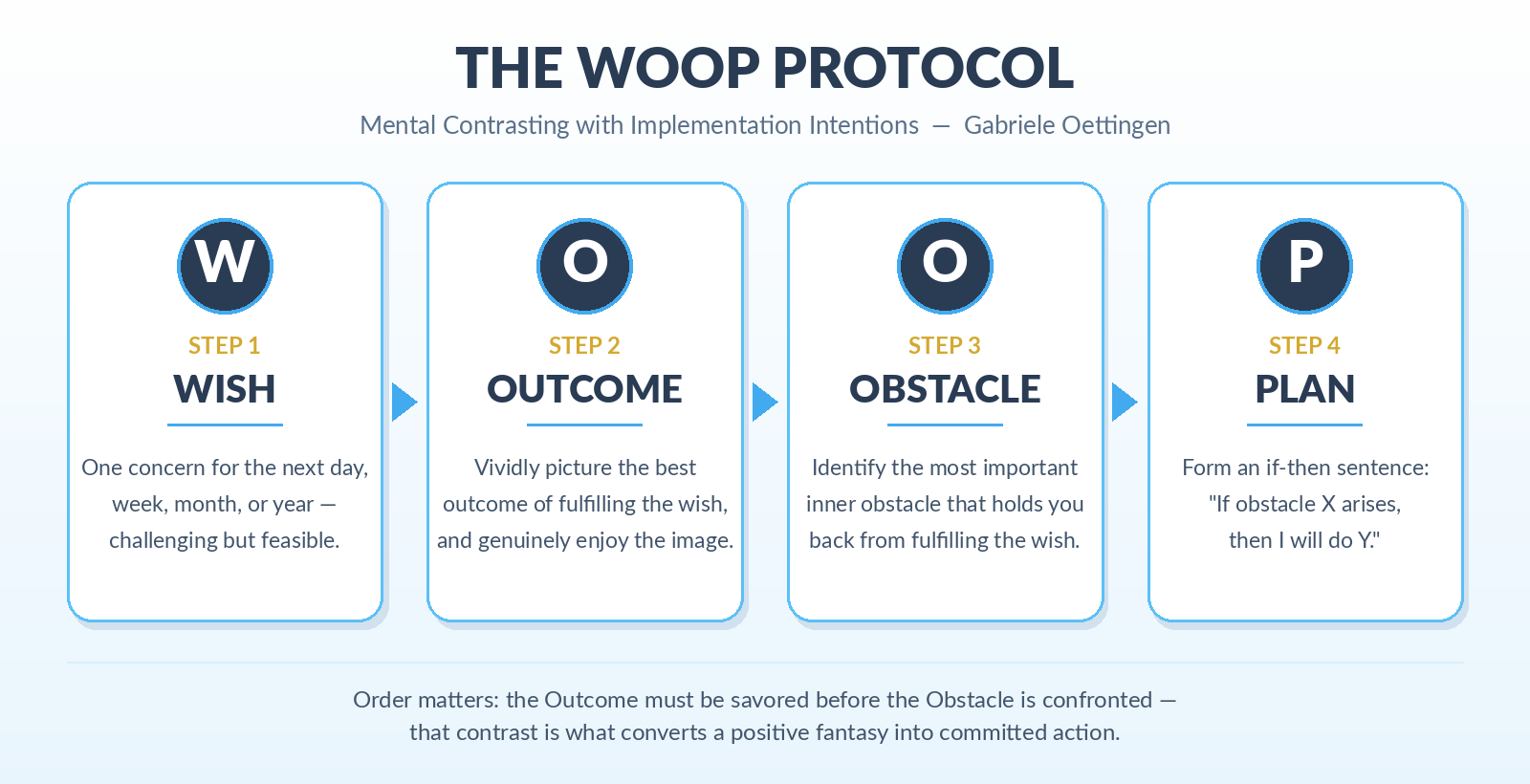
The protocol asks you, in sequence, to do four things. Name a Wish you have for the next day, week, month, or year that is challenging but feasible. Picture the best Outcome of fulfilling that wish, let yourself genuinely enjoy the image. Picture the most important inner Obstacle that holds you back from fulfilling the wish. Then formulate a Plan in the form of an "If [obstacle situation X arises], then I will [response Y]" sentence.
That description sounds tame enough to be mistaken for a generic goal-setting worksheet. The reason it isn’t is the order of operations and the specific psychological state each step puts the user into. Oettingen’s earliest finding, the one she has been quietly defending in Journal of Personality and Social Psychology for two decades, is that the picture-the-Outcome step on its own is dangerous. Done by itself, it produces what she calls "positive fantasies," and positive fantasies are surprisingly reliable predictors of not attaining the goal in question. The Obstacle step is not an inspirational warm-up; it’s a corrective measure that pulls the wishful state back toward usefulness.
That makes WOOP unusual among popular goal frameworks. SMART goals (Specific, Measurable, Achievable, Relevant, Time-bound; Doran 1981) ask you to specify the wish more precisely. Goal-Setting Theory (Locke & Latham 1990) asks you to make the wish difficult and specific. Implementation Intentions (Gollwitzer 1999) ask you to pre-wire the trigger-response pair. None of those frameworks treats the Outcome-fantasy step as inherently risky, and almost no commercial productivity or wellness product treats it that way either. WOOP is the rare protocol that says, in effect: the visualization step has a known failure mode, and we are going to insert a built-in counterweight before the visualization is allowed to do damage.
Mental Contrasting is the underlying mechanism. The full label in the literature is "mental contrasting of a desired future with present reality." Empirically, what the contrast does is force the brain to compute an implicit expectancy. "Can I actually do this, given what is currently in the way?", and to bind motivation to the answer of that computation. When expectancy of success is high, the contrast produces strong selective goal commitment: the person locks in, allocates effort, and pursues. When expectancy of success is low, the contrast produces disengagement: the person releases the wish without ever paying the cost of committed-but-failing pursuit. Both outcomes are adaptive. The non-adaptive outcome is the modal one in everyday life, committing to a wish in the absence of any expectancy check, then under-investing because the brain quietly knows the wish is implausible.
The Four Steps: Wish, Outcome, Obstacle, Plan
Wish: The Articulated Goal
The Wish step asks for one personal concern that is challenging but feasible. Oettingen’s instructions emphasize feasibility because Mental Contrasting only works in the right expectancy band. A wish you assess as completely impossible will not produce contrast-driven commitment under any condition; a wish you assess as guaranteed will not produce it either. The mechanism lives in the middle of the expectancy distribution, the band where outcome is genuinely uncertain and effort allocation actually matters.
The articulation also matters at the level of grain. "I want to be healthier" is a wish at the wrong grain, too abstract to interrogate. "I want to walk thirty minutes every day for the next month" sits at a grain where the obstacle question can return a real answer. The grain rule that emerges across Oettingen’s lab studies is roughly: name a concrete wish at a horizon between the next few hours and the next twelve weeks. Beyond twelve weeks, the contrast loses traction because too much intervening reality is unforeseeable.
Outcome: The Best Result of Fulfilling the Wish
The Outcome step asks for the most positive result of fulfilling the wish, and asks you to dwell on the resulting feeling for a few moments, even letting an image form. This is the psychological state most self-help protocols spend an entire chapter recommending and most productivity coaches build whole industries around. In Oettingen’s protocol, it lasts roughly thirty seconds, and its purpose is not to motivate. Its purpose is to anchor the desired future vividly enough that the next step, the obstacle, has something concrete to contrast against.
Treating the Outcome step as a thirty-second ingredient rather than the whole meal is the single most counter-cultural move in the entire WOOP protocol. The product manager who wants to keep users in flow will want to extend this step. The wellness app that monetizes on positive affect will want to extend this step. Every commercial pressure pulls toward letting the user marinate in the picture in the head. Resist. The picture is the bait the contrast needs; it is not the food.
Obstacle: The Inner Block That Holds You Back
The Obstacle step is where the protocol earns its differential against every other goal-setting framework. The instruction is precise: identify the most important inner obstacle, in yourself, that holds you back from fulfilling the wish. Not the boss who is unreasonable, not the spouse who is unsupportive, not the broken treadmill, those are real and they matter, but they are not what this step is about. The step asks: what is in you that gets in the way?
The reason for the inner-locus restriction is mechanical. Mental Contrasting works by triggering a self-relevant expectancy computation, and the brain runs that computation more cleanly against an internal candidate cause than against a fully external one. An obstacle phrased as "I keep telling myself I’ll start tomorrow" activates a contrast the brain can do something with. An obstacle phrased as "the gym is too far away" activates a search for an environmental fix that does not require Mental Contrasting at all.
This is also where the protocol can feel uncomfortable to run. Sitting with an honest inner obstacle for the thirty seconds the protocol asks for, laziness, fear of looking incompetent, the comfort of the current routine, resentment that the goal feels like someone else’s idea, is not a pleasant experience. The discomfort is the work. Skipping the discomfort is the failure mode. Products that try to make this step painless almost always remove the contrast and end up shipping a positive-fantasy generator with extra steps.
Plan: If-Then Implementation Intention
The Plan step takes the obstacle the user just named and converts it into a single sentence in the form "If [obstacle situation X arises], then I will [response Y]." This is Gollwitzer’s Implementation Intention construct grafted onto Oettingen’s contrasting protocol. The Plan is what gives WOOP its in-the-moment behavioral leverage.
The mechanism behind Implementation Intentions is well-established. The if-then format pre-loads a perceptual-motor link between a specified situational cue and a specified response, so that when the cue actually fires in the world, the response activates with reduced cognitive cost. Gollwitzer and Sheeran’s 2006 meta-analysis pooled 94 independent studies and found a medium-to-large overall effect (d ≈ 0.65) on goal attainment. The format works for behaviors as varied as taking a vitamin, voting, drinking water, and not eating chocolate after 7pm.
What WOOP adds to bare Implementation Intentions is energization. Implementation Intentions improve the situation-to-response link; they do not by themselves answer the prior question of whether the user has any motivational fuel to allocate to the goal in the first place. Mental Contrasting answers the prior question. Stack them and you get a protocol where the user has both the motivational commitment and the trigger-response pre-wiring to enact the commitment when the obstacle actually arises in real life. Koestner, Lekes, Powers, and Chicoine’s 2002 study (Journal of Personality and Social Psychology) found that goal pursuit was strongest precisely when the goal was self-concordant and backed by Implementation Intentions, with each component contributing measurable independent variance.
Mental Contrasting vs Indulging vs Dwelling
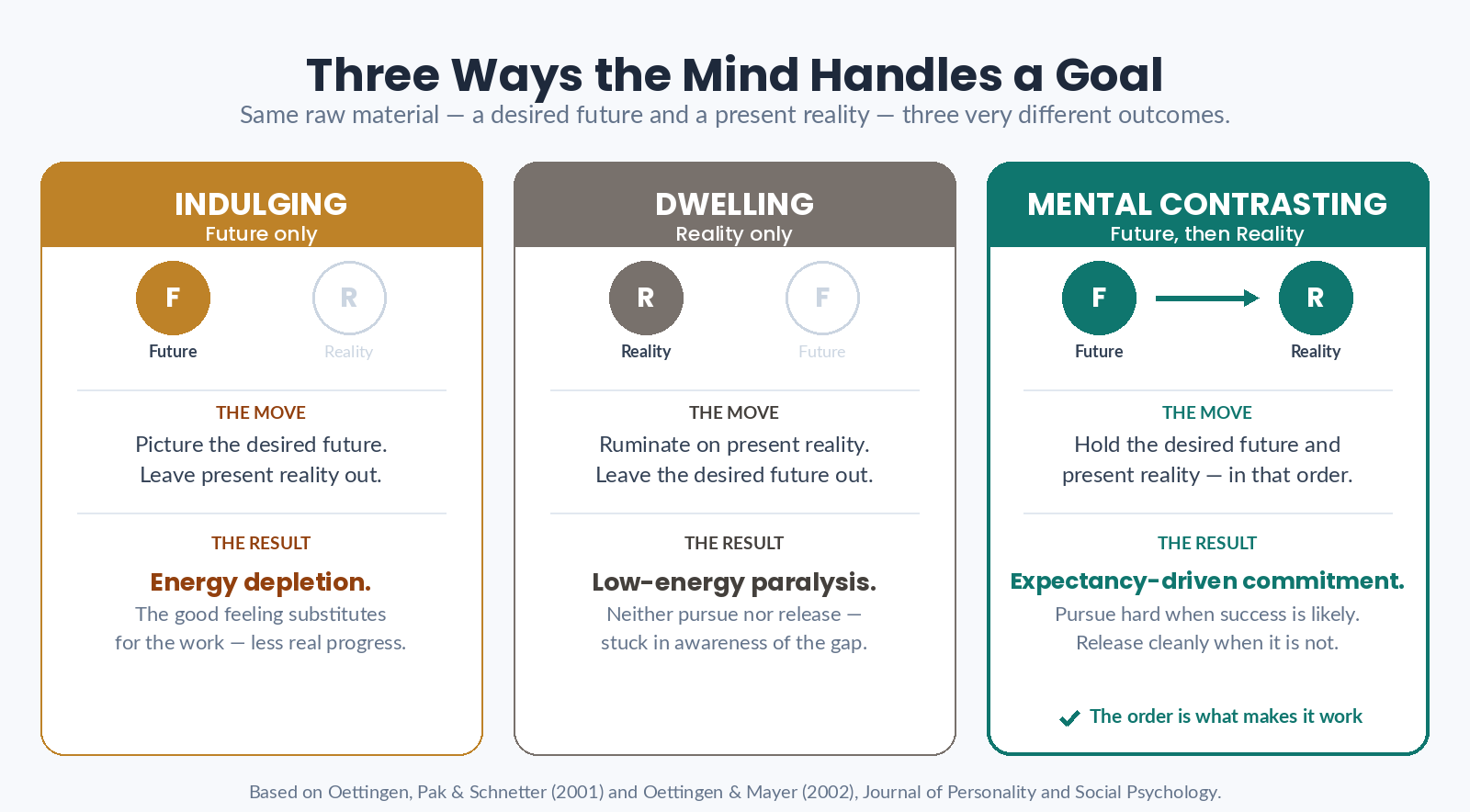
The reason Mental Contrasting works is that two of its near-neighbors actively don’t, and Oettingen’s lab has spent twenty years documenting exactly how they fail. The three states form a clean comparison set: Mental Contrasting, Indulging, and Dwelling. Each starts with the same raw material, a desired future and a present reality, and produces a different motivational signature.
Indulging: Future Only
Indulging is the pure-positive-fantasy state, picture the desired future, leave reality out of the picture entirely. This is the state most commercial "visualization" advice puts the user in, and the state most vision boards, manifestation rituals, and motivational keynote speakers recommend. The empirical record on Indulging is unambiguous and slightly disturbing.
Oettingen and Mayer’s 2002 paper in Journal of Personality and Social Psychology reported four studies in four populations. Obese women in a weight-loss program were asked to imagine themselves having lost the target weight; women whose pre-program positive fantasies were more vivid lost fewer pounds at one year and at two years (women who fantasized more lost roughly 24 pounds less at two years than women who fantasized less in their reported sample). MS patients fantasizing about recovery showed less actual recovery six months later. Hip-replacement patients with more positive fantasies showed slower rehab progress. College graduates with vivid job-success fantasies received fewer offers and lower starting salaries two years out. Across populations, the pattern repeated: more positive fantasy, less real-world progress.
The mechanism is energy depletion. The fantasy delivers some of the affective payoff the actual achievement was supposed to deliver, and the brain, which is a homeostatic system optimizing for state-change, has less reason to mobilize the energy required for the actual achievement. The pleasant feeling acts as a partial substitute for the work. Once you have already felt good about the imagined outcome, getting the real outcome stops being as urgent.
This finding is one of the most consequential and least-publicized results in motivation psychology. The entire popular self-help industry runs on positive visualization, and the laboratory data suggests positive visualization unsupported by contrast is, on average, mildly counter-productive. The corollary for product designers is direct: an onboarding flow that lets users fantasize about success without putting them in contact with the obstacle layer is, on the data, building a churn machine with optimistic packaging.
Dwelling: Reality Only
Dwelling is the symmetric error: ruminate on the present reality, leave the desired future out of the picture entirely. This is the state most self-criticism, most catastrophizing, and a lot of clinical depression operates in. Dwelling produces low-energy disengagement without the diagnostic benefit Mental Contrasting’s expectancy-driven release produces. The user winds up neither pursuing nor releasing, they sit in a paralytic awareness of the gap.
Dwelling is less prevalent in product design than Indulging, but it appears in specific failure modes. Apps that surface aggressive negative comparison data without paired positive-future articulation can push users into a dwelling state. Health apps that lead with risk statistics, finance apps that lead with debt growth, fitness apps that lead with deficit metrics, all of them risk this if they do not carefully pair the present-reality frame with a desired-future frame the user can mentally contrast against.
Mental Contrasting: Future Then Reality, In That Order
Mental Contrasting puts the desired future and the present reality together, in that order, and asks the brain to perform the contrast computation. The order matters. Oettingen, Pak, and Schnetter’s 2001 paper (Journal of Personality and Social Psychology 80) varied the sequence and found that future-then-reality produces selective expectancy-driven commitment, reality-then-future produces no contrast effect, and neither alone (Indulging or Dwelling) produces it.
The output of the contrast is bimodal. High expectancy: strong commitment, pursuit, persistence under setback. Low expectancy: clean disengagement, attention reallocation. The thing that does not happen under successful Mental Contrasting is the modal everyday outcome, half-committed pursuit of a wish the user implicitly knows is unlikely to succeed. That modal outcome is where most productivity goals, most fitness goals, most language-learning goals, and most product engagement curves live. WOOP’s design discipline is to refuse to ship the user into that zone.
What Oettingen Got Right
Three durable contributions of the Mental Contrasting program survive every methodological critique I have seen in the literature, and each one matters for behavioral design.
The first is the empirical demonstration that positive fantasy alone is not motivationally neutral, it is mildly demotivating. The replication count is impressive: four populations in the 2002 paper, follow-ups in academic achievement (Gollwitzer, Oettingen, Kirby, Duckworth, & Mayer 2011), interpersonal goals (Oettingen, Stephens, Mayer, & Brinkmann 2010), and dieting self-regulation in non-clinical samples (Johannessen, Oettingen, & Mayer 2012). The effect sizes are not enormous, but the sign is reliable across domains. Anyone designing motivation systems who has been telling users to "visualize the win" without a contrast step has been, on average, slightly hurting their long-run engagement curves. Oettingen’s work supplies the empirical backing for the corrective.
The second is the formalization of Mental Contrasting as an expectancy-dependent rather than energy-dependent mechanism. Earlier goal-setting work (Locke & Latham; Bandura’s self-efficacy program) had recognized that expectancy mattered for goal commitment. Oettingen’s contribution was operationalizing the procedure that converts an unexamined wish into an expectancy-bound commitment, in real time, by a non-clinical user, in under five minutes. That packaging is what turned a laboratory phenomenon into a deployable behavioral protocol. The 2014 book and the WOOP my Life app are downstream of that move.
The third is the Implementation Intention integration. Oettingen and Gollwitzer have collaborated for decades, and their joint papers (Oettingen & Gollwitzer 2010; Oettingen, Wittchen & Gollwitzer 2013) made the case that Mental Contrasting and Implementation Intentions are complementary rather than competitive. Stoeber et al. and others have replicated the additive pattern. The cleanest version of the result is: contrasting alone improves outcomes for high-expectancy goals; if-then planning alone improves outcomes for any goal where situational cues are predictable; the combination outperforms either component on the kind of goal most users actually carry, moderately important, moderately difficult, with predictable but interruptible obstacle sequences. The integration paper Oettingen co-authored with Cross is not a marketing convenience; it is the design move that made the laboratory protocol shippable.
Where WOOP Falls Apart
Three failure modes of the protocol have been documented well enough to take seriously. None of them invalidate the construct. All of them constrain how a designer should ship it.
Effect Sizes Are Modest, Not Magic
The headline replications produce statistically reliable but modest effect sizes. Cross-domain meta-analytic work (Cross & Sheffield 2019 on health-behavior change; Wang, Wang & Gai 2021 on overall goal attainment) puts Mental Contrasting interventions in the d ≈ 0.20-0.35 band on most outcomes. Implementation Intentions add a separate, larger boost (d ≈ 0.60-0.65 in the Gollwitzer & Sheeran 2006 meta), and the WOOP package combines both, but the headline claim is reliability across domains rather than transformative magnitude in any one.
This matters for product design because the effect-size band is small enough to vanish under noise from other design choices. A WOOP intervention dropped onto a poorly designed onboarding flow will not rescue the flow. A WOOP intervention dropped onto a well-designed flow will not transform retention. The protocol earns its keep as a precision tool, it closes a specific gap that most goal-articulation layers leak through, not as a stand-alone motivation generator.
The Effect Depends on Self-Insight About the Inner Obstacle
The Obstacle step assumes the user can accurately introspect on what holds them back. Decades of work on the limits of introspection (Nisbett & Wilson 1977, "Telling more than we can know"; the broader confabulation literature) suggest this assumption is on uneven ground. Users frequently report obstacles that turn out, on later behavioral measurement, to be confabulated, plausible-sounding stories that do not actually predict where the goal will fail.
The applied implication is that WOOP’s effect should be larger for users who already have reasonable self-insight about their failure modes (typically: older users, more reflective users, users who have failed at the goal before in ways they can name) and smaller for users who are running a goal for the first time in a domain they have not yet failed in. The protocol does not collapse for low-insight users; it just does less work. Coupling WOOP with iterative refinement, re-running the protocol after the first real-world setback, when the user has new behavioral data on what actually got in the way, is one design move that mitigates this.
The Inner-Locus Framing Can Pathologize Structural Barriers
The Obstacle step’s instruction to identify an inner obstacle is mechanically motivated. Mental Contrasting works through self-relevant expectancy computation, but in applied contexts it can shade into a frame that makes external barriers invisible. A laid-off worker pursuing a job-search wish whose obstacle is the labor market should not be told their main obstacle is in their head. A graduate student whose obstacle is an exploitative advisor should not be told the same. WOOP-the-protocol is supposed to be deployed alongside, not instead of, an honest accounting of the structural conditions the wish lives inside.
Practitioners adapting WOOP to therapy contexts (e.g., Stadler, Oettingen & Gollwitzer 2010 on dietary intake; the WOOP-for-Adolescent-Stress trials) have generally handled this by running an explicit external-obstacle inventory before the inner-obstacle step. That correction is not in the consumer packaging of the protocol, but it should be present any time WOOP is deployed inside a product where structural inequities affect goal pursuit, which is most products, most of the time. A weight-loss app deployed in a food desert needs a different obstacle layer than one deployed in a wealthy suburb. A career-coaching tool deployed during a recession needs a different obstacle layer than one deployed during an expansion. Pretending the inner obstacle is the only obstacle is the most common applied misuse of the protocol I have seen.
What’s Really Happening Inside the Brain
Mental Contrasting recruits a specific configuration of executive networks, and the imaging work clarifies why the order-of-operations matters and why the contrast cannot be skipped.
Oettingen, Mayer, Sevincer, Stephens, Pak, and Hagenah’s 2009 paper in Personality and Social Psychology Bulletin reported the first behavioral-and-physiological signature of Mental Contrasting: blood pressure as a marker of energization, where contrasting users showed the expected expectancy-dependent energization pattern (high-expectancy contrast users mobilized; low-expectancy contrast users disengaged) while indulging and dwelling users did not. The cardiovascular signature is the cleanest available marker of the mechanism in non-imaging settings.
The fMRI work that came later (Achtziger, Fehr, Oettingen, Gollwitzer & Rockstroh 2009; later unpublished and conference-reported follow-ups by Oettingen’s group) implicates a network that includes the dorsolateral prefrontal cortex (DLPFC) for goal representation and prospective planning, the medial prefrontal cortex (mPFC) for self-relevant evaluation, and the anterior cingulate cortex (ACC) for the conflict-monitoring computation that the future-versus-reality contrast requires. The default-mode network appears to be involved in the fantasy-generation step (consistent with the broader prospection literature; Schacter, Addis & Buckner 2007), and the down-regulation of default-mode activity during the contrast step appears to be part of what differentiates contrasting from indulging.
The neuroscience map is consistent with the behavioral pattern. Indulging keeps the user in default-mode prospection, which produces affective satisfaction without engaging the executive control networks required for actual pursuit. Mental Contrasting forces a switch from default-mode prospection to dorsal-attention executive control, and the switch is what makes the energization expectancy-dependent rather than fantasy-driven. This is also why the contrast feels effortful, it is recruiting the network that motor planning, working memory, and reasoning all also draw from.
For Implementation Intentions, the imaging picture is even clearer. Implementation Intentions appear to delegate behavioral control from the prefrontal "intentional" system to the situational-cue-driven "automatic" system, with reduced reliance on prefrontal resources at the moment of execution (Gollwitzer 1999; subsequent imaging work by Brandstätter, Lengfelder & Gollwitzer; later work by Achtziger and colleagues). This is why if-then plans work even under cognitive load, fatigue, or intoxication, the behavior has been pre-routed off the costly top-down circuit. The combination. Mental Contrasting to engage the executive network for selective commitment, Implementation Intentions to delegate the execution off the executive network at the moment of action, is the mechanism behind WOOP’s apparent ability to hold up across diverse populations and conditions.
WOOP vs Other Goal-Pursuit Models
WOOP vs SMART Goals
SMART goals (Specific, Measurable, Achievable, Relevant, Time-bound) is the dominant goal-articulation framework in management consulting and corporate training. It is a useful articulation hygiene checklist and an empirically poor motivation protocol. SMART helps the user state the wish at the right grain (the W in WOOP). It says nothing about the Outcome step, nothing about the Obstacle step, and nothing about the Plan step. A SMART goal that lives in a user’s calendar without an obstacle inventory or an if-then plan is, behaviorally, an articulated wish. The articulation is necessary, but it is not the work.
The right relationship between SMART and WOOP is layered. Use SMART to write the W. Then run the OOP. SMART without OOP is naked articulation. WOOP without SMART tends to operate at vaguer wish grains than necessary.
WOOP vs Goal-Setting Theory (Locke & Latham)
Locke and Latham’s program (formalized in A Theory of Goal Setting and Task Performance, 1990) is the most cited applied motivation framework of the twentieth century. The headline finding, that specific, difficult goals produce higher performance than vague or easy goals, is one of the most-replicated effects in industrial-organizational psychology. The mechanism is direction, effort, persistence, and strategy development (the Locke-Latham "four mechanisms").
WOOP and Goal-Setting Theory address different layers. Goal-Setting Theory tells you the wish should be specific and difficult and that commitment is moderated by self-efficacy and feedback. WOOP gives you the procedure to convert a candidate wish into expectancy-bound commitment in the first place, plus the if-then plan to execute it under interruption. They stack cleanly. The Goal-Setting commitment moderator (self-efficacy) is essentially the expectancy term Mental Contrasting is computing. Goal-Setting Theory tells you which wishes are worth holding; WOOP tells you how to hold them.
WOOP vs Self-Determination Theory
Self-Determination Theory (Ryan & Deci 2000; the parent framework behind the Self-Concordance Model) operates one layer up from WOOP. SDT asks which wishes are worth pursuing, the autonomous, identified, intrinsically-regulated ones, and predicts well-being increase will follow autonomous pursuit. WOOP asks how any given wish, autonomous or not, gets converted into commitment-plus-execution.
The right stack puts SDT upstream of WOOP. Use SDT (or its goal-level cousin, the Self-Concordance Model) to filter for wishes that have a chance of producing well-being increase if attained. Then run WOOP on the surviving wishes. WOOP-without-SDT can convert low-concordance external wishes into committed pursuit, which is a different, and worse, failure mode than the positive-fantasy failure WOOP corrects for. The two protocols are not redundant; they answer adjacent questions.
WOOP vs Hope Theory
Hope Theory (Snyder 1991) decomposes hope into pathways thinking (route generation) and agency thinking (motivational fuel for the route). The decomposition is a useful diagnostic vocabulary. Where WOOP differs is in being a procedure rather than a construct. Hope Theory tells you what cognitive ingredients goal pursuit requires; WOOP gives you a four-step protocol that, run, generates those ingredients in real time. Hope Theory’s pathways component maps closely onto WOOP’s Plan step; the agency component maps loosely onto the energization that successful Mental Contrasting produces; the two frameworks diagnose and prescribe at different levels of the motivation stack.
WOOP in the Real World
Healthcare and Behavior Change
The most-cited applied trials of WOOP and Mental Contrasting come from the health-behavior literature. Stadler, Oettingen, and Gollwitzer’s 2010 trial on dietary intake (American Journal of Preventive Medicine) trained women to apply Mental Contrasting with Implementation Intentions to fruit-and-vegetable consumption; intervention participants doubled their intake versus the control group two years later. Christiansen, Oettingen, Dahme, and Klinger’s 2010 chronic-back-pain trial reported improved physical mobility at three months post-intervention. The larger Cross and Sheffield 2019 review of mental-contrasting interventions across health behaviors recovered consistently positive but heterogeneous effects.
The applied health pattern is clear: WOOP works best for behavior change where the obstacle is a recurring, predictable inner state (urge, temptation, fatigue, anxiety) that the user can identify after one or two pursuit attempts. It works less well for behaviors whose obstacles are highly novel each time or for goals where the user has not yet failed enough to know the obstacle.
Education
The education trials follow a similar pattern. Duckworth, Grant, Loew, Oettingen, and Gollwitzer’s 2011 study with high-school students (Educational Psychology) found Mental Contrasting with Implementation Intentions improved completion of PSAT practice questions. Gollwitzer, Oettingen, Kirby, Duckworth, and Mayer’s 2011 trial with schoolchildren, including a low-income US middle-school sample, showed sizable improvements in foreign-language vocabulary learning. Saddawi-Konefka, Baker, Guarino, Burns, Oettingen, Gollwitzer, and Charnin’s 2017 trial with anesthesia residents showed improvements in studying behaviors.
The education pattern reinforces the general one. WOOP is most useful at the level of weekly study commitments, exam-week study plans, and concrete behavior chains (start studying within 10 minutes of arriving home; if I open social media instead, I will close the tab and open the textbook). It is less useful at the level of vague aspirations (do better in school) or career-grade goals (become a doctor) where the time horizon defeats the contrast mechanism.
Workplace and Career
Workplace applications include Oettingen, Stephens, Mayer, and Brinkmann’s 2010 study on interpersonal goals at work and Sheeran, Webb, and Gollwitzer’s broader implementation-intention work in organizational settings. Bono and Judge’s 2003 paper on transformational leadership, connected to the Self-Concordance literature, provides indirect evidence that the goal-articulation layer matters at scale: leaders who help subordinates articulate self-concordant goals see better effort and well-being outcomes, and the WOOP procedure is one of the few practical tools available for running a goal-articulation conversation in under fifteen minutes.
The applied workplace pattern: WOOP works for performance reviews where the manager is willing to spend time on Obstacle and Plan rather than just Wish and Outcome (which is the natural slope of every annual review template). It does not survive contact with a corporate goal-cascade process that mandates Outcome-only articulation across every level.
Consumer Apps and Product Design
The WOOP my Life app, developed by Oettingen’s group, runs the protocol as a guided four-screen experience and has been studied in field trials (Schwörer, Krott & Oettingen 2020). Outside the official app, the protocol shows up in onboarding flows, habit-tracking products, and journaling apps under different names. The design pattern that survives translation is the same: do not let the user articulate a wish without a paired obstacle inventory; do not let the user save a goal without an if-then plan; surface the user’s stated obstacle in the moment the situation arises (notification: "You said this would be the moment to do X, what’s the if-then?").
The pattern that does not survive translation is the consumer wellness app that imports "visualization" without "contrast." Those apps run on Indulging, and Oettingen’s twenty years of replications predict, accurately, that they produce affective satisfaction without behavior change. The category’s retention numbers are consistent with the prediction.
The Elephant in the Room: When Obstacles Are Not Inside You
The single most important political question about WOOP is the one the protocol does not raise. The Obstacle step asks for an inner obstacle. Most of the population, in most of the world, has at least some real outer obstacles. A protocol that systematically directs attention away from outer obstacles can become an instrument of pretending the world is just.
The literature acknowledges the problem in places. Oettingen and her collaborators have repeatedly noted that Mental Contrasting works best for goals that are challenging-but-feasible, that is, for goals whose outer obstacles are not absolutely binding. The implicit boundary condition is that the user has already done the upstream work of distinguishing wishes that are blocked by inner factors (procrastination, fear, indulgence) from wishes that are blocked by outer factors (the labor market, structural racism, an exploitative employer, an under-resourced school). When that upstream distinction is honest, the protocol’s inner-locus framing is fine. When it is not honest, the protocol can become a sophisticated way of telling people their problems are their own fault.
This is not a hypothetical concern. The applied positive-psychology literature has a long history of this failure mode. Held 2002’s "Tyranny of the Positive Attitude," Ehrenreich’s Bright-Sided 2009 critique, the broader analysis of "wellness imperialism", and any protocol that asks users to look inside for the cause of their stuck-ness sits in the danger zone unless paired with explicit external-obstacle work.
The design move I have come to recommend, after watching teams ship WOOP into apps for users with non-trivial structural barriers, is a two-step Obstacle inventory. Pass one: name every outer obstacle (cost, access, schedule, social context, infrastructure). Decide which ones can be reduced and which ones must be designed around. Pass two: with the outer obstacles bracketed, run the WOOP Obstacle step on the residual inner obstacles. The protocol works on the residual; it does not work as a substitute for the upstream honesty pass. Skipping pass one is the most common applied misuse, and it produces both worse behavioral outcomes and a politically off-key product surface.
How to Apply WOOP with the Octalysis Framework
WOOP maps onto the Octalysis Framework with unusual cleanness because each of its four steps recruits a different Core Drive at the right moment in the goal-pursuit arc. Most goal-setting tools either over-recruit one Core Drive (typically Core Drive 2: Development & Accomplishment, via progress visualization) or under-recruit Core Drive 8: Loss & Avoidance (because it feels Black-Hat to designers who haven’t internalized the Octalysis distinction). WOOP routes through four Core Drives in sequence and exits with all four bound to a single behavioral target.

Wish & Outcome: Core Drive 1 (Epic Meaning & Calling) and Core Drive 2 (Development & Accomplishment)
The Wish step articulates the goal. The Outcome step generates the desired-future image. Together they activate Core Drive 1 (Epic Meaning & Calling), the user names a goal that connects to a larger sense of who they are or want to be, and Core Drive 2 (Development & Accomplishment) — the goal is framed as a state-change to be earned. Game Technique #67 (Calling) is the canonical CD1 anchor; Game Technique #15 (Goal Setting) is the canonical CD2 anchor. Most goal-articulation tools stop here. WOOP’s distinction is that it doesn’t.
Obstacle: Core Drive 8 (Loss & Avoidance) at the Right Place
The Obstacle step deliberately recruits Core Drive 8 (Loss & Avoidance) — the user pictures the inner state that has cost them this goal before, and the affect that picture generates is precisely the loss-avoidance signal that keeps the wish from being treated as costless fantasy. This is the use of CD8 most designers under-deploy because they have absorbed the rule "Black Hat is bad" without learning the corollary "CD8 in the diagnostic position is what makes White-Hat motivation costable." WOOP places CD8 in the right position: not as the engine of pursuit, but as the diagnostic that converts wish into commitment.
The reason this matters operationally is that products that under-deploy CD8 in the diagnostic position end up over-deploying it in the engine position later, when retention starts to slip and the team reaches for streak shame, loss-frame notifications, and scarcity timers. A WOOP-aware design uses CD8 once, at the goal-articulation layer, to make the wish honest. The downstream engagement layer can then run on White-Hat Core Drives without needing CD8 to be the load-bearing wall.
Plan: Core Drive 4 (Ownership & Possession) of the Trigger Surface
The Plan step converts the obstacle into an if-then sentence the user wrote themselves. The user owns the trigger and the response. This is Core Drive 4 (Ownership & Possession) at the trigger surface. The strongest CD4 Game Techniques here are #1 (Avatars) — the user as the agent in their own if-then sentence — and #13 (Step-by-Step Tutorial) tree branches the user has chosen rather than been served. The contrast against default goal-tracking apps is sharp: most apps own the trigger (the notification schedule, the streak threshold) and assign the user the response. WOOP-aware design inverts this — the user owns both halves of the if-then, and the product surfaces the user’s own sentence at the moment the trigger fires.
Want to know which Core Drives your goal-setting flow actually fires, and where user wishes stall before becoming plans? Run your product through my free Octalysis Tool.
Game-Technique Levers
The Octalysis Game Techniques most useful at each step:
- Wish: Calling (#67), Narrative (#10), Heroes (#82) — anchor the wish at identity grain.
- Outcome: Goal Setting (#15), Achievement Symbols (#3) — but cap exposure to thirty seconds; do not let CD2 anchors expand the Outcome step into a fantasy resort.
- Obstacle: Real-Time Feedback (#57) on past failure data, Fear of Loss (#23) at the diagnostic dose, Anchored Juxtaposition (#22 in some indices) — surface the user’s own past obstacle data so the obstacle name is grounded.
- Plan: Avatars (#1), Step-by-Step Tutorial (#13) trees, Plant Picker (#44) for if-then customization, Implementation Trees (the broader CD4 architecture).
The diagnostic upside of routing through these specific Game Techniques is that the team designing the goal-articulation surface stops reaching for the same five techniques (progress bars, streaks, badges, point counters, leaderboards) that already populate every competitor product. WOOP forces a different palette because the four Core Drives it recruits are not the four most product-PMs reach for.
Practical Steps: Designing for Mental Contrasting
If you are deploying WOOP in a product, a coaching practice, or your own life, the following sequence packages the lab-and-field literature into a runnable protocol. None of these steps is original to me; all of them survive across the trials.
- Cap the wish horizon. Twelve weeks is the upper bound for which the contrast mechanism reliably produces commitment. Beyond that, the user is running an aspiration, not a goal. Aspirations need a different protocol (typically: decompose into three-month wishes, run WOOP on the next one, revisit on cadence).
- Run the outer-obstacle inventory before the inner one. Name every external barrier the user can identify. Decide which can be reduced via design and which must be lived with. Bracket those before running the WOOP Obstacle step. Skipping this is the most common misuse of the protocol in apps deployed to non-WEIRD (Western, Educated, Industrialized, Rich, Democratic) or structurally-disadvantaged populations.
- Time-box the Outcome step at thirty to sixty seconds. The outcome image is bait for the contrast, not the meal. Products that let users marinate in the outcome for minutes are quietly running an Indulging session and degrading the very behavior they think they’re producing.
- Force a single inner obstacle. Users will want to list five. The protocol works on the most consequential one. Five obstacles named together produces no contrast effect because no single contrast computation runs.
- Make the if-then plan a complete sentence. Both clauses must specify a concrete situational cue and a concrete behavioral response. "If I get tired, I will rest" is not an if-then — "rest" is not a specified response. "If I notice myself opening X (formerly Twitter) at 9pm, I will close the tab and open my book to the bookmark" is.
- Surface the user’s sentence at the moment the trigger fires. The single highest-impact design move available to a product implementing WOOP is the in-the-moment surfacing of the user’s own if-then sentence. The user wrote "if I get the urge to skip the gym, I will put on my shoes anyway." The product, at 6:55 PM on a gym day, surfaces that exact sentence. This is the moment the protocol earns its keep.
- Re-run on cadence. Obstacles change. Self-insight improves with iterations. A WOOP intervention that fires once at onboarding and never again is leaving most of its potential on the table. Cadenced re-runs (weekly for short-horizon wishes, monthly for longer-horizon ones) compound the effect.
WOOP Was the Beginning, Not the End
Mental Contrasting was the laboratory mechanism. Implementation Intentions were the laboratory mechanism. WOOP was the deployable packaging. None of those is the end state of goal-pursuit design. The next-generation work in Oettingen’s lab and adjacent groups is already moving past the four-step protocol toward continuous interventions that monitor goal pursuit in real time and re-run the contrast cycle when behavioral data signals it needs running.
The frontier as of the mid-2020s includes adaptive Implementation Intentions (Bélanger-Gravel et al.) that update the if-then specification when the original cue stops firing, micro-affirmation work that pairs values affirmation with the obstacle step, and integrative protocols that combine WOOP with the Self-Concordance Model‘s autonomy-screen so that only autonomously-regulated wishes ever reach the WOOP layer. None of these has the replication record the underlying components do, but the design direction is clear: the protocol should know more about the user’s pursuit history than the user can explicitly recall, and the contrast it runs should be informed by the data the product has been collecting all along.
The applied implication for designers is that WOOP is the floor, not the ceiling. Ship the protocol; treat the data the protocol generates as fuel for the next contrast; iterate. Yu-kai’s Octalysis design practice has, for fifteen years, treated motivation systems as living organisms rather than fixed architectures. WOOP fits that frame. It is a protocol that improves the goal-articulation layer of a product within a single user session, and it improves more across sessions if the product is willing to keep paying attention.
Frequently Asked Questions
What does WOOP stand for?
WOOP stands for Wish, Outcome, Obstacle, Plan. It is a four-step self-regulation protocol developed by Gabriele Oettingen, professor of psychology at NYU and the University of Hamburg. The protocol combines two distinct laboratory programs, Mental Contrasting (Oettingen’s own work) and Implementation Intentions (Peter Gollwitzer’s work), into a runnable five-minute exercise published in Oettingen’s 2014 book Rethinking Positive Thinking.
Is WOOP the same as Mental Contrasting?
WOOP is Mental Contrasting plus a fourth Plan step that adds an Implementation Intention. Mental Contrasting alone is the Wish-Outcome-Obstacle sequence. Adding the if-then Plan converts the protocol from a goal-commitment tool into a goal-commitment-plus-execution tool. The Gollwitzer-and-Sheeran 2006 meta-analysis estimates Implementation Intentions add roughly d ≈ 0.65 on goal attainment relative to baseline goal-setting.
Why does positive thinking sometimes hurt performance?
Oettingen and Mayer’s 2002 paper in Journal of Personality and Social Psychology reported four samples (weight-loss patients, MS patients, hip-replacement patients, and college graduates) in which more vivid pre-pursuit positive fantasies were associated with worse real-world outcomes (less weight lost, slower recovery, fewer job offers, lower starting salary). The proposed mechanism is energy depletion: the fantasy delivers some of the affective payoff the actual achievement was supposed to deliver, and the brain reduces the motivational fuel allocated to the achievement. The corrective is Mental Contrasting, which pairs the fantasy with a concrete obstacle so the contrast forces an expectancy computation rather than letting the fantasy run as standalone affect.
What’s the difference between Mental Contrasting, Indulging, and Dwelling?
Mental Contrasting puts the desired future in contact with present reality, in that order, and produces expectancy-dependent commitment (high-expectancy users mobilize, low-expectancy users disengage cleanly). Indulging is fantasy without reality — the user marinates in the desired outcome and produces affect without commitment. Dwelling is reality without future — the user ruminates on the present obstacle without articulated wish and produces low-energy paralysis. Only Mental Contrasting produces selective goal commitment; the other two do not.
How long does a WOOP session take?
Five to ten minutes. The Wish step is roughly thirty seconds; the Outcome step roughly thirty to sixty seconds; the Obstacle step roughly thirty to sixty seconds; the Plan step roughly one to two minutes. The protocol is deliberately short so it can run inside a real-life moment of decision rather than as a journaling exercise.
Does WOOP work for long-term goals?
Less reliably than for short-to-medium-horizon goals. The contrast mechanism depends on the user generating a vivid Outcome image and a credible Obstacle, both of which lose definition past a twelve-week horizon. The applied recommendation is to decompose long-term aspirations into three-month wishes, run WOOP on the nearest one, and re-run on cadence as the goal evolves.
Can WOOP be used in therapy or healthcare settings?
Yes, with care. Trials by Stadler, Oettingen, and Gollwitzer (2010) on dietary intake, Christiansen et al. (2010) on chronic back pain, and Saddawi-Konefka et al. (2017) on anesthesia residents have reported positive applied effects. Therapeutic adaptations typically run an explicit external-obstacle inventory before the inner-obstacle step, to avoid the inner-locus framing pathologizing structural barriers.
Why does the order of steps matter?
Oettingen, Pak, and Schnetter’s 2001 paper in Journal of Personality and Social Psychology directly tested order effects. Future-then-reality produces the expectancy-dependent commitment signature; reality-then-future does not produce it. The order maps onto the underlying brain-network sequence: default-mode prospection generates the desired-future image, then dorsal-attention executive control performs the contrast against present reality. Reversing the order does not fire the same circuit.
How does WOOP compare to SMART goals?
SMART (Specific, Measurable, Achievable, Relevant, Time-bound) is an articulation hygiene checklist for the Wish step. It tells you how to write a goal, not how to convert a goal into commitment or execution. WOOP picks up where SMART leaves off — Mental Contrasting produces the commitment, Implementation Intentions produce the execution. Use SMART to write the W; run WOOP on the result.
What are the limitations of WOOP?
Three documented limits. Effect sizes are reliable but modest (typically d ≈ 0.20-0.35 for Mental Contrasting alone, larger when combined with Implementation Intentions). The Obstacle step depends on user self-insight, which is unevenly distributed and improves with iteration. The inner-locus framing can pathologize structural barriers if deployed without an external-obstacle inventory upstream. Used with awareness of all three, the protocol earns its keep as a precision tool for the goal-articulation layer.
References
- Oettingen, G. (1996). Positive fantasy and motivation. In P. M. Gollwitzer & J. A. Bargh (Eds.), The psychology of action: Linking cognition and motivation to behavior (pp. 236-259). Guilford Press.
- Oettingen, G. (2000). Expectancy effects on behavior depend on self-regulatory thought. Social Cognition, 18(2), 101-129.
- Oettingen, G., Pak, H., & Schnetter, K. (2001). Self-regulation of goal-setting: Turning free fantasies about the future into binding goals. Journal of Personality and Social Psychology, 80(5), 736-753.
- Oettingen, G., & Mayer, D. (2002). The motivating function of thinking about the future: Expectations versus fantasies. Journal of Personality and Social Psychology, 83(5), 1198-1212.
- Oettingen, G., Mayer, D., Sevincer, A. T., Stephens, E. J., Pak, H., & Hagenah, M. (2009). Mental contrasting and goal commitment: The mediating role of energization. Personality and Social Psychology Bulletin, 35(5), 608-622.
- Oettingen, G., & Gollwitzer, P. M. (2010). Strategies of setting and implementing goals: Mental contrasting and implementation intentions. In J. E. Maddux & J. P. Tangney (Eds.), Social psychological foundations of clinical psychology (pp. 114-135). Guilford Press.
- Oettingen, G. (2012). Future thought and behaviour change. European Review of Social Psychology, 23(1), 1-63.
- Oettingen, G. (2014). Rethinking positive thinking: Inside the new science of motivation. Current/Penguin.
- Gollwitzer, P. M. (1999). Implementation intentions: Strong effects of simple plans. American Psychologist, 54(7), 493-503.
- Gollwitzer, P. M., & Sheeran, P. (2006). Implementation intentions and goal achievement: A meta-analysis of effects and processes. Advances in Experimental Social Psychology, 38, 69-119.
- Stadler, G., Oettingen, G., & Gollwitzer, P. M. (2010). Intervention effects of information and self-regulation on eating fruits and vegetables over two years. Health Psychology, 29(3), 274-283.
- Duckworth, A. L., Grant, H., Loew, B., Oettingen, G., & Gollwitzer, P. M. (2011). Self-regulation strategies improve self-discipline in adolescents: Benefits of mental contrasting and implementation intentions. Educational Psychology, 31(1), 17-26.
- Cross, A., & Sheffield, D. (2019). Mental contrasting for health behaviour change: A systematic review and meta-analysis of effects and moderator variables. Health Psychology Review, 13(2), 209-225.
- Saddawi-Konefka, D., Baker, K., Guarino, A., Burns, S. M., Oettingen, G., Gollwitzer, P. M., & Charnin, J. E. (2017). Changing resident physician studying behaviors: A randomized, comparative-effectiveness trial of goal-setting versus use of WOOP. Journal of Graduate Medical Education, 9(4), 451-457.
- Locke, E. A., & Latham, G. P. (1990). A theory of goal setting and task performance. Prentice-Hall.
Related Reading
- Self-Determination Theory — the parent autonomy-support framework that filters which wishes are worth running WOOP on.
- Self-Concordance Model — Sheldon & Elliot’s goal-level extension of SDT; pairs upstream of WOOP for autonomy screening.
- Hope Theory — Snyder’s Pathways + Agency decomposition; diagnostic vocabulary for what WOOP procedurally generates.
- Expectancy Theory — Vroom’s Effort × Performance × Valence equation; the formal antecedent to expectancy-dependent commitment.
- The Octalysis Framework — the eight Core Drives that structure how WOOP’s four steps map onto product mechanics.
- Actionable Gamification & 10,000 Hours of Play — Yu-kai Chou’s books, where the Octalysis Core Drives behind WOOP’s motivation layer are explained in full.