
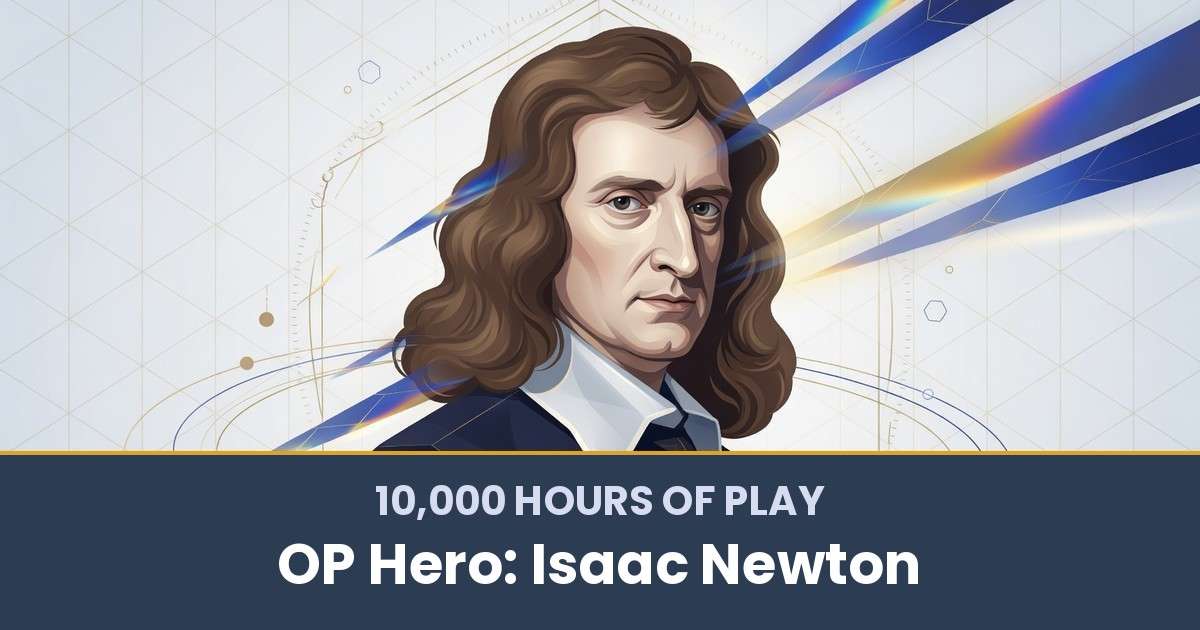


Most people, when they think of Isaac Newton, picture a wig, a Latin tome, and an apple. They miss the actual character build underneath.
The truth is wilder. A young farm-boy from Lincolnshire gets sent home from Cambridge during a plague, stays alone in a country house for roughly two years, and in that window invents the math of calculus, decomposes white light into the visible spectrum, and works out the gravity equations that explain why the apple falls AND why the moon doesn’t. Then he comes back to academia, fights priority duels for thirty years, has a complete mental breakdown at 50, and somehow respawns as Master of the Royal Mint running England’s monetary policy.
That’s not one career arc. That’s a player on his sixth playthrough.
If you read Newton’s life through the 10,000 Hours of Play framework — the six-step model I use to audit any legendary life as a game build — you stop seeing a saintly genius and start seeing a real character sheet. Attributes that were freakishly tuned at birth. A Class that swapped twice. A short list of Skills he ground until they were lethal. Allies who, without them, would have left half the inventions in a desk drawer. And one collapse so total that the comeback is the most instructive part of the whole run.
⚡ Speed Run Notes
- Newton’s “game” was simple and obsessive: extract universal rules from messy reality, in physics, optics, prophecy, and even alchemy.
- His ATTRIBUTES were freakishly tuned at birth — extreme inwardness, geometric imagination, and a willingness to overturn any authority that disagreed with his experiments.
- His real ROLE shift was Reclusive Innovator → Public Scientist → Master of the Mint. Most people remember the middle one and forget how unusual the third is.
- Six canon Skills carried him: Lich Grind, Cognitive Lens, Elemental Transposition, Astral Projection, Aegis, and Phoenix Rebirth.
- The Principia would not exist without Edmond Halley personally funding and editing it. Allies aren’t garnish in this build — they’re the only reason it shipped.
- His 1693 breakdown is the most useful chapter for normal humans. The respawn into Mint Master at 53 is the proof that a complete reroll is allowed.
Table of Contents
- Step 1: The Game — What Newton Was Actually Playing
- Step 2: Attributes — The Innate Stats
- Step 3: Role(s) — The Character Class Across Chapters
- Step 4: Skills — The Real-Life Game Skills Newton Mastered
- Step 5: Allies — The People Who Multiplied Newton
- Step 6: Quests — The Milestones That Shaped the Saga
- What You Can Steal From Newton’s Build
- Where this framework comes from
- Related Reading
About Yu-kai Chou

Yu-kai Chou is the author of 10,000 Hours of Play — the book that treats your life as the most important game you’ll ever build a character in, and gives you the 6-Step framework (Game · Attributes · Role · Skills · Allies · Quests) to play it on purpose. He has spent two decades developing the system through which this post analyzes its OP Hero, and applies it to his own life and to the lives of the people he advises around the world.
Chou’s other framework, the Octalysis Framework, has been applied by LEGO, Microsoft, Porsche, Coca-Cola, Salesforce, and MrBeast, impacting over 1.5 Billion Users. He has taught the methodology at Harvard, Stanford, Yale, Tesla, Google, BCG, and IDEO, and has advised governments in eight nations including Ukraine, the United Kingdom, the Kingdom of Bahrain, Singapore, Taiwan, the Netherlands, Kazakhstan, and South Korea.
His work has been cited by Harvard, Stanford, MIT, Forbes, Wall Street Journal, Wired, US Department of Energy, NIST, NSF, NCBI, US Department of Education, ClinicalTrials.gov, and Google Scholar — with 3,700+ more academic publications. Explore his books here.
What I personally lift from Newton’s build is the lesson on Roles. Most readers fixate on the Principia, but the most underrated move in his life is the pivot at 53 from Reclusive Innovator to Master of the Mint. That tells you a legendary character sheet isn’t locked at birth — even a wizard can change class, and the second class can be as world-shaping as the first.
Step 1: The Game — What Newton Was Actually Playing
Newton’s life had one through-line, and once you see it, the rest of his decisions stop looking like a grab-bag of brilliance.
His game was: extract simple, universal rules from messy reality, and prove them so rigorously they cannot be doubted. That’s it. He played it in physics. He played it in optics. He played it in prophecy and chronology. He played it in alchemy. He even played it, much later in life, in monetary policy.
You can see this game in his own writing. In the second edition of the Principia (1713), he opens Book III with what he calls the “Regulae Philosophandi” — Rules of Reasoning in Philosophy. Rule IV insists that conclusions made general by induction from experiments should be taken as universally true until phenomena force a revision. That’s a player declaring the win condition out loud: derive a rule, generalize it, defend it.
This is why his life looks chaotic until you zoom out. The same player who decomposed white light with a prism in 1666 was, in 1716, drafting tables to reconcile biblical chronology with classical history. To him, those weren’t different games. They were the same meta-quest — finding the hidden order — applied to different scenery. Most lives I audit through the 6 Steps framework have a clear “what” they were chasing. Newton’s “what” is unusually portable, which is why he could swap Roles and still feel like he was playing one game.
The instructive bit for the rest of us: when you can name your meta-game in one sentence, you can change everything else — your role, your domain, your tools — without losing the plot.
Step 2: Attributes — The Innate Stats
Attributes are the traits you didn’t earn. They were visible before you knew what they were. With Newton, four are unusually loud.
Extreme inwardness and solitary focus. William Stukeley, who interviewed people who knew Newton as a child for his 1752 Memoirs of Sir Isaac Newton’s Life, described the young Newton as sober, silent, and intensely solitary — more interested in building windmills, water clocks, and lantern-kites than in playing with other children. That’s not learned introversion. That’s a base stat.
Hyper-persistent pattern seeking. His undergraduate “Quaestiones Quaedam Philosophicae” notebook from 1661–1664 (Cambridge Add. Ms. 4004) shows him systematically organizing every known phenomenon under headings — “Of the Air and Aethers,” “Of Motion,” “Of Gravity and Levity.” A teenager voluntarily putting all of nature into a labeled file system. That’s the future Principia writing itself in a notebook before anyone asked.
Willingness to overturn authority. In the same notebook, he wrote that he must depart from received opinions when they conflict with experiment. Two years later he used that disposition to claim — against the entire history of optics — that white light was a heterogeneous mixture of colored rays. That conviction-before-credentials trait is a stat, not a method. It’s also exactly what Yu-kai writes about in the Talent Triangle Method — when natural attribute, learned skill, and genuine interest align, the human becomes obsessive in a way no incentive can manufacture.
Geometric imagination. Most people who read the Principia notice it’s written in classical geometry, not the algebraic calculus Newton invented. The reason is that he thought in cones, pencils, and proportions. His Opticks (Book I, Proposition II) reads like an engineer’s blueprint book, not a treatise. He was loading and unloading 3D models in his head before the phrase “spatial reasoning” existed.
Read together, these four stats predict the life. A child with extreme inwardness, pattern obsession, authority-defiance, and geometric vision is almost forced into Newton’s career. The lesson isn’t that you should clone Newton. It’s that your own loud stats are also predicting something — and most people are still ignoring theirs.
Step 3: Role(s) — The Character Class Across Chapters
Most heroes I write up cycle through two roles. Newton ran three, and the third is the one most readers underestimate.
Role 1: Apprentice Natural Philosopher (1661–1669). He matriculates at Trinity College on 5 June 1661, takes his B.A. in early 1665, and reads everything — Descartes, Aristotle, Wallis, Hooke. Heavy intake. Almost no public output. This is the classic Learner-Tinkerer phase, where you absorb the field before you challenge it. Almost every legendary build has one. Even Charles Darwin’s eight-year detour cataloguing barnacles follows the same pattern — quiet years of taxonomy before the world-shaking output.
Role 2: Reclusive Innovator → Public Scientist (1665–1696). This is the chapter everyone remembers. Cambridge closes for plague in 1665. Newton goes home to Woolsthorpe. In roughly two years there, he later told Pierre Varignon in a 1718 letter, he worked out his method of fluxions (calculus), his theory of colors, and the inverse-square gravity idea. Then comes the public arc: Lucasian Professor in 1669, reflecting telescope to the Royal Society in 1671, the Principia in 1687. He goes from monk to lord of the field in two decades. The class is still Mage, but now it’s a Mage with a published spellbook.
Role 3: Master of the Mint (1696–1727). This is the move nobody mentions. In 1696, at 53, Newton accepts the post of Warden of the Royal Mint. Three years later he is promoted to Master of the Mint. He runs England’s monetary policy until his death in 1727. He doesn’t dabble in the role — he prosecutes counterfeiters personally, oversees the Great Recoinage, and rebuilds confidence in the currency. The most powerful theoretical physicist alive spent the back third of his life as a financial administrator. He didn’t retire on his reputation. He rerolled the character.
The pattern matters because most people quietly assume their Role at 30 is their Role for life. Newton, at twice that age, treated Role like a slot you can re-equip.
Step 4: Skills — The Real-Life Game Skills Newton Mastered
Six canon Real-Life Game Skills carry his story. Picking the right Skills is its own art — see the Skills Spectrum for how to think about which to develop deep versus wide. Newton was a textbook deep-stack specialist.
Lich Grind (Warlock) — intense, secluded work periods. The Plague years 1665–1666 are the canonical case. Locked away at Woolsthorpe, alone, no Cambridge meetings, no Royal Society politics, he produced more original mathematics, optics, and physics in 24 months than most fields do in a generation. This is the same Warlock pattern that powers other extreme productivity moves like the Lich Pact polyphasic sleep schedule — Warlocks pay an upfront cost in normal social rhythms and collect compounded output.
Cognitive Lens (Mage) — zooming in on details and zooming out for strategy. The prism experimentum crucis in 1666 is the perfect demo. Newton zoomed in close enough to isolate single colored rays of refracted light, then zoomed out wide enough to conclude that white light itself was the sum, not the source. Most people only do one of those moves well. Newton flipped between them at will.
Elemental Transposition (Mage) — reframing every problem as a solvable puzzle. He took motion, light, and gravity — phenomena other natural philosophers were content to describe verbally — and recast each one as a geometric problem with a definite answer. The famous apple-and-moon thought, whether or not the apple was literal, is the move. He saw a falling fruit and asked the puzzle question: same force, different distance, what’s the relationship? This Mage skill is the difference between observing and inventing.
Astral Projection (Mage) — seeing all possible outcomes. The Principia’s Book III is the most ambitious version of this skill ever recorded. He took an inverse-square law inferred from terrestrial and planetary data and projected it everywhere — comets, tides, the precession of the equinoxes, the shape of the Earth. He wasn’t proving one orbit. He was casting one rule and watching it bind every possible orbit, forever. Einstein would do the same move in 1915 with general relativity, and he was building on the platform Newton’s projection had defined.
Aegis (Paladin) — ignoring public criticism and naysayers while pushing the Quest. Newton spent decades in priority disputes — with Hooke over inverse-square credit, with Leibniz over calculus, with Flamsteed over star data. He did not let any of those fights stop the work. He let them slow it down, sour it, occasionally weaponize it, but the Principia still shipped, Opticks still shipped, the Mint reforms still shipped. Aegis isn’t about being unbothered. It’s about being able to keep producing while bothered.
Phoenix Rebirth (Paladin) — recover from devastating failure and come back stronger. In late 1693, Newton collapsed. His letters to John Locke from that September show paranoia, insomnia, and a fear that his mind was failing. He lost months. He had moments of believing his closest friends were plotting against him. By any reasonable measure, the 1693 Newton looks finished. And then he isn’t. Within three years he is in London as Warden of the Mint. Within six he is Master of the Mint. Within fourteen he is President of the Royal Society. The respawn is real and it is on a longer time horizon than most rebuilds are willing to tolerate.
Step 5: Allies — The People Who Multiplied Newton
The myth of Newton is solitary. The record disagrees. Five allies, in particular, change the curve.
Isaac Barrow (1669) — Barrow was Lucasian Professor of Mathematics at Trinity. In 1669, he resigned the chair and arranged for Newton to take it. That’s not mentorship in the standard sense; that’s a senior player handing a junior player the platform that lets him publish for the next 30 years.
Edmond Halley (1684–1687) — In August 1684, Halley visited Newton in Cambridge and asked what curve a planet would describe if attracted by an inverse-square force. Newton said “an ellipse” and admitted he could prove it but had mislaid the work. Halley spent the next three years prying the proof out of him, then personally edited and funded the printing of the Principia in 1687. Without that one visit, the most important book in the history of physics might never have left Newton’s desk.
Henry More (1660s–1675) — Cambridge Platonist, one of Newton’s early intellectual influences on questions of vacuum, spirit, and absolute space. The 1675 More-Newton letters show ideas being tested between them. More didn’t write Newton’s physics; he gave Newton a sparring partner for the metaphysical edges.
John Locke (1690s) — Their correspondence in the 1690s — including Newton’s harrowing 1693 letters during the breakdown — kept Newton connected to the English political and philosophical elite. Locke didn’t do Newton’s math. He did Newton’s reputation maintenance.
Roger Cotes (1713) — Edited the second edition of the Principia and wrote the preface defending Newtonian method against Cartesian critics. Cotes’ work meant the Principia spread further and was read more clearly. Editors are multipliers; people who have never tried to publish a serious book underestimate how much.
Notice the spread. Barrow gave him the platform. Halley pulled the book out of him. More gave him the philosophical scaffolding. Locke kept him in the network. Cotes amplified the final product. Each Ally fits a different slot in the build, and removing any one of them puts a serious dent in the legacy. Compare with Tesla’s much sparser ally roster and you understand why one legacy compounded while the other fragmented.
Step 6: Quests — The Milestones That Shaped the Saga
Six quests carry the saga, and one of them is a failure that turned into a portal.
Quest 1: The Annus Mirabilis at Woolsthorpe (1665–1666). Cambridge closes for plague. Newton goes home and spends roughly two years alone with notebooks. In that window: fluxions (calculus), the generalized binomial theorem, first work on color theory, and the initial gravity insight. He later told Pierre Varignon in a 1718 letter that he was in “the prime of my age for invention” during those months.
Quest 2: Reflecting telescope demonstrated to the Royal Society (1671). Newton ground his own mirror and built a small reflecting telescope to avoid the chromatic aberration that plagued refractors. The Royal Society fellows were stunned; this is the moment he goes from unknown Lucasian Professor to a name in London.
Quest 3: Principia Mathematica (1687). The single most consequential physics book ever published. Three laws of motion, universal gravitation, derivations of Kepler’s laws, the tides, the Earth’s oblate shape, comet orbits. Without Halley’s relentless prodding from 1684 onward, this quest doesn’t ship.
Quest 4: Opticks (1704). Newton’s mature work on light, color, and optical experiments. Unlike the Principia, this one he wrote in English, accessible to a wider audience, and the Queries at the end of later editions seeded a century of follow-up experimental physics.
Quest 5: Master of the Mint and the Great Recoinage (1696–1727). Appointed Warden in 1696, promoted to Master in 1699, he ran the systematic re-coining of English currency, hunted counterfeiters as a personal project, and stayed in the role until his death. A theoretical genius doing thirty years of operational governance.
Quest 6 — the setback: the 1693 breakdown. In September 1693, Newton wrote to John Locke that he could not sleep, was being slandered, had lost his “former consistency of mind.” Some historians blame mercury poisoning from alchemy experiments. Others blame burnout, grief, or undiagnosed bipolar episodes. Whatever the cause, his correspondence shows months of disabling collapse. It is genuinely the worst chapter of his life. And it sits directly before the second-life arc — the Mint, the presidency of the Royal Society, the knighthood in 1705. The collapse is the doorway, not the dead end.
What You Can Steal From Newton’s Build
Three lessons from this character sheet that I think hold up for normal humans.
First: name your meta-game in one sentence. Newton’s was “extract universal rules from messy reality.” That’s why he could swap from optics to gravity to monetary policy without feeling like he had abandoned anything. If your meta-game is “make companies that make money,” every pivot looks like betrayal. If it’s “find the lever where one good decision changes a thousand things,” every pivot looks like the same game.
Second: respect the grind, but don’t romanticize it. Newton’s two plague years at Woolsthorpe are the single most-cited example of solo creative work in Western history. We treat it like a magic ritual. It wasn’t. It was 24 months of compounding output by a player who already had freakishly tuned Attributes and 8 years of Cambridge intake before the door closed. Lich Grind only pays out on capital you already deposited.
Third: keep the second-life slot open. The Newton you remember from the textbooks is Newton at 44, releasing the Principia. The Newton who reformed England’s currency was 53 to 84. That’s a longer second act than the first. Most builds default-assume the career you have at 35 is the career you have at 75. Look at the rest of the OP Hero profiles and you’ll notice — almost every legendary character sheet has at least one full Role swap after age 50. Newton’s just makes it impossible to ignore.
Where this framework comes from

Want the full system this profile is built on?
Every OP Hero piece runs through the same 6-Step framework from 10,000 Hours of Play: Unlock Your Real-Life Legendary Success. The book covers the full system, walks through Yu-kai’s own life run as the first applied case study, and gives you the worksheets to audit your own build.
Related Reading
- All OP Hero Profiles — the full character-sheet library
- OP Hero: Albert Einstein — the physicist who picked up where Newton’s projection ended
- OP Hero: Nikola Tesla — Astral Projection without Newton’s ally roster
- OP Hero: Marcus Aurelius — another reluctant philosopher-administrator
- Turning Life Into a Game — the 6-Step framework explained from scratch
- The Talent Triangle Method — finding the attribute, skill, and interest overlap that makes a player legendary