
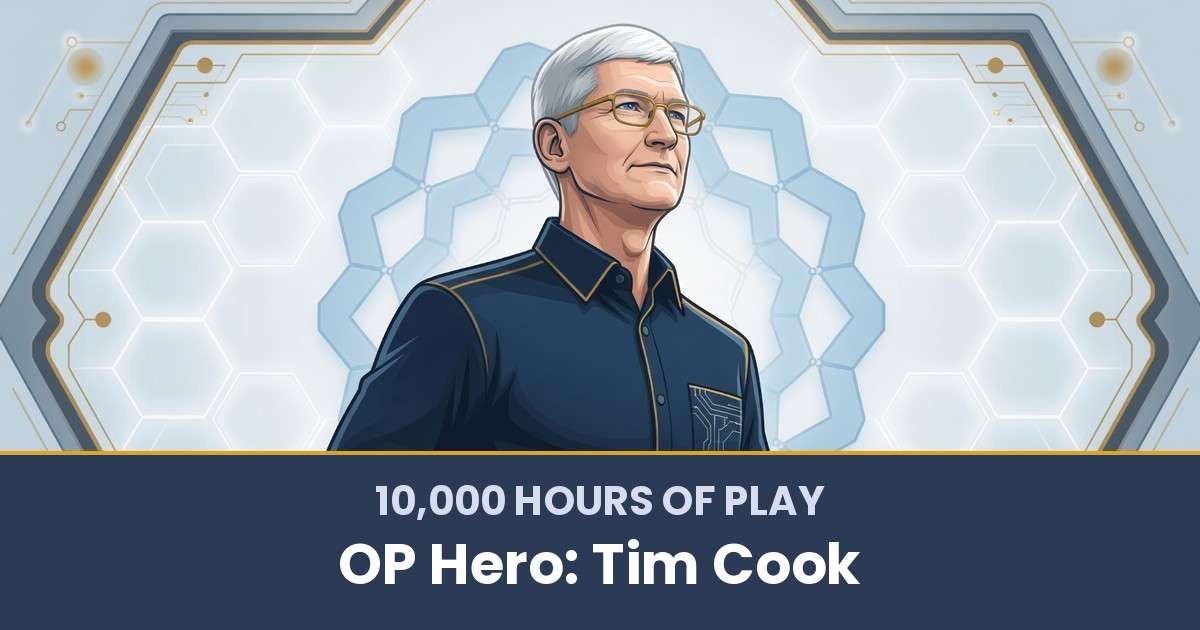
10,000 Hours of Play by OP Hero: Tim Cook
Tim Cook's 6-Step OP-Hero breakdown — the supply chain Mage who outlasted Steve Jobs' shadow, weathered Apple Maps, and rebuilt Apple into a $3T machine.


Steve Jobs handed Tim Cook a $350 billion company, an army of disciples who’d memorized Jobs’ keynote cadence, and a clear message from half the tech press: nobody can run Apple without him.
Fifteen years later, Apple is worth more than $3 trillion and Cook has shipped the Watch, AirPods, the Services pivot, Apple Silicon, and Vision Pro on his own watch. The “caretaker CEO” headline aged into one of the strangest underestimations in modern business writing.
The interesting question isn’t whether Tim Cook is a good CEO. The interesting question is what kind of build lets a quiet supply chain guy from Robertsdale, Alabama outlast the most charismatic founder of his era and grow the company anyway.
Score his life as a character sheet — Game, Attributes, Role, Skills, Allies, Quests — and a very specific kind of OP Hero comes into view.
⚡ Speed Run Notes
- Tim Cook’s Game wasn’t replacing Steve Jobs. It was proving that disciplined operations at planetary scale is its own form of creativity — the kind that compounds for a decade once vision sets the direction.
- His signature move at Apple was the supply chain teardown — closing factories, slashing inventory cycles from months to days, locking in component contracts years ahead. The machine behind the magic was rebuilt before any iPhone existed.
- The FBI encryption fight in 2016, the Bloomberg Businessweek “I’m proud to be gay” essay in 2014, the Apple Silicon bet that took a decade to ship — none of those are operator moves. They’re conviction moves dressed in operator clothes.
- Apple Maps in 2012 was Cook’s first public disaster. The recovery — apology letter, Scott Forstall out, iOS reorganized around services — is one of the cleanest Phoenix Rebirth runs in modern tech.
- You don’t need to run a $3T company to steal his build. You need a Game that values quiet compounding, a daily rigor most people skip, and the spine to say no when the market wants a yes.
Table of Contents
- About Yu-kai Chou
- Step 1: The Game — What Tim Cook Was Actually Playing
- Step 2: Attributes — The Innate Stats
- Step 3: Role(s) — The Character Class Across Chapters
- Step 4: Skills — The Real-Life Game Skills Tim Cook Mastered
- Step 5: Allies — The People Who Multiplied Tim Cook
- Step 6: Quests — The Milestones That Shaped the Saga
- What You Can Steal From Tim Cook’s Build
- Where this framework comes from
- Related Reading
About Yu-kai Chou

Yu-kai Chou is the author of 10,000 Hours of Play — the book that treats your life as the most important game you’ll ever build a character in, and gives you the 6-Step framework (Game · Attributes · Role · Skills · Allies · Quests) to play it on purpose. He has spent two decades developing the system through which this post analyzes its OP Hero, and applies it to his own life and to the lives of the people he advises around the world.
Chou’s other framework, the Octalysis Framework, has been applied by LEGO, Microsoft, Porsche, Coca-Cola, Salesforce, and MrBeast, impacting over 1.5 Billion Users. He has taught the methodology at Harvard, Stanford, Yale, Tesla, Google, BCG, and IDEO, and has advised governments in eight nations including Ukraine, the United Kingdom, the Kingdom of Bahrain, Singapore, Taiwan, the Netherlands, Kazakhstan, and South Korea.
His work has been cited by Harvard, Stanford, MIT, Forbes, Wall Street Journal, Wired, US Department of Energy, NIST, NSF, NCBI, US Department of Education, ClinicalTrials.gov, and Google Scholar — with 3,700+ more academic publications. Explore his books here.
What I personally find instructive about Tim Cook’s build is that almost nothing about his character sheet looks like a stereotypical Silicon Valley founder. He’s not a visionary in the keynote-cadence sense; he’s a systems builder who happens to be running a consumer brand. If you take only one lesson from his run, take how much leverage you can quietly compound while the rest of the room is performing energy. The wattage is real — it just stays in the cabinet.
Step 1: The Game — What Tim Cook Was Actually Playing
Ask the average reader what Tim Cook’s Game is and you’ll hear “be CEO of Apple.” That’s the position, not the Game.
The Game Cook has been playing since IBM in the 1980s is more specific: prove that operational excellence at planetary scale — supply chain, logistics, manufacturing discipline, ethical leadership — is a creative act in its own right, not the boring layer under the actually-interesting product work. He picked technology as his stage, but the actual quest is the same one industrial engineering has been answering for a century: how do you move atoms and people through a complex system with the lowest possible waste and the highest possible integrity?
The through-line is consistent. At IBM in the late 1980s he ran fulfillment for the PC division across North and Latin America. At Compaq in 1997 he ran corporate materials for the biggest PC maker in the world. When Steve Jobs hired him in March 1998 to run Apple’s worldwide operations, Cook arrived with a teardown ready and shipped it within two years — most of Apple’s factories closed, warehouses sold, inventory cycle compressed from months to days. The same instinct shows up in his 2014 essay in Bloomberg Businessweek (“I’m proud to be gay”) and in the 2016 FBI encryption standoff: a moral system runs the same way an operational system does, which is to say you build it carefully and you don’t ship until it’s right.
This is what the 10,000 Hours of Play framework calls your Game. Not your job title. The deep, repeated question your output keeps answering. Cook’s is: how do you build a quiet machine that delivers a billion units of any promise — products, privacy, values — without breaking?
Twenty-plus years at Apple and three trillion dollars later, the answer keeps shipping.
Step 2: Attributes — The Innate Stats
Attributes are the traits that show up early — the raw stats you brought to the character creation screen. Cook’s sheet rolled high on four.
Systems thinking and pattern recognition. At Auburn, Cook chose Industrial Engineering — a major that exists specifically to model complex systems and reduce waste. He graduated in 1982 and went straight into IBM’s manufacturing track. By his late twenties he was running fulfillment for the IBM PC division. You can train someone to read a spreadsheet; you can’t easily train them to see a 50-supplier global production network as a single living object. Cook has done that for forty years.
Calm under pressure. Colleagues across IBM, Compaq, and Apple have described the same trait — long silences in meetings, no theatrical reactions to bad news, a low-affect default that absorbs stress instead of broadcasting it. During Steve Jobs’ medical leaves in 2004, 2009, and 2011, Cook ran the company as acting CEO without visible turbulence. Press leaks during those windows are almost nonexistent. That’s not a learned PR posture. That’s a temperament.
Moral seriousness. Cook frames decisions in values language consistently and early — privacy as a “fundamental human right,” environmental commitments tied to actual factory metrics, the 2014 Bloomberg essay coming out as gay because, in his own words, “if hearing that the CEO of Apple is gay can help someone struggling, then it’s worth the trade-off with my own privacy.” That’s not a CEO-school move. That’s a person who arrived with a moral compass and routed his career through it.
Discipline and frugality. Up before five most mornings. Gym before email. A net worth in the high hundreds of millions that hasn’t shifted his daily routine. He once told 60 Minutes that he answers emails for an hour before sunrise because it’s the part of the day nobody else has yet. The rigor isn’t performed; it’s the same rigor that closed the warehouses.
If you want to think clearly about your own Attribute stack, the OP Talent Triangle Method is the cleanest tool for it. Most readers will underrate “calm under pressure” because it doesn’t look like a stat. Cook’s career is the argument that it absolutely is.
Step 3: Role(s) — The Character Class Across Chapters
Classes are the working identity you put on at each chapter. Cook’s class shifted four times — and only the labels changed.
Industrial engineer trainee (1978–1994). Auburn for the BS in 1982, then twelve years at IBM. Last role: Director of North American Fulfillment for the PC division. Manufacturing, distribution, channel economics. Apprentice-grinding-the-systems-spec mode.
Top-tier supply chain commander (1994–1998). Six months at Intelligent Electronics as COO of the Reseller Division, then to Compaq as Vice President for Corporate Materials. At Compaq he was responsible for procurement for the largest PC maker in the world at a time when PC margins lived or died on supply discipline. Six months in, Steve Jobs called.
Apple’s operations architect (1998–2011). Hired in March 1998 as Senior Vice President for Worldwide Operations. Within two years Cook had closed most of Apple’s factories, sold the company’s warehouses, signed long-term component contracts that locked competitors out of flash memory in some windows, and rebuilt the company on an outsourced manufacturing footing. Inventory cycles dropped from months to days. By 2005 he was Chief Operating Officer, running Apple’s day-to-day for the entire late-Jobs era. The product magic above the line stayed Jobs’; the machine below it became Cook’s.
CEO and elder statesman (2011–present). Named CEO on August 24, 2011, six weeks before Jobs died. The “caretaker” narrative arrived immediately and aged badly. Apple Watch (2015), AirPods (2016), the Services pivot, Apple Silicon (M1, November 2020), Vision Pro (2024), and the slow climb past $1T (2018), $2T (2020), and $3T (2022) market cap milestones — all of those are Cook-era shipments. The class flip wasn’t from Operations Guy to Visionary. It was from operator who served the vision to operator who set it.
Step 4: Skills — The Real-Life Game Skills Tim Cook Mastered
Cook’s character sheet leans on six canon Skills more than anything else.
Cosmic Alignment (Mage) — his master Skill. Cosmic Alignment is the ability to optimize complex logistics and orchestrate how many moving parts come together. The Apple supply chain teardown between 1998 and 2001 is the single cleanest expression of this Skill in modern industry. He pre-bought $1.25 billion of flash memory in 2005 to lock out competitors on iPod nano components. He spent on robotic test equipment and automated assembly lines years before competitors needed them. The Skills Spectrum has a useful framing for the difference between a Mage who specializes and one who dabbles — Cook is the textbook specialist, and the Skills Spectrum guide walks through why a specialist Mage at this depth is the rarest archetype in tech leadership.
Devour (Warlock) — reduce steps, components, and processes until the system gets lean. Within two years of joining Apple, Cook had closed most factories, sold the warehouses, and consolidated suppliers. Inventory dropped from a Jobs-era 30+ days to under 5 days. He treated unnecessary steps the way a Warlock treats unnecessary mana — they exist to be cut. The discipline is so internalized that it shaped Apple’s later decisions on Apple Silicon (one chip instead of negotiating with Intel) and Services (one billing relationship per user instead of a tangled per-product partner stack).
Mastermind (Ranger) — create, adapt, and execute complex multi-year plans. The Apple Silicon transition is the cleanest case. The work that became the M1 launched in 2008 with the acquisition of P.A. Semi for $278 million. A1, A4, A6 chips followed for iPhone and iPad. By 2018, internal Mac prototypes were running on Apple Silicon. The M1 shipped November 2020 — a twelve-year arc, executed across three different product categories, ending with one of the biggest architecture shifts in personal computing history. The plan didn’t leak. The transition didn’t slip. That’s Mastermind at full strength.
Vision Manifestation (Warlock) — visualize success so vividly it shapes reality. The Services pivot is the case study most under-discussed. In the early 2010s, with iPhone growth saturating, Cook bet that Apple’s installed base could be monetized through Services — App Store, iCloud, Music, TV+, Fitness+, Apple Care, advertising. By 2024, Services revenue passed $96 billion annually with gross margins above 70%. The bet shaped the company’s stock multiple more than any single product launch since the iPhone itself. The same vision discipline shows up in the Apple Watch (a market Apple created) and in Apple Silicon (an outcome most analysts said was impossible). The pattern of relentless, secluded, multi-year work behind those bets is the same Warlock-class compounding muscle behind the Lich Pact — different surface, same underlying class signature: do the unglamorous work for years until reality starts agreeing with you.
Aegis (Paladin) — ignore public criticism while pushing the Quest. In February 2016, the FBI demanded Apple write a custom build of iOS to unlock the San Bernardino shooter’s iPhone. Cook’s open letter refusing the order is one of the most consequential corporate statements of the decade. The pressure — from Congress, from the press, from the public — was intense, and Cook held the line until the FBI quietly dropped the case. The same Skill carried him through the “Apple is boring under Cook” decade-long critique that began roughly the day he took the job and only stopped when the $3T market cap made it unsustainable. You outlast the narrative until the narrative has to bend.
Phoenix Rebirth (Paladin) — recover from devastating failure stronger than before. Apple Maps in September 2012 was Cook’s first public disaster as CEO. Roads in the wrong places. Cities labeled in the wrong country. The Brooklyn Bridge drawn as a roller coaster. He published a public apology — itself a culture-rare move at Apple — recommended customers use Google Maps in the interim, and reorganized the entire Maps program. Scott Forstall, the SVP behind iOS at the time, was out within a month. The reorganization that followed put services and operations under tighter coordination — the structural shape Apple is still running on. Most companies survive a disaster like Maps by hiding it. Cook fixed it in public.
Step 5: Allies — The People Who Multiplied Tim Cook
Nobody builds a $3T company solo. Cook’s Allies stack is small, load-bearing, and quietly chosen.
Steve Jobs. The single most important Ally in the build. Jobs hired Cook in March 1998 against the advice of several recruiters who thought Cook should stay at Compaq for stability. Jobs gave Cook the mandate to rebuild operations and let him run unbothered. The reciprocal trust — Jobs covering product vision, Cook covering the machine — was the architecture Apple ran on for thirteen years. Cook has said publicly that Jobs taught him that the purpose of the company was to serve humanity, and the language has been consistent ever since.
Jeff Williams. Cook’s longtime number two. Williams joined Apple in 1998 (a few months after Cook, also out of IBM) and built the operations layer underneath him for two decades. By the time Cook became CEO, Williams had become COO and ran the Apple Watch program from concept to ship. He is the operations leadership Apple has because Cook trained him into it. Internal succession depth is itself a Skill.
Lisa Jackson and Katherine Adams. Jackson, former EPA Administrator under Obama, joined Apple in 2013 to run Environment, Policy, and Social Initiatives — and shipped the carbon-neutral 2030 commitment that Apple’s supply chain actually maps to. Adams is General Counsel — the legal architect behind the FBI standoff, the antitrust posture, and the operating-system disclosures. Both are evidence that Cook recruits Allies who can run their own departments at C-suite caliber, not deputies who only echo him.
Warren Buffett. Berkshire Hathaway began buying Apple in 2016 and now owns one of the largest single stakes. The Buffett endorsement repositioned Apple from “growth tech stock” to “core American business” in the public market’s eyes during a period when Cook was being questioned on innovation. The Ally here isn’t the capital — it’s the credibility loan during the hardest years of the narrative fight.
The Apple board, especially Art Levinson. Levinson, chairman since 2011, gave Cook the institutional cover to play long ball — the Apple Silicon decade, the Services bet, the Vision Pro launch. A board that lets the CEO run a five-year transition without quarterly panic is a structural Ally most CEOs don’t get.
Step 6: Quests — The Milestones That Shaped the Saga
Here are the run’s defining Quests, including the ones that almost broke it.
March 1998 — joins Apple as SVP Worldwide Operations. Leaves Compaq, a market leader, for an Apple that’s still bleeding cash. The Compaq executives reportedly thought he was making a career-ending move. He had been at Compaq for six months.
2000–2001 — Apple supply chain teardown. Factories closed. Warehouses sold. Inventory cycle compressed from 30+ days to under 5. The machine that would later ship 200+ million iPhones a year was built before the iPhone existed.
August 24, 2011 — named CEO of Apple. Jobs resigns; Cook takes the chair. Six weeks later Jobs dies. The succession that the industry had spent years scripting as a disaster is, in retrospect, one of the cleanest in business history. The press wrote the “caretaker” headlines anyway.
September 2012 — Apple Maps disaster. iOS 6 ships, Maps melts down, public apology letter, Scott Forstall out within a month. The first time Cook had to run Phoenix Rebirth at the company-wide level. The reorg that followed is the operating model Apple still runs.
October 30, 2014 — Bloomberg Businessweek essay. Cook publishes “I’m proud to be gay” — the first openly gay CEO of a Fortune 500 company. The essay frames the decision as a duty: “if hearing that the CEO of Apple is gay can help someone struggling… then it’s worth the trade-off.” The personal cost is real; so is the cultural compounding for everyone who came after.
February 16, 2016 — open letter refusing the FBI. Apple is ordered by a federal court to write a custom iOS build to crack the San Bernardino shooter’s iPhone. Cook publishes the refusal letter. The standoff lasts six weeks before the FBI drops the case. Encryption-as-default on hundreds of millions of devices stays.
August 2, 2018 → August 19, 2020 → January 3, 2022 — $1T, $2T, $3T market cap. Apple becomes the first U.S. public company to cross each threshold. The compounding of seven years of Cook-era operations + product + services is what those numbers represent. Many critics moved on around the $2T mark.
November 10, 2020 — Apple Silicon M1 ships. The twelve-year project that started with the P.A. Semi acquisition crosses the finish line. Mac performance per watt jumps in ways the Intel roadmap could not have matched. Cook’s Mastermind run pays out.
February 2, 2024 — Vision Pro launches. Cook’s first truly new product category. Reception is mixed; sales are below initial projections. The book on Vision Pro is not yet closed. The fact that Cook keeps shipping new categories sixteen years into his tenure is the answer to the “no innovation under Cook” narrative — even if any single category lands soft. For more profiles of operators who outlasted their critics, the OP Hero hub has the full catalog.
What You Can Steal From Tim Cook’s Build
Most readers will walk away from a Tim Cook profile thinking the lesson is “be the operations person.” That’s the wrong takeaway. The lesson is more useful: pick a Game where quiet rigor compounds, hire Allies who can run their own departments, and never confuse charisma with leverage.
Three concrete moves you can lift off his character sheet today.
First, build the machine before you need it. Cook rebuilt Apple’s supply chain in 1998–2001 — before the iPod, before the iPhone, before there was any product line that justified the rebuild. The operating discipline was there waiting when the demand arrived. Find your version of that — the dull infrastructure work nobody is asking for yet — and start it now. (The parallel for builders running consumer-tech businesses is sharp; Jeff Bezos’ build at Amazon runs on the same Cosmic Alignment instinct, and Jensen Huang’s CUDA bet is the same Mastermind move on a different timescale.)
Second, when the disaster ships, own it in public. Maps was a fixable problem only because Cook treated it as one. The apology letter wasn’t a PR move — it was a leadership move that signaled to the company that pretending was off the table. Whatever your version of Apple Maps is, the move is the same: name it, fix it, route the org around the fix.
Third, install an Aegis. Find the line you won’t cross — privacy, integrity, who you actually are — and decide ahead of time that you’ll take the criticism rather than move it. Cook’s 2014 essay and 2016 FBI letter were possible because the spine work had been done years earlier. When the moment came, the answer was already in.
The build is repeatable. That’s the entire point of a framework.
Where this framework comes from

Want the full system this profile is built on?
Every OP Hero piece runs through the same 6-Step framework from 10,000 Hours of Play: Unlock Your Real-Life Legendary Success. The book covers the full system, walks through Yu-kai’s own life run as the first applied case study, and gives you the worksheets to audit your own build.
Related Reading
- All OP Hero Profiles — the full catalog of life-as-RPG breakdowns through the 10K HP framework.
- OP Hero: Jeff Bezos — another operator who treated infrastructure as the actual product.
- OP Hero: Jensen Huang — a Mastermind run across a decade, just on chips instead of devices.
- OP Hero: Bill Gates — the founder-to-CEO-to-statesman arc, on a different brand.
- OP Hero: Yvon Chouinard — values-led leadership that survives a public-market era.
- Turning Life Into a Game — the 6-Step framework, explained from scratch.