
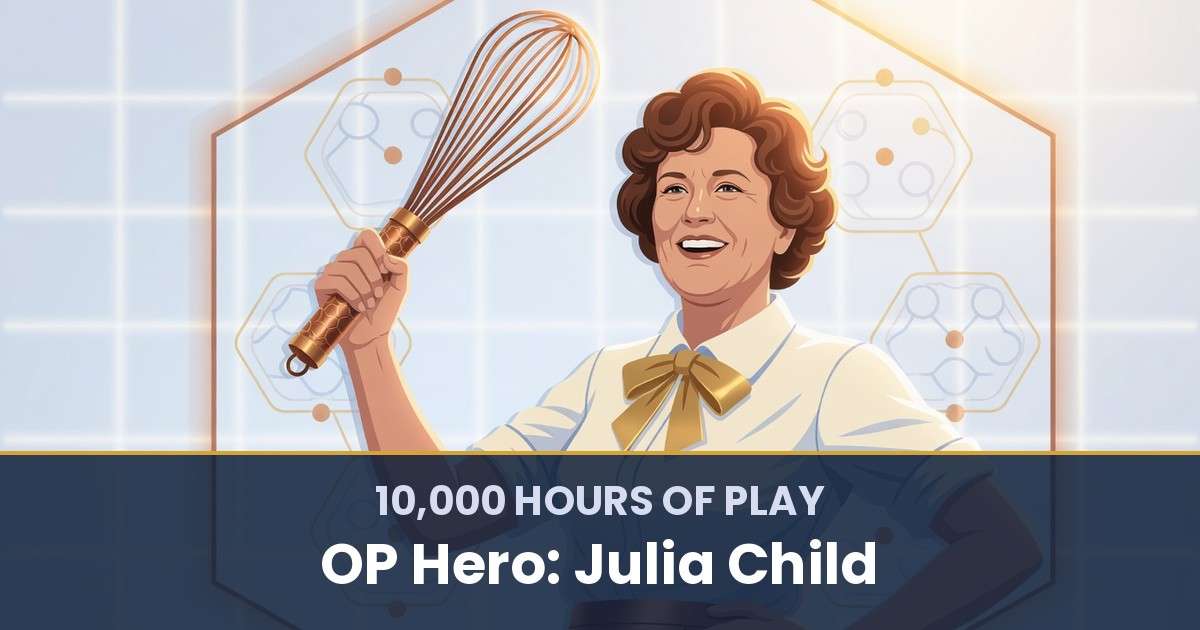
10,000 Hours of Play by OP Hero: Julia Child
She couldn't cook at 36. By 50 she was America's most famous teacher. Julia Child's full character build, run through the 6-Step 10K HP framework.


In November 1948, a 36-year-old American woman sat down at La Couronne in Rouen and ate a plate of sole meunière. She could not cook. She had no profession, no French, and no idea what to do with the second half of her life.
She would later describe that lunch as the most exciting meal of her life. Within thirteen years she had co-written the book that taught America how to cook, and within fifteen she was the most recognizable teacher on American television.
Julia Child is the strongest counter-argument I know to the belief that your character build locks in by 30. She respec’d her entire class at an age when most players assume the skill trees are closed, and the stats she carried over from her old life turned out to be the exact ones her new Game required.
So let’s run her through the 6-Step framework from 10,000 Hours of Play: her Game, Attributes, Roles, Skills, Allies, and Quests. Pay attention to how late every milestone arrives. That lateness is the lesson.
⚡ Speed Run Notes
- Julia Child didn’t enter a kitchen seriously until 37. Her first cookbook came out at 49, her TV show at 50. The “too late” window is mostly fiction.
- Her real Game was never cooking. It was translation: taking elite French technique and re-engineering it so an American home cook could execute it without fear.
- Her OSS intelligence work (1942–45) built the exact stat that later powered her cookbook: the patience to systematize thousands of small details into one reliable index.
- Mastering the Art of French Cooking was rejected by Houghton Mifflin after years of work. The revision that followed, not the original draft, became the classic.
- Her on-air flubs were a feature. By recovering calmly from mistakes on The French Chef, she taught viewers the one thing recipes can’t: failure is part of the dish.
Table of Contents
About Yu-kai Chou

Yu-kai Chou is the author of 10,000 Hours of Play — the book that treats your life as the most important game you’ll ever build a character in, and gives you the 6-Step framework (Game · Attributes · Role · Skills · Allies · Quests) to play it on purpose. He has spent two decades developing the system through which this post analyzes its OP Hero, and applies it to his own life and to the lives of the people he advises around the world.
Chou’s other framework, the Octalysis Framework, has been applied by LEGO, Microsoft, Porsche, Coca-Cola, Salesforce, and MrBeast, impacting over 1.5 Billion Users. He has taught the methodology at Harvard, Stanford, Yale, Tesla, Google, BCG, and IDEO, and has advised governments in eight nations including Ukraine, the United Kingdom, the Kingdom of Bahrain, Singapore, Taiwan, the Netherlands, Kazakhstan, and South Korea.
His work has been cited by Harvard, Stanford, MIT, Forbes, Wall Street Journal, Wired, US Department of Energy, NIST, NSF, NCBI, US Department of Education, ClinicalTrials.gov, and Google Scholar — with 3,700+ more academic publications. Explore his books here.
What I find instructive about Julia Child’s build is that she never wasted a stat point, even when it looked like she was wasting a decade. The card-index discipline she ground out in an intelligence office became recipe engineering; the social boldness of an expat became television presence. If you take one lesson from her sheet, take this: your “irrelevant” past skills are usually your future class synergy waiting for the right Game.
Step 1: The Game — What Julia Child Was Actually Playing
Surface reading: Julia Child played the cooking game. Wrong. Plenty of people in 1950s Paris could cook better than she could, and none of them changed how a nation eats.
Her actual Game was translation. After that 1948 lunch in Rouen, she became obsessed with two things at once: mastering French technique at full depth, and re-engineering it so an ordinary American with a supermarket and an electric stove could reproduce it without a culture, a vocabulary, or a French market street.
You can see the Game in what she refused. Her cookbook was pitched as an instructional manual, not a lifestyle book. Where French recipes said “cook until done,” her pages specified the pan, the heat, and the timing, because the player she served wasn’t the Parisian chef. It was the nervous cook in Ohio attempting boeuf bourguignon for the first time.
Choosing a Game that specific is rarer than it sounds. Ray Kroc found his Game in his 50s by seeing a system where others saw a hamburger stand; Child found hers at 36 by seeing a teaching problem where others saw dinner. Late discovery didn’t weaken either build. It funded them, because both arrived with decades of transferable stats already banked.
Step 2: Attributes — The Innate Stats
Attributes are the stats you ship with, visible long before the Game is chosen. Child’s sheet shows at least four.
Risk appetite. In her early 30s, with no relevant training, she volunteered for overseas wartime service with the Office of Strategic Services and accepted postings to Ceylon and China. After the war she moved to France without speaking the language. None of this is learnable temperament; it was already installed.
Systems patience. At the OSS she maintained a master index of thousands of intelligence personnel, typed onto note cards, one at a time. Most people read that as clerical trivia. I read it as the single most predictive line on her sheet: the same capacity to hold a thousand small details in a reliable structure later turned chaotic French recipes into testable, repeatable steps.
Social boldness. Colleagues and biographers describe her as exuberant and unembarrassed by failure decades before a camera ever found her. That trait was idle for forty years until television made it a primary stat.
Heightened taste. Her near-ecstatic response to that first sole meunière wasn’t acting. Perception of nuance in craft is an Attribute, and hers ran hot.
Notice the pattern: not one of these stats was “cooking.” The Talent Triangle Method exists for exactly this audit: your edge usually sits where existing Attributes intersect, not where the job title says it should.
Step 3: Role(s) — The Character Class Across Chapters
Child’s career reads like a player who kept re-rolling until the class matched the stats.
Chapter one: Smith College graduate, class of 1934, drifting through writing jobs. Chapter two: OSS research assistant from 1942 to 1945, building information systems in Washington, Ceylon, and China. Chapter three: culinary student in Paris, enrolled at Le Cordon Bleu in 1949 at an age when classmates assumed she was lost.
Then the classes start compounding. Cookbook architect through the 1950s, co-running the small Paris cooking school L’École des Trois Gourmandes with Simone Beck and Louisette Bertholle. Television teacher from 1963, when The French Chef put live technique in front of a national audience. Finally, culinary elder: the institutional steward whose kitchen now sits in the Smithsonian.
The deep mechanic here is that no Role was abandoned; each was absorbed into the next. The OSS researcher lived inside the cookbook author. The teacher lived inside the TV host. Grace Hopper ran the same pattern in computing (wartime service feeding a late, public teaching career), and in both builds the famous final Role was only possible because the invisible earlier ones kept their XP.
Step 4: Skills — The Real-Life Game Skills Julia Child Mastered
Attributes are rolled; Skills are trained. In 10,000 Hours of Play, every learnable Skill belongs to one of seven Classes, from the Warlock’s Lich Pact to the Druid’s gentler arts, and the Skills Spectrum tells you how deep to train each one. Child’s build leans Paladin-Druid with a sharp Mage core.
Courageous Heart (Paladin) — charging into uncharted, uncomfortable territory. She cast it joining the OSS, again moving to France, and again walking into Le Cordon Bleu at 37 as the conspicuous American in a room of professionals.
Ley Line Infusion (Mage) — rapidly absorbing a large body of knowledge. Between 1949 and 1951 she compressed French technique through Cordon Bleu coursework plus private lessons with chef Max Bugnard, going from “cannot cook” to professional-grade preparation in roughly two years of obsessive practice.
Floral Blossom (Druid) — educating and mentoring others. This is her signature cast. With Beck and Bertholle she tested and rewrote recipes until they worked in American kitchens with American equipment, converting vague French cues into foolproof sequenced instructions. The skill of teaching, trained deliberately, is what separated her book from every French cookbook before it.
Revive (Paladin) — recovering from failure and taking new action toward the next Quest. By most biographical accounts she failed her first attempt at a Cordon Bleu exam, then passed and kept going. Years later, when the manuscript she had spent most of a decade on was rejected, she revised rather than retired. Both casts preceded her biggest wins.
Chaos Control (Warlock) — accepting setbacks in real time and shifting straight into solution mode. On The French Chef, working under live-to-tape constraints, she dropped things, mistimed dishes, and calmly repaired the situation on camera. Those recoveries became the show’s most trusted teaching moments, proof to viewers that mistakes are part of cooking rather than the end of it.
Step 5: Allies — The People Who Multiplied Julia Child
No OP Hero solos the campaign, and Child’s Alliance is one of the best-documented in this series.
Paul Child, whom she married in 1946, brought her to Paris through his posting, encouraged the Cordon Bleu enrollment, and photographed and designed visual material for her work for decades. He is the ally who made the respec possible.
Simone Beck and Louisette Bertholle supplied the French culinary depth and co-authored Mastering the Art of French Cooking. The book was a party quest, never a solo one.
Avis DeVoto became her American champion after a 1952 exchange of letters that started over kitchen knives, then spent years shopping the manuscript through the US publishing world. Judith Jones at Alfred A. Knopf rescued that manuscript after Houghton Mifflin’s rejection and edited it into the 1961 classic. Max Bugnard gave her the private instruction that pushed technique to professional level.
And then there’s WGBH, the Boston public television station that turned an omelet demonstration on a book-review program into a 1962 pilot, and the pilot into The French Chef. Public television was also the alliance structure behind Fred Rogers, and the parallel is worth noticing: both heroes found institutional allies that valued teaching over spectacle, and both repaid the bet for decades.
Step 6: Quests — The Milestones That Shaped the Saga
The war quest (1942–45). OSS service across Washington, Ceylon, and China, including work on a shark repellent developed to protect downed airmen and sailors. Strange quest, real XP: systems discipline, security under pressure, and the confidence of having operated far from home.
The student quest (1949–51). Le Cordon Bleu, a failed first exam attempt by most accounts, graduation, then private mastery work with Bugnard. The quest where the Game was chosen.
The decade quest (early 1950s–1961). Mastering the Art of French Cooking: a contract signed with Houghton Mifflin in 1954, years of testing, and then the publisher’s rejection of the manuscript as too long and complicated. This is the failure chapter of the saga. The party revised, Judith Jones championed it at Knopf, and Volume 1 shipped in 1961 as an unexpected bestseller.
The broadcast quest (1963–73). The French Chef: 201 episodes across 10 seasons, a Peabody Award in 1964, an Emmy in 1966, and a nation that suddenly believed it could cook.
The legacy quest (2001–04). In 2001 she donated her entire Cambridge kitchen to the Smithsonian’s National Museum of American History, where it remains on permanent display. She died on August 13, 2004, two days before her 92nd birthday, with the Game still being played by millions of her students.
Every quest fed the same translation Game, which is why her build holds together better than résumés twice as tidy. Browse the rest of the OP Hero roster and you’ll find few sagas where the failure chapter so clearly produced the masterpiece.
What You Can Steal From Julia Child’s Build
Stop pricing your age into your build. Child entered her Game at 36, shipped her first major Quest at 49, and unlocked her famous Role at 50. The window you think closed is usually still open; what closes is your willingness to be a beginner inside it.
Audit your idle stats. Her card-index patience looked worthless until recipe engineering made it priceless. Somewhere on your sheet is a skill your current job mislabels as trivia.
Train Revive before you need it. The rejection of a decade’s work would end most campaigns. She had already practiced recovering from a failed exam, a missed timing, a fallen dish. Small recoveries are reps for the big one.
And take the advice most often attributed to her seriously as build advice: the only real stumbling block is fear of failure — and cooking rewards a what-the-hell attitude over perfectionism.
The next time you watch someone calmly fix a collapsed dish instead of hiding it, you’re watching the skill that built an empire out of a late start.
Where this framework comes from

Want the full system this profile is built on?
Every OP Hero piece runs through the same 6-Step framework from 10,000 Hours of Play: Unlock Your Real-Life Legendary Success. The book covers the full system, walks through Yu-kai’s own life run as the first applied case study, and gives you the worksheets to audit your own build.
Related Reading
- All OP Hero Profiles: the full roster
- 10,000 Hours of Play by OP Hero: Hedy Lamarr
- 10,000 Hours of Play by OP Hero: Dolly Parton
- 10,000 Hours of Play by OP Hero: Grace Hopper
- What’s Your Edge Strength? The Talent Triangle Method