
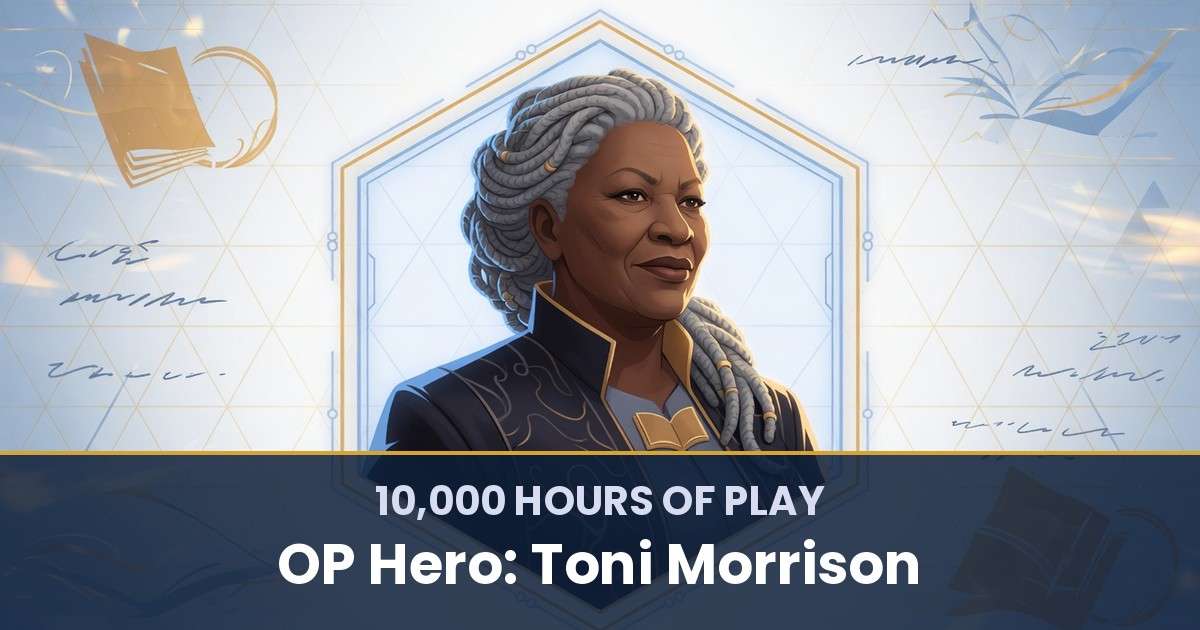
10,000 Hours of Play by OP Hero: Toni Morrison
Toni Morrison published her first novel at 39, around a full-time job and solo parenting, then became the first Black woman to win the Nobel in Literature.


Toni Morrison published her first novel at 39, writing it before dawn at her kitchen table because that was the only hour the house was quiet. She had two young sons asleep down the hall and a full day of editing other people’s manuscripts ahead of her. The book sold poorly and went out of print.
Twenty-three years later she won the Nobel Prize in Literature, the first African-American woman ever to do so.
Most people would read that gap as a story about patience. It is really a story about a player who refused to let her circumstances assign her game. She had a senior editor’s career, a household to run alone, and every reasonable excuse to never become a novelist at all.
Here is what her run teaches anyone who suspects their real work is being crowded out by their responsibilities.
⚡ Speed Run Notes
- Morrison’s real game was never prizes. It was making Black interior life structurally central to American literature, and she pursued that single objective from the editor’s chair and the writer’s desk for fifty years.
- She started her novel-writing run at 39, around a demanding job and solo parenting, by claiming the pre-dawn hours nobody else wanted. The constraint did not delay the work. It forced the discipline that produced it.
- Her first novel, The Bluest Eye (1970), was a commercial failure that went out of print. She wrote five more before the world caught up.
- For years she built other writers as a Random House editor (Muhammad Ali, Angela Davis, Gayl Jones) before she fully backed her own voice. The editor’s eye became the novelist’s edge.
- Song of Solomon (1977) won the National Book Critics Circle Award; Beloved (1987) won the Pulitzer; the Nobel came in 1993. The trophies arrived in her fifties and sixties.
- She wrote about incest, slavery, and self-hatred when publishing wanted Black stories to be palatable. She chose the hard subject every time, and it is why the work still cuts.
Table of Contents
About Yu-kai Chou

Yu-kai Chou is the author of 10,000 Hours of Play — the book that treats your life as the most important game you’ll ever build a character in, and gives you the 6-Step framework (Game · Attributes · Role · Skills · Allies · Quests) to play it on purpose. He has spent two decades developing the system through which this post analyzes its OP Hero, and applies it to his own life and to the lives of the people he advises around the world.
Chou’s other framework, the Octalysis Framework, has been applied by LEGO, Microsoft, Porsche, Coca-Cola, Salesforce, and MrBeast, impacting over 1.5 Billion Users. He has taught the methodology at Harvard, Stanford, Yale, Tesla, Google, BCG, and IDEO, and has advised governments in eight nations including Ukraine, the United Kingdom, the Kingdom of Bahrain, Singapore, Taiwan, the Netherlands, Kazakhstan, and South Korea.
His work has been cited by Harvard, Stanford, MIT, Forbes, Wall Street Journal, Wired, US Department of Energy, NIST, NSF, NCBI, US Department of Education, ClinicalTrials.gov, and Google Scholar — with 3,700+ more academic publications. Explore his books here.
I keep coming back to Morrison because she is the cleanest proof that your day job and your real work are not enemies. She did not quit editing to find herself. She used the editor’s discipline, the reader’s eye, and one unglamorous hour before sunrise to build a body of work that outlasted every publishing trend around it. The lesson I lift from her build is that you do not wait for permission or free time to start your real game. You carve it out of the schedule you already have, and you refuse to make your subject smaller to make it easier.
Step 1: The Game — What Toni Morrison Was Actually Playing
Every life runs on a hidden objective the person keeps chasing across decades. Morrison’s was unusually clear, and she pursued it from two chairs at once. The game was to put Black life, Black memory, and Black language at the structural center of American literature, not at its margins as local color.
This is the first move in treating your life as a game you can actually win: naming the real objective instead of accepting the one your circumstances hand you. Publishing in the 1960s had a slot for Black writing, and it was a small one off to the side. Morrison kept defecting from that game to play a much larger one, where the interior life of a poor Black girl in Ohio was as worthy of serious literature as anything by the writers she had studied at Cornell.
She once put the rule plainly: “If you find a book you really want to read but it hasn’t been written yet, then you must write it.” That is the sentence of someone who decided to stop waiting for the culture to produce her game and produce it herself.
The scoreboard never changed, but the way she played it deepened. First she enlarged the canon from inside publishing, as an editor. Then she enlarged it from the page, as a novelist. Same objective, two completely different instruments, fifty years of pointing both at the same target.
Step 2: Attributes — The Innate Stats
Attributes are the raw stats you show up with, visible early and hard to teach. Morrison’s sheet was loaded in the places that matter most for a writer.
Her first stat was deep pattern recognition. She instinctively linked a single private life to the large historical structures pressing on it, seeing how slavery, migration, and shame moved through individual people. That is the engine under all her fiction, and it was running long before she had a theory for it.
Her second stat was an unusual tolerance for difficult emotional material. Where many writers flinch, she went toward shame, violence, and grief and sat with them until they yielded meaning rather than just shock. Her debut took on a Black girl’s longing for blue eyes, a subject most editors would have called too painful to sell.
The third stat was intellectual independence. She built a distinct literary project on her own terms rather than following the critical or commercial fashion of the moment, and she held that line for decades against people who wanted her work to be more universal, meaning less specific.
This is where a tool like the Talent Triangle Method earns its keep. Morrison’s spike sat at the intersection of language, historical insight, and moral nerve. Any one of those alone makes a competent writer. Stacked together, they were worth organizing an entire second career around, even one she did not start until midlife.
Step 3: Role(s) — The Character Class Across Chapters
A life is rarely one class. Morrison respecced several times, and each chapter reads like a different character built on the same core mission.
First she was the Student and Scholar. Born Chloe Ardelia Wofford in Lorain, Ohio, in 1931, she earned a degree in English from Howard University in 1953 and a master’s from Cornell in 1955, writing her thesis on William Faulkner and Virginia Woolf, two authors obsessed with memory and point of view, the exact tools she would later turn on her own material.
Then came her longest-running class, the Editor. Joining Random House in the late 1960s, she became the first Black woman senior editor in its fiction division, a position of real power over which voices reached the public. For years this was her main role, and writing was the thing she did before work.
Her breakout class was the Novelist, beginning with The Bluest Eye in 1970 and continuing across eleven novels. Layered on top came the Public Intellectual, the role in which she wrote criticism like Playing in the Dark in 1992 and, after the Nobel, spoke for literature itself on the world stage. A contemporary like Maya Angelou walked a similar path from private survival to public voice. Same person, same game, four different characters stacked over a lifetime.
Step 4: Skills — The Real-Life Game Skills Morrison Mastered
Attributes are potential. Skills are the trained moves that turn potential into results, and Morrison’s build maps cleanly onto the canon Real-Life Game Skills. On the Skills Spectrum she was a deep specialist in language who learned to wield it across fiction, criticism, and public speech.
The foundation was Lich Grind (Warlock): intense, secluded work periods carved out of an unforgiving schedule. To write The Bluest Eye she rose before her two sons woke and worked in the pre-dawn quiet, fitting the novel into the only hours a single mother with a full-time job could find. That stolen hour, repeated for years, is where the entire career was built.
Underneath the fiction ran Arcane Wisdom (Mage): absorbing wide material and synthesizing it into something clear. Her editorial work demanded it, shaping autobiographies for Muhammad Ali and Angela Davis and championing new novelists like Gayl Jones. The same synthesizing mind produced The Black Book in 1974, a documentary scrapbook of Black American history she conceived and edited.
Her signature was Loremaster (Druid): weaving stories so structurally controlled that the form itself carries meaning. The shifting perspectives and broken chronology of Song of Solomon and Beloved are not decoration. They make the reader experience memory and haunting from the inside.
What made the subjects possible was Courageous Heart (Paladin): charging into uncomfortable territory on purpose. Morrison wrote about incest, the trauma of slavery, and internalized self-hatred at a time when the market rewarded gentler Black narratives. Like Frida Kahlo, who painted her own pain without flinching, Morrison treated the hardest material as the most worth facing, and that refusal to look away is why the work still lands.
Step 5: Allies — The People Who Multiplied Morrison
The myth says a genius rises alone. The record says Morrison was multiplied by a community she also spent years multiplying in return.
Random House itself was an ally as much as an employer. The editor’s chair gave her a working education in how literature actually gets made, acquired, and pushed into the world, knowledge most first-time novelists simply do not have when they sit down to write.
The writers she edited formed a second circle. By developing Gayl Jones, Toni Cade Bambara, and others, she helped build the very tradition of serious Black literature she wanted her own work to sit inside. She was not just adding her book to a shelf. She was building the shelf. That is a rarer and more durable move than chasing a solo win, and the same instinct ran in reverse: the literary community she strengthened was there to recognize her when her turn came.
The Nobel committee and a global readership formed the last circle, converting a major American novelist into an international one in 1993. Allies, in Morrison’s run, were never just people who helped her climb. They were people she lifted on the way up, which is exactly why so many were ready to vouch for the work when the prizes were being decided.
Step 6: Quests — The Milestones That Shaped the Saga
Quests are the specific milestones, including the ones that hurt. Morrison’s saga is stacked with both, and the order matters.
The first quest looked like a failure. The Bluest Eye, published in 1970 when she was 39, sold modestly and went out of print. A debut that disappears is the kind of setback that ends most writing careers before they start. Morrison treated it as a level cleared rather than a verdict, and kept writing. That is Revive (Paladin) in its purest form: recovering from a real failure and taking the next action toward the next quest instead of quitting.
The next quests compounded fast. Song of Solomon won the National Book Critics Circle Award in 1977 and made her a major name. Beloved, published in 1987, won the Pulitzer Prize for Fiction the following year and remains her most famous book. Playing in the Dark in 1992 proved she could reshape how scholars read American literature, not just how readers felt it.
The summit quest was the 1993 Nobel Prize in Literature, which made her the first African-American woman to win it. Honors kept arriving, including the Presidential Medal of Freedom in 2012, and she taught for years as a chaired professor at Princeton until 2006. She kept publishing novels nearly to the end of her life, dying in 2019 at 88.
The shape of that arc, a flop then a slow climb then a late and total vindication, is one you can trace across many other OP Hero profiles. The single mother writing before dawn here rhymes with J.K. Rowling, who also built an empire out of stolen writing hours and an early manuscript nobody wanted.
What You Can Steal From Morrison’s Build
You are not going to out-write Morrison, and that is not the point. The point is the playstyle.
Start your real game before you feel ready and before the schedule clears, because it never clears. Morrison did not wait for a sabbatical or a clean year. She found one hour the world was not using and put her whole life’s work in it. Refuse to shrink your subject to make it sell, the way she refused to make Black life smaller or sweeter for the market. When your first real attempt fails, and an out-of-print debut is a real failure, treat it as a cleared level rather than a final score. And build the field you want to belong to, not just your own entry in it, because the people you lift are the same people who carry you later.
A girl named Chloe from a steel town in Ohio became the first Black woman to win the Nobel Prize in Literature, and she did it on a second career she squeezed in around a full-time job and two kids. The starting schedule said there was no room. She made the room anyway, one dark morning at a time, and changed what American literature was allowed to be about. Decide what your pre-dawn hour is for, then go claim it.
Where this framework comes from

Want the full system this profile is built on?
Every OP Hero piece runs through the same 6-Step framework from 10,000 Hours of Play: Unlock Your Real-Life Legendary Success. The book covers the full system, walks through Yu-kai’s own life run as the first applied case study, and gives you the worksheets to audit your own build.
Related Reading
- All OP Hero Profiles: the full roster of legendary builds analyzed through the 10K HP framework.
- OP Hero: Maya Angelou, another writer who turned a hard early life into a public voice for a generation.
- OP Hero: J.K. Rowling, a single mother who built a career out of stolen writing hours and a rejected manuscript.
- OP Hero: Frida Kahlo, an artist who made her own pain the subject no one else dared to paint.
- The 10,000 Hours of Play Framework: the 6 steps for turning your own life into a game worth playing.
- The Talent Triangle Method, how to find the spike worth organizing your life around.